Annuals That Pollinators Love

Conservation biologist Douglas Tallamy [Nature’s Best Hope, 2019] urges us to use our gardens to help fight looming threats to life on Planet Earth, two being shrinking agricultural land and loss of habitat for our vital pollinators. How can we use our little plots to impact such huge issues while also beautifying our landscapes? Dr. Tallamy assures us that our combined efforts can go a long way toward correcting both problems. So, this winter as we pore over gardening catalogs, we who have enlisted in the cause of supporting pollinators should pay extra attention to seed and plant descriptions, looking for evidence of plentiful pollen and nectar supplies for bees, butterflies, hummingbirds, etc.
One small way to focus is by looking for colorful, pollinator-friendly annuals to incorporate among the perennials, herbs, vegetables, native wildflowers, etc., in our garden plans. Annuals that are both ornamental and beneficial include easy-to-grow cosmos, marigolds, sunflowers, coreopsis, salvias, and zinnias. Some can be obtained as nursery starts, while all can be seeded directly into the soil. With proper care, especially deadheading, they can provide color and pollinator food for a season. Their flattish, daisy-like flower heads make rich pollen and nectar supplies easily accessible to bees (the most important pollinators), butterflies such as Monarchs and Swallowtails, and certain flies. [On zinnias, for example, pollen and nectar sources make up a yellow center, easy for pollinators to spot, except perhaps for showy fully double varieties that tend to bury the food supply.]

Plant breeders tempt us every year with exotic cultivars and hybrids of familiar annuals. These promise color and interest, but many fail to feed pollinators. The features that supply rich pollen and nectar may have been weakened or bred out. For example, pollen-free sunflowers touted for cut flower arrangements may be colorful but are useless to pollinators. Cultivars bred from flowers that are normally flat and daisy-like instead may have dense pom-poms that look quirky and cute but make pollen and nectar too difficult for bees and butterflies to reach. Unless a new variety promises great benefits, tried and true standards may be the best bets for pollinators.

A four-year research project by University of Minnesota Extension (2015-2018) studied more than 30 annual varieties and identified the following nine as the most popular with pollinators… (click on the newsletter cover for the full article)
Making a Way for Pollinators

Over the years we’ve written in this space about the long-term focus on pollinators at The Quarry Farm and ways our related gardening practices have evolved. We’ve talked about selecting butterfly-friendly plants for our garden at Red Fox Cabin and beyond. We’ve talked about conditions that butterflies, bees, bats and hummingbirds need to survive or that threaten their existence, and we’ve shared photos of some of the beauties that have graced our garden.

Our concern for pollinators really began during the 1990s when Gerald Coburn began photographing and studying the butterflies on The Quarry Farm. As his inventory grew (eventually to around 55), we learned about preferred host and food plants and began choosing plants accordingly. Our plantings of popular annuals and “Perennials of the Year” transitioned to mixed beds of plants and flowers known to support butterflies, bees and hummingbirds. We planted pollinator-friendly native grasses like Indian Grass and Big Bluestem. We put up bee blocks where native bees could lay their eggs. When we learned of the deadly impact of pesticides on butterflies and bees, we stopped using Sevin in our large vegetable garden at the time and became organic gardeners.

Click to download

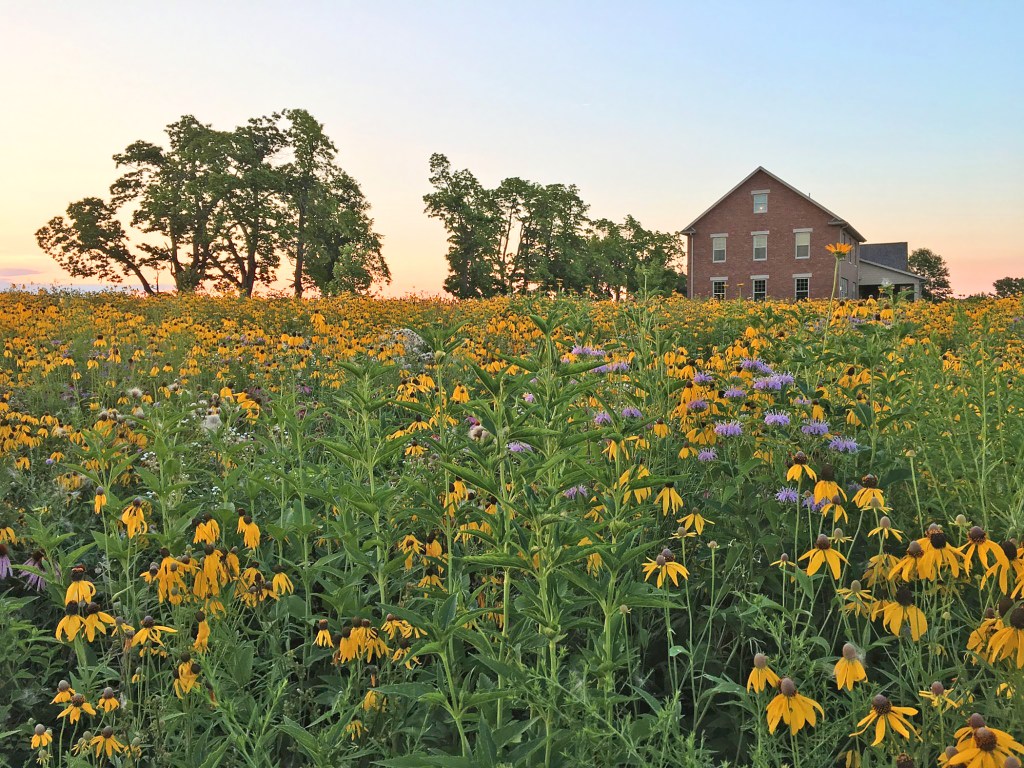
As reported in previous issues, an exciting new chapter in our history of gardening for pollinators opened five years ago when, as an educational project, the Putnam County Master Gardeners designed and planted a pollinator habitat garden next to Red Fox Cabin. The dedication and hard work of the Master Gardeners have made the site a model in miniature of what a pollinator habitat garden should be—not rigidly structured, mulched and manicured, but purposefully planned, nevertheless. It’s become a diverse riot of plants that offer food and shelter for a stopover or home for an entire life cycle. It’s fenced in and has a handsome gated entrance, decorative hardscaping and informative signage.

Before the Master Gardeners turned the first shovelful, they studied pollinator issues—who the pollinators are, their vital ecological importance, the features of a pollinator habitat, and devastating environmental challenges to survival, including pesticide use and habitat loss. Because land is increasingly polluted, paved over, robbed of diversity, and otherwise made unsupportive, the distances between food and rest sources may be too great for long-distance migrators—for instance, bats and Monarchs—to survive their journeys.

Some concerned environmentalists have proposed creating pollinator corridors to support migratory pollinators throughout their journeys. The idea is for people living along migratory routes to make a concerted effort to offer habitats with food, water and shelter—even if they’re only a few square feet of garden space—at intervals necessary for life-saving stopovers.

An intriguing “what if?” is this: what if people living along interstates, highways, or even country roads like the one that runs past The Quarry Farm were to join in common cause to learn about pollinator issues and then plant habitat gardens, uncontaminated, big or small, along their “corridors.” Several residents on our country road have already established pollinator gardens and larger habitats. What might happen if we organized, gave our cause a name and spread the word?

—The Gardener at Red Fox Cabin

Herman Pollinator Habitat, Road 7L and Road O, Riley Township

The Buzz

I’ve been struggling to find some clever way to start this post, to write the hook I need to pull you in and I’m failing miserably. Miserably. So, because my brain is fogged with the ridiculous heat we’re dealing with, I’ll just say that it’s about bees. Yeah. Bees. The kind that make honey, that bumble flower to flower, that kamikaze in defense of their homes, that, in conjunction with birds, create a happy little euphemism for sex. And sex is sexy, so maybe that’s all the hook I really need.

Clever me.

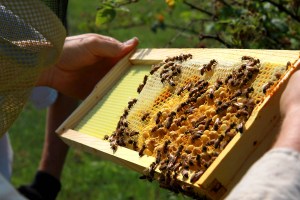
So, the bees. We set up a hive in mid April. Anne’s cousin, Brian, made all the arrangements for the bees and we took care of the materials: the hive body, the supers, the frames, the feeding troughs. We provided them a steady diet of syrup (sugar and water) and we’d pull off the hive cover and the inner cover on a nearly daily basis and ogle them from a distance. Yesterday, we got up close and personal. Brian came up from Columbus and he and Anne cracked the hive, pulled out the frames and checked out the action. The news could have been better.

Brian Erchenbrecher examining a frame from The Quarry Farm hive.

While the bees had developed new comb on the frames, there wasn’t nearly enough. And, again, while there were eggs and signs of developing brood, there wasn’t much and indications are that the developing brood are mostly drones. What are drones, you ask? They’re ne’er-do-well playboys, eating the nectar and giving back nearly nothing. They have no stinger, so they can’t protect the hive. They have no pollen sacs, so they can’t gather food. Their idea of work is chasing virgin queens.

Think Bruce Wayne, but no Batman. There you have it. Drones.

So what’s the big deal? So what if the hive’s Bohemian, populated with lotus eaters? If there are  only drones and no workers, there’s no comb. Without comb, there’s no honey. Without honey, the bees starve come winter. In fact, come late autumn the worker bees force the drones from the hive. They have to. Driving them out could well mean the difference between starving to death and surviving until spring.

It’s been suggested by scientists who study bees that a bee hive operates very much like a human brain. I mean, there’s no higher cognitive function, but otherwise, scientists have posited that their operations are very similar. If that’s the case, then our hive brain is more like Forrest Gump’s than Stephen Hawking’s. Which is not to say that it can’t improve. There is still hope, albeit one akin to the Flowers for Algernon variety. Realistically? Odds are, based on what we saw yesterday, that the hive will fail, the brain will die and we’ll have to start fresh next spring. That’s not what we wanted to hear, but there’s still good news.

And here it is.

The catalpa hive

Down the road from us, near the intersection of Roads 7-L and O, there’s a line of catalpa trees. In one of those trees is a hive of feral bees. This is a very cool thing, particularly when you understand that the hive has survived and thrived for roughly four years. With the population of bees dwindling as a consequence of a host of issues, to find a succesful wild hive is seriously cool. Why? Bees are our primary pollinators. Without them, plants that reproduce through pollination, and that’s the vast majority of our fruits and vegetables, simply don’t reproduce. No reproduction = No food.

So cheer on the bees, both wild and domestic. We’ll keep you posted on their progress.