The sun is out today so it seemed a good day to roll out The Quarry Farm Summer 2019 Newsletter. Click on the cover to the left and download a copy.
Included in this season’s news are details about the design and building of a new Cranberry Run footbridge. The previous footbridge, built by Gerald Coburn and Kevin Siefker at the turn of the century and re-engineered by David Seitz, survived floodwater currents longer than any other bridge. This spring, we discovered that the northern-most weight-bearing pole was rotten, Dave went into action with assistance from his daughter Aili. He documented the new bridge-building project via email to Board President Laura. It’s a fascinating read that we share in the printed newsletter. The beauty of the electronic page offers more space for photos, so we’re sharing the report here as well.
 Tuesday, April 16
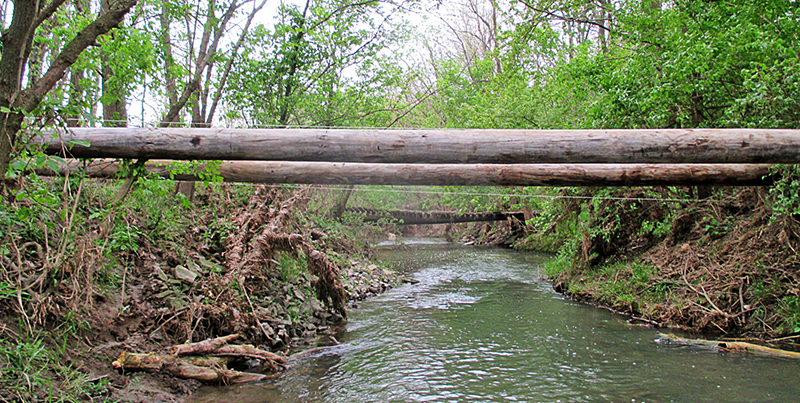
Some pictures of the bridge, from this afternoon. A good one of the actual break in the north side pole. You can see it drooping below the 2 x 6s, which are holding it together. I’m starting to like the idea of moving the bridge to the south, to the more narrow part of the channel.
Wednesday, May 8
This afternoon I rode up to the QF to see the poles, and tie them off a bit, so they wouldn’t head for Toledo or similar. Both are partly in and partly out of the water. They are beauties: 35 ft. long. One is just 50 meters south of the old bridge. The other is clear down toward the bend. Maybe 150 meters south of  the old bridge. Put on my boots, and waded around a bunch. I put strings across the creek, and measured widths, and heights, looking for the best spot. Another point: Since the bridge is now a regular “raft,” I don’t see any sense in burying the poles into the bank. They float up and down these days, often enough. We’ll want chains on the new bridge, like the old. Instead, I’d like to put the poles up on railroad ties. One on each bank would result in the pole top being over a foot taller than the bank. Could put several railroad ties on each bank, for better stability, and to minimize sinking and stress on the banks.
 Thursday, May 9
I was worried about the thunderstorms flooding the creek, and losing (the poles). As it turned out, the rain we had was necessary for me to move them to the bridge site. I worked pretty hard with the pry bar on the close one. About an hour to move it 50 meters or so. The creek was too shallow at the rapids. But for the far one, even after the rain and the creek rose 4 inches or so, it still took 2 hours of back work to get it to the bridge site. And just getting it from the bank into the creek was a challenge. Pry bar and blocks were enough, but barely.
The cable puller held together till the end, but was getting iffy on the last pole. With the puller and the recovery straps, it is slow work, but possible.
Tuesday, May 14
Was able to get the first two railroad ties in place, with the poles on top. Will try to get two more ties installed, later in the week. They are heavier than I expected. The one on the west end was about 240 #, and larger than the others. They will keep the poles up off the ground, and stabilize the bridge. Higher the better.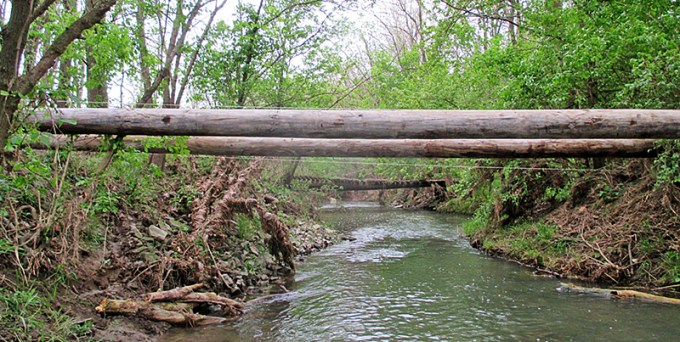
Tuesday, May 21
Worked till dark forced us to stop. The idea was to take off every other board, and transfer them over to the new bridge. That way there would be access to the quarry at all times. Unfortunately, it took us several hours to get the poles “rolled” to the proper position before we started. They both had a sag as received, particularly the north pole. We were able to get the sag rolled 180 degrees up, before the first planks were fastened, so the sag is now an “arch.” But it got dark and we had to stop with about 5 planks short on the new bridge. There are planks all the way over the water, but not enough for a walk across. The current plan is to come up and continue the plank installation tomorrow, weather permitting.
Removing the runner and the screws from the old bridge was indeed a challenge. I brought every kind and size of screw driver I had, and needed them. Some screws were over 4 inches long, and there were multiple types on most of the planks. On the new bridge, I am using new 3 inch zinc coated construction screws, with a torx 25 driver. Two per side. And drilling the pilot holes before screwing them in. Less stress on the poles, and they can be removed when necessary. For a bit of stability while working on the bridge, Aili hung up a yellow stretch of anchor rope at shoulder height above the planks, to give something to hold on to.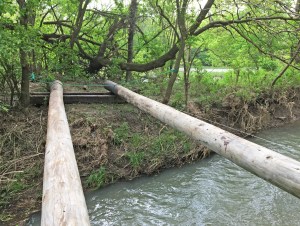
Thursday, May 23
Well, we finally got packed and rolling by sunset again. Home just after 10 p.m. Without Aili the planks wouldn’t be done yet. Aili picked through them, and with the 10 new 2 x 6s and “re-purposing” the recently added 2 x 10s that were part of the ramps, felt pretty good about them. And with the spacing, and being flat, it seems quite stable to me. I’ll give them a good inspection, after they’ve been in service some months, and are dried out. They were staying wet all the time on the old bridge.
The last job of the day was to remove the west side anchor chain from the old bridge, and do a temporary anchor job on the west end of the new bridge. I didn’t move the east side chain off the old bridge yet. Will do that one later too when I move the “good” south pole to the proposed ravine bridge site. Also need to anchor the railroad ties. Don’t want them floating away either.
Wednesday, May 29
We had a pleasant day putting up the side ropes, and holders. Re-used the yellow twist anchor rope that we left for the temporary safety rope. It is only half inch diameter, but pretty strong. Totally synthetic, so only worried about UV light wearing it out.
Have chains on both ends now, so should be OK if there is a mega flood. Should go up and back down without taking off for Toledo. Chains are around the poles, and anchored on the railroad ties as well, so we don’t lose them. I’ll make some small changes once I take all the chain off the old bridge. Feel pretty good about it now.

 That was 20 years ago. “Drift Zone” signs populate the neighboring fields. Local nurseries carrying various types of milkweed—and people are planting them. Several neighbors grow almost-acres of native grasses, wildflowers and Canada thistles poke their spiky heads up here and there as the natives are allowed to reestablish. Even so, anger still festers in me, 20 years after we were made to stand by and suffer a fool’s errand. Few mantids have turned their mystic heads my way since then and the goldfinches are still shy.