Where are You, Woolly Bear?

Have you noticed, as we have on The Quarry Farm, an absence of Woolly Bear caterpillars this fall? Typically, the fuzzy black and brown creatures are a common sight in late summer/early fall, crawling on the warm pavement of our country road. Not so this year. Here’s a brief look at the life of our fuzzy, bristly friend, to know it better and attempt to understand why its scarcity matters.

Woolly Bears are the caterpillar form of several related moth species, including the orange-yellow Isabella Tiger Moth (Pyrrharctis Isabella), which ranges across the U.S, and Southern Canada. The moth typically produces two broods a year. It lives about two weeks, nectaring on a wide variety of flowers. It mates, lays eggs, and dies. The caterpillars we see in the fall are the second brood. They’ve grown fat on leaves such as violets, nettle, sunflower, maple, and elm, and green grasses, and they may have shed five or six times while growing. When the fall brood is ready to pupate, it finds protective winter cover under leaf litter or logs or rocks. During the winter it pupates in a cocoon made from its bristly hairs and emerges as an adult in the spring. The cycle repeats to produce a summer brood.

The second-generation caterpillars that we see in the fall (in a normal year) have eaten their fill, are preparing to hibernate, and are out and about because they’re looking for cover. They are not going to poison us if we pick them up (although they can feel prickly). And sadly, they can’t predict our winter weather—by coloration or by size of the brown band around their middle. Those features are influenced by stage of development, belonging to a particular tiger moth species, and diet. There is no special little weather sensor embedded under the fuzz.

So why are we seeing so few Woolly Bears? First and foremost, no doubt, is the serious decline of many moth species worldwide—for all the reasons that we know too well and are struggling to deal with: climate change, habitat loss, light pollution in populated areas, pesticide and herbicide use. Also, we could look around us recently at a bleached, drought-ridden landscape and see little food for Woolly Bears preparing to hibernate. Their absence matters because, as pollinators and a major food source for birds and other animals, moths are an important link in the food chain that sustains us.

—The Gardener at The Quarry Farm

Summer 2020 Newsletter

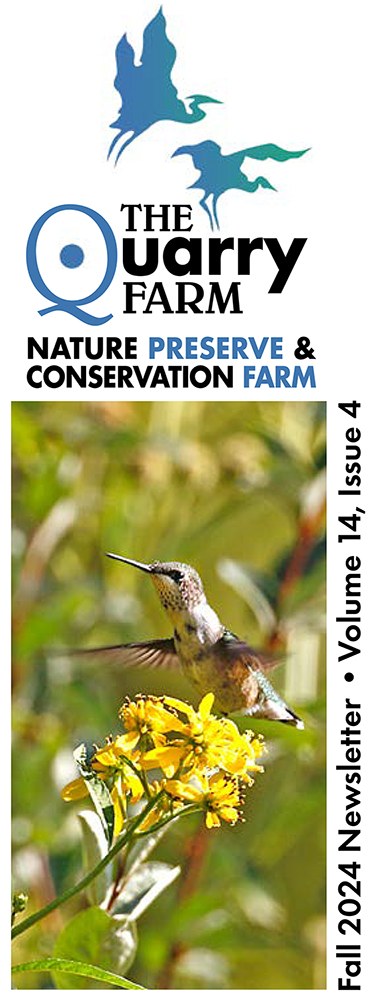
The following is an excerpt from the Summer 2020 Quarry Farm Newsletter. Click on the cover to the left to download your complete copy, including scheduled events and activities for the season.

As it did for everyone, March 2020 threw The Quarry Farm for a loop, upending plans for programs, school group visits and public workshops. But we know this is nothing compared to what others have gone through. Indeed, the nature preserve has been a refuge with ample opportunity for social distancing.

Just before the State of Ohio announced stay-at-home orders to slow the spread of the coronavirus, The Quarry Farm Board of Directors was able to conduct the annual meeting on January 16. A major goal for the new decade is to develop a clearly marked trail system on the nature preserve, complete with directional markers and trailhead signage that includes a map. Board member Paul Nusbaum went to work this spring on a new trail that loops through the north eastern floodplain. This low scrub area is perfect habitat for migratory warblers. Board member Deb Weston, an avid birder, discovered the value of the new trail along with fellow birder David Smith. On one birding venture on the new path, they found themselves spinning in circles to identify all of the different species of birds singing their travelling hearts out. On that May morning, just one of the early-rise walks Deb spent here with her binoculars and eBird app, they identified and recorded 57 avian species.

“That’s the beauty of The Quarry Farm,” she said. “You don’t have to walk 20 miles to be in the different habitats and see the birds that utilize them.” During this “Stay Home” time, The Quarry Farm has provided a place for a lot of people to social distance while volunteering their time and talents to help out here. Just before local schools shuttered doors in March, Miller City-New Cleveland High School student Emma Barlage registered as The Quarry Farm’s Spring intern. From March through May, Emma spent up to 20 hours per week lopping and pulling bush honeysuckle saplings and seedlings. Findlay’s Rich and Nora Park offered to help out, too. With Emma assigned to the northwest hillsides and floodplain, the Parks’ to the uplands east of the old stone quarry, and David Seitz continuing his work in the south (see back page), we are watching native trees and wildflowers emerge along the trails almost overnight.

As noted above, this season has not gone according to plan. However, with social distancing and sanitizer at the ready, we have continued to provide tours and offer programs for individual families and small groups, by appointment. In early May, a Girl Scout troop from Leipsic came here to earn their hiking badges. As they climbed out of the Riley Creek floodplain toward the grass prairie, two large fluffy feathered great horned owl fledglings bobbed in a black walnut at eye level. In June, a Bluffton Boy Scout Troop came to hike. Hike they did, down, up and around almost every trail, including those not traversed by most visiting groups. We looked for the nesting pair of Scarlet Tanagers with no luck, but we did see a male Baltimore Oriole bobbing amongst the aquatic plants on the quarry wetland.

There is a tremendous amount of golf cart traffic in front of the farm animal sanctuary fence. Chablis the Llama sits placidly under the pines at sunset, blinking her long lashes at the onlookers. If you wish to schedule an outdoor visit onsite during Summer 2020, send an email to thequarryfarm@gmail.com.