 Tonight’s Golden Snitch Walk was called on account of no snitches. In mid-March the evening air was buzzing with them. As I closed the gate on evening chores, two American Woodcocks–the absolute model for J.K. Rowling’s glittery winged ball, or I’ll eat my Ravenclaw hat–twisted in their funnel-cloud dance not more than 20 feet above me.
Then it got cold; freezy enough for S’more to agree to keep his thermal goat coat strapped on just a little while longer.
Our first scheduled woodcock walk was windy and chilly. We saw deer and Indian hemp, counted birds and tracks. But snitches were nowhere to be seen or heard. That didn’t changeover the next few weeks. I told the April 6 preregistrants that the birds had come and gone for 2019.

This dead tree is home to woodpeckers, fungi and all sorts of creatures.
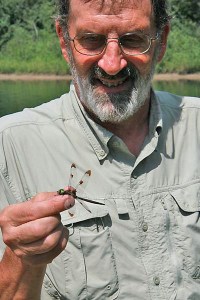
Snitches aside, today was a gorgeous day; the first real spring day that we’ve had since one random warm breath in March. I walked the planned walk route, dipping a net into the quarry. Its waters team with dragonfly and damselfly nymphs, snails and shrimpish scuds. No mosquito larvae dare swim near the predatory odonata; such is the beauty of a healthy wetland.
 No frog egg masses string the surface yet. There are frogs and toads clucking, burring and trilling from the quarry’s edge northeast across the vernal pools of Coburn’s Bottom to the property line at Riley Creek. All those Hey-Baby-Baby-Babies mean tadpoles are brewing in the slurry. A toad hops across the trail in front of me, not a snitch but gold all the same from the lowering sun and amphibian afterglow.
Two Canada geese sail in for the night, skidding across the quarry’s still surface. The ripples haven’t yet subsided when a small flock of wood ducks join them. I hurry along the path to bridge Cranberry Run so as not to scare them away. I’ve just climbed the hill and am up and out of the preserve when, behind me, I hear an airborne whistling.
“PE-E-E-ENT!”
I look up to see a winged softball arc over the quarry.
Show-off.
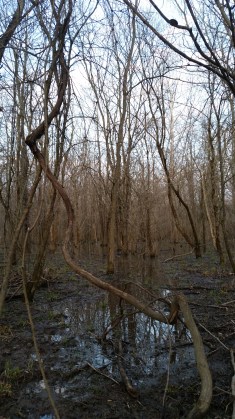
 The old stone quarry has changed a lot over 150 years, from not being there at all to a horse-drawn limestone operation, from spring-fed fishing hole to wetland. Black willows and other water-loving trees and plants grow there now. Wood ducks, wild turkeys, owls, squirrels, tree frogs and herons roost high above the banks. They see you before you even know they are there, falling silent or bursting from the branches in a great show of chatter or feathers.
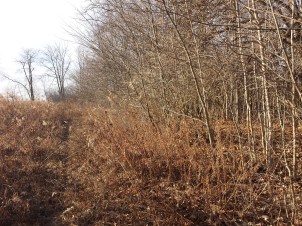
 Last weekend the dogs and I found the tree in pieces. The path is strangely open now. Stick-tights thrive in the open sunlight, laying waste to another pair of shorts and leaving the future of my t-shirt in doubt as well. Thankfully, jewelweed grows nearby to stop the burr itch. I wonder if the wild ginger will move to shade further along the bank.

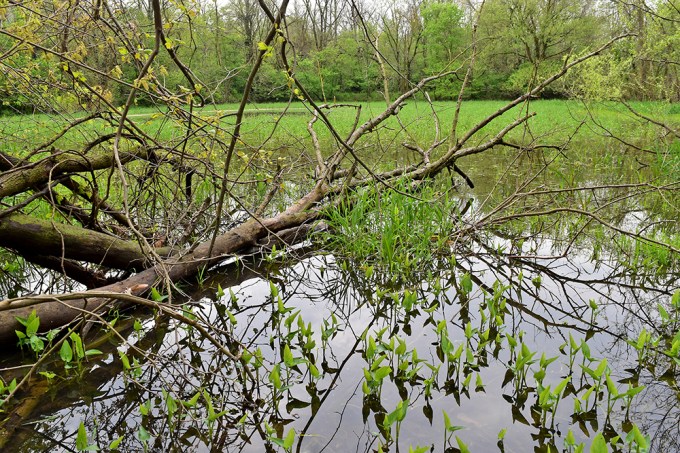
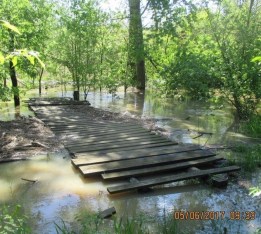 Two weeks ago, heavy rain flooded the quarry. Kayakers paddled through the preserve, weaving through trees well above the Run’s banks. The footbridge floated, held fast by heavy chains, thanks to
  absent
  The week before that, Steve came back to the house with a bucket of fairy shrimp in quarry water. I love to watch these tool in healthy circles, especially since their presence tells me that the wetlands are doing such fine work sponging sediment and impurities in the floodplain. The pools did such a great job that the bucket also contained a salamander larva with waving spaniel-ear-gills, and a predaceous diving beetle nymph.
 This Great Backyard Bird Count weekend is unusual in more ways than one. To begin with, this is the first in which I wore shorts outside.
 Today is Day 3 in the 19th year that the Cornell Lab of Ornithology and National Audubon Society have coordinated this international weekend of documenting birds. It’s a four-day snapshot of what birds are where. Some years, a few days after the count is over, I see a bird that wasn’t on our checklist and think, “I wish that had been here last week.” But that’s the point; as long as the species made someone’s checklist somewhere, all is well for now.