It’s a chilly, breezy spring afternoon, and I’m crossing the Cranberry Run bridge. lugging a flat of purple violets dug up from the garden around Red Fox Cabin. I’m headed for the floodplain to the north between our Quarry-turned-wetland-pond and Riley Creek. As I follow the trail around the northwest corner of the Quarry, bullfrogs erupt noisily from the bank and plop-plop-plop into the water. Out in the shallow depths of the Quarry several beds of flags are pushing up spiky leaves. Their clear blue flowers will come later. On both sides of the path Spring Beauties are blooming, small and delicate.
Farther north on the trail, the Spring Beauties are sparser and the soil looks washed. Floodwaters flow down Cranberry Run from the south to cover this area at least once a year, draining slowly into Riley Creek. It’s here on the floodplain that I’ve come to plant some violets and see what might be starting to grow this spring. That’s of special interest because for years dense, spreading thickets of bush honeysuckle and multiflora rose, as well as wild grapevine tangles have effectively shaded out most vegetation. Until now.
As a result of David Seitz’s hard work this past year, the invasive scrub that had smothered the plain is now the stuff of several enormous brush piles, some given names for fun like the Giant Turtle Pile and North Turtle Pile. These mounds are providing wildlife cover, while sunlight filtering through the branches of hackberries, bitternut hickories, and sycamores will bring dormant seeds to life—for better or worse perhaps, considering what may have settled out of floodwaters and lain in wait for sunshine. The coming months will tell. Today I’m seeing tufts of grass and sedges and wispy sprigs of bed straw that may soon cover the ground like green froth—and twine around ankles.
As I head back down the trail, violets all planted, I imagine a time when they’ll form a purple carpet lifting above tall grasses. I imagine Dutchman’s Breeches, Jack-in-the-Pulpits, Trilliums, Jerusalem Artichokes, Heliopsis, and other native plants migrating to the floodplain. I envision myself transplanting more native plants and flowers to the woods. I picture the native trees that Anne is going to plant soon grown tall and sheltering. Several times, I spot an enemy near the path and stoop to yank a leafy honeysuckle seedling.
—The Quarry Farm Gardener
 Tonight’s Golden Snitch Walk was called on account of no snitches. In mid-March the evening air was buzzing with them. As I closed the gate on evening chores, two American Woodcocks–the absolute model for J.K. Rowling’s glittery winged ball, or I’ll eat my Ravenclaw hat–twisted in their funnel-cloud dance not more than 20 feet above me.

 No frog egg masses string the surface yet. There are frogs and toads clucking, burring and trilling from the quarry’s edge northeast across the vernal pools of Coburn’s Bottom to the property line at Riley Creek. All those Hey-Baby-Baby-Babies mean tadpoles are brewing in the slurry. A toad hops across the trail in front of me, not a snitch but gold all the same from the lowering sun and amphibian afterglow.
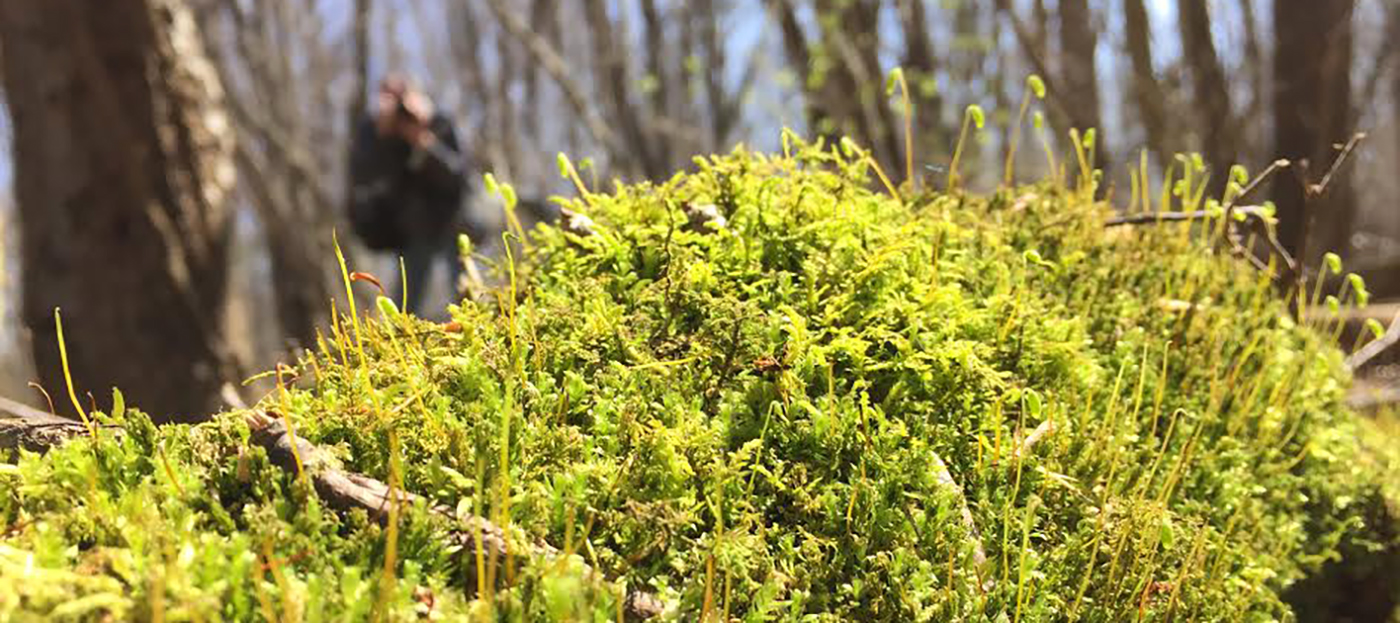 On Saturday, my old frayed running shoes picked up another layer of camouflage.
 On the quarry, wood duck and mallard couples made come-hither eyes at each other until we spoiled the fun. Wood ducks skittered over the east bank and a mallard duck “wank, wank, wanked” toward Riley Creek, her emerald-headed, testosterone-addled suitor in pursuit.
 We saw bloodroot leaves uncurling from the ground. Native Americans used the red extract from this wildflower’s roots as a natural dye, most notably for basket weaving. Above ground and growing wild in the sunlit clearing around the old homesteads well north of the tallgrass meadow, the bloodroot flowers bloom.
 A few spring beauties and ramps dot the southeast ridge as it rises east of the cut-off. In the warmer air and spongy soil in the U of the oxbow, three toadshade trilliums fan over moss
  and decaying stumps crawling with industrious crustaceans.