We haven’t provided a Super Dave update for a while. That doesn’t mean that David Seitz hasn’t been here at least two times a week, clearing invasive plants, combatting poison ivy, engineering and re-engineering bridges and boulder crossings, and mowing paths. Here’s a month’s-worth of catch-up.
Please never give up, David.
June 24
Had a pleasant afternoon yesterday, working at the QF. Clearing the euonymus patch. Pushing to the south, opening that area. It is really old honeysuckle, with a mass of new ones coming up, and really thick. Also worked through a couple growing multiflora patches. Trying to save the young trees, while digging the honeysuckle around them, and cutting the grape and poison ivy vines. Am now far enough south that I’m closer to the turtle pile again, and moving the brush to the turtle pile is easier.
Saw the big heron landing, as I was walking to the Jeep, but couldn’t get close enough to get a picture.
June 26
Was watching the weather radar, and it looked like the worst of the front would miss the QF, off to the west, so I came on up for an afternoon of digging honeysuckle. Got the first shower just around 1300 hrs, but it didn’t last too long, and was cool enough after that. Less than 1/4 inch. I could wear the rain coat for the day. I ran the chain saw to start, and walked around the work area with it, just east of the turtle pile, trimming branches off the big old honeysuckle. Surprising how the bugs leave the area to get away from the saw. Continued on south and east, doing a band of honeysuckle 10 meters wide, till I got to the open corridor east of the turtle pile. Where you can see out east into the swampy area. Will start moving back north next week, widening the corridor. Visible progress. Was tired by 17:30, and called it a day.
Hauling to just the north side of the turtle pile now, and it is growing. Lot of mass there.
Saw several deer come bounding through, but otherwise it was a quiet day for critters.
June 29
Made a visit today. Didn’t have anything else going, so came up and did about 5 hours of honeysuckle, vines, and multiflora, widening the turtle-swamp corridor. Just clearing to the north, back toward the euonymus pile. I kept working till I’d ran out of ice tea. It was hot and with almost no breeze, and the half gallon thermos was needed.
Now from the turtle pile, you can easily see east into the swamp area. Is some heavy thicket there, working north. Big old honeysuckle trunks take a lot of work to dig out.
The rain last night raised the level at the old bridge dam. Hoping for a bit more rain this week, and less heat.
July 2
Had a pleasant, cool afternoon at the QF, digging honeysuckle southeast of the euonymus pile. Working the thicket to the north of the turtle-swamp corridor. Widening the opening. Looking much more open now, across the swamp, as I dig into that thick old growth.
Got into some poison ivy liana. Several were so big they looked like trees themselves, except you could see the heavy PI vines and their branches were just off the vine trunks. Chopped the vines, and will let them go for a while. May want to cut the dead trees, to stop them just growing again. So much PI growing in that area, that just clearing the brush means carrying bits of PI is inevitable. Washed up with goop once home, but have the usual small rashes this morning where I got scratches.
At the end of the day, I patched some of the leaks on the old bridge dam, to raise the water level a bit there. The level at the dam was up 2 inches while I worked, and still rising. At 73, still playing in the puddles.
July 5
Was a bit warm, and no wind down by the quarry. But I did get in about 3 and a half hours of honeysuckle and vine cutting. Working north still, and piling on the euonymus pile.
At the end of the day, I worked plugging up the old bridge dam some more. Water was 3″ below the “hanging rock” when I started,, and after 45 minutes, it was just at the hanging rock. Not much flow, so changes in level are slower. Hope we get a shower this week.
Had the shovel with me, so walked down to the stepping stones and re-spaced them a bit. Now easier to use. Dragged the tire and rim up on the bank. Next visit I’ll bring it up to the road, and put it next to the truck tire. Is actually a pretty good tire, and holding air.
There was a little (14″) northern water snake in the creek, north of the dam.
July 9
Lovely day at the QF. Started by bringing the “spare tire” up to the fence. Holding air fine. Looks like an old Jeep Cherokee rim, with an almost new tire. Don’t know what you want done with it, but you can always roll it down into the creek during the next flood!
Worked SE of the euonymus pile, back into the thicket. Is interesting there, as the thicket is now mostly other trees, and the honeysuckle is smaller and only 1/3 of the brush. Looks better every session, but a lot left to clear.
Plenty of PI vines to cut, too. Did that in the last 15 minutes, and then cleaned up my arms when I got to the Jeep.
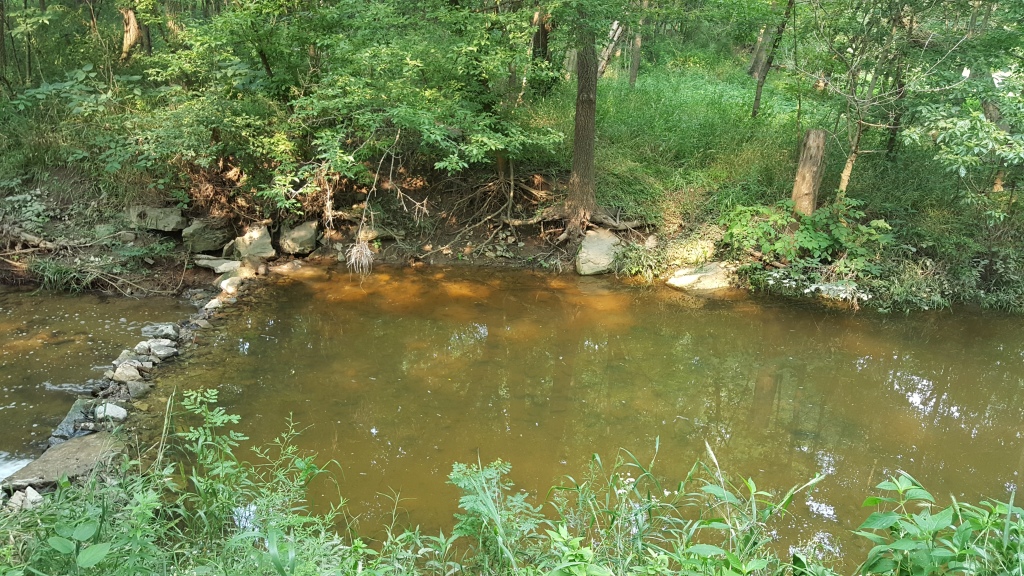
The old bridge dam pool was 4″ below the hanging rock when I arrived. Decided to patch up some of the bigger leaks with small rocks and gravel. After, the level in the creek rose about 2″, over 45 minutes. Was still rising slowly, when I left. Creek flow was very small. Photos attached.
Saw a 6″ crawdad come down the bank, and play in the edge of the water. But didn’t go fully into it. Just wet itself, and then hid by a rock. Surprised me, again.
July 14
Was a pleasant day at the QF, except for the bugs. They are doing well, in the thickets. Used a bunch of permethrin spray on my clothes, then “Skin-so-soft” for the mosquitos, and finally frequent shots of DEET for the flies, as usual. But today they were back at me after just a few minutes.
Working north into the thicket, east of the euonymus pile. Working the eastern side of the thicket, so not much honeysuckle out in the swamp area. But a bunch of multiflora, and poison ivy galore. Nasty. Cut and hauled about 5 hours.
Next visit, I will mow the paths around the quarry with the brush cutter. Just need a trim.
Thanks for the cookies!
July 19
Didn’t get to the QF until 1400 hrs, and started right in with your Bolens brush cutter. Spent about 2 and a half hours mowing the paths around the quarry, and down to the stepping stones. Unfortunately, the Bolens lost a screw off the shaft, and I had to stop mowing for the day. Brought it back, and will put new screws in and return it. Small repair.
Spent the last half hour touching up the old bridge dam, where there were a couple larger leaks. Water level was 4″ up on the hanging rock, and climbing, and the quarry was at +2″ on the pipe, and draining out into the creek. Creek water was almost clear, fortunately.