at the root of the problem, something wonderful

P1020028As a race, humans have found a lot of ways of saying that no matter what — somewhere, somehow — there’s a little bit of good in every bad situation: it’s an ill wind that blows no good, every dark cloud has a silver lining.

As it turns out, what we found out here at The Quarry Farm, there’s truth to be found there. But first, a little bit about bush honeysuckle.

In the early 1970s, before anybody was paying attention, it was common knowledge that planting honeysuckle was a good thing, particularly if you wanted to attract birds. And while there are honeysuckle species native to North America, more than a few that aren’t were allowed to proliferate. Morrow’s and Amur honeysuckle were particularly popular for their dense foliage and bright red berries and now particularly troublesome as two of the most invasive species of honeysuckle unadvisedly planted. Both can grow as tall as 15 feet and both are monoculture plants; they crowd out everything  around them and nothing grows beneath their spreading branches. There’s even evidence that they engage in chemical warfare, releasing toxins into the soil to kill off any competition until there’s nothing at the base of these plants but bare soil. While they typically don’t do well in shaded environments, preferring to grow at the verges of woodlands, both take advantage of any disturbance in the upper story of a woods to move in and establish a fortified foothold at the first opportunity. And while it’s true that birds love their bright red berries, they offer little in the way of nutrition. Sure, they brighten the feathers of cardinals and the burning breasts of robins, but they’re junk food, the natural equivalent of candy bars and potato chips.

In short, they’re a nightmare for any organization or agency working to develop or maintain native habitat. And they’re here on The Quarry Farm in numbers too vast to count. We’ve adopted a multifold approach to getting a handle on this problem, but the most effective method is to simply pull them up by the roots whenever and wherever it’s possible.

Recently, we accepted an application from Emma, a first-year student at Antioch College, to assist us in our many efforts. One of her primary responsibilities is to help control bush honeysuckle on The Quarry Farm. Right away, we put her to work, yanking up the pest.

And here comes the silver lining.
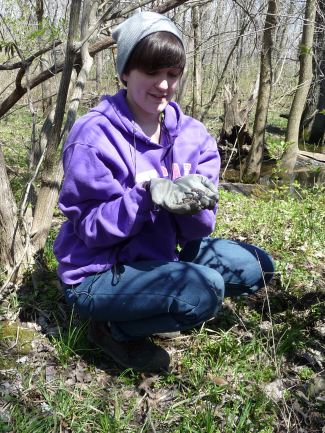
P1020031Emma set to work first along the Cut-Off, a man-made wetland created when the county opted to straighten the stream in the 1960s, thereby isolating what was once an oxbow in Cranberry Run. At the end of her third day, while making her way back to her temporary home, she stopped to pull one last medium-sized clump of honeysuckle…and found a salamander nestled beneath its roots.

IMG_5663

To say the least, we’re thrilled. It’s a wonderful start to what we know will be a productive 10 weeks.

Thank you, Emma, and welcome.

Better than chocolate bunny ears

c4670934-429a-4ad5-a309-5e643be723edOn Saturday, my old frayed running shoes picked up another layer of camouflage.

Easter Eve started out chilly, with thick frost and a skim of ice on the goats’ and donkeys’ water pans.f04836dd-60e0-4c6f-904b-068631678062 On the quarry, wood duck and mallard couples made come-hither eyes at each other until we spoiled the fun. Wood ducks skittered over the east bank and a mallard duck “wank, wank, wanked” toward Riley Creek, her emerald-headed, testosterone-addled suitor in pursuit. 22a018ab-350c-442f-bdfd-262d00d61d72
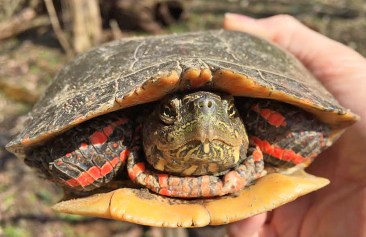
The turtles were more confident, waiting until we had our cameras out before they slid below water surfaces. Steve found one crossing between Cranberry Run and the oxbow “cut-off”, a wetland left when Allen County engineers tried to tame the little creek’s meanderings half a century ago.

c61571af-e857-498b-8471-737a025bbcdeWe saw bloodroot leaves uncurling from the ground. Native Americans used the red extract from this wildflower’s roots as a natural dye, most notably for basket weaving. Above ground and growing wild in the sunlit clearing around the old homesteads well north of the tallgrass meadow, the bloodroot flowers bloom.
a50e38b0-ea6a-4d59-bcca-040f7f0940caA few spring beauties and ramps dot the southeast ridge as it rises east of the cut-off. In the warmer air and spongy soil in the U of the oxbow, three toadshade trilliums fan over moss f4cb27d4-c57e-4d8b-8dfd-5a3ef1c4e172and decaying stumps crawling with industrious crustaceans.

Steve counted four species of butterfly, including two red admirals duking it out with anglewings–commas or question marks?–a camera-shy mourning cloak and a spring azure doing some sort of strange contortions in the back field.

We also picked up several bottles and cans, one with the smaller V from an old pull tab. These are the ‘blooms’ that are best picked. Never planted is even better.

Big Girl

We called her as we saw her and so her name, the name we gave her, was Big Girl. And she was. Big. At least in comparison to the Prissies, the first 16 chickens to live on The Quarry Farm. Big, too, in that she eventually made this place her own.

She came to us through Nature’s Nursery, but our understanding of her life started in a depressed and battered neighborhood near downtown Toledo. A gang of kids was harassing her with sticks and stones and fists and feet until a man we never met, never heard more about than to know the part he played in Big Girl’s life, stepped out of his house and drove them off. He called the people we know, who called us and here she came.

Not surprisingly, she was suspicious of us; kept her distance. Literally. She maintained a space of roughly 30 feet between her and any human being in the yard. If you took a step toward her, she took a step away. As evenings would wear on, we’d have to wait until full dark, then go out and find where she’d perched for the night, catch her up and put her in the coop, safe from every big and little thing that goes bump in the night.

And so it went, until one day it didn’t. It wasn’t a gradual acceptance, but an all-in sort of thing. One day she was meticulously guarding her personal space and the next she was standing on my foot, looking up at me and wanting food. It took about three months, but she’d finally made up her mind.

That was in 2009. Yesterday, she crossed the water. She’d been fading for months and when we opened the coop door in the morning, we knew. She eased herself out into the sun and, after a bit, lay down. She stayed there for the remainder of the day with the three of us checking on her every little bit. Then, with afternoon slipping into evening, she simply went with it, followed the westering sun.

 I suspect I’ll always look for her, perched in the crabapple tree or up in a pine, bullying one hen or another out of her way as they all race to the coop for a treat. And in some sense, I’ll always find her.

This is home, hers and ours, in spirit or in flesh, and that much more solidly established for her having made it so.

big girl

Big Girl

Not tomorrow, but today

We’ve been away for awhile–not in body so much as in mind.

For the past few days, the sky has loomed gray. While the temperatures were in the 30s (Fahrenheit), the air was heavy with wet, the kind of damp that soaks into your tissues and no amount of blankets will chase the chill away.

The cold hasn’t stopped the morass of mud all around The Quarry Farm. While quilts and jackets kept us warm, the animals burrowed under Bridenbaugh straw. A few northbound red-winged blackbirds showed up this week to promise that spring is close. Then these vernal signals went silent, too.

It was like that earlier today. Then the sun came out a few minutes ago. And happily, so did everyone else.

Chilled count forecast

Saturday’s scheduled Great Back Yard Bird Count (The Quarry Farm Nature Preserve & Conservation Farm edition) is still on, despite predicted temperatures of 13 in Northwest Ohio. The birds will be sheltering as much as possible, but the feeders will be full and suet stocked to help them weather the weather, and we will document those that do turn up.

The Cornell Lab of Ornithology has created a strangely soothing animated migration map using millions of bird observations from participants in previous eBird and the Great Backyard Bird Count tallies. The map tracks the annual journeys of 118 bird species from point to point of the Americas. Check it out and get ready to bundle up Saturday to add more birding data from this weekend’s count.

Two sides to everything

This Martin Luther King Day is cold. Yes it’s January, and yes, this is Northwest Ohio. But a predicted high of 9 degrees Fahrenheit (wind chill -4) meant wrangling the goats into their coats last evening and coaxing Lucy the donkey into a new purple insulated number. The latter was much easier than anticipated. I would even venture to say that she liked it, although her girth meant that the length is for horses and the coat will need alteration.

Goats Marsh and S’more, however, do their best to peel back the velcroed straps on their parkas. Marsh rubs up against posts and building corners. S’more just reaches around and pulls his off. By sunrise today, his was laying out in the paddock. Giant goat Mister Bill, while happy to keep his coat on, boxed my left ear during my first attempt to shrug S’more’s coat over his squirrely head. With my ear and head ringing, it just seemed a good idea to throw boots in the closet and crawl back under the comforters.

Instead, Steve and I threw on more layers and drove to Bridenbaughs’ farm to fill the truck bed with hay. Tomorrow isn’t going to get any warmer, and the fires under those quilted coats have to be stoked since, even with arctic cold, all the creatures on the farm animal sanctuary insist on moving from outbuilding to outbuilding. The hay is always greener on the other side of the wall, I suppose.

As we drove back over the M-6 bridge, the UPS truck teetered past. Outside the gate, the driver had left a large, square, flat package. On its face was a note from Sandy, one of Mister Bill’s original caretakers. Along with “Fragile” and “Don’t open with a knife” the markered face said “Hi Billy” and “With love to my friends.”

Dog PaintingLast summer, Sandy and Doug visited Mister Bill here on The Quarry Farm. They brought him treats, delectable items that he unwillingly shared with most of the other goats. While walking the gardens and sharing a human lunch outside Red Fox Cabin, we told Sandy about our intent to hang paintings around the perimeter of the sanctuary. The package that came in the mail was the size and shape of just such a painting.
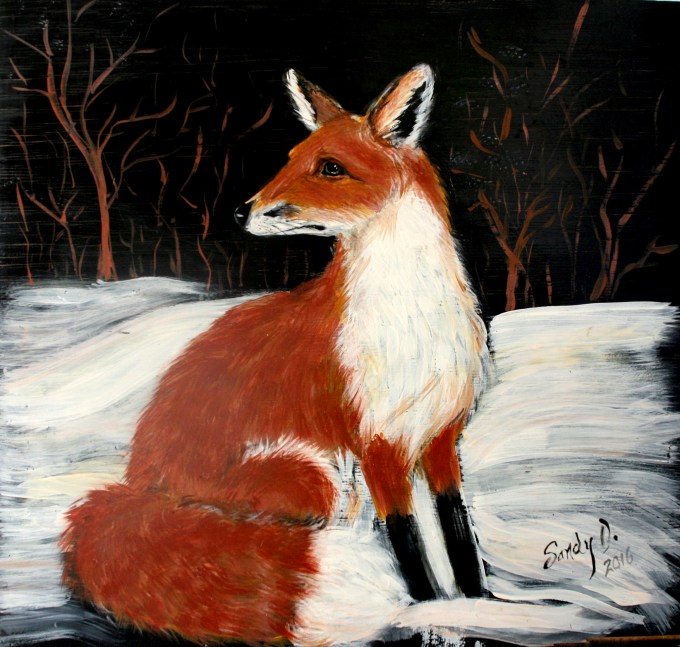
And it was.

We talked about treating it, how to properly display the piece, etc., and flipped the board to check mounting possibilities.

On the back is this.Fox Painting

Words fail. So I leave you today with Miracle Max in all his purples, blues and rosey reds.

Miracle Max

Nine more words: Thank you, Sandy for the winter reminder of loveliness.


The rain rain rain falls down down down

Today is rainy, cold and a hot cuppa sits in front of me. The floor has been mopped and mopped and mopped again to keep the muddy footprints at bay. Steven just suggested that we build a raised walkway so travelers can leap from stone to stone to make their way to the house in the event of such soup as surrounds us now.

I toyed with the idea of taking a photo of the preserve tree line, but the light is so dim that I’ll just tell you the trees are quiet and dripping grays and browns. The donkeys and goats are hunkered down in the paddock building in nests of straw, while the chickens do the same in their coop. The geese, however, are bubbling happy murmurs in the puddles that are fast joining into one big sea of waterlogged mud and winter grass.702974_10208387964407583_1535727157_n

Potbellies Carlton and Beatrice are trying very hard to be small, their legs crossed just in case the humans might get it in their heads that the pigs probably need to go outside to relieve themselves. Nemo was in her crate for a stretch, having thrown a large piglet tantrum because we couldn’t stop the downpour during her favorite hour of rooting. Now she is out and sprawled across her increasingly small dog bed.

David Seitz has worked steadily in the last month to ready the back grassland for wildflower seeds. The seeds were supplied by the Pollinator Partnership, as part of its U.S. Bee Buffer Project. The nature preserve was selected as a bee buffer research site as it borders neighboring farm fields at the south east corner. David and his daughter Ily spent much of Christmas Eve here working on the three acres that will be devoted to the effort. I hoped to take photos of the spot today.

Instead, I’ll keep my feet warm under a pink pig and plan on another walk on a dry day–maybe New Year’s Day–at least until it’s time to tuck the birds in for the night.


Making jam

1908061_875195272492033_3010147628062901086_nCome on out to 1/8 mile north of 14321 Road 7L, Pandora on Saturday, October 3, at 6 p.m. for

The Quarry Farm Jam

(formerly known as Acoustic Night — now we are wired!)

Acoustic Night

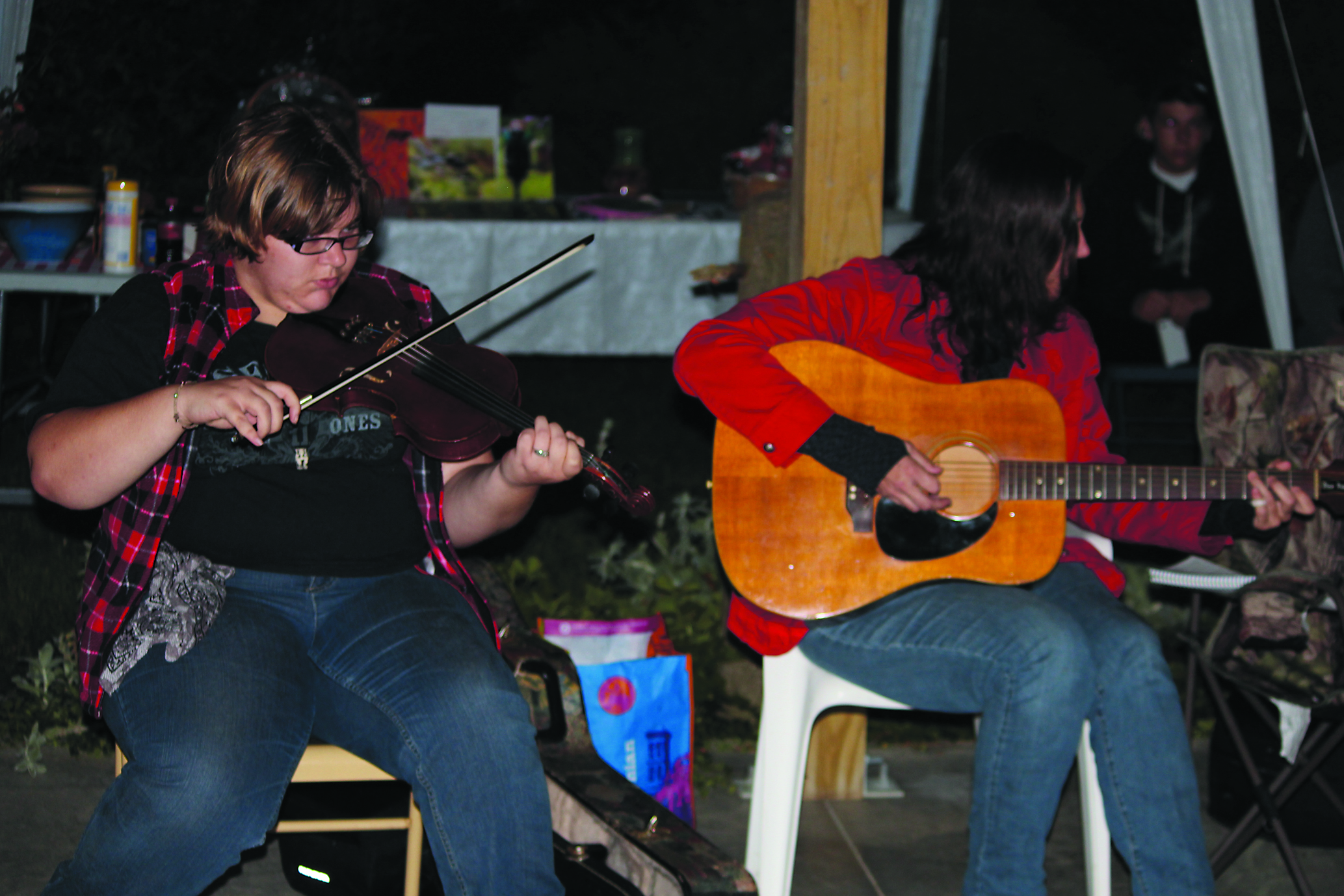
Acoustic Night2Join in with a musical instrument of any kind, or just bring a chair and kick back under the stars (or under the Seitz Family Pavilion roof) and enjoy yourself.

Last year’s line-up featured guitars, a ukulele, a sax, violin, and many voices. Free kazoos will be available, as will cider and cookies.

There will also be a small silent auction of items made by local artists, with all proceeds to benefit The Quarry Farm Nature Preserve & Conservation Farm educational programming, trail maintenance and for the care and feeding of the farm animal sanctuary.