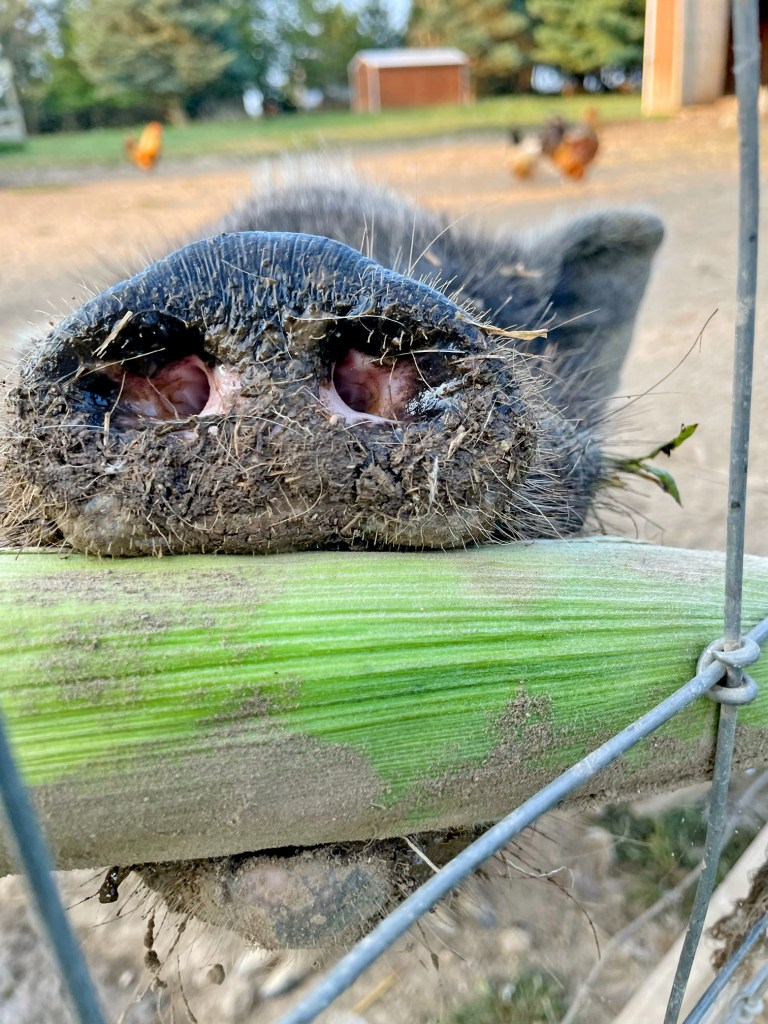
At this point in time, the farm animal sanctuary is primarily a senior living facility. The three donkeys are well into their 20s. At five, Clive is the youngest of the five pot-bellied pigs. The others, as well as Nemo the big pig, are at least 10. Brownie the Rouen Duck is at least five (I just read that they can live to be five!) As with humans, supplements joint health and anti-inflammatories are part of daily food prep. The residents came here to live out their lives in as much peace and freedom as possible. It’s tough to admit when The Quarry Farm may not be the best place for them to do so.
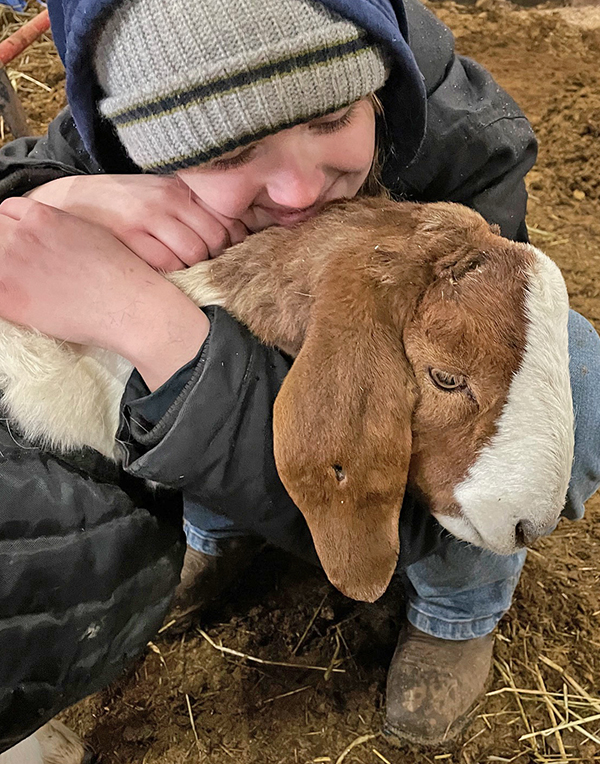
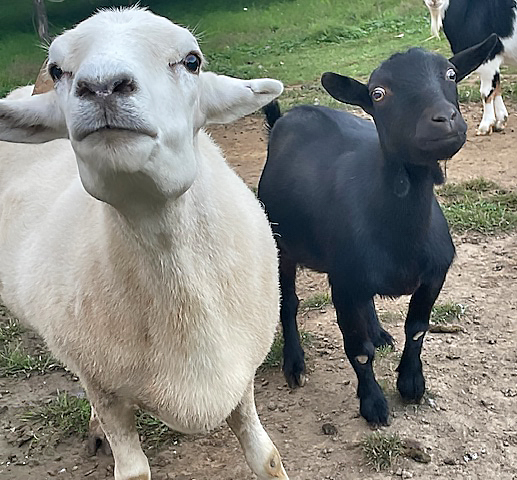
Tommy the Boehr Goat was bottle-raised by a gentle boy who cared for him. He was initially named “Tongue-ey” because the little goat was unable to keep his tongue in his mouth. When Tongue-ey came here, we hoped that he would become part of the herd. Unfortunately, the other goats kept him at a distance. We found out why when we found him non-responsive on a January morning. We drove him to Ohio State University Farm Animal Services where he spent a week.
The prognosis was probable failure to thrive. His little body was unable to regulate its temperature and he was unable to fight off parasites as healthy goats do with regular treatment. Our friend Tim Jasinki at Lake Erie Nature & Science Center put us in touch with Whispering Acres Farm Animal Sanctuary near Medina. This facility is home to a number of animals with special needs, and many of these animals are ambassadors for hospice therapy and veterans with PTSD. Tiny Tongue-ey—now Tommy—was immediately surrounded by equally tiny goats. Janine Smalley, the director of the sanctuary, sent photos of him at work, providing comfort to someone in need.
…and Sometimes the Best Place is Here
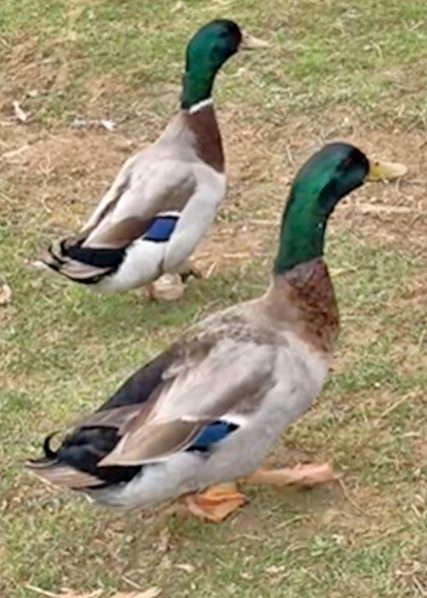
While making arrangements to transfer Tommy to Whispering Acres, Janine asked if The Quarry Farm would be able to accept any ducks. Someone had just surrendered two Rouen drakes. In addition to Brownie, there are two more Rouen ducks here. Brownie and the Brownettes could certainly hold their own. Although it is Spring and the two brilliantly-plumed males are rather obnoxious with the season, Brownie leads them around by their bills.
There isn’t much opportunity to travel for us. Someone (someones, ideally) must be on hand who can carry 5-gallon buckets in winter when the water hose is detached and who can suggest to a 700-pound, heat-prostrated pig that she shouldn’t block the paddock gate but rather get up and plunk herself in the cool mud wallow. Someone(s) must know the various bird and mammal personalities well enough to convince them to go in at night and how to distribute breakfast the next morning so that everyone gets enough. It takes a small village, one that doesn’t have a whole lot of residents.
Occasionally, we are able to be away; two of us together. Just a few nights ‘away ‘abroad’ are enough to remind us why we choose to live here in the middle of braying, crowing, wallowing, and leaf whispers. It’s good to return to this place where the cricket frogs still sing in Spring and screech owls screech and make guttural whoops in Fall. They do that last thing, you know. It took us the longest time to figure out that the same little owl with the high-pitched warble also growls.
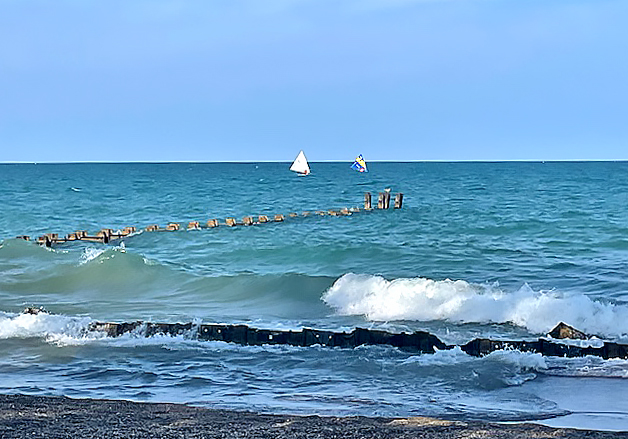
Lake Michigan at Millard Park
Last Friday, we piled stuff in the car and drove to visit family and an art festival in Chicago. Chicago seems a world away from our one-lane rural road, but it’s only slightly longer than a trip across the width of Ohio. Our route through Indiana featured 3 hours of very dry corn fields before Gary, IN brought us to the Skyway bridge to Illinois (complete with a troll on either side to pay.) The Democratic National Convention had ended the night before, but that traffic was joined by incoming patrons of 2 art festivals (including ours), a world music fest and a tattoo extravaganza. After two hours of Friday evening on I-94, we dipped our sweaty fingers and toes in cool, clear Lake Michigan at Millard Park.
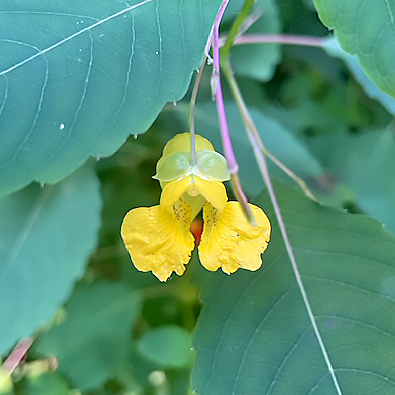
Yellow Jewelweed
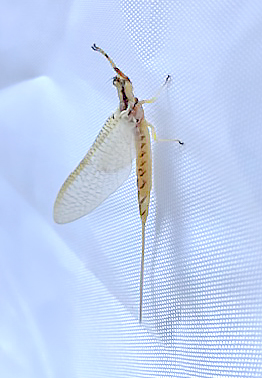
Mayfly
Millard Park, as well as other Chicago-area parks, bike paths, and train right-of-ways are undergoing habitat restoration. There are signs informing pedestrians that the Wingstem, Cup Plant, Joe Pye and Iron Weed planted along the paths are part of a concentrated effort to restore the natural balance of the region. The gardens surrounding mansions and bungalows are planted with riots of native purples, magentas and golds rather than specimen cultivars mulched to the stem as is commonly done in Northwest Ohio. The deep roots of those native plants are part of an effort to restore health to soil and to filter impurities from Lake Michigan’s watershed. The lake itself entertains, bathes, and quenches the people, animals, birds, and insects that live there. Deep in the ravine road to Millard Park, orange and yellow touch-me-not Jewelweed camouflages multimillion-dollar home drainage systems.
The same plants live on The Quarry Farm. Goldfinches burst from the riot of color planted along Chicago Transit Authority’s Purple Line just as they do next to Red Fox Cabin. Jewelweed pods pop from a dragonfly’s touch along Cranberry Run. The more Jewelweed the better. Its natural astringent powers stop the itch of poison ivy that it grows alongside.
Many of us Midwest/Easterners also experience the late summer emergence of cicadas. A couple of weeks ago, My Steven worried that he hadn’t heard them much recently. Two broods emerged in Illinois this year, including in Chicago. This is the first time these two specific broods have co-emerged since 1803. The first brood thrummed above the streets and sidewalks in June. They suffered from over-active libidos when Massospora cicadina—a puppeteer fungus that rivals the post-apocalyptic mushroom heads featured in “The Last of Us”—replaced about a third of each insect’s body, including the parts that fuel reproduction. Currently, the city is being serenaded by the second brood. On the ride home, I heard a news report about these cicadas’ eggs are being invaded by Oak Leaf Itch Mite populations. The mites are always around. They normally invade other insect eggs housed in the galls on oak leaves. But the mites are having Chicago field days this summer. They feast on the eggs of some trillion Brood XII and Brood XIX cicadas. The frenzied mites fall from the trees and keep munching. Tasty humans are advised to wear long sleeves rather than spray.
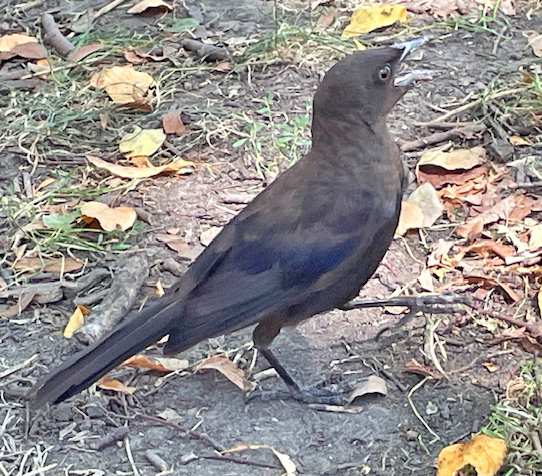
Juvenile Grackle hunts for cicadas
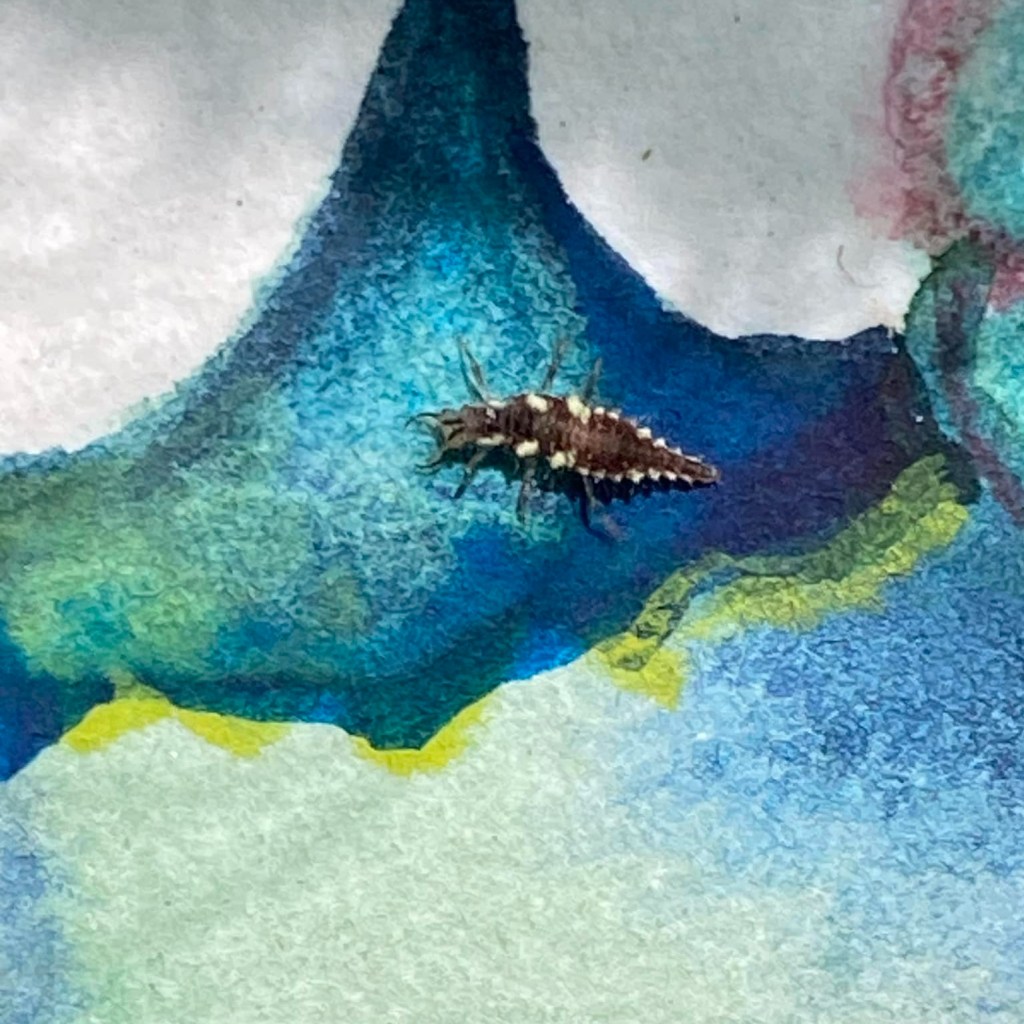
A beneficial, art-enthusiastic Red-lipped Green Lacewing (larva)
But spray they do. As we shaded under American Hackberry trees at the Bucktown Arts Fest, a citronella candle burned in the park oval. A juvenile Grackle hopped in and out of artists’ tents, dismembering and eating cicadas every few feet. He hopped over to the candle, tried to perch on the rim and, shrieking, scurried under an awning. He was chased back out. The chaser sprayed a stream of DEET up and down their thighs, complaining of insect bites. A dead Assassin Beetle larva—a beneficial insect—fell from the air onto my watercolor paper.
Willy and Pluto
We drove through our front gate on 7L on Monday evening. Our bellies were still full of deep-dish Chicago pizza and 7-layer halva. It was hot and sticky and cicadas were singing in the nature preserve. Quinn screamed and wagged her tail. Steve collected tufts of shed fox fur that she left in her wake and we remembered why it’s good to get away and come home again.
Five wild turkeys ambled through our yard today, not two hundred feet from our home. We frequently hear them in the morning back on the quarry and occasionally see them in the evening, well behind our house, roosting in the cottonwood and walnut trees. They’ve never come this close before, though, and even though I know that they’re simply wandering to and from the soy bean fields across the road and so are likely to pass close by either here or Red Fox Cabin, it still caused me a bit of concern. I worried that they were becoming less wary, less concerned about our presence and, by association, the presence of other people, as well. I worried about the upcoming turkey season and how they’d prove easy targets if they were comfortable around us.
I worried, that is, until I tried to get a photo.
It was Anne who first spotted them and pointed them out to me. They were walking down a path along the tree line that separates the farm part of The Quarry Farm from the nature preserve side. I grabbed my camera and headed out to where Anne had last seen them. I moved to the far side of the tree line and worked my way up the path on the other side, then down the path on our side of the trees. Then up again. Then down. You’re looking at every photo I was able to get. You see them, right? The photographs, here between the lines of black and white text? Yeah, neither do I. That’s because I couldn’t get any. I can’t say that I didn’t see them. I did, at least in bits and pieces: the glide of a blue-gray head; a bronze-feathered body slipping through brush; a quick flash of red from a wattle. But that was all I got, quick glimpses. They ran me round and round an area about the size of an American football field, always on the other side of the field and always virtually concealed in thick scrub. So, no worries about their growing comfortable with humans. And no photos, either, not of turkeys anyway. But, since a picture paints a thousand words, here’s a shot from the winter before last.
It is autumn, though, and there are plenty of other animals moving about. In the back field, a leopard frog boasted better than average camouflage. If it hadn’t jumped, I never would have seen it. In the woods, the last of summer’s dragonflies are torpid with the cold, allowing for some pretty extreme close-ups. Closer to home, in the crabapple tree some thirty feet from our front door, a wheel bug traveled leaf to leaf, hunting an increasingly rare meal.
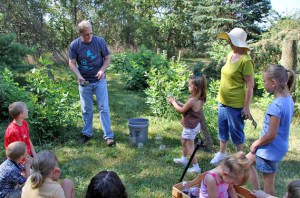
The Junior Master Gardeners of Continental (Ohio) graced The Quarry Farm with their presence on July 11, the first group to visit since the big wind blew through. Although there are still a couple of downed trees here and there, the paths were clear and mowed in time for the travelers to arrive.
Led by Charlene Finch, the group of 20 adults and children of varying ages drove in around 10 a.m. to beat the afternoon heat. They divided into three groups to rotate through three different learning and activity stations.
Mints and other herbs and flowers are bundled
Group #1 met under the shady zelkova in front of Red Fox Cabin. From Board President Laura they discovered the history of the cabin and the grounds, the gardens and made herb bundles from cuttings gathered there.
Group #2 circled next to the ash stumps, recent victims of the invasive emerald ash borer. This was the perfect spot to hear Steve the Insect Guy talk about stream ecology, perfect because his roundtable included a meet-and-greet with riverine beneficial insects that grow up to combat harmful insects.
Meeting a dragonfly nymph
Group #3 walked to the farm animal sanctuary where they were heartily welcomed by Buddy the miniature donkey. Despite the white-hot rising sun, Buddy held his post at the southwest corner of the paddock and brayed greetings to each group, keeping up the conversation throughout their stay at the station. One volunteer in each group was assigned to pet Buddy so that he would keep quiet long enough for Beatrice the pygmy pot-bellied pig to come out and meet the kids. This event was the first educational outing for Beatrice. She took a special shine to a gentle boy named Brandon, allowing him to feed her a piece of apple. Geese and chickens checked out the group from a distance, as did the goats.
Buddy greets a gardener
After all groups had rotated through the stations, everyone met at the cabin for cookies, lemonade, ice water and a group photo on the front porch. Some strolled through the gardens to see the blooms of drought-tolerant flowers and to scout for butterflies and dragonflies. Many thanks to Board Secretary Rita for photographically recording the event and for sharing them for this post.