
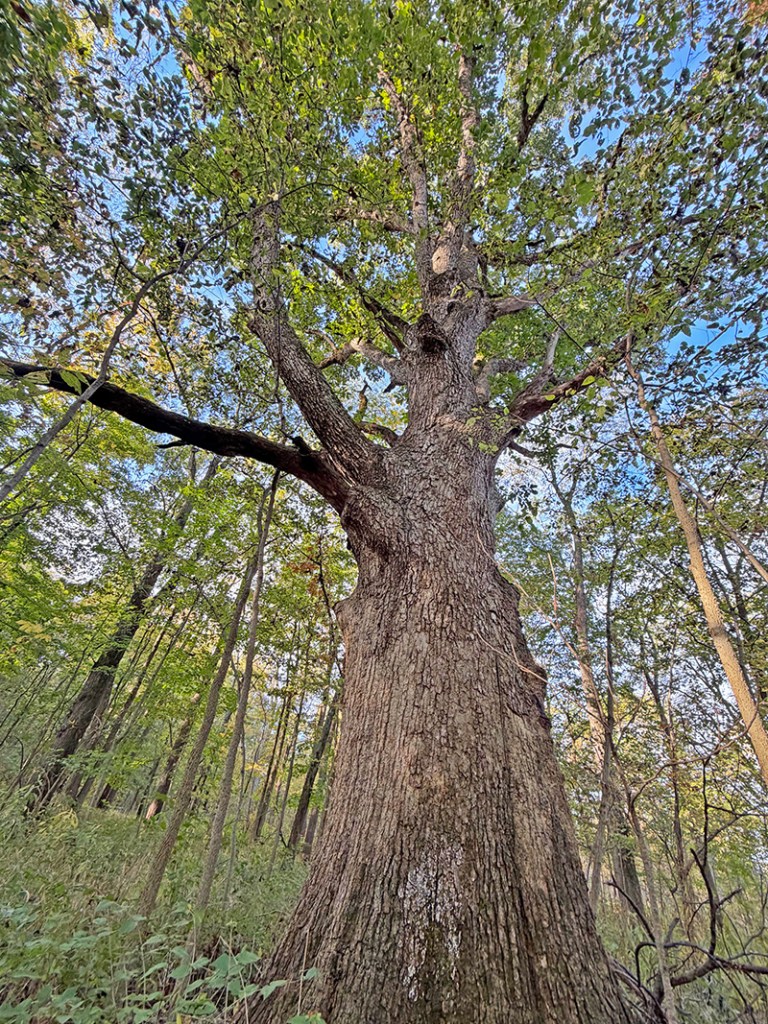
A large oak tree grows in Pony Hollow, the area of the nature preserve that is as Old Growth as it gets here on The Quarry Farm. Pony Hollow is so named because, once upon a time, two ponies named Cookie and Babe pastured here. They seemed to prefer its steep slopes above Cranberry Run and the shelter provided by two established Black Walnuts and that one significant oak.
Last spring I walked the property with Dan Bartlett, a forester with the Ohio Department of Natural Resources and Kevin Edinger, District Conservationist with USDA/NRCS Ohio. Dan was excited to spot a young Chinquapin Oak growing in the upland woods at the intersection of the Wetland Forest and Upland trails. I led the two visitors down into the Hollow to show him the large oak. He told me that the tree is one variety of White Oak—a Chinquapin. As we followed the trails, we spotted more young oaks, all the same species, likely the progeny of the great oak that resides in the Hollow.
When we think of Ohio’s remaining native keystone species, if we do, what comes to mind are big mammals like White-tailed Deer and flashy birds like the Bald Eagle. Those are 2 that are always shouted out when we ask students for examples. But never has there been a shout for plants. And if you’re going to shout, oak trees are a keystone species that deserves significant shouting.
According to research touted by the USDA and U.S. Forest Service, oaks provide numerous ecosystem services that support human well-being: providing shelter, regulating the environment, and enhancing culture and aesthetics. And without a food chain leading up to humans, our well-being would be moot. Oaks play a significant part in that ladder. In a single region, up to 2,300 species—including birds, insects, fungi, lichens, and mammals—are associated with oaks. Doug Tallamy, a leading entymologist and conservationist, states that oaks sustain a complex, year-round web of life, creating habitat and resources for countless species, from caterpillars right on up the food chain. They store significant amounts of carbon, helping mitigate climate change.
Oak trees appeared on this planet about 65 million years ago. Unlike other forms of life they have not gone extinct because their seeds are encased in a hard shell. These seeds and oak leaves are coated with tannic acid, which prevents fungi and insects from harming them. Oak trees can continue to grow and produce acorns for 700 years. One tree can produce about 10 million acorns during its lifetime, even though they don’t begin to produce these seeds until they are at least 50 years old.
Yet oaks are in decline due to the combined stress of climate change, drought, and pests and pathogens. Tallamy writes, “We cannot casually accept the loss of oaks without also accepting the loss of thousands of other plants and animals that depend on them.”
Despite significant deforestation and drainage efforts, white oaks are our best hope for survival in Northwest Ohio. They are ecologically adaptable, historically dominant, and well-suited to the region’s soils and climate. They just need our help. It takes many arms to hug the Mama Oak in Pony Hollow. Even though she and other Chinquapin oaks seem to be standing strong on The Quarry Farm, the Gardener allowed a chinquapin oal seedling to grow in the pollinator garden, deciding it’s ultimately more valuable than the flowers. We planted a little Chinquapin on the farm animal sanctuary this fall. It is surrounded by goat fencing. I stroke its leaves and pray for it to survive because we all need it to.
Carl Sagan, American astronomer and planetary scientist, offered a really good reason for that need, I think. “This oak tree and me, we’re made of the same stuff.”

