Where are You, Woolly Bear?

Have you noticed, as we have on The Quarry Farm, an absence of Woolly Bear caterpillars this fall? Typically, the fuzzy black and brown creatures are a common sight in late summer/early fall, crawling on the warm pavement of our country road. Not so this year. Here’s a brief look at the life of our fuzzy, bristly friend, to know it better and attempt to understand why its scarcity matters.

Woolly Bears are the caterpillar form of several related moth species, including the orange-yellow Isabella Tiger Moth (Pyrrharctis Isabella), which ranges across the U.S, and Southern Canada. The moth typically produces two broods a year. It lives about two weeks, nectaring on a wide variety of flowers. It mates, lays eggs, and dies. The caterpillars we see in the fall are the second brood. They’ve grown fat on leaves such as violets, nettle, sunflower, maple, and elm, and green grasses, and they may have shed five or six times while growing. When the fall brood is ready to pupate, it finds protective winter cover under leaf litter or logs or rocks. During the winter it pupates in a cocoon made from its bristly hairs and emerges as an adult in the spring. The cycle repeats to produce a summer brood.

The second-generation caterpillars that we see in the fall (in a normal year) have eaten their fill, are preparing to hibernate, and are out and about because they’re looking for cover. They are not going to poison us if we pick them up (although they can feel prickly). And sadly, they can’t predict our winter weather—by coloration or by size of the brown band around their middle. Those features are influenced by stage of development, belonging to a particular tiger moth species, and diet. There is no special little weather sensor embedded under the fuzz.

So why are we seeing so few Woolly Bears? First and foremost, no doubt, is the serious decline of many moth species worldwide—for all the reasons that we know too well and are struggling to deal with: climate change, habitat loss, light pollution in populated areas, pesticide and herbicide use. Also, we could look around us recently at a bleached, drought-ridden landscape and see little food for Woolly Bears preparing to hibernate. Their absence matters because, as pollinators and a major food source for birds and other animals, moths are an important link in the food chain that sustains us.

—The Gardener at The Quarry Farm

A long week with not enough time

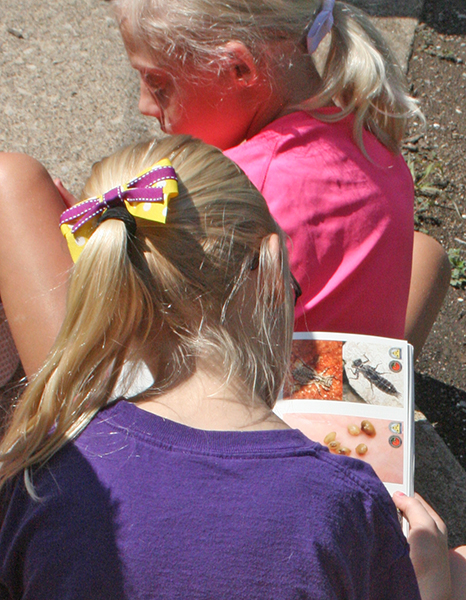
Beginning with an 11 a.m. appointment with a room full of children and a few adults at the main branch in Ottawa, we visited every Putnam County District Library location in the county. In this case, “we” is not a royal “we” but rather two humans, a middle-aged Virginia opossum and a bucket of freshwater macroinvertebrates.

Two weeks ago, we drove an hour east to Honey Creek, a Seneca County tributary to the Sandusky River. Our mission was to collect hellgramites, the impressive predatory aquatic larva of the terrestrial and flighted dobsonfly. By all rights, or if all was right with the world, we should have been able to find them in Cranberry Run as it passes through The Quarry. Underneath all the silt of the stream and Riley Creek into which it flows — even the bigger Blanchard at the end of the Riley — there is a river bottom of cobbles and boulders, prime habitat for hellgrammites. But there’s that silt, smothering everything.

Like I said, we drove to Honey Creek in between heavy rains and flood events and did net a few dobsonfly larva as well as two large dragonfly “babies”: a spidery skimmer and a froglike darner. Here at home, we collected leeches, snails, and half of a freshwater clam shell, its mother-of-pearl lining worn smooth. We set up an aquarium for their stay.

Each weekday morning, Captain John Smith was loaded into a carrier and as many macros as we could fish out of the aquarium were placed in a bucket for transport. No dragonflies made the bucket because, a few days after their arrival in Putnam County, the hellgrammites ate them.

S & J 2BoysIt was a good week. We met new people, the Captain made a favorable impression for his kind, and I got to play with leeches. One young man suggested that leeches are kind of like shape-shifters. I like that. I’m going to remember that for our next gig. Two more suggested that the Captain’s tail looks like corn on the cob. Never though about that before, and they’re right.

Today is Saturday, and we are kind of tired. It seemed like a long week, what with two speaking engagements per day on top of day jobs, slogging buckets and straw through rain and mud here on the farm and in parking lots and nursing one of the potbellies through a mysterious spate of abscesses until his appointment next week at Ohio State University Veterinary Clinic.

IMG_4408But I realized, after finishing Sy Montgomery’s The Good, Good Pig, that two speaking engagements per day for five days wasn’t nearly enough time to point out the importance of Virginia opossums and hellgrammites in our human lives. You need a lifetime of appreciation.

Nor is it enough time to admire the intricate, delicate patterns that trace the exoskeletons, especially across the backs of their heads. One glance in a bucket at the boneless athleticism of a swimming leech is just not enough, not enough for anyone.

We hope it was at least enough to leave everyone wanting to learn more. As Ms. Montgomery noted in her book, maybe a one-off was enough to lead some to a new way of thinking.