Live and Learn

As with nearly every other environmentally-minded organization that I can think of, a big part of The Quarry Farm’s mission is education. We hold teacher workshops here, host programs both in-class and on-site for school groups, conduct tours for civic organizations and offer hands-on, guided workshops in organic gardening, water quality assessment, macroinvertebrate identification and a wide variety of other similar programming.

Yesterday, the shoe was on the other foot.

Representatives of The Quarry Farm attended the annual meeting of the Ohio Odonata Society (http://www.marietta.edu/~odonata/officers.html) in the Buehner Center at Oak Openings Metropark (http://www.metroparkstoledo.com/metro/parksandplaces/index.asp?page_id=510). Highlighting the day’s events were trips to two sites where participants photographed and collected odonates.

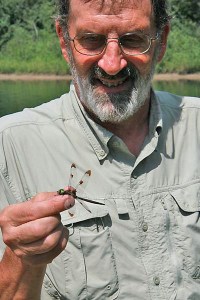
Bob Restifo, secretary-treasurer for the Ohio Odonata Society, examines a Prince Baskettail.

Now I suppose that there are a few of you feeling more than a bit smug right now since you already know what an odonate is. For those of you who don’t have nearly as much spare time as the aforementioned, we’re talking about dragonflies and damselflies. And they were teeming. While we did see more than a few species that we have yet to record here at The Quarry

Cedar Waxwing

Farm, such as the Unicorn Clubtail and the Prince Baskettail, most are common visitors and residents along Cranberry Run, in the eleven-acre back field and on the quarry. Among the more common species were Blue Dashers, Black Saddlebag, Common Whitetail, Widow and Twelve-spots. What wasn’t nearly as common were the sheer numbers of dragonflies, both in the number of different species present and the number of individuals within those species. And with that increase in numbers came a similar increase in the activity of animals that feed on odonates. Bullfrogs leapt from wetlands and cedar waxwings swooped over grasses snatching these aerial predators for their own meals. In fact, at one of the two sites the cedar waxwings clearly used us to improve their chances of catching a quick bite. They stalked us as we walked the verge of a wetland, waiting until we’d disturbed newly hatched dragonflies from their hiding places and then catching them as they flitted up and away.

Bullfrogs leapt from the water to prey on passing odonates.

We’d like to take this opportunity to thank the Ohio Odonata Society for the opportunity to spend a day in such an interesting fashion. We’d also like to single out three men in particular:  providing a great deal of insight and information were Bob Restifo, secretary-treasurer of the OOS, and Bob Glotzhober, member at large and a former president of the society, both of whom have spent decades studying and collecting odonates; we’d also like to thank Dave Betts, without whose input we’d have missed this incredible opportunity.

This slideshow requires JavaScript.

Recipe Share?

Help us combat voracious invasives in the kitchen! Or, as The Quarry Farm’s Board President Laura says, “If you can’t beat ’em, eat ’em” (thinly-disguised, blatant plug for one of the Quarry Farm’s presentations–see WORKSHOPS AND PRESENTATIONS).

I’m asking you to share any and all recipes using invasive flora. For instance, did you know that garlic mustard (Alliaria officinalis) is a year-round salad green?

Check out RECIPES FOR SUSTAINABILITY in the menu bar on The Quarry Farm home page. I’ll post shared recipes to that page as I receive them. Recipes don’t have to be for edibles. Who knows? Maybe your great-great aunt passed down a tried-and-true mosquito-repellent ointment recipe using juniper berries.

The Appalachian Forest Heritage Area offers the downloadable “Garlic Mustard: From Pest to Pesto, a Culinary Guide”. Now if we can just find a good use for Japanese honeysuckle… http://www.afha.us/garlic_mustard/gm_recipes.pdf

Raiding the Pantry, Old School

When I first started reading, after the picture books but before Tolkein and Bradbury and Ellison, I was drawn to stories like The Swiss Family Robinson and My Side of the Mountain. They were tales about people who basically fell off the map, who by accident or design no longer had access to civilization. To me, in great part, civilization meant grocery stores, because, hey, you can always find shelter, build a fire, weave a poncho out of leaves, design a method for extracting potable water from the air. That’s easy, right? But food? Come on, what are you gonna do if you can’t jet down to the local 7-Eleven or Krogers or Piggly Wiggly and grab a loaf of Wonder Bread and a jar of Peter Pan?

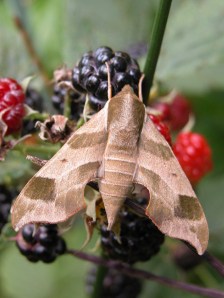
Virginia Creeper Sphinx Moth on black raspberry bramble

As it turns out, you make the whole world your larder. Man, but that grabbed by imagination; that a person could just walk out and pick breakfast, unearth lunch and chase down dinner was about the coolest thing I could think of. I used to hide bananas and bologna sandwiches (safely wrapped in plastic baggies) in our back yard. Then I’d set out in search of food, knowing that if I failed, I’d surely starve. Those were great days and, not surprisingly, given all the melodrama I invested in the whole process, that was some of the best food I ever ate. And now, well, I have the opportunity to do it for real.

So I do.

Right now, the raspberries are starting to come in. It’s early for them. I usually don’t start seriously picking until around the 4th of July. This year, however, they’ve been coming on since the beginning of June. You’ll probably hear me say this a lot this year, but it’s the weather: the mild winter, the rain we had earlier this spring and the hot and dry conditions we have now. Everything’s early. We had red-winged blackbirds on the property in March, blossoms on the blackberry brambles in late April, grasshoppers in the bottom land in mid-May and now, black raspberries.

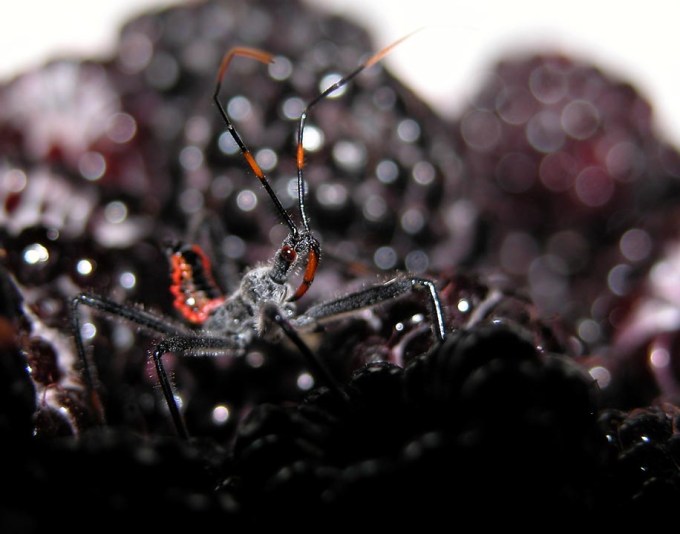
Berry patches are rife with macroinvertebrates. Here, an immature wheel bug perches in a bowl of black raspberries.

Now I get to go and play castaway, claw my way through the wilderness until I’ve gathered enough sustenance to keep me alive for a few more hours. It’s hard and dangerous work, but food is life.

On the other hand, if the berries don’t pan out, there’s always that loaf of Wonder Bread and the jar of Peter Pan.

An Hour On the Quarry

We, here at The Quarry Farm, have the great good fortune of living on a piece of land that provides a host of possibilities. Because of the forward thinking of a few remarkable people (and here I’m going to name names: Carl Seitz, Joyce Seitz, Gerald Coburn and Laura Coburn), we have houses and gardens and driveways and such. But we also have an area that, for the past 40 years at any rate, has had the opportunity to go Nature’s way.

For me, there’s a definite split, a line where domestic ends and wild begins. Here is where we keep the chickens, chase the pig, run the dogs, elude the duck and other happy little domestic activities. There is where the wild things are. Here: yard. There: not yard. It’s a convenient line, too, because it’s visible: a strip of trees that divides here and there. I include the line itself, the trees, in the there category, as part of the wild area of the Quarry Farm. From the tree line on is where Nature looms. That’s where Cranberry Run snakes through the property, where the turkeys make themselves known with gobbles and great splay-footed tracks, where great blue herons heave themselves from the water with complaining voices that Hollywood stole for Jurassic Park, where the occasional coyote howls and the foxes yip and the tree frogs sing and the squirrels, raccoons and skunks argue amongst themselves and with anyone or anything else that happens to grab their attention. It’s loud, it’s messy, it’s chaotic and it is absolutely beautiful. It’s a place I love to go. And today, in a very small way, I’m going to share. I set myself a challenge, gave myself one hour to walk along and across the stream, past the quarry and through the trees to the big field, then loop back along the path, across the stream and home again. In that time and along that walk, I took photographs. Fifty-nine photographs, to be precise. I’m not going to burden you with all of them, but I do want to share a few. And it all started in the tree line.
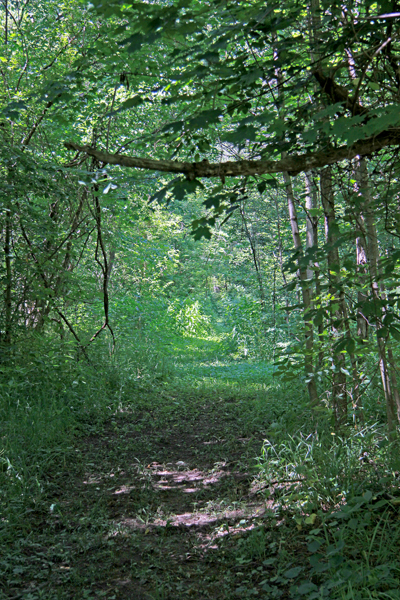
My first photo op fell into the “well, you just don’t see that every day” category. Before passing from here to there, I paused to try and get a shot of a widow skimmer dragonfly. While in the process of completely failing to do that, I heard a rustling in the grass in the treeline. Rabbit, I thought. Then rethought, because I heard a bit of scrabbling as it ran up a tree. Squirrel, then. Nope. I’d heard of groundhogs climbing trees, but that was the first time I’d ever seen it up close and personal. It was a juvenile and had obviously found something tasty (as evidenced by the leaf dangling from the corner of its mouth) that drew it just a little too far from a bolt hole. When it realized that I was coming in its direction, it took the best avenue of escape open to it. Up.

I was pleased to find that the wood duck who had nested on the quarry was still in place along with her brood of four ducklings. They’re skittish birds, quick to run at the first sign of possible trouble. As I came up on them, mother went one way and the four little ones, another. Even so, I caught a quick glimpse of them as they fled across the duck weed. The little ones have grown enough so that they are nearly fully feathered. Their wings whickered as they half-flew, half-ran across the water.
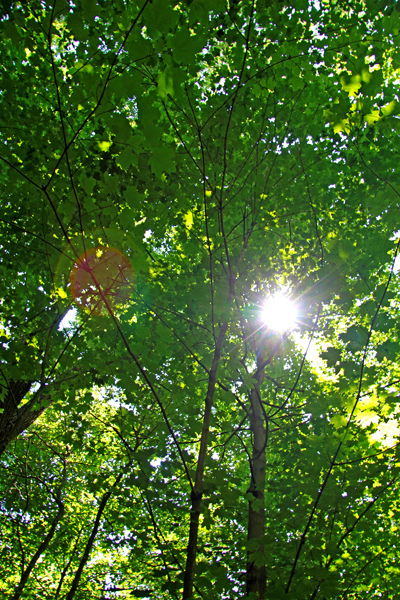
Although it was hot today – temperatures here were pushing 90 degrees – the main trail leading to the big back field was relatively cool. Over the course of the past four decades, the property surrounding the quarry has undergone significant changes. In many places, scrub and thick undergrowth is giving way to hard woods: in most cases, sugar maple trees. Where a relatively short time ago jersey cows grazed, there is now a full-blown second-stage forest. This year in particular, with its mild winter and wet spring, seems to have fostered growth. The trees form a canopy that filters the sun, dappling the ground with shifting patterns of light.

The big back field is nearly as varied in its habitats as the whole of the property. The greatest part of the eleven acres could easily be considered meadow, though there are, spotted here and there, scrub trees and brush. It is surrounded on all four sides by verdant growth: the forest that is the bulk of The Quarry Farm. Black raspberry and blackberry brambles tangle at the edges with wild rose and grape vines reaching out from the woods. On this particular day, a red-tailed hawk spun about the field in ever-widening circles. She screamed as she flew, though I’m not sure why. Maybe calling to a mate or to young offspring in nearby trees, or possibly just announcing her presence.

It’s a source of pride for us that we have such a healthy macroinvertebrate population on the property. This time of year, we see all manner of dragonflies and damselflies.
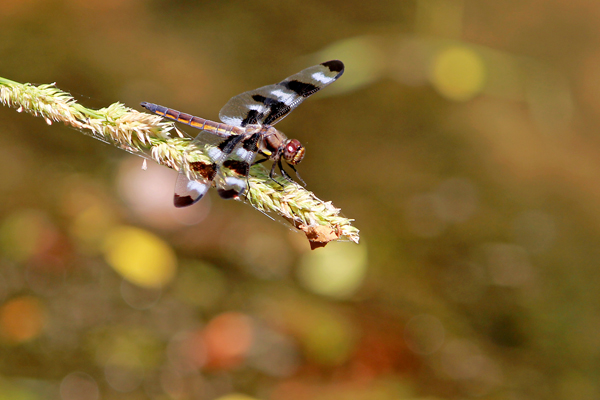
Twelve-spotted skimmer

They swarm up and down the stream, hunting, procreating and laying eggs, and they teem in the back field where there are plenty of prey species for them to feed on. While there are all manner of stories suggesting that dragonflies and damselflies are a nuisance, possibly even life-threatening, they are simply not true.

Bluet damselfly on rose cane

The fact is that these members of the order Odonata are some of the most beneficial insects out there, eating their weight every day in mosquitoes, midges and other annoying insects.

Ebony jewelwing damselfy

I was fascinated by them as a child, though I rarely had the opportunity to see them.

Now, generally beginning in late April, I go for a walk and there they are. When I see them, I can’t help but think of how cartographers, when they were filling in uncharted areas on maps, would write, Here Be Dragons. And they were probably right.

So there it is. One hour on the quarry. But you don’t have to take my word for it. It’s not necessary to limit yourself to two-dimensions. Contact us and make an appointment to see it in 3D. We’re not only happy to show it to you, but, in many ways, doing precisely that is who we are and certainly what we do. Contact us. Please. We’re counting on it.
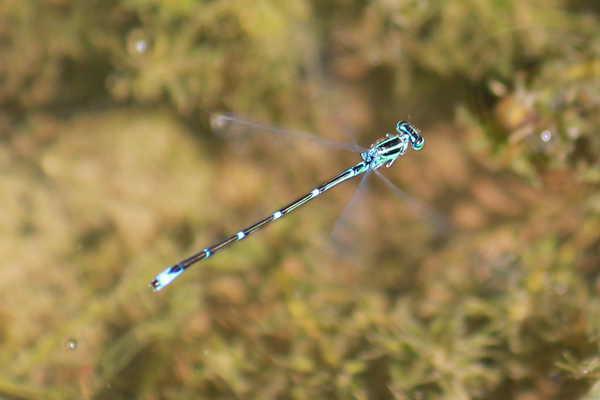
Bluet damselfly hovering over Cranberry Run

 

CAPTION THIS! Winners

We’ve been remiss in announcing the results of The Quarry Farm’s first CAPTION THIS! competition. Truth is, we were torn. So, instead of sacrificing one over another, we decided to have two winners. Without further ado, here are the submissions presented by Joan Hahn and Laura Zitzelberger (and, yes, the entries appear in that order):


Is that Aramis you’re wearing?

I really feel that Kierkegaard was the father of the existentialist movement…don’t you?

Thanks to everyone who played and watch for future opportunities to CAPTION THIS! with The Quarry Farm.

An Eighth Direction

Preparing shelter house pad

The shelter house project at Red Fox Cabin is underway. A crew from Hovest Construction broke ground on Tuesday, clearing and leveling ground between the posts of the compass garden for 24’ x 24’ concrete pad. The crew finished and sealed the pad on Wednesday and cleaned and leveled the work site this morning. By August, this pad should support a 20’ x 20’ shelter house, the site of many future meetings, presentations and gatherings of all sorts on the Quarry Farm.

For anyone helping to raise the shelter house, there will be food. That includes observers.

Dooryard Garden Club at Red Fox Cabin’s zelkova

Members of the Putnam County Dooryard Garden Club visited right after Hovest Construction packed up their Bobcat. The group inspected the new project before touring the cabin, walking the Cranberry Run Trail, and meeting Educational Ambassadors Buddy the miniature donkey and Beatrice the pygmy potbellied pig.


Back up! What is a compass garden?

As the official name states, the Quarry Farm includes a nature preserve and a conservation farm. Red Fox Cabin and the gardens that surround it are part of both designations. One of the original gardens developed by Gerald and Laura Coburn was the compass garden. This garden is engineered according to the European navigational instrument that measures directions in a frame of reference that is stationary relative to the surface of the earth. However, the Red Fox Cabin compass garden was also designed in homage to the Coburn clan’s Native American heritage, primarily with traceable roots to the Cherokee Nation.

The Cherokee honor seven sacred directions to encompass a fully-dimensional world rather than one of singular dimension. In addition to the four singular dimension directions (east, north, west and south), there are: up (above), down (below) and center (which is where you are). Each direction is also associated with a season and a color:

  • NORTH is the keeper of winter, the season of survival and waiting. The North is associated with the color blue and the path of quiet.
  • SOUTH is the keeper of summer, the season of warmth. The South is associated with the color white, representing peace, happiness, and serenity.
  • EAST is the keeper of spring, the re-awakening of Mother Earth after a long sleep. The East is associated with the color red and represents victory, power, and war.
  • WEST is the keeper of autumn, the season of death and where it is hidden. The West is associated with the color black.
  • ABOVE is associated with the color yellow and represents peace.
  • CENTER is associated with the color green and represents the here and now.
  • BELOW is associated with orange/brown which represents the chaos and turmoil of the ever-changing Earth.

Note that I speak of the compass garden in the past tense. Invasive plants overran most of the directional plantings. Recently, the Quarry Farm board decided a permanent structure was needed to shelter visiting groups requiring seated onsite presentations since Red Fox Cabin can only hold a limited number of people at a time. The compass garden ground was deemed the most convenient location for such a shelter. The spot also sits just above the old stone quarry-turned-wetland, offering cool summer breezes and good views of butterflies, migratory birds and native trees.

So maybe some of the visual symbols of the old compass garden are missing, but the fully-directional world of the Quarry Farm is still growing. The house wren that is nesting in the apple gourd even stood her ground next to the construction site. She was back at her post this morning, scolding all visitors from her high tower in the zelkova tree.

Find out more about the Cherokee Nation, past, present and future, folklore and tradition, at
http://www.cherokee.org/Default.aspx.

This slideshow requires JavaScript.

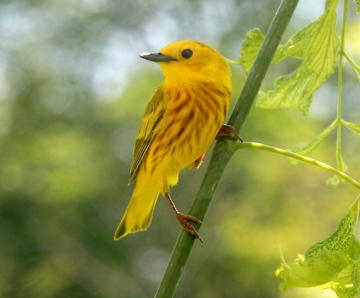
A Bird of an Entirely Different Feather

I spend a good deal of my time looking down. I mean, that’s where the chickens usually are, right? Not to mention my feet, which need more than a little governance. But, head down, I miss a lot. I manage to stay on my feet, which is good, and not step on one of the girls, which is even better, but the wonders of the world frequently pass me by. So I’m amazed that on one of those rare occasions that I do look up, I spot something breathtaking, something beautiful.

According to the University of Michigan Museum of Zoology Diversity Web, yellow warblers are common in North America. Declining numbers have been noted here and there, generally because of land clearance and herbicide and pesticide use. Usually when riparian corridor (a healthy number of trees and plants along a river or stream) is allowed to recover, these beautiful summerbirds make a good comeback. Cranberry Run passes through The Quarry Farm on its way to Riley Creek, with trees, grasses, and blackraspberry brambles to feed warblers. http://animaldiversity.ummz.umich.edu/site/accounts/information/Dendroica_petechia.html

Making Leaves While the Sun Shines

Putting Burdock to Work

For everyone who wonders why there have been colossal burdock plants flourishing in certain yards in the neighborhood, you can rest easy as the plants have been harvested. The giant leaves from these towering weeds* were reserved for today’s “Art in Nature: Make a Lasting Leaf” workshop on the grounds of The Quarry Farm’s Red Fox Cabin here on Road 7L.

Casting in Concrete

NOAA predicted a hot, dry day without much-needed rain but the shade trees off the front porch kept today’s outdoor studio cool enough to cast leaf-molded birdbaths, bowls and stepping stones. But enough talk. Here are some photos of the Class of June 9, 2012.

If you couldn’t make today’s event, look for upcoming workshops posted in “events”, or get on our emailing list by sending a message saying, “Sign me up for the newsletter” or “Put me on the mailing list” or “Hey, you!” to thequarryfarm@gmail.com.

*Although I’m paraphrasing, a favorite quote says something along the lines that one person’s flower is another man’s weed growing where he doesn’t want it.

This slideshow requires JavaScript.

It’s All Give and Take

Trawling for Crumbs

Oftimes chickens giveth breakfast, yet other times they taketh away.

This morning I was out on the front deck encouraging Her Porcine Highness Princess Buttercup Beatrice to come in. I was eating a lovely ciabatta toast smeared with cream cheese and topped with lettuce fresh from the garden. When she came up the steps, I leaned over to pull a fuzz of some sort from her chin.

My mistake.

The Priscillas (all of the original Hubbard Golden Comets here are named Priscilla–another story for another time) had also come up the steps. One of them flew into the air and handily snatched my breakfast from my fingers and ran under the elderberry bush.

Toast Thief on the Run

We love our girls. They are beautiful, happy, insectivorous and give us the best brown eggs. But sometimes a friendly chicken just doesn’t honor that whole personal space thing.

Caption This!

It was suggested to us that a photo in an earlier post was just begging for a caption. It was further suggested that we might offer up another little competition. So, here’s Caption This! Not only do you get the opportunity to win a set of ten Quarry Farm notecards, but I get to put off writing a lengthier piece for yet another day. What say we give it a deadline of Monday, June 11, 2012.