The Answer, a Bit Later Than Intended

Perhaps you recall the quiz that wrapped the January 14 post?

flooded bridgeHere’s a little quiz for you: Your eyes and nose present clues that can help you determine cause and effect. We all know that. When you study the photo above of the flooded foot bridge (click for an enlargement) you can see different kinds of plants, trees, and even water. See the stacked foam along the bridge? What does an accumulation of six inches or more of foam along a water body’s edge indicate?”

Thanks to Daryl Bridenbaugh who pointed out that the answer was not forthcoming the following day as noted in the original post, here’s the rest of the story:

A) Too many toad eggs to count

B) Everyone in the tri-county area did laundry today

C) Something smells fishy!

ANSWER: Both B and C. The foam build up on this particular day was piled up above six inches on the bridge and stream bank and did not break apart easily. It smelled musty…kind of like laundry that been left out on a rainy day. However, there was patchy foam floating in the current.

Some of this foam is caused by naturally occurring dissolved organic compounds. Foam that doesn’t build up very high and that breaks apart easily. This kind of foam sometimes smells fishy.

The day-old-wash stuff may be a different story. It can be a sign of human activity, including detergents and excess nutrients that can increase algae growth, more suspended solids and lower dissolved oxygen for the fish, insects and everything else that makes its living in the aquatic food chain.

Sometimes you don’t need a chemical test kit to get an idea what’s flowing downstream. Just use your eyes, ears and nose. If they tell you something’s fishy (and not in a good way), then it’s time to take a closer look for the source.

For more detailed reading, visit http://www.umaine.edu/WaterResearch/FieldGuide/onthewater.htm.

Another Hour On a Different Day

Seven months ago, I took an hour and wandered through the wild part of The Quarry Farm taking pictures. It was June then and the temperature beneath the green overhang of the woods was pushing 90 degrees. All manner of birds and insects were buzzing, chirping and flitting about and the sky was clear and blue.

Today was a little different.

While there was blue sky to be seen, it was through ragged patches in the cloud cover. There were birds, as well, but they moved about only as needed, making quick trips from the tall grass below our house to the feeders hanging from the cherry tree off our north deck. The temperature was in the middle teens with a wind chill of negative one.

Like I said, different.

Wild TurkeysEven so, there was a lot to see. It all started with Anne exclaiming about turkeys. The Ohio Department of Natural Resource’s Division of Wildlife released about half a dozen near here some ten years ago. Over that decade, they’ve flourished. We’ve seen flocks of more than a dozen moving through the brush below our house and on the other side of Cranberry Run. Today, there were four of them as close to the house as I’ve seen them. In all likelihood, they were eating the seed that had fallen from the feeders.

LollyLolly, an American Bulldog mix that we adopted from the Allen County Humane Society shortly before Christmas, joined me on the trek, ranging ahead of me, then back, sniffing at everything and exploring every nook and crannyTurkey's Demise that caught her eye. To the east of the quarry, she brought to my attention a former member of the flock of turkeys that had passed through our yard earlier in the day. It had been there for some time and there was no sign of the cause of its fate. There are any number of predators that could have killed the bird: foxes, hawks, eagles, raccoons, the occasional coyote or dog and, of course, us. Humans.

Trees in WinterThe trees that are filling in the wooded area of the property are mostly sugar maples, though there are plenty of honey locusts, walnuts, sycamores and buckeyes, as well. In the summer, their leaves shade the ground below and, at least psychologically, provide some relief from the heat. In the winter, their branches scrape at the sky, catch at the clouds and capture a weak winter sun. The visuals are stark, these dark branches against the fleeting gaps of blue where the clouds are torn apart by the wind. It’s clear why winter trees, stripped of their softening leaves, are often described as skeletal. Even so, it’s beautiful, this contrast of dark on light, darkest brown on blue.

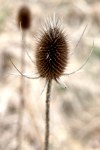
The big back field, over eleven acres of grass grown rampant and thorny brush, is brownTeasel and dry and bitterly cold. There are constant rustlings in the dead undergrowth: possibly the wanderings of mice, voles or field rats. More likely, though, these sounds are the scraping of dried plant against dried plant, pushed together by the wind. Most common in this field of brown are the spiky heads of teasel. They rise up above the dead grass in clusters of two or five or seven or more.
I’ve managed to photograph quite a bit, though possibly more interesting are the things that I’ve failed to capture. Like the pair of bald eagles that rose up out of the southern part of The Quarry Farm and looped over my head while I stood in the back field, hand in pockets against the cold, camera in its bag. By the time I got it out, the camera, they had soared the better part of a mile away to the east. Or the four white-tailed deer that Lolly scared up. All I saw of them were their flashing tails as they bounded leisurely away from Lolly’s spirited chase.
The CabinBy the time all of this has happened, the wind has found both Lolly and me. My hands and face are numb and slow to respond. Even Lolly’s had enough, leading me back to the path that will take us back to the house. I would say “home”, but we are already there. Even here, in the cold.

After all, every bit of it, every twig and branch and frozen patch of ground, is The Quarry Farm.

Buddy and Jeff

What’s Your Sign?

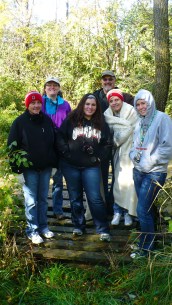
Group in Field

Alicia and Andrew Phillips review a winter star chart before leaving Red Fox Cabin for the trails.

Alicia and Andrew Phillips review a winter star chart before leaving Red Fox Cabin for the trails.

Astronomers have posited that if you were to count each and every grain of sand on all of the world’s beaches, you still wouldn’t come close to the number of stars in the sky. As a matter of fact, it’s suggested that you’d have to multiply that number by ten before you’d even come close. So it should come as no surprise, then, that the human imagination has configured the stars into any number of shapes over the thousands of years that we’ve been staring skyward. This past Saturday night, a group of participants in The Quarry Farm’s first Star Walk had the opportunity to view a few of these constellations.

It was nearly a perfect night for such an event. Although cloud cover had made star-gazing next to impossible for most of the week, a cold front moved in late Saturday afternoon and swept the sky clear. And while still chilly, the woods that surround the big back field provided a windbreak and pulled the teeth of the worst of the cold. While the wind howled outside the preserve, some stargazers even removed an outer layer.

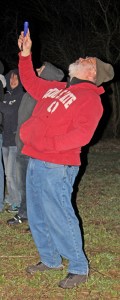
Mike Erchenbrecher looks to the stars

Mike Erchenbrecher looks to the stars

Mike Erchenbrecher, an award-winning retired Franklin County science teacher and avid amateur astronomist, escorted more than a dozen people through the woods and back to the big eleven-acre field where we all turned our faces up. Mike immediately pointed out the Hunter’s two dogs, Canis Major, the big dog, and Procyon, the little dog, and then the Hunter himself, Orion, with his belt of three stars. His finger traced a giant W as he talked about Cassiopeia, the Queen, who is forever chased by Cepheus, the King. And then, of course, there were the zodiacal constellations. At this time of year, the most readily recognizable of such is Gemini, with its two bright stars, Castor and Pollux. Taurus is also recognizable, as well as Cancer.

Some closeups of what we saw:

  • The constellation Cygnus the Swan, which contains Cygnus X-1, the first object identified as a probable black hole
  • jupmoon4Jupiter and its moons*…we could make out a moon on either side of bright Jupiter overhead.
  • Orion NebulaThe Orion Nebula** below Orion’s Belt appeared to us as a hazy spot.
  • Core of Andromeda GalaxyOur Milky Way was outshown by the half moon, but the Andromeda galaxy** was visible to the north.


Mike handed out star charts and independent-study over hot chocolate and cookies. Here are satellite passes for the next few days:

International Space Station

Brightness                 Start                 Highest point                 End                 Pass type
                [Mag]                 Time                 Alt.                 Az.                 Time                 Alt.                 Az.                 Time                 Alt.                 Az.
20 Jan -0.8 06:11:53 13° N 06:11:53 13° N 06:13:03 10° NNE Visible
21 Jan -0.9 06:56:32 10° NNW 06:58:23 14° N 07:00:13 10° NE Visible
22 Jan -0.8 06:08:04 13° N 06:08:04 13° N 06:09:28 10° NNE Visible
23 Jan -1.2 06:52:31 11° NNW 06:54:49 18° NNE 06:57:12 10° ENE Visible
24 Jan -0.9 06:04:09 15° N 06:04:14 15° N 06:06:16 10° NE Visible
25 Jan -1.8 06:48:34 13° NNW 06:51:01 29° NNE 06:53:57 10° E Visible
26 Jan -1.4 06:00:13 21° NNE 06:00:27 21° NNE 06:03:04 10° ENE Visible
27 Jan 0.1 05:11:53 11° NE 05:11:53 11° NE 05:12:04 10° ENE Visible
27 Jan -3.0 06:44:40 18° NW 06:46:56 62° NNE 06:50:11 10° ESE Visible
28 Jan -2.2 05:56:22 37° NNE 05:56:25 37° NNE 05:59:30 10° E Visible
29 Jan 0.0 05:08:06 13° ENE 05:08:06 13° ENE 05:08:37 10° E Visible
29 Jan -3.0 06:40:53 24° WNW 06:42:33 50° SW 06:45:44 10° SE Visible

Iridium Flares
OK, so what’s an iridium flare? Iridium flares are relatively new ultra bright objects in the sky, produced by the glancing reflection of the sun’s rays off a particular type of satellite–the Iridium satellite. Because the main mission antenna are pointing towards Earth, at predictable points in their orbit, they pickup the sun’s glare and direct it towards the Earth, producing the “flash”. Because they flash so quickly, here are the dates and times to look fast:

Time                     Brightness                     Altitude                     Azimuth                 Satellite                 Distance to flare centre                 Brightness at flare centre                 Sun altitude
Jan 22, 18:18:55 -0.5 31° 198° (SSW) Iridium 46 33 km (W) -7.0 -7°
Jan 23, 18:12:57 -2.6 31° 200° (SSW) Iridium 49 17 km (W) -6.9 -6°
Jan 23, 19:48:44 -0.9 34° 155° (SSE) Iridium 58 34 km (W) -7.6 -24°
Jan 24, 19:42:42 -3.7 35° 156° (SSE) Iridium 55 14 km (W) -7.6 -22°
Jan 25, 19:36:36 -0.1 34° 155° (SSE) Iridium 31 40 km (E) -7.6 -21°

For these and other updates realted to satellites (natural and human-made): http://www.heavens-above.com/?lat=40.94806&lng=-83.96111&loc=Pandora&alt=227&tz=EST

To find out where the International Space Station is in relation to you, enroll at http://spotthestation.nasa.gov/ to get alerts for your specific area

Find yourself looking at the night sky with your cell phone in hand? Use to “GoogleSky” to help you navigate the view.

* Michael Stegina/Adam Block/NOAO/AURA/NSF

** Satellite images taken by the Advanced Camera for Surveys (ACS) aboard NASA/ESA Hubble Space Telescope

No Point In Mopping

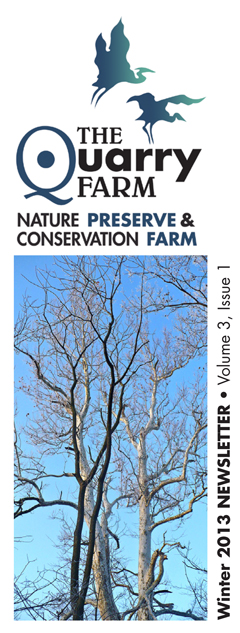
Winter 2013 TQF CoverThe word of the day is WET. The Quarry Farm, indeed all of Putnam County, went from snow and blue skies to green grass, brown fields, swollen and fast-moving streams and gray skies in 48 hours.

Saturday’s 60-degree temperatures saw the flock–all ten Priscillas, Barbara, Big Girl and Karen–out of the hen-house. As I cleaned their digs, as well as the goose buildings, the girls murmured their pleasure at being out to scratch in the grass and in their tunnels under the forsythia, elderberry and tamarisk. I swear they even purred.

Buddy brayed a few times, bringing me on the run to see what concerned our good guard donkey. Twice it was to let me know that Beatrice was thinking about visiting the neighbors. The third I found out later was because a pair of bald eagles had led a Gilboa couple from the Blanchard down the Riley Creek river valley to The Quarry Farm and the banks of Cranberry Run.

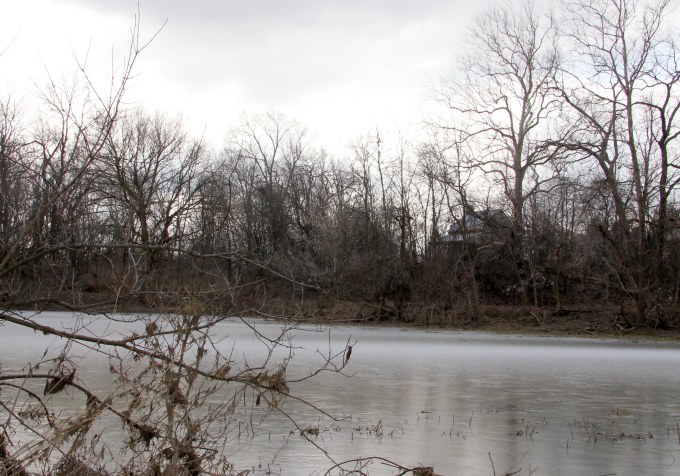
October BridgeLast night’s and today’s rains have laid low the eagles as well as the hens. The geese enjoyed splashing in the puddles, but the girls preferred to scratch through the fresh straw of the hen-house. Buddy stuck his head out a couple of times, but he and the goats mostly stayed high and dry. Not so for anything in the floodplain. Compare the photo taken during the fall photo shoot and sketch walk (right) to the one taken today of the same foot bridge and you’ll see that Cranberry Run has some receding to do from the rainfall, snowmelt and torrential runoff from surrounding fields. But if you scroll back to the January 1 post you’ll see how quickly the scenery changes here.

Here’s a little quiz for you: Your eyes and nose present clues that can help you determine cause and effect. We all know that. When you study the photo above of the flooded foot bridge (click for an enlargement) you can see different kinds of plants, trees, and even water. See the stacked foam along the bridge? What does an accumulation of six inches or more of foam along a water body’s edge indicate? Check back tomorrow for the answer.

flooded bridge

No doubt we’ll have clear skies and firm ground by January 19. Click on the cover of our current newsletter (upper left) to download the complete issue. You’ll find announcements for two upcoming events including this weekend’s first Stargazing Walk. Hope to have a good gathering for this new event. Mike Erchenbrecher is a dynamic speaker and educator. He’s one of those people who can draw you into a subject with his infectious love for all things earth science. Top that off with hot chocolate and a warm campfire and you couldn’t find a better way to spend your winter Saturday evening. Owl calling and counting is optional.

Since The Quarry Farm trails aren’t open to the public without appointment, at least until the boardwalks are in and the permanent trail markers are up, we ask that you call or email ahead. Plus we need to know how many lanterns to have on hand to light the way.

A New Year’s Celebration

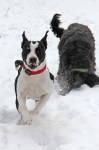
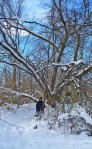
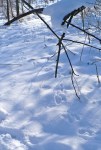
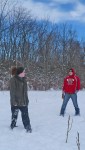
Lolly 3Although we didn’t celebrate a white Christmas on The Quarry Farm, when the snow finally did come, it failed to disappoint. In the last week we’ve received the better part of eight inches and it has transformed the area into a winter scene that would make even Currier & Ives jealous. For Lolly, a recent addition to the farm made possible by the good people at The Humane Society of Allen County, it was also her introduction to the wild part of The Quarry Farm.

We could try to paint a picture for you with words, talk about the stark contrast of the trees against the snow, the blue of the sky, Lolly’s exuberance as she bounded across the back field, but I’d inevitably fall short. So I’ll not even try. Instead, we’ll let the pictures speak for themselves.

Happy New Year, everybody.