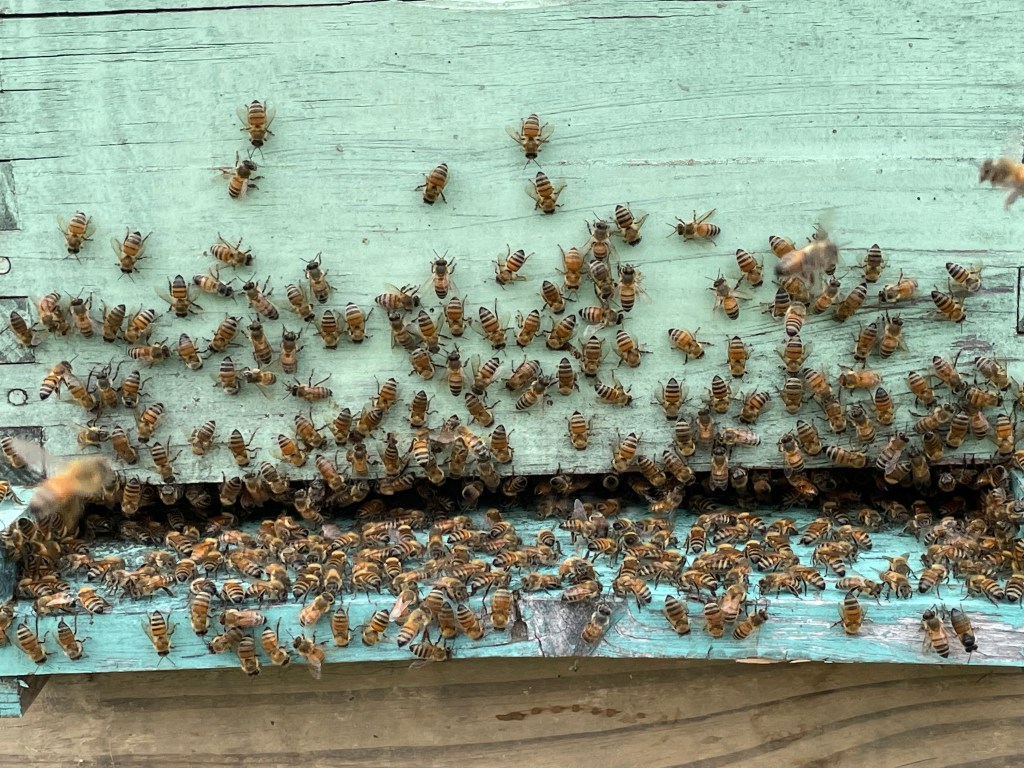
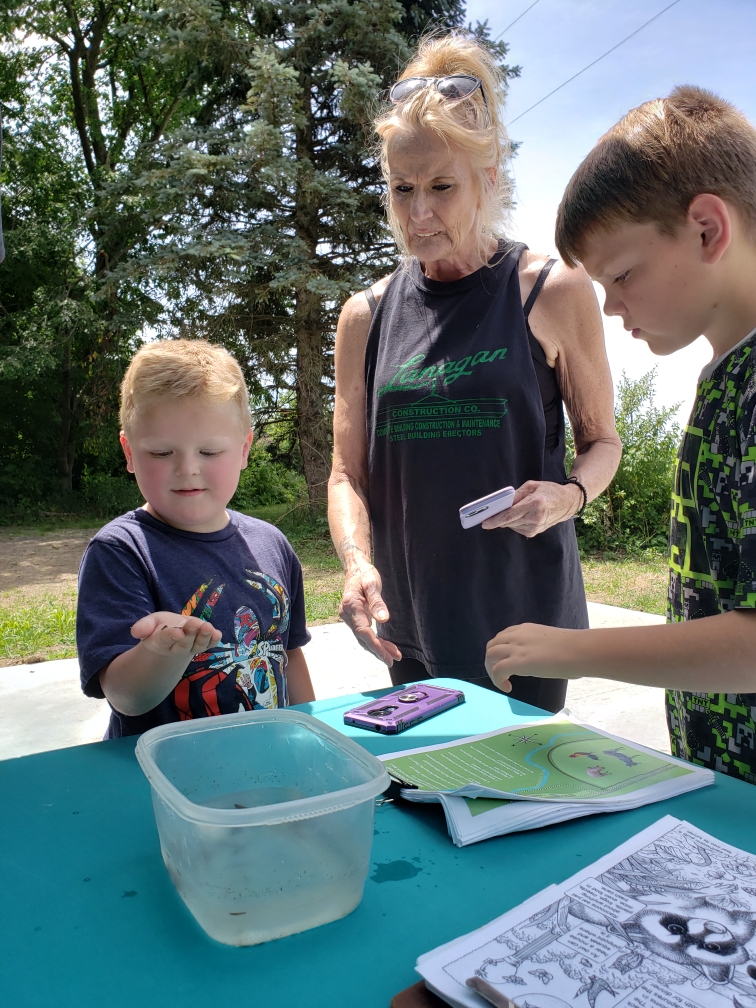
Today was Spring Family Day on The Quarry Farm. At 1 p.m., the temperature was in the 90s, sending a puddle of honeybees up the side of the north hive to cool…maybe. We are very, very new to beekeeping so I don’t know why they are washboarding backwards and forwards above the hive entrance. But I did learn this week that this inch-by-inch dance is called ”washboarding” and I would do it to cool off outside my hive if I were a honeybee.
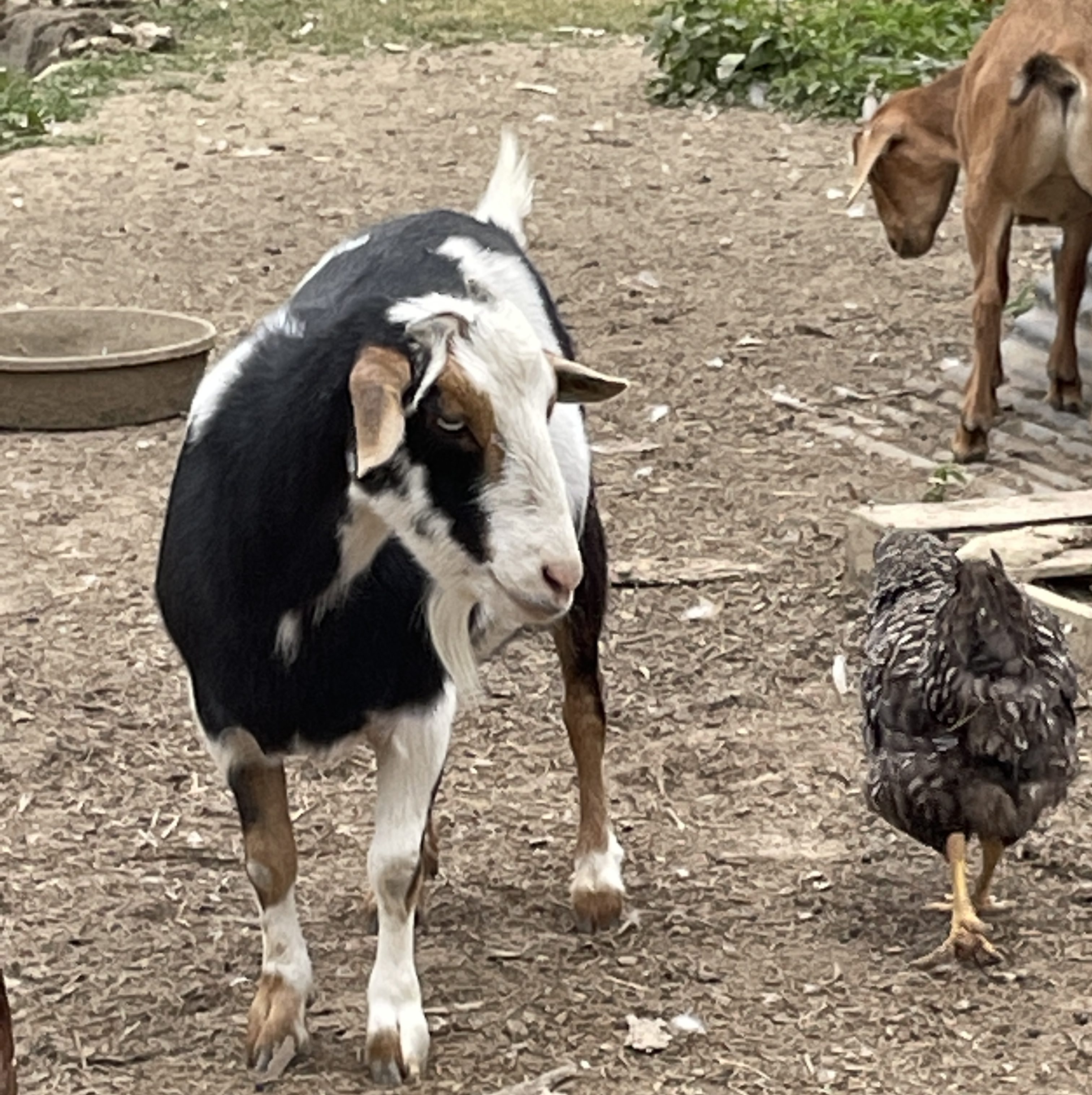
So a little before 1 p.m. the first family arrived. The Rita the Greeter’s table and umbrella was up, ice water and cookies were in the pavilion and “staff” appeared as coolly collected as anyone could be during a Midwest heatwave. Dragonflies swanned in and out of blooming Lizard’s Tongue on the quarry wetland. Pearly Crescent Butterflies flickered orange under Buckeye tree leaves. Nemo cooled in her mud bath and Beatrice emerged from her own spa to visit with her piggy admirers.
“It’s all so peaceful,” someone said.
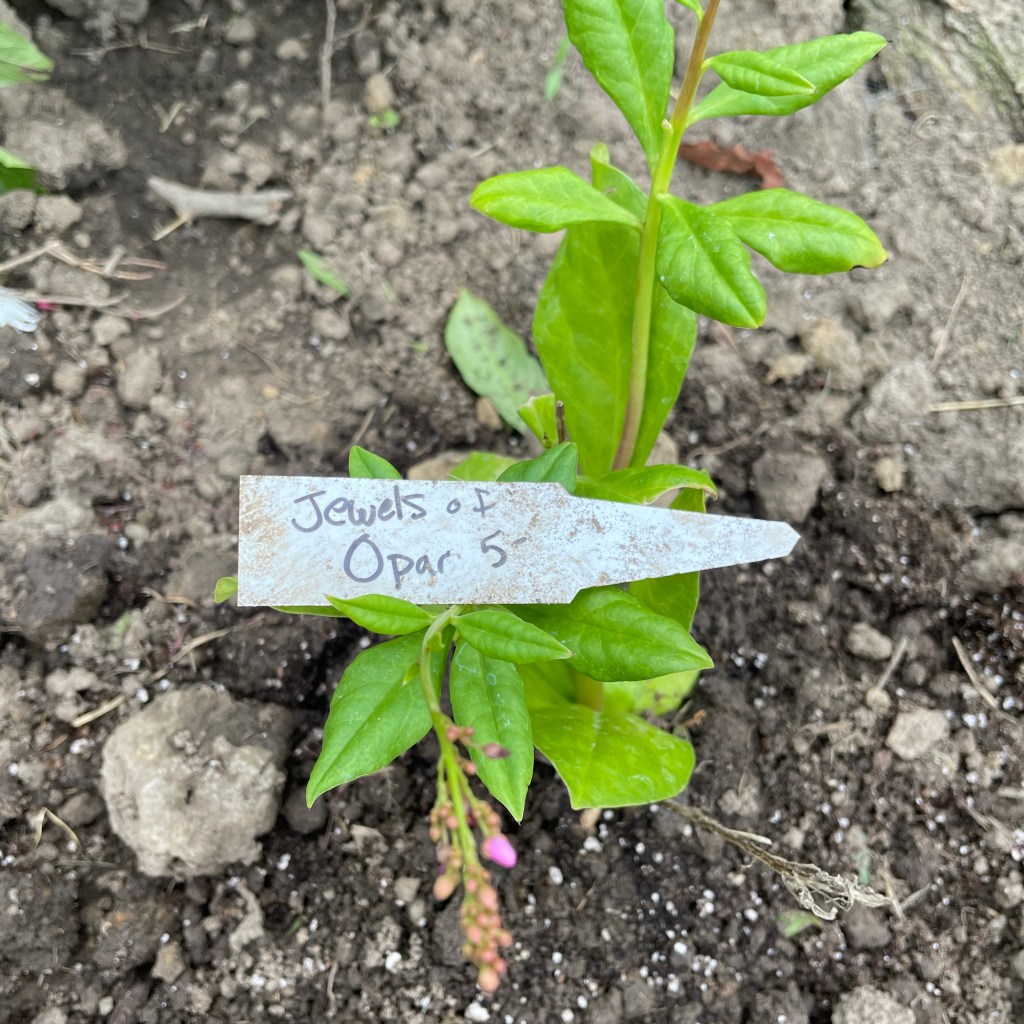
I smiled, making a mental note to take my new plants out of the truck as soon as possible. At 6 a.m. this morning, My Steven saw the donkeys at the front door, Nemo lounging in the flowering herb bed and several goats munching away at the blossoms. I forgot to latch the lower chain on the south gate last night. While Steve sold his bread at the Bluffton Farmer’s Market, I bought new herbs from Ann Boyd’s My Own Backyard.
Over the years we’ve written in this space about the long-term focus on pollinators at The Quarry Farm and ways our related gardening practices have evolved. We’ve talked about selecting butterfly-friendly plants for our garden at Red Fox Cabin and beyond. We’ve talked about conditions that butterflies, bees, bats and hummingbirds need to survive or that threaten their existence, and we’ve shared photos of some of the beauties that have graced our garden.
Our concern for pollinators really began during the 1990s when Gerald Coburn began photographing and studying the butterflies on The Quarry Farm. As his inventory grew (eventually to around 55), we learned about preferred host and food plants and began choosing plants accordingly. Our plantings of popular annuals and “Perennials of the Year” transitioned to mixed beds of plants and flowers known to support butterflies, bees and hummingbirds. We planted pollinator-friendly native grasses like Indian Grass and Big Bluestem. We put up bee blocks where native bees could lay their eggs. When we learned of the deadly impact of pesticides on butterflies and bees, we stopped using Sevin in our large vegetable garden at the time and became organic gardeners.
Click to download
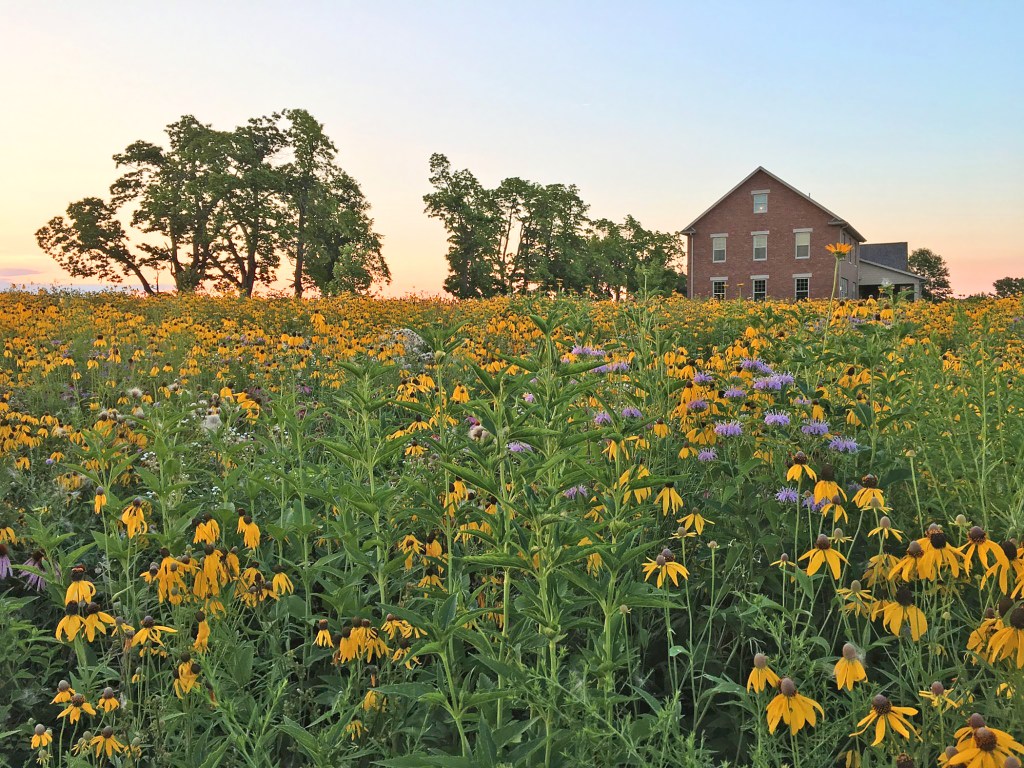
As reported in previous issues, an exciting new chapter in our history of gardening for pollinators opened five years ago when, as an educational project, the Putnam County Master Gardeners designed and planted a pollinator habitat garden next to Red Fox Cabin. The dedication and hard work of the Master Gardeners have made the site a model in miniature of what a pollinator habitat garden should be—not rigidly structured, mulched and manicured, but purposefully planned, nevertheless. It’s become a diverse riot of plants that offer food and shelter for a stopover or home for an entire life cycle. It’s fenced in and has a handsome gated entrance, decorative hardscaping and informative signage.
Before the Master Gardeners turned the first shovelful, they studied pollinator issues—who the pollinators are, their vital ecological importance, the features of a pollinator habitat, and devastating environmental challenges to survival, including pesticide use and habitat loss. Because land is increasingly polluted, paved over, robbed of diversity, and otherwise made unsupportive, the distances between food and rest sources may be too great for long-distance migrators—for instance, bats and Monarchs—to survive their journeys.
Some concerned environmentalists have proposed creating pollinator corridors to support migratory pollinators throughout their journeys. The idea is for people living along migratory routes to make a concerted effort to offer habitats with food, water and shelter—even if they’re only a few square feet of garden space—at intervals necessary for life-saving stopovers.
An intriguing “what if?” is this: what if people living along interstates, highways, or even country roads like the one that runs past The Quarry Farm were to join in common cause to learn about pollinator issues and then plant habitat gardens, uncontaminated, big or small, along their “corridors.” Several residents on our country road have already established pollinator gardens and larger habitats. What might happen if we organized, gave our cause a name and spread the word?
—The Gardener at Red Fox Cabin
Herman Pollinator Habitat, Road 7L and Road O, Riley Township
About 20 years ago, I planted a ground cover that was all the rage at the time. I decided that glossy, dark-green euonymus fortunei, a native of Asia, would be ideal to fill in prettily around shrubs and to block weeds. As years went by, a patch in Red Fox Garden succumbed to scale, and the euonymus at my house had a rude habit of climbing up the garage siding and suckering in until pulled down. However, its dense cover did block weeds, and I liked the look of it.
Download the Fall 2021 Newsletter
So, I was not prepared when Cousin David, who has spent years clearing invasive shrubs and vines from the Quarry Farm nature preserve, reported an unfamiliar branching vine climbing in a cluster of trees deep in the woods, well beyond my house and garden. It was neither poison ivy nor wild grape vine, and its leaves looked a little like myrtle, only larger. I made a discomfiting discovery: The invader was euonymus fortunei, my pretty ground cover gone rogue. Looking it up on the internet, I was shocked to learn that euonymus is now generally considered an invasive species, a landscaping no-no.
Horticultural websites discuss the aggressive nature of euonymus fortunei. One example is this from North Carolina State University Extension: “Some cultivars may be more of a vine and others more of a small shrub, but the vining cultivars and some shrubs can both be invasive… Climbing euonymus readily escapes into native forests and has no trouble dominating medium-sized trees. [It] is listed as invasive in North Carolina and in other states of the southeast and northeast. When used as ground cover for the showy leaves, it tends to climb if given support. . . .When this vine climbs trees it produces aerial rootlets along its branches. [Its small white berries] are eaten by some birds which is how the plant is spread and often how it becomes more invasive.” This is surely how euonymus flew from my garden into the woods of the preserve.
My experience with euonymus fortunei has been another hard lesson learned about plant selection over the years. When perusing catalogs and nurseries, I should try harder to temper my feverish impulses with some cautionary reminders: Choose natives to the area, more likely to settle companionably into the landscape. Don’t make impulsive purchases based solely on glowing descriptions, especially if a plant is an introduction, sometimes even a “new, improved” cultivar. Know soil (sand, loam, and/or clay), moisture and light preferences. Know how a plant propagates and spreads, so it can be contained if it sends out runners or produces thousands of seeds per plant. In general, know how it interacts with other plants and wildlife.
Better knowledge about such issues might have prevented invasions of bush honeysuckle and multiflora rose, and too many others, which were thought decades ago to have beneficial uses as wildlife food and cover and as living fencing, but became scourges to field and forest, including The Quarry Farm.
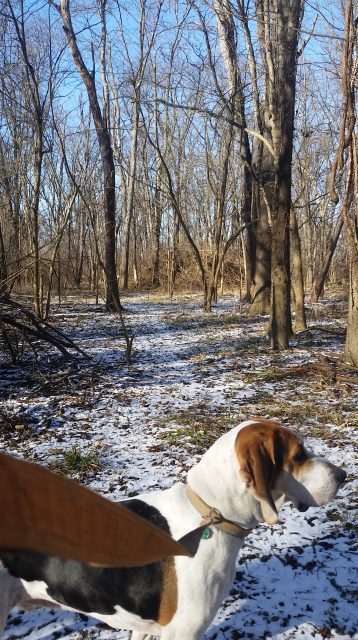
I asked Fergus—floppy-eared Muppet dog, as Steve calls him—if he wanted to go for a walk this afternoon. He treated the question with great suspicion. He rolled his eyes and curled more tightly into the kennel under the stairs, one with a broken latch that seems to be considered a safe cave for cats, dogs and fox, probably because the door is always open. It was Ferg’s nap space today and the leash in my hand probably said “trip to the vet” instead of fun.
I didn’t realize that Fergus had never been for a walk on the trails. He is one of those dogs with twitchy legs that, if given the opportunity, will run and run on the trail of scent and excitement until he stops…and has no idea where he is. When he does make a trip outside the gate, it usually is for a medical reason. So it took some coaxing to get him to the gate today. There was slight hesitation outside the gate, then he found his feet and nearly took me off mine.
We skied the snowy hill down to Cranberry Run. Then there were three bridges to conquer. Fergus’ legs shook as he stepped over the slats, just like most people do. He paused halfway and watched the water flow below. But adventure in the form of a running fox squirrel were incentive enough cross to the opposite bank. Coburn’s Bottom Trail led us to David’s Turtle Pile of bush honeysuckle brush where a deer and a flock of turkeys flushed and melted back into the trees.
We followed turkey tracks up the hill past Sycamore Point and saw the deer and turkeys in the upland grasses. Then they spotted us and disappeared into the snow, sunlight and stands of black walnut, sugar maples, and honey locusts. A white-breasted nuthatch gave us a good piece of its mind, but we never heard the deer or the turkeys again. I’m sure they knew exactly where we were, and kept themselves hidden an hour later when my mom hiked the same trails to enjoy this Day-After-Christmas snow before it melts away with a new work week.
Later, Fergus curled up in his bed and snored softly. I thought my arms were tired from keeping him in check. Turns out that it is exhausting for a hound dog to pull his human up and down hill, through woodland, grassland and back again.
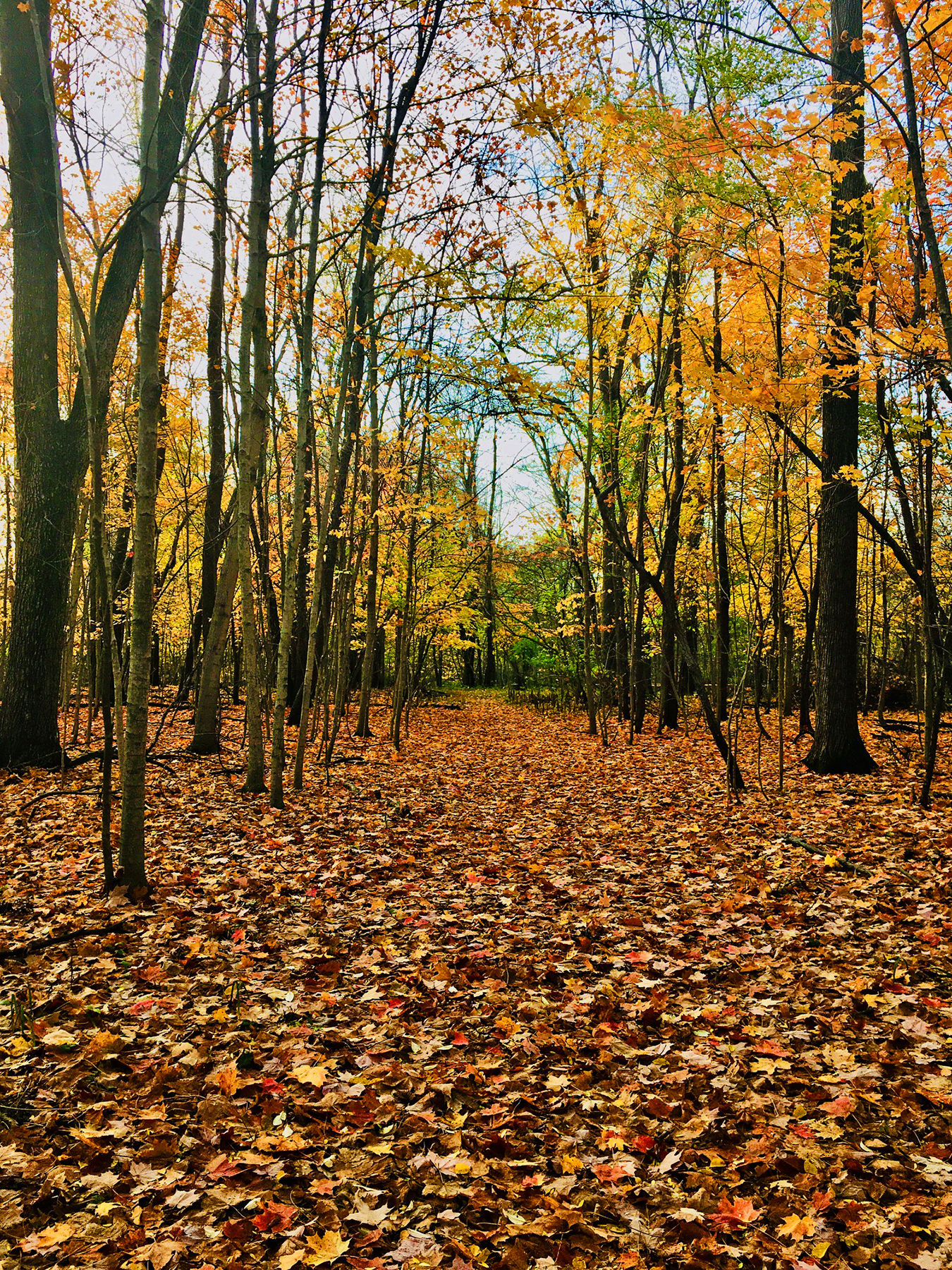
For a warm minute, Northwest Ohioans were treated to spectacular fall color, said to be a result of a wet spring and dry fall. A droughty spring can cause tree branches to seal themselves off from new leaves. They’ll drop before they’ve had a chance to develop an autumn foliate aurora.
The minute has all but passed. The ghost of toilet-paper streamers haunt leafless branches. Who is going to chuck those golden streamers over the tallest tree after waiting in line to buy even the roughest roll of sandpaper not six months ago?
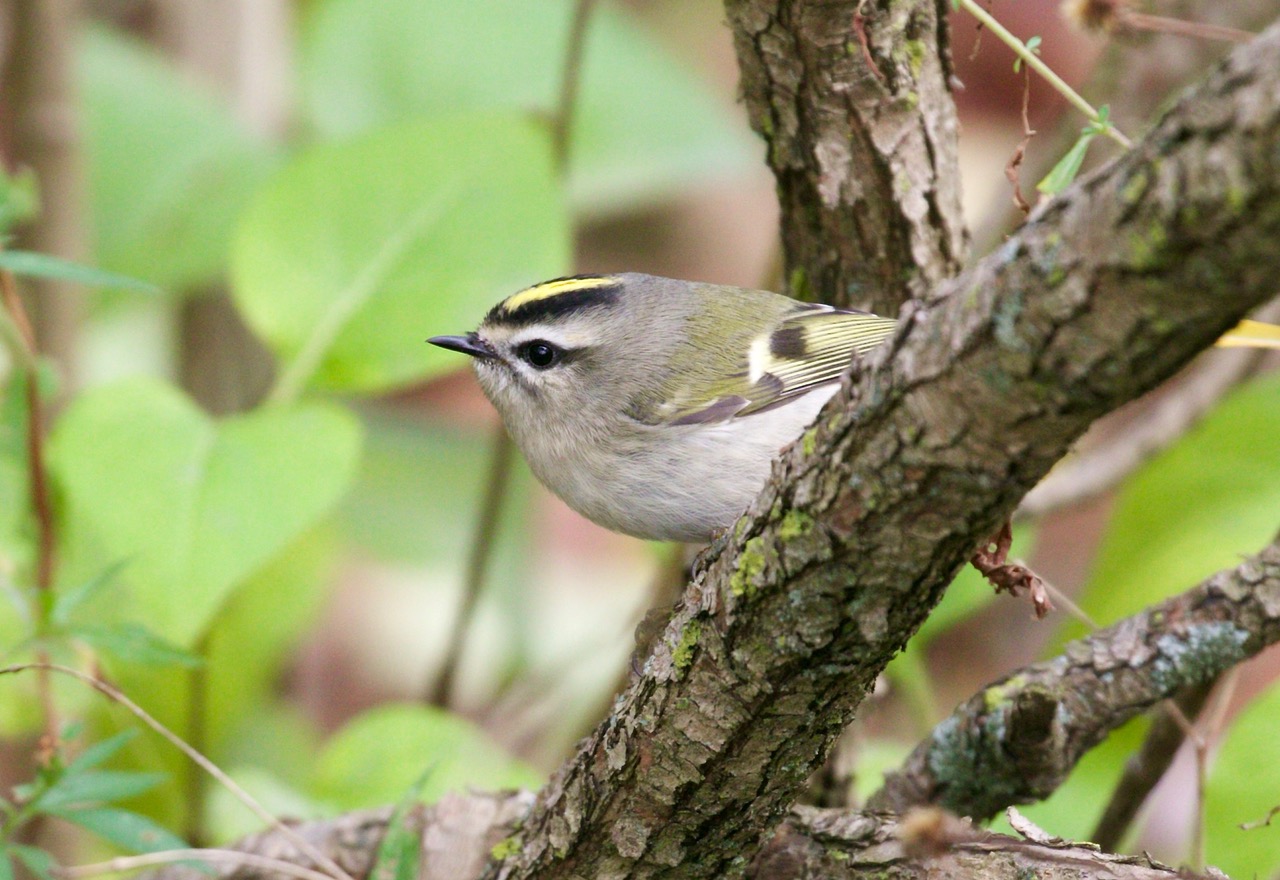
GoldenCrownedKinglet
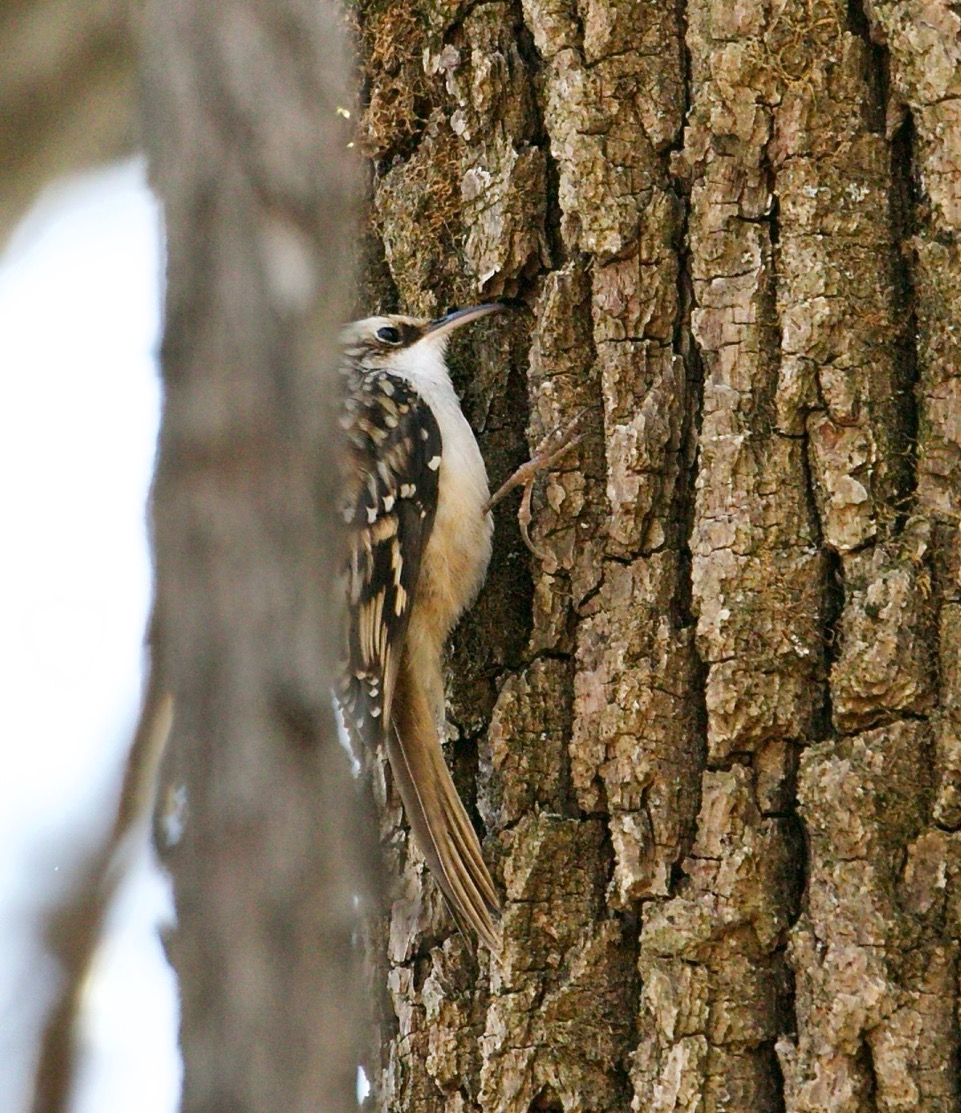
Brown Creeper
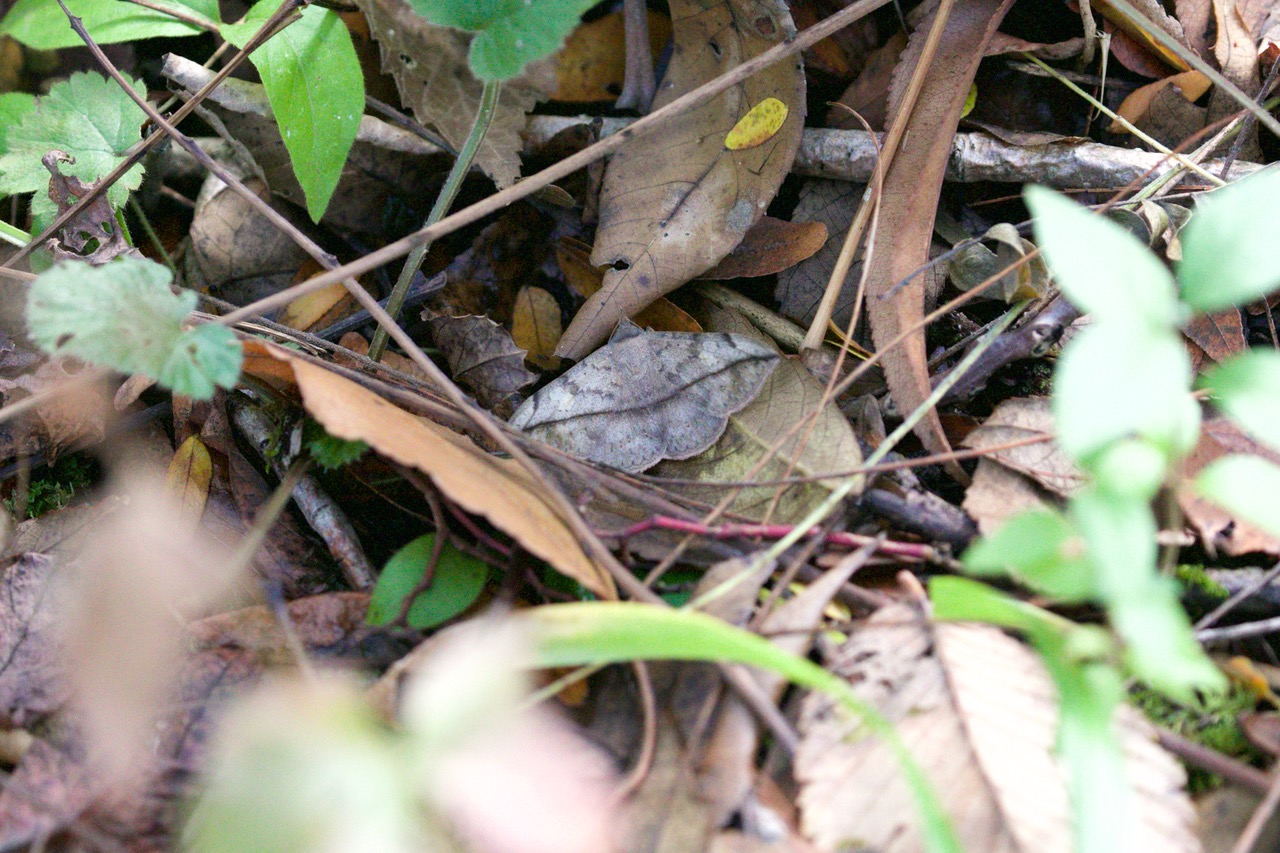
Moth in Leaves
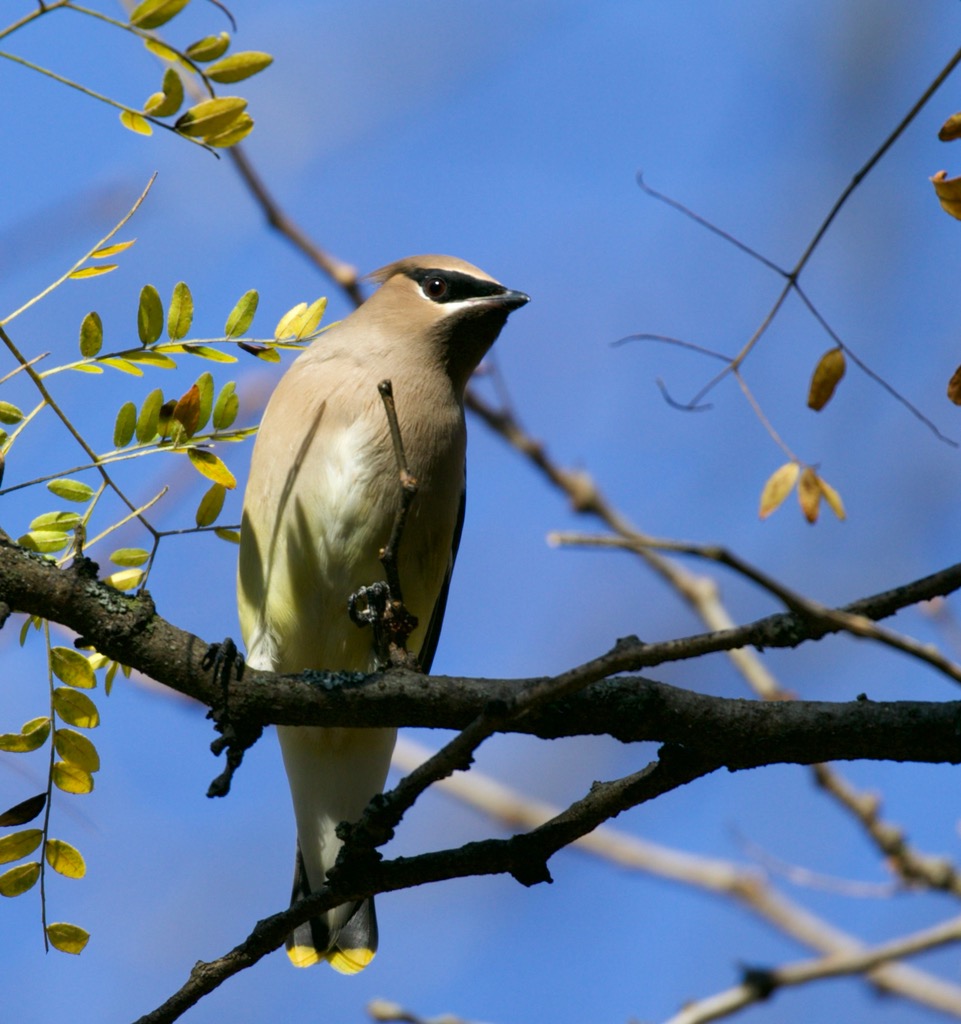
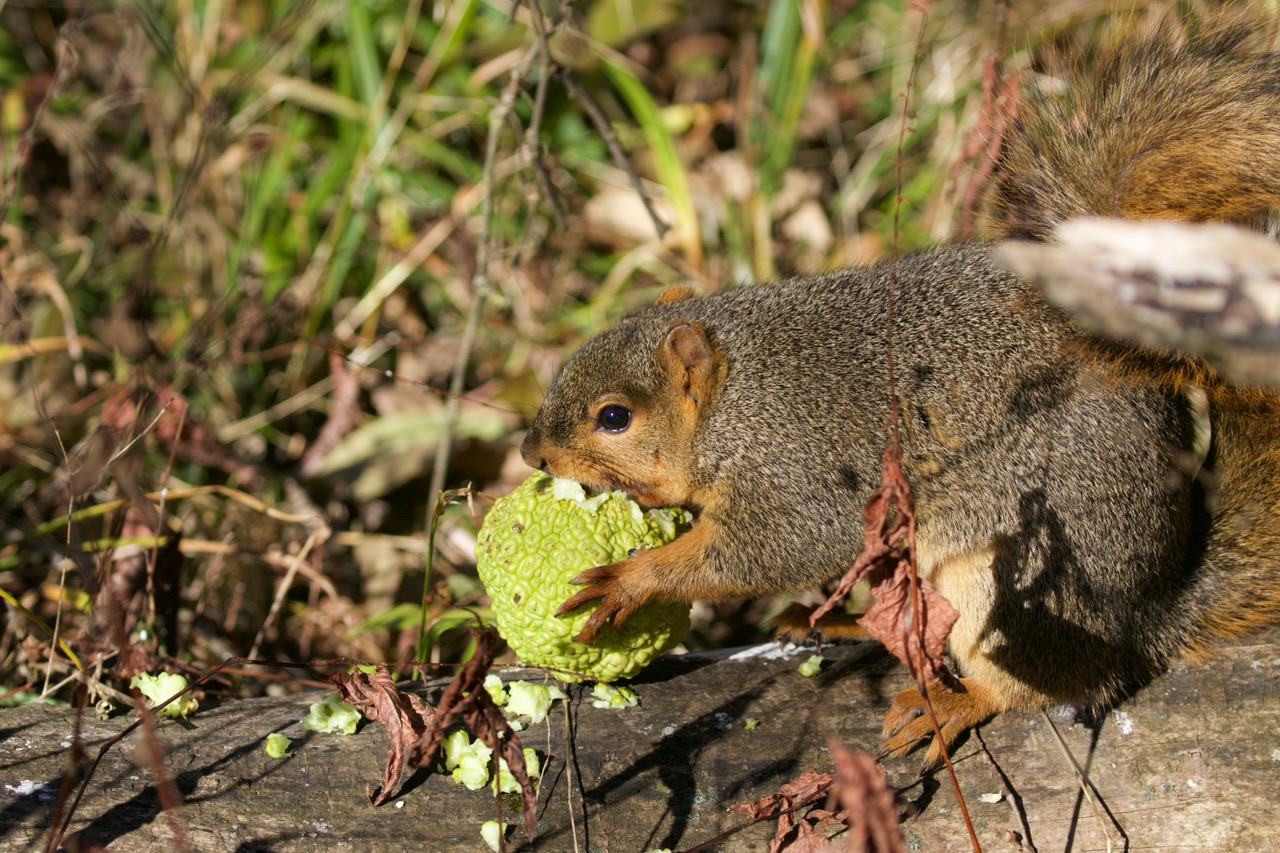
But there are other signs of autumn ticking off the clock. Last week’s storms rained newly-shorn corn husks. The cottonwoods along Cranberry Run are decorated with turkey vultures. They spread their six-foot wingspans and lift off for sunnier skies when I try to take a photo. Winter birds skitter up and down bare trees and Eastern Fox Squirrels fatten themselves on Osage Oranges. Moths blend with browning leaves on the woodland floor. The latter doesn’t bode well for wild winter stores since the green fruits are the rodents’ least favorite food source. Bring forth your tired, your weary, your fallen acorns because the wild ones are going to need them.
EasternFoxSquirrel
There is running water in Cranberry Run. After last week’s rain, small puddles became a smooth pool of stained glass in shades of leaf-litter orange, red and yellow. After work, I walked down to where my grandpa once forded the stream and was sad to see that the stream wasn’t flowing. But it was, trickling over the most elevated riffle. What I didn’t realize was that Riley Creek was rising with heavy rains from the south, so fast that the Run’s current was flowing upstream.
Everything is flowing backwards these days. We can’t civilly agree (or disagree) on what to display in our yards, on our bumpers, or what to wear (or not.) What we can agree on is that cold air makes wearing a face mask easier. As Saturday evening’s snow fell fast and thick enough to leave a visible dusting, I didn’t mind so much when Quinn the Fox stashed her toys under my blanketed body, effectively tucking me in for a chilly night.
(Thanks to Deb Weston for sharing her photos. Her subjects cooperated. Maybe it’s because she is such an avid birder here on The Quarry Farm that she’s become one of the flock.)
Today’s “Quarry Farm Fridays with the Bluffton Public Library” featured North America’s marsupial. Angus the Virginia Opossum is our resident education ambassador for his kind.
May 9 is the biggest day in birding this year. As it’s just 9:30 p.m., it still “is” even though the wind tonight is wild and wooly and no self-respecting owl is going to land in the bowed cottonwood outside the window before midnight.
Female cardinal
I don’t know birds. Rather, I have met a few and we got along well. I could pick them out in a crowd. But I don’t recognize many wild birds by call or even by sight unless they are posing neatly at eye level. For the blessed luck and good of all, Deb Weston is a frequent Quarry Farm flyer who helps us see beyond the cardinals, chickadees and house finches at the bird feeders and into the high canopy for warblers, kinglets and other birds who are presently passing through these parts.
Black-throated blue warbler
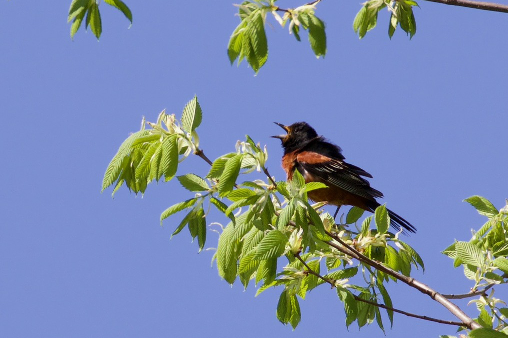
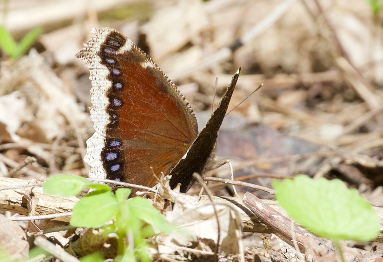
Not that there is anything less than splendid about the birds we are most familiar with. Deb shared a stunning shot of a fluorescent-beaked female cardinal gathering nesting material from a clutch of honey locust thorns. On the same day, however, she photographed a black-throated blue warbler perched on a rope of grapevine. Along the way, she digitized an orchard oriole singing it’s heart out and a mourning cloak butterfly. Because butterflies are seemingly as confused by climate change as humans are, they are arriving here or emerging from their winter quarters with no food in sight. When Deb shared the butterfly photo, it was a sight for sore eyes.
Mourning cloak butterfly
Just as nature around the world is reveling in the cleaner air and water that’s a result of human lockdown, wild things are going about their business unimpeded here in the Back 40. On Friday night a small group of Girl Scouts spread out along the trails to earn their trailblazing badges. As they climbed out of the Riley Creek floodplain toward the grass prairie, two large fluffy feathered great horned owl fledglings bobbed in a black walnut at eye level. Their parent murmured a short distance away, waiting for us to move along our earthbound way.
As Ohio Department of Health Director Dr. Amy Acton so eloquently said regarding the present pandemic, we humans are waking up to life. While we blink sleep from our eyes, life goes on around us.
Here on The Quarry Farm, bush honeysuckle whacking is a means to social-distance ourselves during Ohio’s StayHome proclamation. At this pace we may see the forest for the invasive trees this year. As David Seitz works his way south from the old stone quarry, Paul Nusbaum is clearing A new walking trail to skirt the ancient homestead well, Riley Creek, and the Bottom’s rich vernal pools. That area is a quiet shelter for migrating songbirds. As I took out my own pandemic fear and frustration on bush honeysuckle and a [gasp/horror/curses] privet I found at the northern-most point of the nature preserve, a Black and White Warbler eyeballed me from the top of a small maple. My camera and phone sat safely at home on the kitchen counter so the only image I can share with you is a description of a dainty bird, striped black and white from beak to tail.
The aforementioned lack of camera is the lead in to the story that I saved for sharing on a rainy day. Thunder rolls outside today and heavy downpours turning clear Cranberry Run the creamy brown of the surrounding fields, so here goes. I present to you a tale filled with suspense, partial nudity and a happy ending.
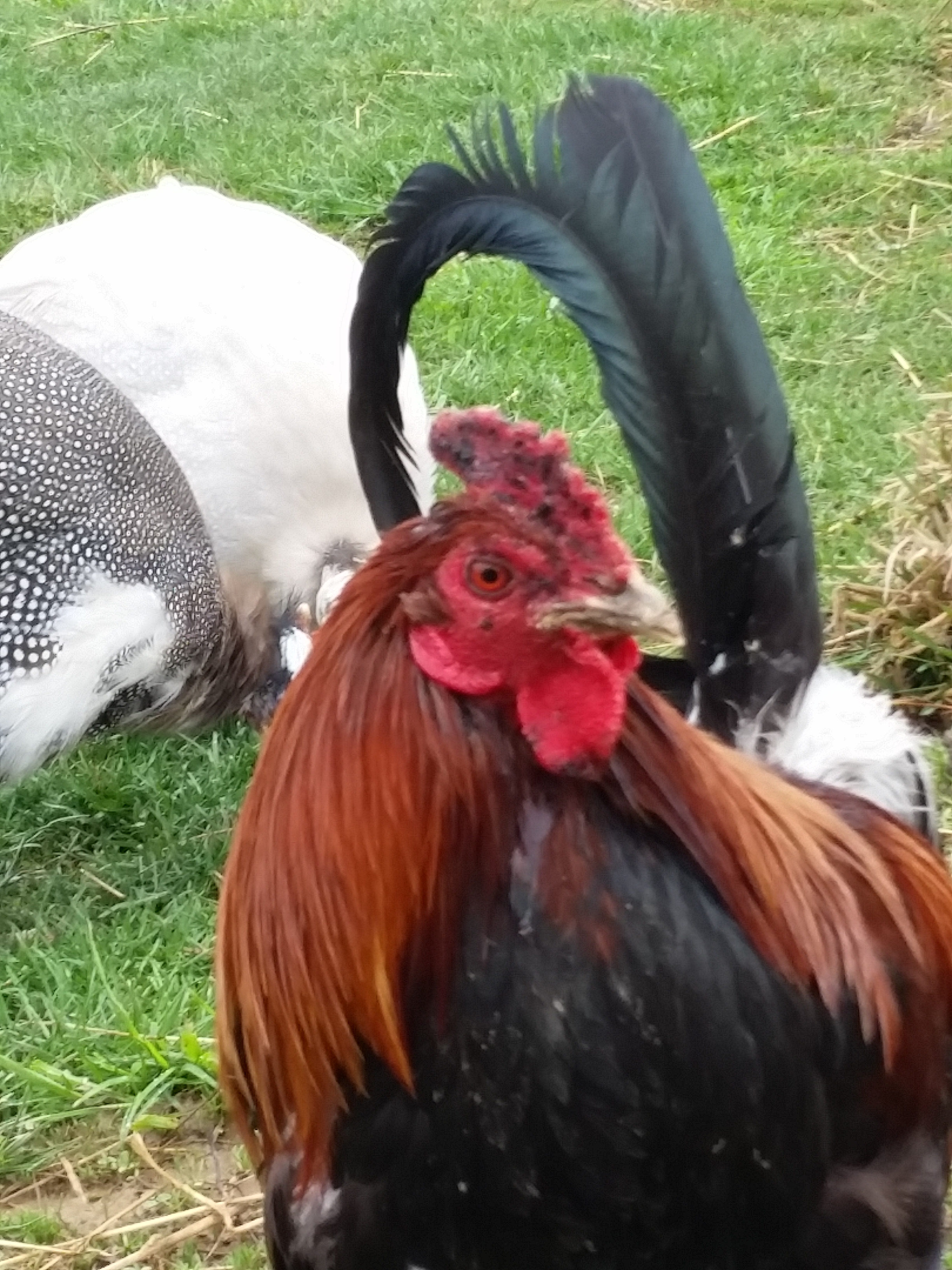
It was a dark and cloudy Wednesday night. Somewhere in the darkness, a domestic fowl uttered a strangled cry. Fergus the Tree Walker Coonhound scrambled to his feet, baying all the way down the stairs. I stumbled along behind, forgetting my eyeglasses on the nightstand. Fergus blew out the front door and down the driveway. Quinn Fox wove through the hound’s floppy Muppet feet, emerging through the tangle with Gerald the Rooster in her jaws. I screeched at her to “drop it!” She did! Fearing the worst, I carried a limp Gerald into the house. He had a heartbeat, so I left him in the bathroom basin and ran back outside, trading Fergus for Cady the Pitbull because Cady is quieter at 2:00 a.m. than an excited hound dog. My Steven was now in the fray, tracking Quinn with the flashlight app on his cell.
I was in a shortie. Steve wore a t-shirt and boxers. Our shoes and my eyesight were in the house. It was maybe 40 degrees on March 25 in Northwest Ohio.
We took turns going back inside to grab shoes, jackets and cheddar cheese. After much fun and games on Quinn’s part, the little red streak took refuge under the front porch. Steve shown light under the deck while I crawled under, cheese in my cold little fist. Since Quinn likes cheese and there is no soft pillow under the porch, she was ripe for reclamation. Once she was back in the warm house with Fergus and Cady, Steve spotted a wet mound of gray fur at the point of the Fergus/Quinn collision. A young Virginia Opossum lay there. Its tongue lolled on the grass and its legs curled in little clawed fists. We stared at it in the beam of the cell light, surmising that the marsupial had probably climbed up in the roosting box shared by Gerald and Arthur and startled Gerald into mad flight. While we watched, the dead creature blinked. Steve carried him/her down the hill and into the woods.
As far as we know, the opossum is fine. Quinn, Fergus and Cady are fine. Gerald was standing in the basin by 2:10 and is fine. That bird has the nine lives of a cat. We figure that, between picking fights with Arthur, predator encounters and a past life as a cockfighting rooster, he’s depleted his store of vivacity by at least half. Steve and I, however, ran through any amount of dignity we ever had long ago.
Earlier this month, friend Kathy Doty taught me how to spot the difference between male and female Monarch butterflies. Visually, it’s really not that different than humans. I kept hearing that little girl who was a YouTube sensation several years back, her sing-song show-and-tell voice explaining to her classmates, “Boys have theses, see.” I’ve sat through a lot of PowerPoint presentations about Monarchs. I know the right way to hold them as you apply a tracking tag prior to release. But no one has every told me who has what. Kathy also displayed a young Praying Mantis and a viable Swallowtail chrysalis, anchored in place by one tiny gossamer lasso of swallowtail thread. She spotted both eggs and caterpillars in the Red Fox Cabin gardens. The sightings never cease to thrill.
Several days later, a steady stream of visitors to Summer 2019 Family Day watched monarchs, bumblebees and more dragonflies than I have seen since the June 2012 floor wax discharge decimated the variety of dragonfly nymphs one could sample in Riley Creek. It was hot, hot, hot in the sun. Steady breeze and ice water kept those of us anchored to the ground cool enough to take pleasure in flighted creatures who have the wherewithal to catch thermals.
With double-digit degrees less outside, Deb Weston walked the trails with her Debbie and a camera on Thursday. They spotted an Ebony Jewelwing damselfly, a female Baltimore Oriole, a Painted Lady butterfly, a Monarch, and two Rose-breasted Grosbeaks, birds I haven’t seen since I picked wild raspberries along the cut-off oxbow to sell at Andy’s IGA in Pandora.
I could wax on. How about I share Deb’s photos instead?







 Earlier this month, friend Kathy Doty taught me how to spot the difference between male and female Monarch butterflies. Visually, it’s really not that different than humans. I kept hearing that little girl who was a YouTube sensation several years back, her sing-song show-and-tell voice explaining to her classmates, “Boys have theses, see.” I’ve sat through a lot of PowerPoint presentations about Monarchs. I know the right way to hold them as you apply a tracking tag prior to release. But no one has every told me who has what. Kathy also displayed a young Praying Mantis and a viable Swallowtail chrysalis, anchored in place by one tiny gossamer lasso of swallowtail thread. She spotted both eggs and caterpillars in the Red Fox Cabin gardens. The sightings never cease to thrill.