First polar snow

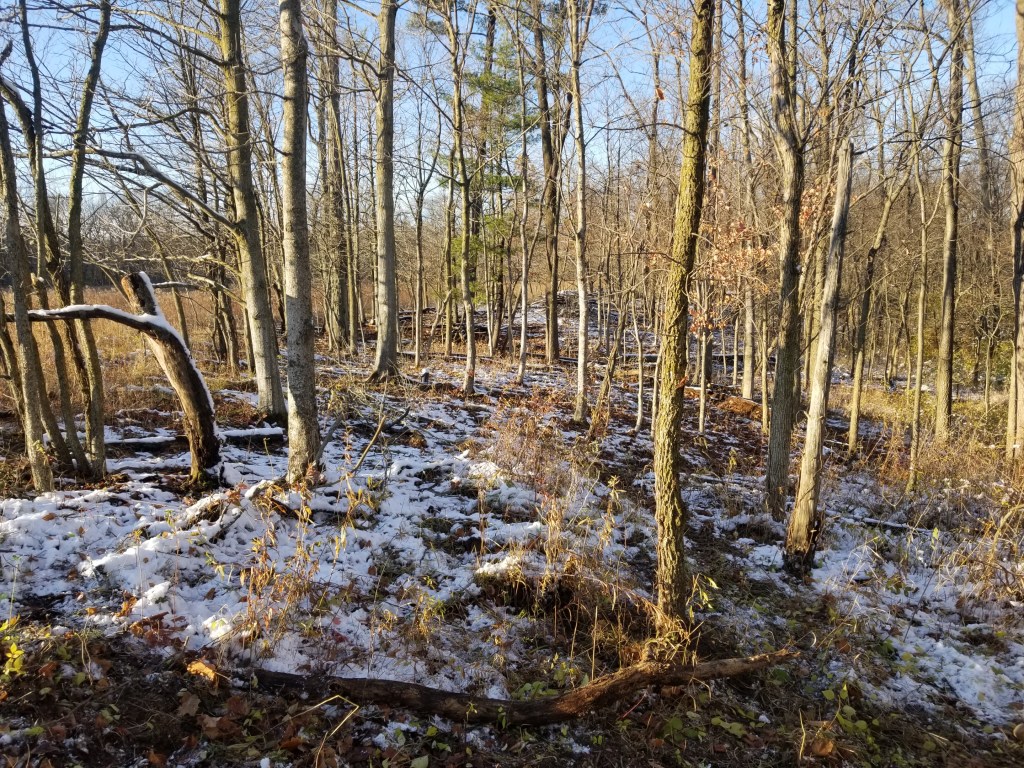
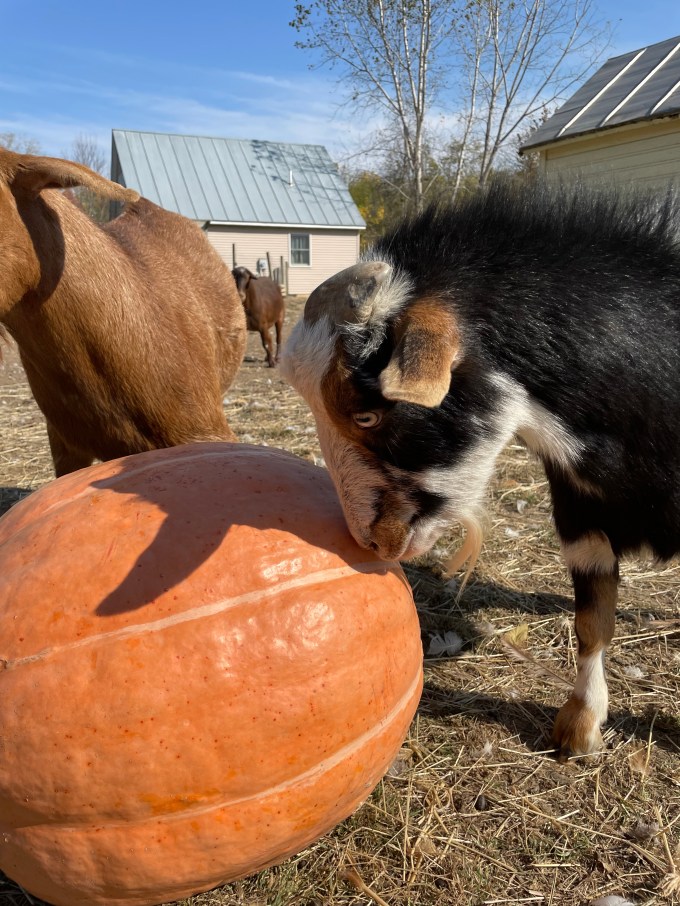
The water pans and buckets could still be filled by the outdoor hose two weeks ago. Yesterday, we woke to an inch of snow and a wagon full of frozen Hilty Farm pumpkins. Dave and Jane brought their juicy orange produce last week to rave donkey and pig reviews.

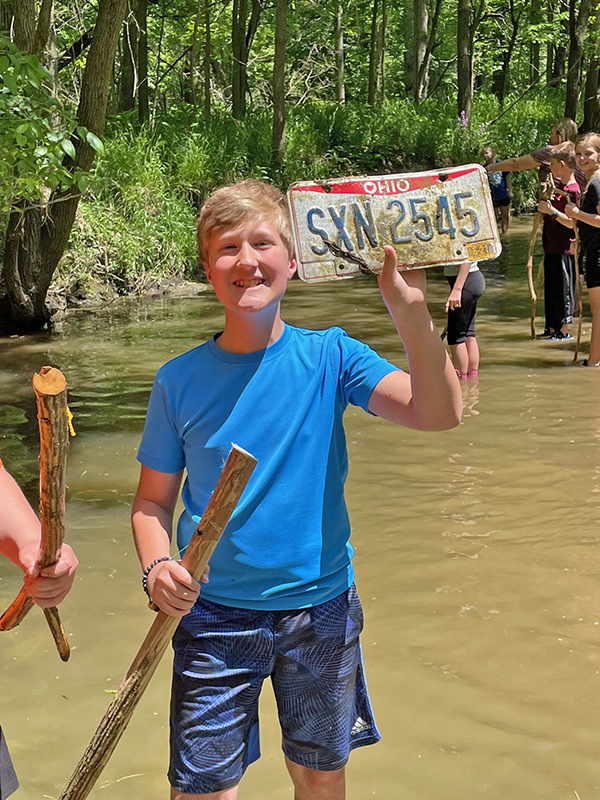
Today, snowmelt is pooling in the dry Cranberry Run bed and David Seitz is still removing invasive evergreen Amur honeysuckle from the southeast property line.

The wind is cold and blowing from the southwest open field across road 7L. In the forest, birds and squirrels scold in the calm of the trees. The wind won’t settle but temperatures are to rise. By Saturday’s “National Hiking Day Hike at Night”, temperatures will be in the 50s Fahrenheit as is fairly normal for November in Ohio. Put on good walking shoes, weather-appropriate clothes and join us on the nature preserve trails to enjoy the mental and physical health benefits of hiking.

Download your copy of the Fall 2025 Newsletter for a full calendar of events.

Summer is here and so is our newsletter

Download your copy of The Quarry Farm Newsletter/Summer 2025. Our first event onsite is an herb kokedama workshop. There are four herb kokedama growing on the porch of Steve’s kitchen–they are a fresh, cool, environmentally-friendly cultural experience. And registration is now open for The Quarry Farm 2025 5K, which we have moved up to September 13. This is a major fundraiser for us. With traditional funding—grants, corporate sponsorships—fewer and farther between with ongoing unrest, we need your support more than ever. Thank you.

And because an 11″ x 17″, two-sided newsletter will only allow for a small selection of the photos that are captured on The Quarry Farm from season to season, here are a few Spring snapshots that didn’t fit on the pages.

Sometimes the Best Place is Someplace Else…

Click to download Spring 2025 Newsletter

At this point in time, the farm animal sanctuary is primarily a senior living facility. The three donkeys are well into their 20s. At five, Clive is the youngest of the five pot-bellied pigs. The others, as well as Nemo the big pig, are at least 10. Brownie the Rouen Duck is at least five (I just read that they can live to be five!) As with humans, supplements joint health and anti-inflammatories are part of daily food prep. The residents came here to live out their lives in as much peace and freedom as possible. It’s tough to admit when The Quarry Farm may not be the best place for them to do so.

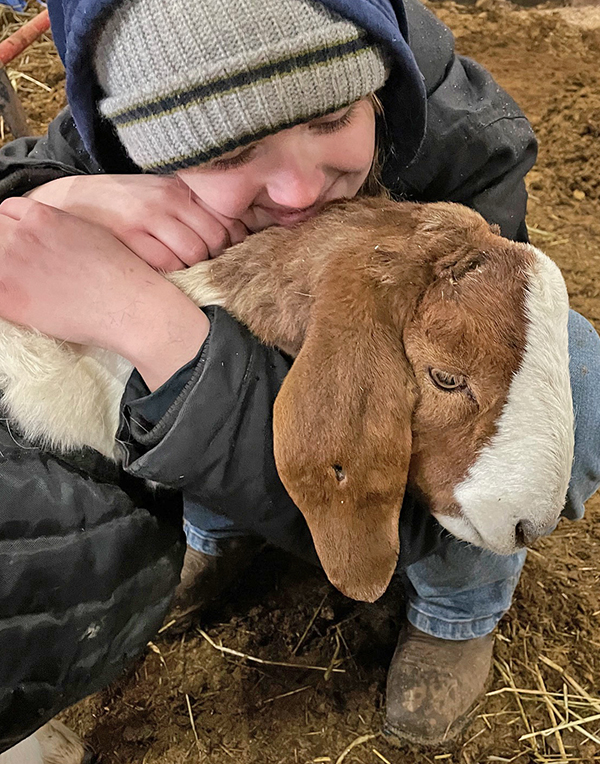
Tommy the Boehr Goat was bottle-raised by a gentle boy who cared for him. He was initially named “Tongue-ey” because the little goat was unable to keep his tongue in his mouth. When Tongue-ey came here, we hoped that he would become part of the herd. Unfortunately, the other goats kept him at a distance. We found out why when we found him non-responsive on a January morning. We drove him to Ohio State University Farm Animal Services where he spent a week.

The prognosis was probable failure to thrive. His little body was unable to regulate its temperature and he was unable to fight off parasites as healthy goats do with regular treatment. Our friend Tim Jasinki at Lake Erie Nature & Science Center put us in touch with Whispering Acres Farm Animal Sanctuary near Medina. This facility is home to a number of animals with special needs, and many of these animals are ambassadors for hospice therapy and veterans with PTSD. Tiny Tongue-ey—now Tommy—was immediately surrounded by equally tiny goats. Janine Smalley, the director of the sanctuary, sent photos of him at work, providing comfort to someone in need.

…and Sometimes the Best Place is Here

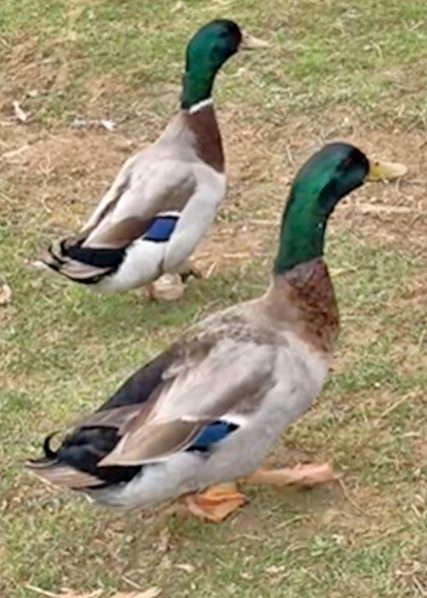
While making arrangements to transfer Tommy to Whispering Acres, Janine asked if The Quarry Farm would be able to accept any ducks. Someone had just surrendered two Rouen drakes. In addition to Brownie, there are two more Rouen ducks here. Brownie and the Brownettes could certainly hold their own. Although it is Spring and the two brilliantly-plumed males are rather obnoxious with the season, Brownie leads them around by their bills.

Where are You, Woolly Bear?

Have you noticed, as we have on The Quarry Farm, an absence of Woolly Bear caterpillars this fall? Typically, the fuzzy black and brown creatures are a common sight in late summer/early fall, crawling on the warm pavement of our country road. Not so this year. Here’s a brief look at the life of our fuzzy, bristly friend, to know it better and attempt to understand why its scarcity matters.

Woolly Bears are the caterpillar form of several related moth species, including the orange-yellow Isabella Tiger Moth (Pyrrharctis Isabella), which ranges across the U.S, and Southern Canada. The moth typically produces two broods a year. It lives about two weeks, nectaring on a wide variety of flowers. It mates, lays eggs, and dies. The caterpillars we see in the fall are the second brood. They’ve grown fat on leaves such as violets, nettle, sunflower, maple, and elm, and green grasses, and they may have shed five or six times while growing. When the fall brood is ready to pupate, it finds protective winter cover under leaf litter or logs or rocks. During the winter it pupates in a cocoon made from its bristly hairs and emerges as an adult in the spring. The cycle repeats to produce a summer brood.

The second-generation caterpillars that we see in the fall (in a normal year) have eaten their fill, are preparing to hibernate, and are out and about because they’re looking for cover. They are not going to poison us if we pick them up (although they can feel prickly). And sadly, they can’t predict our winter weather—by coloration or by size of the brown band around their middle. Those features are influenced by stage of development, belonging to a particular tiger moth species, and diet. There is no special little weather sensor embedded under the fuzz.

So why are we seeing so few Woolly Bears? First and foremost, no doubt, is the serious decline of many moth species worldwide—for all the reasons that we know too well and are struggling to deal with: climate change, habitat loss, light pollution in populated areas, pesticide and herbicide use. Also, we could look around us recently at a bleached, drought-ridden landscape and see little food for Woolly Bears preparing to hibernate. Their absence matters because, as pollinators and a major food source for birds and other animals, moths are an important link in the food chain that sustains us.

—The Gardener at The Quarry Farm

so much sky

I was going to title this post, “Eclipse”. 

“Eclipse” was the headline online and in print before and after April 8, 2024. The total solar eclipse that occurs when the dark silhouette of the Moon completely obscures the bright light of the Sun was going to be either A) the end of the world as we know it, with hoards of outsiders streaming across Ohio to rob us all of our lives and livelihood. Or B) this natural phenomenon that occurs every 18 months or so somewhere in the world was going to be a great big ol’ treat, right here.

Download for newsletter

The actual title is offered in gratitude for something that brought a whole bunch of people together—in peace—for four awe-inspiring minutes. The total solar eclipse of 2024 brought people from across the United States to the gardens, creek bank and pasture of The Quarry Farm on April 8. People from Ohio, New Hampshire, Michigan, Indiana, North and South Carolina, and Virginia chose to view the phenomenon from the comfort of camp chairs, alongside the farm animal sanctuary residents, or hiking in the nature preserve.

One gentleman arrived after totality. He had driven here from Eugene, Oregon but heavy traffic held him at a Maumee River crossing. He pulled over to watch then drove south to Road 7L where he walked the trails and sampled eclipse baked goods in the summer kitchen bakery. I didn’t speak with him but others did. I wonder if he will make the trek down under for the next totality.

Board member Martha Erchenbrecher observed the behavior of Bruce the Turkey and K the Canada Goose during the eclipse. K took notice, bobbing his head in surprise. Bruce stayed still. Her observations were shared with the Solar Eclipse Safari Team of North Carolina State University and Arizona State University. We all noticed that both wild and domestic animals fell silent during totality. The farm animals headed for the barns but went back for more visitor attention at the fenceline.

As for me, I didn’t decide ahead of time where I would watch. A couple of hours before, I listened to an interview with a retired astrophysicist known as “Mr. Eclipse”. He has traveled far and wide to see the sun eclipsed completely and partially. He advised that, when the day and time of an eclipse arrives, one shouldn’t think too much about who you ought to be with or how you should view (other than to be safe about it.) One should just be in the moment. So as the moon began to block the sun from view, I found a pair of eclipse glasses that one of the hikers had dropped on the path to the prairie. I parked myself on a quarried boulder beside the quarry wetland. I could hear cheering from up in the gardens and Red Fox Cabin. The sound didn’t budge two turtles that were perched on a log, but the smaller of the two dove under when the astronomical curtain fell.

Total eclipse is just one week away

Chris Brown’s 7th Grade Science students from Glandorf Elementary visited The Quarry Farm on March 15 to demonstrate how to safely view the April 8 total solar eclipse and to make a solar eclipse viewer from a cereal box, as well as one made out of a paper towel roll. Videos of the students are posted to The Quarry Farm YouTube Channel and Facebook page. The videos, recipes and posters were also designed by the students and those are shared on Facebook. The farm animal sanctuary residents provided video commentary.
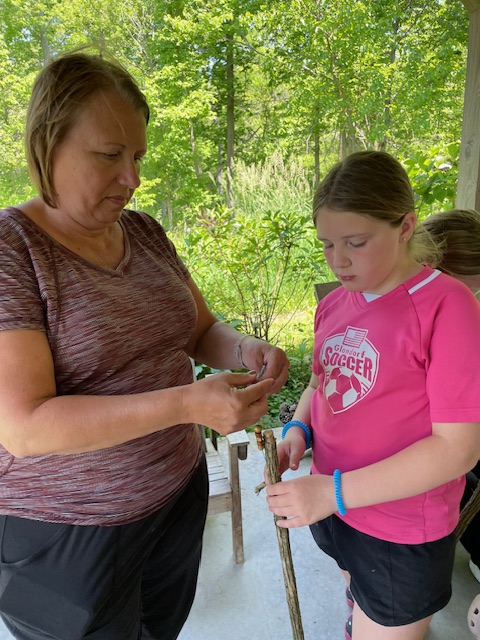
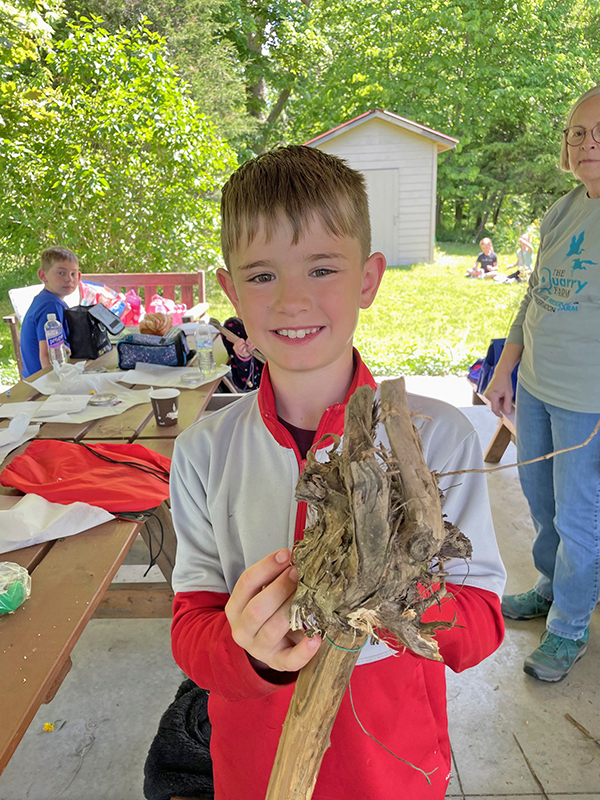
Debbie Leiber, Deb Weston and David Seitz have been working hard to keep the trails clear, what with all of the high winds dropping branches from treetops. They have been harvesting bush honeysuckle trunks which are made into hiking sticks throughout the year. The Quarry Farm is part of Toledo’s Imagination Station Ambassador program. As such, we were provided with lesson plans, solar eclipse glasses and photo-sensitive beads that will change color during totality. Those beads will be available for registered participants to string on the handles of hiking sticks during our April 8 “Total Eclipse on the Prairie” program.
March 1 was a bit chilly starting out, but a good day to work in the woods, according to David Seitz. He posed here next to one of the mammoth, invasive bush honeysuckle shrubs that he has been removing from the nature preserve for five years and counting. He does a brushcutter sweep periodically to keep fast-growing seedlings from filling back in. This gives native wildflowers and trees a chance to grow in their place. Dave has also cut scores of wild grapevine and poison ivy that pull down and siphon energy from the native trees.

Just ask

Lavender was one of several victims of a chain farm store’s new retail chick display system. Rather than an open-air enclosure system, this new system took up less retail floor space by stacking the live products in an enclosed space. The stack was a high-rise; a chick skyscraper with no open windows to vent the ammonia produced by heated chick feces. We saw one little chick beating its beak on the upper layer’s window. All the other chicks on that level were dead. The chicks on lower levels were dead or slowly dying. We were given permission to help clear the dead and purchase the living for $1. The farm store reverted to the one air system at all of their locations, at least in Northwest Ohio.

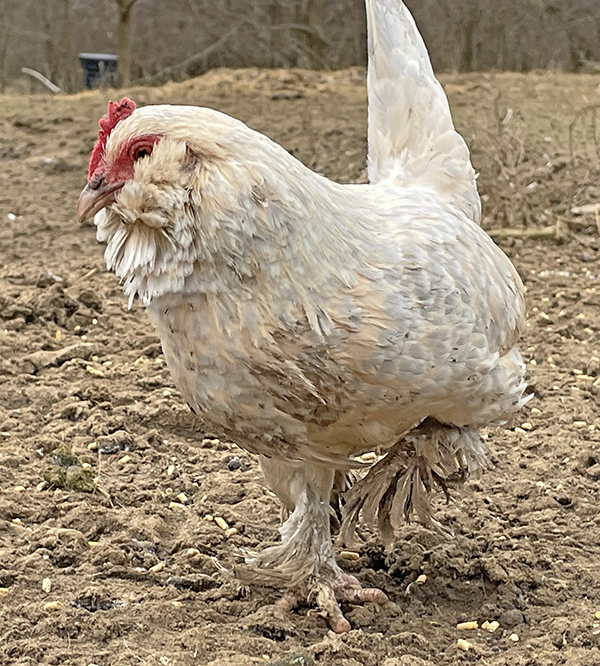
Three of the chicks that came to the farm animal sanctuary survived. Sidney, a Silkie Rooster, and Speckles, a calico Bantam hen, are tight buddies. Lavender, so-named for her muted violet-and-pearl plumage, keeps her own counsel. She is what is referred to as a “fancy”, with swirls of feathers booting her little feet. She flits in and out of the standard flock of hens and roosters, dodging under their feet for breakfast. This system works well for her in summer and fall. In wet spring and soupy winter mud and slush, her feathered boots cake and weight her down. Breeders are not known for their practicality.

Last year, her fancy footwear became so clogged that we had to soak them in warm water, trim her foot feathers and keep her indoors to allow her to eat and sleep in dry warmth. Once she recovered, we reintroduced her to the flock and she wanted nothing to do with humans beyond feeding time. Last week, Steve saw her hiding from one of the younger roosters. Lavender hopped up to Steve and chattered. She allowed herself to be picked up. Steve saw that her foot feathers were boggy. He took her inside, soaked her feet, trimmed and dried her feathers and set her outside. She hopped away to rejoin the flock and is not currently seeking human interaction other than at mealtime.

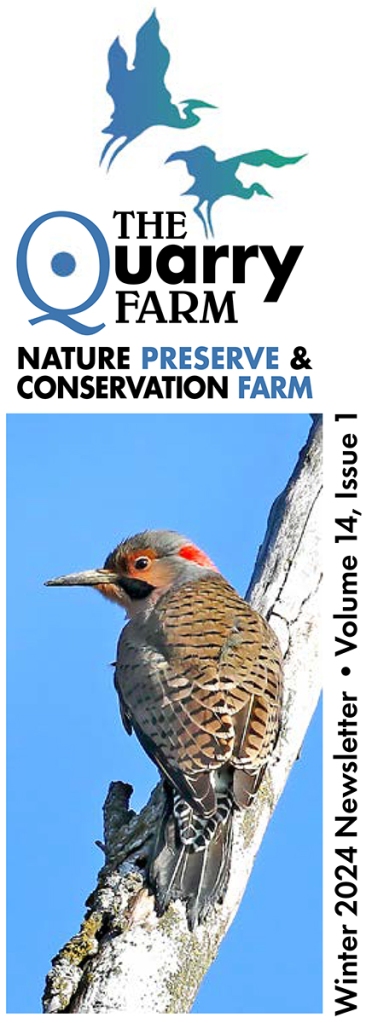
Click on the cover above to download your copy of The Quarry Farm Winter 2024 newsletter.
Pluto’s long road to recovery

Four Nigerian Dwarf goats joined the farm animal sanctuary herd a few years ago, bringing the group to six sweet, spirited individuals. Three were more equipped to back their head-bumps with full sets of curved horns.

Horns protect the herd from predators by allowing goats to butt predators and knock them off their game. This isn’t so much an issue here in the sanctuary. More often, it’s the goaty way to establish a pecking order. Horns also have blood vessels within them that help regulate body temperature. Here they have water and shade in summer and quilted waterproof goat coats for winter’s coldest.

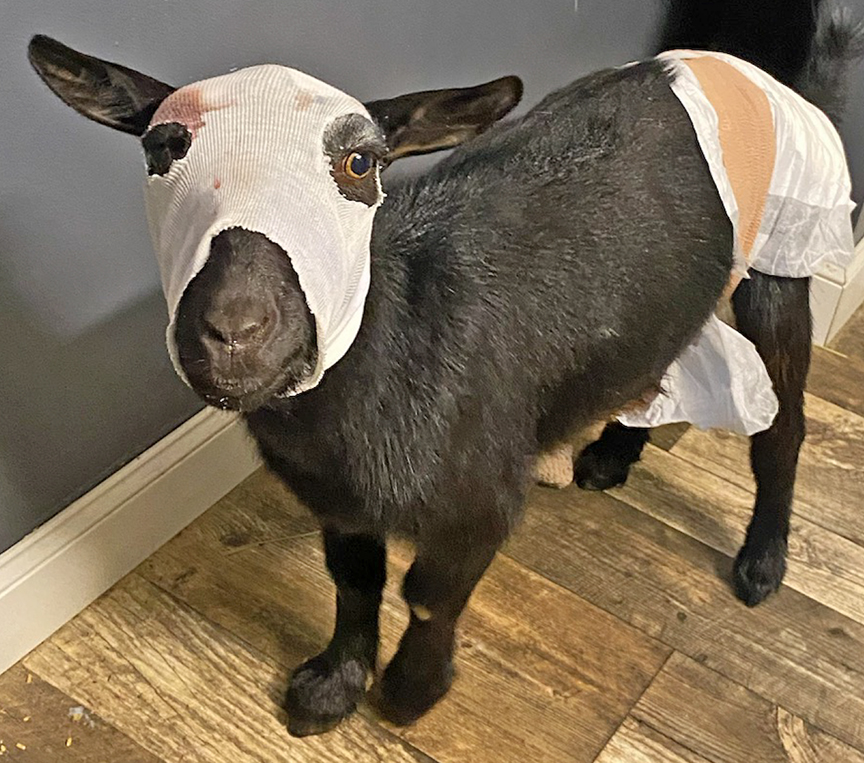
Unfortunately for one of the three with their own personal cornucopia, his curving horns grew into the side of his face. On August 8, it was determined that Pluto’s horns should be surgically removed by a veterinarian. This resulted in great pits in his skull, exposing his sinus cavities. A few days afterward, we had to make an emergency run to Ohio State Veterinary Hospital in Marysville to prevent spread of infection. His cranium must be cleaned, disinfected and bandaged twice a week, well into the holiday season. If you would like to help fund his recovery, all donations to The Quarry Farm Nature Preserve & Conservation Farm are tax-deductible.
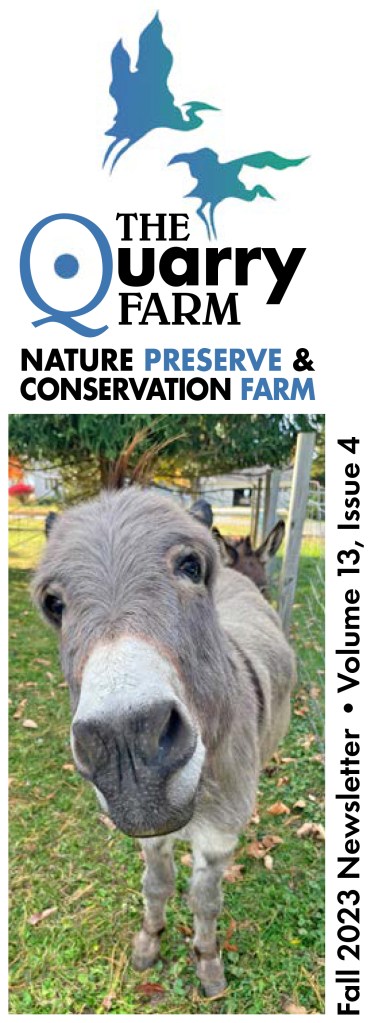
For more about the other, more joyous things that happened here in this summer, as well as upcoming events, click on and download the Fall 2023 newsletter cover. Buddy will be happy to see you.

They come

Little Lady was buried last week. She was at least 23 years of age. Her pale gray calico-ness showed up about the same time that Steve secured the last piece of lumber on the front deck. She didn’t leave the deck so we opened the door. After that, she never left the house except for vet visits and to step out and turn right back around to inside. She was ridiculously healthy, opinionated and acrobatic. We figured that she would scramble up the stairway banister or doorframe one day and check out in mid-journey one day. And that’s almost exactly what she did.

But this writing isn’t about Little Lady. Other than living in the house that sits apart from the farm animal sanctuary here, she wasn’t of The Quarry Farm. This is about what happened after she died.

We cried, grabbed a pick axe and shovel and took her body outside to bury her in the frozen ground under the white pine needles in the north corner of the pasture. She didn’t particularly like other animal company so we didn’t bury her near anyone else. We joke that someday someone will excavate this property and shudder, wondering, “Who WERE these people?” But the remains of a little cat will be there, all by themselves. The excavators may attribute some sort of deification to her.

The donkeys came first, stepping slowly up the slight incline from the lowland. Then the goats. Then Willy the three-legged sheep. And for the first time, in all the physical goodbyes that one has to make on a sanctuary, the geese came. Not Gigi and Henry the domestic Emden and China White, but the Canada Geese. They were delightful, deep flood pools in the north lowland to race-fly across. But the seven geese placed her for soft-release walked slowly up the hill, murmuring to each other with their long necks snaking out in front of them. T, the largest of the little flock, stood on Steve’s feet while I replaced the soil.

I don’t know why they always come. It’s more than out of curiosity and strange odor, of that we’re sure. When Mister Bill the Giant Goat died, everyone—every single one—gathered around his grave. One of the goats knocked the shovel and the first load of dirt out of Steve’s hand.

We bury as deep as we can in order to prevent the unsettling sight of a corpse being predated. In 20 years though, it hasn’t happened. The pine needles were scattered and smoothed over this most recent grave. I looked at it today and you would never know that the spot had been disturbed. The pigs root constantly in spring for green shoots. The chickens follow up for worms and grubs. But they have yet to touch a burial spot.

Maybe it’s the disruption in energy, neither created nor destroyed. I don’t know. I don’t know that any of us humans will ever know, because we seem to think we know it all already. But they do, simply and beautifully.

Keep making more connections. Download your copy of the Spring 2023 newsletter by clicking on the cover.

Name the Newbie

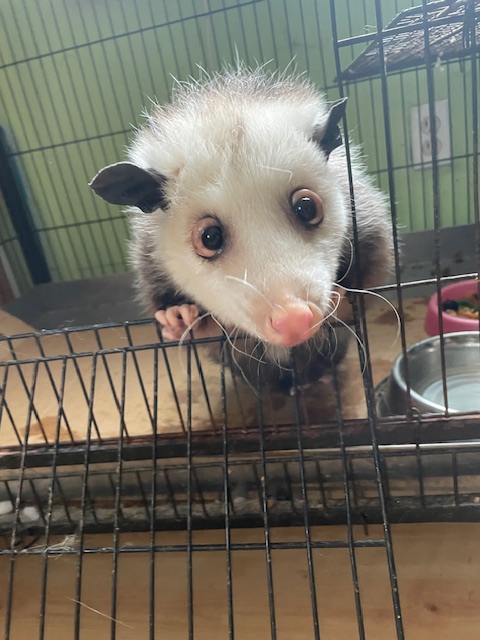
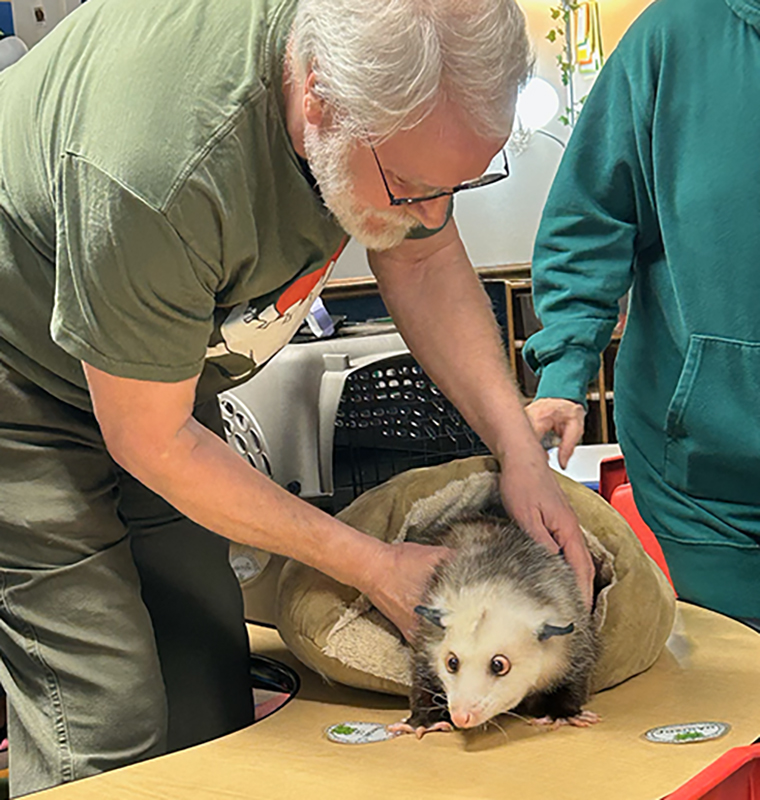
A young female Virginia Opossum will be joining The Quarry Farm in January as an educational ambassador. She was surrendered to Lake Erie Nature & Science Center after she had spent the first months of her life in illegal captivity. She is not afraid of humans and has no experience of the wild world so will live here, helping us teach people about North America’s only native marsupial.
Years ago, we asked people to help us give a name to a male Virginia Opossum. The winning name was Captain John Smith. The name and the history behind it was so intriguing that we ask you to help us again. Please send possible names and the reason behind the suggestion to thequarryfarm@gmail.com by January 21.

Read more about what happened this fall by downloading the Winter 2023 Newsletter and add our calendar of events to your calendar this season.