 The Quarry Farm newsletter for the winter season is at the printer. It’s also available for download—handily click on the cover to ‘receive’ your copy. But budget and conservation of natural resources limits that piece of paper to an 11″ x 17″ piece of paper folded to supply four printed pages. That’s the great thing about this website. We can share more stories and photos in between issues.
This newsletter contains details about engineer David Seitz’s most recent onsite project. This summer and fall, David began to engineer a system that would temper sediment loading from Cranberry Run and help the quarry wetland do its job as a natural water treatment system and wildlife habitat. His daughter Aili has been helping him bring the project to fruition. David is documenting the project via email to Board President Laura. As newsletter space is limited, here’s the rest of the story, so far.
 August 15
Aili worked a bit across the creek with the string trimmer, going around the quarry. I kept going south on the west side path, with the brush cutter. Cut through about 40 yards of honeysuckle thicket, and the path is now open almost to the property line. But all the brush from the thicket is still on the path, and needs to be cleared from the path. Also a log down across the path at eye level. Can duck under, but it wants cutting with the chain saw. Will work on that on a windy day.
September 11
I moved the dead tree which had fallen on the bank, partially blocking the path, and the outlet (gap) of the quarry. Is now much easier to walk south on the east side of the creek, and right on past the quarry. Moved a few rocks up out of the creek bed, and built up the quarry outlet a bit with them. Heavy work. Staggering through the shallow water carrying the rocks is not so good. I think moving them on the red cart would be OK. The creek bottom is mostly flat in that section, with a bit of sand. Saw my favorite invertebrate in the pool…a crawdad! Hadn’t seen one in decades. After I disturbed the sediment, he moved in to look for a snack.
September 17
Was planning to stop hauling and shovel some dirt, but I found a really nice rock, biggest of the day, in the creek bed. Couldn’t resist it! Took 20 minutes to get it on the cart, and 20 more minutes to get it to the quarry gap. And then couldn’t lift it. Finally got the cable puller and strap, to keep it from falling back on my feet. With pulling and pushing, got it up on top. For sure, need to start backing the stone wall with some dirt. Will start shoveling dirt onto the quarry side of the rocks next week.
October 2
I came by today to work on building up the support for the rock wall. Moved about 2 cubic yards of dirt from the quarry to the bank, behind the rock wall. Basically just kept shoveling till I thought the “south quarry gap” and channel were adequately supported for a small to medium flood. Three and a half hours with the shovel, so I was a bit tired, at the end. Spent an additional half hour carrying some more rocks for the top of the bank. Definitely will help to have more rocks.
Putting the culvert in is the second phase, in my mind, and I will try to start on it next Wednesday. I don’t think the bank is high enough yet at the south quarry gap, but there is enough dirt there now that the priority should shift to getting the fill/drain “culvert” installed in the north quarry gap. To function like a stand pipe for draining, and an inlet pipe during floods. At both times, it will be important to prevent erosion of the banks. Thus a couple feet of dirt above the culvert pipe. Am thinking an 8″ x 20 ft. piece of ABS plastic pipe.
Phase 3: Once the pipe is installed, and buried in the bank with a foot or two of quarry dirt, I can return to the south quarry gap area, and build up the bank another foot or so. And widen the bank, also. I’m hoping the pipe will help to maintain a foot or so more water in the quarry throughout the year.
Laid a piece of 2 x 6 across the mud, where the path should probably go. Not necessary once the mud has time to dry up a bit more. Pretty sticky there today.
 October 15
Was pleased to get 15 ft. of the culvert pipe well bedded, and level. The dip in the north gap is well filled now. Covered just 10 ft. of the pipe so far, and only a little, but it looks better. Need to get another foot or more of dirt over the pipe, to keep it in place long term. But for now, the bank is 12–14 inches above the pipe inlet/outlet, so there should be much less erosion in the event of a small flood. The more dirt the better, so I’ll keep shoveling.
The “grand canyon” is getting pretty big, but should disappear after the first big rain. Looks a bit of a construction site now. Trees and grass on the bank will be a big help holding it together, and improving the look. There’s a lot of vegetation in the dirt I’m moving. Should green up in the spring. I forgot to bring along my bug spray yesterday, but didn’t have a single bug bite during the day.
October 18
Water level was higher, but only up 2 inches from the little bit of rain. Was 19 inches from water to inlet of pipe on Monday. Today it is only 17 inches from the creek water to the bottom of the pipe. If the creek rises by 18 inches from today’s level, we’ll start filling the quarry! And if the creek rises 32″ from today’s level, it will overflow the bank and fill the quarry faster. Let’s hope for a 20″ rise in the creek level, sometime in January, and a slow and steady rise in the quarry level.
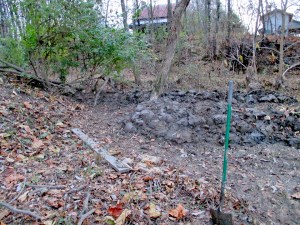 I arrived at about 12:45, and left around 16:15 hrs. Got the pipe almost covered, and that was all I wanted to accomplish today. Enough dirt over it that it looks better, and hopefully won’t wash away on us. Leveling as I went. Could see that the water in the center of the quarry was slightly larger. And the dirt I’m taking from the “grand canyon” was a little wetter also. This is a stopping point, kind of. Stopping shoveling, anyhow. I need to bring up the cable puller, chains, and recovery straps, and move a few big rocks onto the banks at the south and north quarry gaps and in between. Once I build the banks up a bit more with large rocks, I will go back to shoveling. But I’ve a lot of work coming when I’m moving rocks, in the next session.
Last part of this job is just to raise the banks a foot or two more with dirt from the grand canyon. Will get it done by the end of the year, it it stays this dry! Won’t keep the floods from overflowing the banks, but the culvert pipe should help maintain a water level in the quarry and hopefully reduce some of the erosion. There are clumps of flood grass in the tree branches, 3 feet above the level of the banks at the north and south gaps.
November 1
Was quite nice down by the quarry today, shoveling. Bright sun and only a little breeze. I got about 4 hours in, and now have the south and north gaps adequately supported with dirt from the “grand canyon”. Not worried so much about them washing away. Or the culvert. Looks pretty good now.
The creek water was up today, but still about 12″ below the pipe inlet. I looked in the pipe, and it was dry. The grand canyon was full up to the lip, but it didn’t stop me from digging the dirt from there. Sloppy walking though, for sure. Could see that the grand canyon water was more than a foot below the level of the creek water. And the water out in the center of the quarry was 2″ below the grand canyon water.
While I’m happy to have the quarry water level be low at this point, when I’m finished building up the banks (Christmas?) I can set up a siphon and begin raising the water level in the quarry a bit that way. Good to siphon in creek water when the creek is carrying less silt and stuff. A day or two after a big rain would be better. Want to build the banks up a bit more north of the north quarry gap. It is the first point where water will go over the bank now…and the dirt is free. Not fun to move, but good exercise!
 November 5
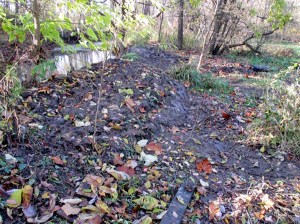
I started shoveling dirt up onto the bank at the north gap. Was thinking I’d just build up to the north of the north gap, but have been thinking about the path there. To get it flat and welcoming to someone hiking around the quarry, it should be level, and at least 3 feet wide. So I just built up the bank some more with that goal in mind, higher than the rocks, and relatively flat as the south gap part. I’d say that the condition of the bank is stabilized, but “not complete”. Will keep building the bank up as time allows, to level the path there.
November 9
 Didn’t quite get the corner filled. Ran out of daylight. Really want to get the path across the top of the bank finished, so it is a pleasant walk all the way around the quarry. Will figure out a rope for a handrail, attached to the trees, as it is an uneven path still, and a drop on both sides, particularly the creek side. I’d like to move a big rock onto the north side of the gaps, to support the dirt better. Have moved the easy ones, so will have to be a little more ambitious about the next rock. I will sleep well tonight.

 The scent of raindrops are in the air. Did you know you can watch the nature preserve bridge project from Google Earth? Engineer David does.
 “Nice day down by the quarry. Built up the bank a bit, at the north side of the culvert. Just wasn’t wide enough. Shoveled about 2 hours. Wide enough now.








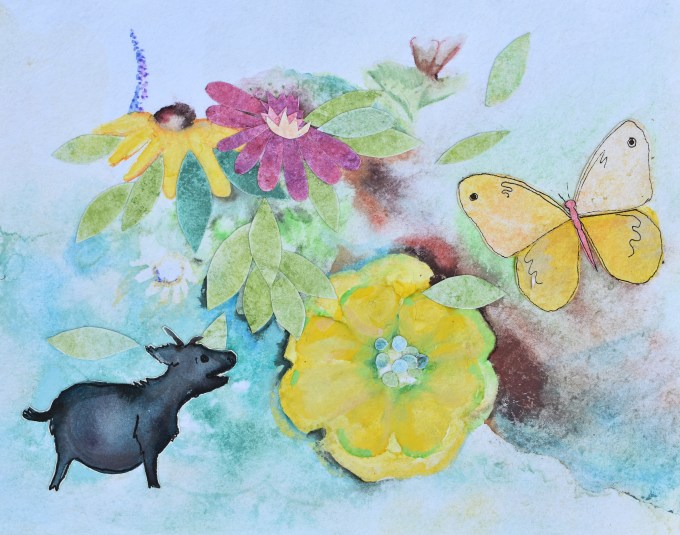


 Earlier this month, friend Kathy Doty taught me how to spot the difference between male and female Monarch butterflies. Visually, it’s really not that different than humans. I kept hearing that little girl who was a YouTube sensation several years back, her sing-song show-and-tell voice explaining to her classmates, “Boys have theses, see.” I’ve sat through a lot of PowerPoint presentations about Monarchs. I know the right way to hold them as you apply a tracking tag prior to release. But no one has every told me who has what. Kathy also displayed a young Praying Mantis and a viable Swallowtail chrysalis, anchored in place by one tiny gossamer lasso of swallowtail thread. She spotted both eggs and caterpillars in the Red Fox Cabin gardens. The sightings never cease to thrill.






 That was 20 years ago. “Drift Zone” signs populate the neighboring fields. Local nurseries carrying various types of milkweed—and people are planting them. Several neighbors grow almost-acres of native grasses, wildflowers and Canada thistles poke their spiky heads up here and there as the natives are allowed to reestablish. Even so, anger still festers in me, 20 years after we were made to stand by and suffer a fool’s errand. Few mantids have turned their mystic heads my way since then and the goldfinches are still shy.

