Talking Turkey

Five wild turkeys ambled through our yard today, not two hundred feet from our home. We frequently hear them in the morning back on the quarry and occasionally see them in the evening, well behind our house, roosting in the cottonwood and walnut trees. They’ve never come this close before, though, and even though I know that they’re simply wandering to and from the soy bean fields across the road and so are likely to pass close by either here or Red Fox Cabin, it still caused me a bit of concern. I worried that they were becoming less wary, less concerned about our presence and, by association, the presence of other people, as well. I worried about the upcoming turkey season and how they’d prove easy targets if they were comfortable around us.

I worried, that is, until I tried to get a photo.

It was Anne who first spotted them and pointed them out to me. They were walking down a path along the tree line that separates the farm part of The Quarry Farm from the nature preserve side. I grabbed my camera and headed out to where Anne had last seen them. I moved to the far side of the tree line and worked my way up the path on the other side, then down the path on our side of the trees. Then up again. Then down. You’re looking at every photo I was able to get. You see them, right? The photographs, here between the lines of black and white text? Yeah, neither do I. That’s because I couldn’t get any. I can’t say that I didn’t see them. I did, at least in bits and pieces: the glide of a blue-gray head; a bronze-feathered body slipping through brush; a quick flash of red from a wattle. But that was all I got, quick glimpses. They ran me round and round an area about the size of an American football field, always on the other side of the field and always virtually concealed in thick scrub. So, no worries about their growing comfortable with humans. And no photos, either, not of turkeys anyway. But, since a picture paints a thousand words, here’s a shot from the winter before last.

It is autumn, though, and there are plenty of other animals moving about. In the back field, a leopard frog boasted better than average camouflage. If it hadn’t jumped, I never would have seen it. In the woods, the last of summer’s dragonflies are torpid with the cold, allowing for some pretty extreme close-ups. Closer to home, in the crabapple tree some thirty feet from our front door, a wheel bug traveled leaf to leaf, hunting an increasingly rare meal.

This slideshow requires JavaScript.

Be Our Neighbor

This past Sunday, September 16, neighbors from up and down Road 7L and from various points around the block visited for an open house. All gathered under the red roof of the Seitz Family Pavilion for cookies, muffins, sandwiches and lemonade.

The sky was blue, blue and more blue, the goldenrod positively gilded and the butterflies flitted on cue. Plenty of mosquito repellent was applied to skin, enough to allow for guests catch up with friends, and for others to walk the gardens and the trails of the nature preserve.

Truly was a beautiful day for the local unveiling. The door is open for many more educational programs, photo and sketch walks, family and group meetings, or just a day or an hour away for one or two.

If you haven’t checked out the ABOUT or WORKSHOPS AND PRESENTATIONS pages here at http://www.thequarryfarm.com, I think this photo from Sunday speaks louder than most words. But don’t let that stop you from perusing the menu anyway.

Monarchs and More

Yesterday was a gorgeous late summer day, the kind with clear blue sky and clouds so clearly defined that you could almost reach up and pluck one right out of the sky. We were honored on this golden day to present once again at the Fulton County “Monarchs and More” event just north of Pettisville at a wetland/prairie owned by Ed Nofziger.

“Monarchs and More” is sponsored by Fulton County Soil and Water Conservation District and Ed and Carol Nofziger. Presenters yesterday included Pat Hayes, Cheryl Rice, Diane Myers, Black Swamp Raptor Rehab, The Quarry Farm, and Pheasants For Ever. Attendees got to visit with a bald eagle and a red-tailed hawk, tag and release monarch butterflies, learn about raingardens, and check aquatic inhabitants.

Ed Nofziger is a generous, adventurous man who went out on a limb years ago and enrolled some of his acreage in the Conservation Reserve Program (CRP) http://www.fsa.usda.gov/FSA/webapp?area=home&subject=copr&topic=crp in order to establish a pollutant-sponging natural area along State Route 2. Although CRP enrollees do benefit financially from the program, this is still a step from the norm for many farmers. But families and folk from throughout Northwest Ohio benefit from Nofziger’s leap of faith, as do school groups who participate in various science excursions to his property on State Route 2. The county commissioners encourage the annual “Monarchs and More” open house.

Thanks, Ed. And Amanda. And everyone who held a crayfish, dragonfly nymph and/or a leech at our station. Before you say, “ew”, did you know that only 10% of leeches actually suck blood, and that dragonflies continually eat their weight in mosquitoes, even as larva growing up in wetlands and streams? So there.

Videographer Steve Lauber of Lauber Digital captured great footage of the afternoon. 

Passing Through

Orphans. The word conjures a host of images, mostly Victorian, of wide-eyed children dressed in rags begging on streets or, empty bowl in hand,  pleading for more; of row on row of narrow beds, each filled with a child praying for a good family. These are Hollywood images, as unrealistic in their portrayal of real orphans as television is in its presentation of detectives or living in New York City. They’re the only ones I know, though. The human kind, anyway.

But there are other kinds of orphans.

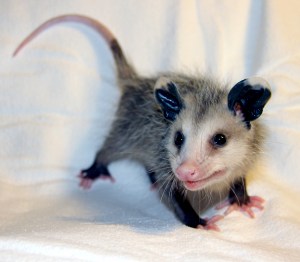
This year we’ve handled the usual: squirrels, opossums, vultures, swifts, starlings, sparrows and more, all either passing through our hands up to Nature’s Nursery or down to us from there for release or fostering. At present, we’re hosting two: a black squirrel and a Virginia opossum.

The opossum was one of six found on their dead mother (she was hit by a car). While we’re not certain how long the little ones were out there clinging to her corpse, it’s likely that it was quite a while. All six were slow and skinny and dotted with fly eggs. The worst part of such a case is that the young continue to feed from their mother and after she has died, the milk that sustained becomes corrupted, poisoned. Five of the six died. On the up side, the one that survived is strong and growing and shows no sign of becoming attached to the people fostering him. Just the opposite, in fact. He hisses and growls when we approach, bites when we lift him out to clean his temporary digs. He’s been here about a month and we expect that he’ll need to stay another before moving on and out there, on the Quarry.

The black squirrel is a new arrival, an intake from a Lima man who found him outside his apartment. After doing everything he could to reunite the little squirrel with his mother, James called us. This squirrel, like the opossum, is strong and a good eater. We’re providing a temporary safe haven for him. Tomorrow he’ll make the trip north to Nature’s Nursery where they have several other juvenile black squirrels.