 As a race, humans have found a lot of ways of saying that no matter what — somewhere, somehow — there’s a little bit of good in every bad situation: it’s an ill wind that blows no good, every dark cloud has a silver lining.
As it turns out, what we found out here at The Quarry Farm, there’s truth to be found there. But first, a little bit about bush honeysuckle.
In the early 1970s, before anybody was paying attention, it was common knowledge that planting honeysuckle was a good thing, particularly if you wanted to attract birds. And while there are honeysuckle species native to North America, more than a few that aren’t were allowed to proliferate. Morrow’s and Amur honeysuckle were particularly popular for their dense foliage and bright red berries and now particularly troublesome as two of the most invasive species of honeysuckle unadvisedly planted. Both can grow as tall as 15 feet and both are monoculture plants; they crowd out everything around them and nothing grows beneath their spreading branches. There’s even evidence that they engage in chemical warfare, releasing toxins into the soil to kill off any competition until there’s nothing at the base of these plants but bare soil. While they typically don’t do well in shaded environments, preferring to grow at the verges of woodlands, both take advantage of any disturbance in the upper story of a woods to move in and establish a fortified foothold at the first opportunity. And while it’s true that birds love their bright red berries, they offer little in the way of nutrition. Sure, they brighten the feathers of cardinals and the burning breasts of robins, but they’re junk food, the natural equivalent of candy bars and potato chips.
In short, they’re a nightmare for any organization or agency working to develop or maintain native habitat. And they’re here on The Quarry Farm in numbers too vast to count. We’ve adopted a multifold approach to getting a handle on this problem, but the most effective method is to simply pull them up by the roots whenever and wherever it’s possible.
Recently, we accepted an application from Emma, a first-year student at Antioch College, to assist us in our many efforts. One of her primary responsibilities is to help control bush honeysuckle on The Quarry Farm. Right away, we put her to work, yanking up the pest.
And here comes the silver lining.
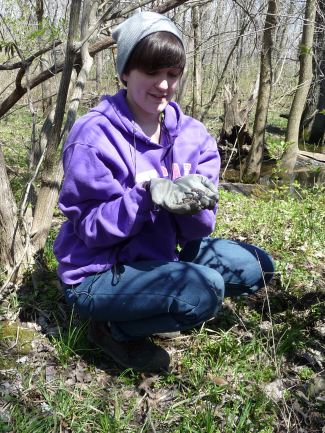 Emma set to work first along the Cut-Off, a man-made wetland created when the county opted to straighten the stream in the 1960s, thereby isolating what was once an oxbow in Cranberry Run. At the end of her third day, while making her way back to her temporary home, she stopped to pull one last medium-sized clump of honeysuckle…and found a salamander nestled beneath its roots.

To say the least, we’re thrilled. It’s a wonderful start to what we know will be a productive 10 weeks.
Thank you, Emma, and welcome.

 Haikus aside, who needs sunshine when you can turn a garbage bag into a raincoat, there are cookies in the pavilion and a lit fireplace in Red Fox Cabin?
 And the beat went on, with Holly Huber stopping by to dig in.
 Can you find the cricket frog above? There’s a free Quarry Farm t-shirt in it for the person who comments here at


 Girl Scouts laugh in the face of 50 mph wind gusts. At least the members of Miller City Girl Scout Troop 20197 do.
 As we hiked upstream along the Cranberry, farm animals joined us on the other side of the fence, led by turkeys Humperdink, Miracle Max and Inigo. When we entered the gate, we were greeted by donkeys, pigs and the geese. Then the wind rose, bringing a bluster of snow that sent us back to the cabin for hot chocolate and cookies.
 On Saturday, my old frayed running shoes picked up another layer of camouflage.
 On the quarry, wood duck and mallard couples made come-hither eyes at each other until we spoiled the fun. Wood ducks skittered over the east bank and a mallard duck “wank, wank, wanked” toward Riley Creek, her emerald-headed, testosterone-addled suitor in pursuit.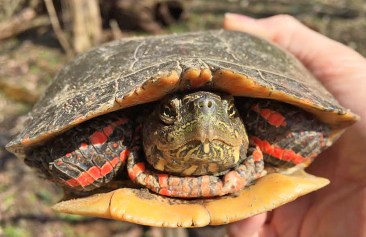
 We saw bloodroot leaves uncurling from the ground. Native Americans used the red extract from this wildflower’s roots as a natural dye, most notably for basket weaving. Above ground and growing wild in the sunlit clearing around the old homesteads well north of the tallgrass meadow, the bloodroot flowers bloom.
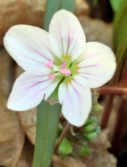 A few spring beauties and ramps dot the southeast ridge as it rises east of the cut-off. In the warmer air and spongy soil in the U of the oxbow, three toadshade trilliums fan over moss
  and decaying stumps crawling with industrious crustaceans.

