Bridging quarantine


It’s nice to get mail.
It’s especially good when it’s a shout-out from someone who shares a passion for what is near and dear to the recipient. Jonelle Meyer spent time here while she was a student at Ottawa-Glandorf High School. When she wasn’t in school or serving as a Toledo ZooTeen, she was grooming shaggy Buddy the donkey or helping with visiting groups. Jonelle graduated in 2014 then barely broke stride by receiving her BS in biology in 2017 from Lourdes Universty. She moved to California in May that year and never looks back—except when she does.
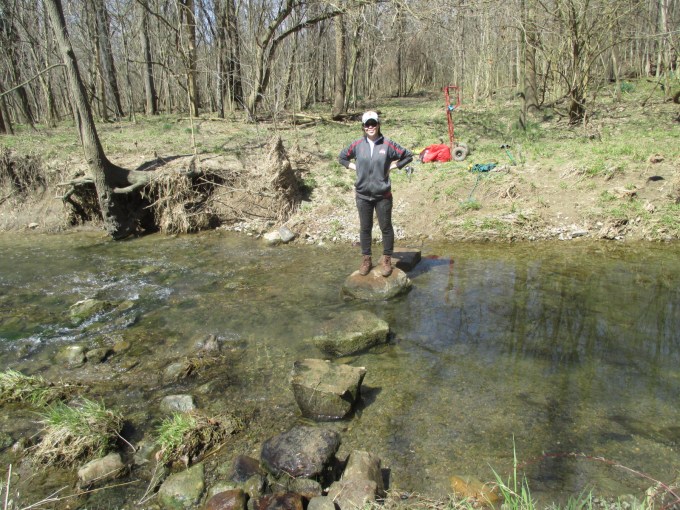
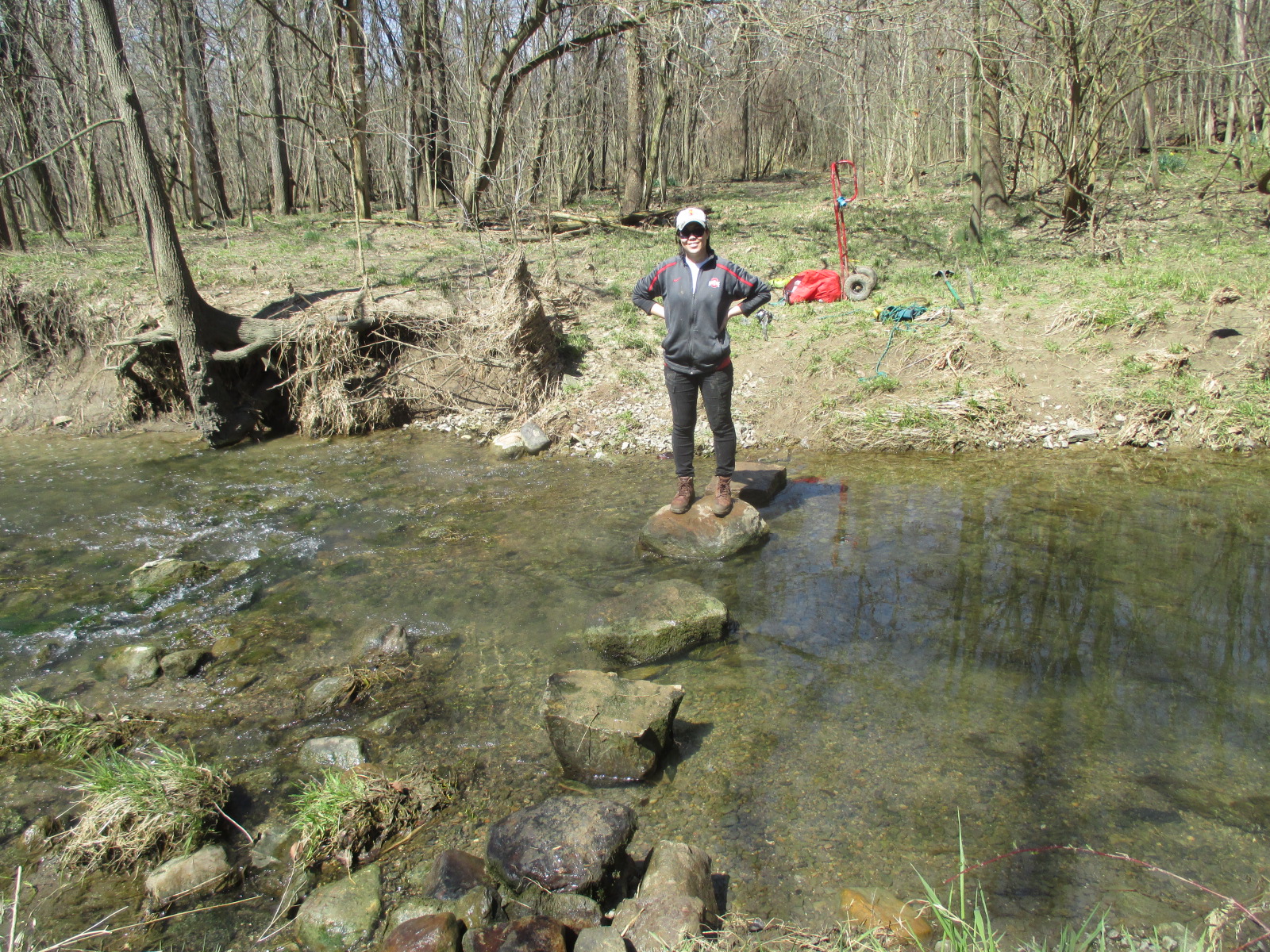
Yesterday she did just that. Up popped a message for us, with a photo of Jonelle wearing her Quarry Farm shirt backstage at Turtle Bay Exploration Park in Redding, CA. As an animal trainer there, she works with rehabilitated wildlife, performs in animal shows and participates in programming. Like so many high-trafficked places this Spring, Turtle Bay is closed to the public. But the behind-the-scenes show goes on, with animals relying on the love, attention and understanding of caretakers like Jonelle.
As Ohio Department of Health Director Dr. Amy Acton so eloquently said regarding the present pandemic, we humans are waking up to life. While we blink sleep from our eyes, life goes on around us.
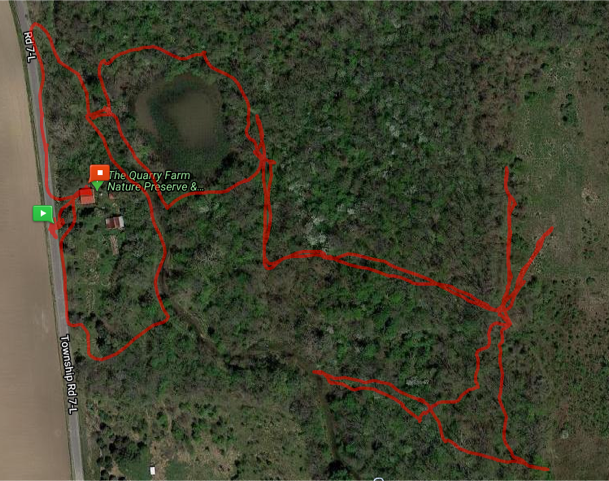
Here on The Quarry Farm, bush honeysuckle whacking is a means to social-distance ourselves during Ohio’s StayHome proclamation. At this pace we may see the forest for the invasive trees this year. As David Seitz works his way south from the old stone quarry, Paul Nusbaum is clearing A new walking trail to skirt the ancient homestead well, Riley Creek, and the Bottom’s rich vernal pools. That area is a quiet shelter for migrating songbirds. As I took out my own pandemic fear and frustration on bush honeysuckle and a [gasp/horror/curses] privet I found at the northern-most point of the nature preserve, a Black and White Warbler eyeballed me from the top of a small maple. My camera and phone sat safely at home on the kitchen counter so the only image I can share with you is a description of a dainty bird, striped black and white from beak to tail.
The aforementioned lack of camera is the lead in to the story that I saved for sharing on a rainy day. Thunder rolls outside today and heavy downpours turning clear Cranberry Run the creamy brown of the surrounding fields, so here goes. I present to you a tale filled with suspense, partial nudity and a happy ending.
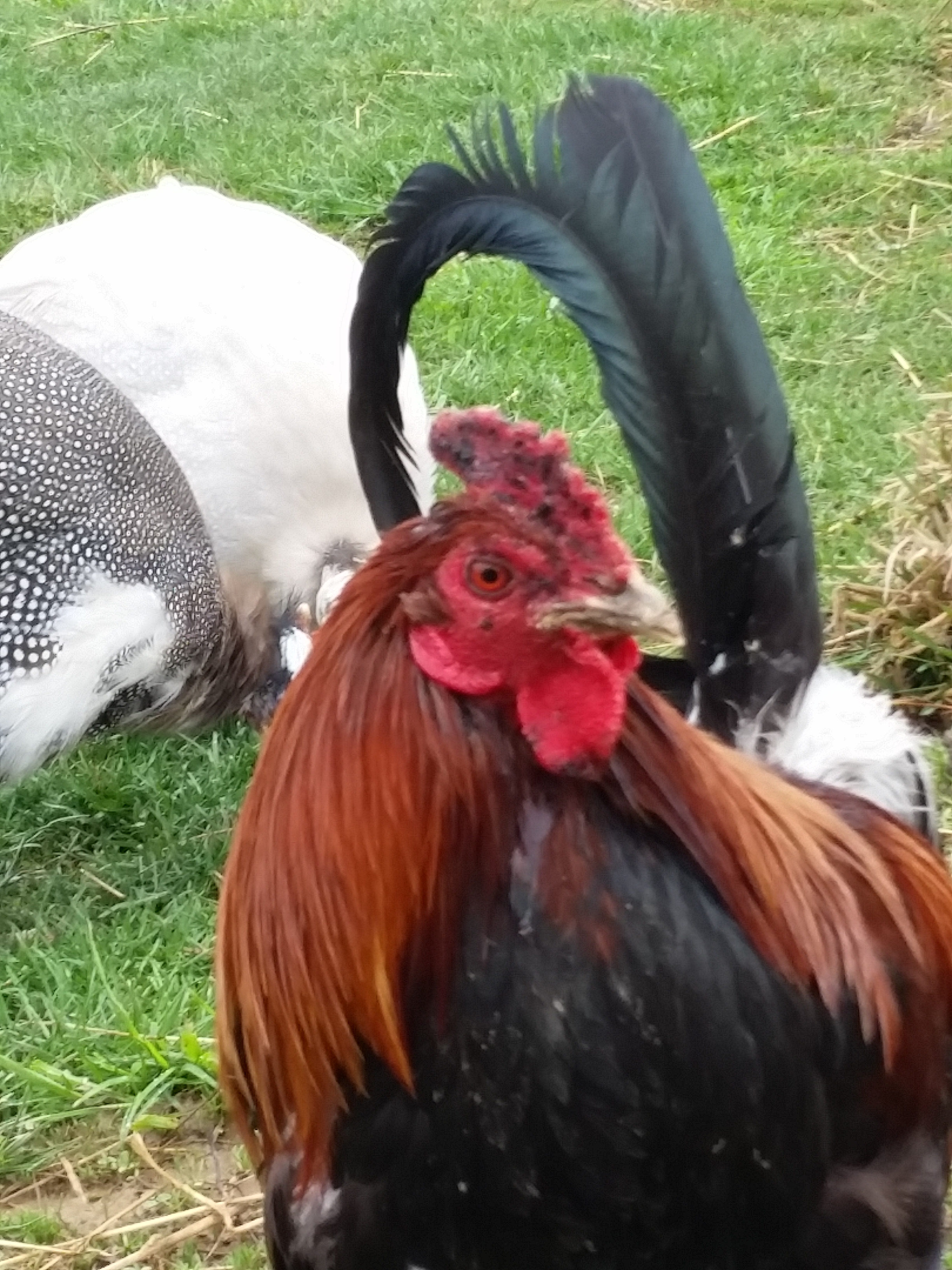
It was a dark and cloudy Wednesday night. Somewhere in the darkness, a domestic fowl uttered a strangled cry. Fergus the Tree Walker Coonhound scrambled to his feet, baying all the way down the stairs. I stumbled along behind, forgetting my eyeglasses on the nightstand. Fergus blew out the front door and down the driveway. Quinn Fox wove through the hound’s floppy Muppet feet, emerging through the tangle with Gerald the Rooster in her jaws. I screeched at her to “drop it!” She did! Fearing the worst, I carried a limp Gerald into the house. He had a heartbeat, so I left him in the bathroom basin and ran back outside, trading Fergus for Cady the Pitbull because Cady is quieter at 2:00 a.m. than an excited hound dog. My Steven was now in the fray, tracking Quinn with the flashlight app on his cell.
I was in a shortie. Steve wore a t-shirt and boxers. Our shoes and my eyesight were in the house. It was maybe 40 degrees on March 25 in Northwest Ohio.
We took turns going back inside to grab shoes, jackets and cheddar cheese. After much fun and games on Quinn’s part, the little red streak took refuge under the front porch. Steve shown light under the deck while I crawled under, cheese in my cold little fist. Since Quinn likes cheese and there is no soft pillow under the porch, she was ripe for reclamation. Once she was back in the warm house with Fergus and Cady, Steve spotted a wet mound of gray fur at the point of the Fergus/Quinn collision. A young Virginia Opossum lay there. Its tongue lolled on the grass and its legs curled in little clawed fists. We stared at it in the beam of the cell light, surmising that the marsupial had probably climbed up in the roosting box shared by Gerald and Arthur and startled Gerald into mad flight. While we watched, the dead creature blinked. Steve carried him/her down the hill and into the woods.
As far as we know, the opossum is fine. Quinn, Fergus and Cady are fine. Gerald was standing in the basin by 2:10 and is fine. That bird has the nine lives of a cat. We figure that, between picking fights with Arthur, predator encounters and a past life as a cockfighting rooster, he’s depleted his store of vivacity by at least half. Steve and I, however, ran through any amount of dignity we ever had long ago.
The headline of this post is a slogan from some years ago. The toymaker Gund used it to promote sales of their plush animals. It’s borrowed to encourage Easter bunnies to place toy rabbits, chicks and ducklings in baskets this Spring and to discourage everyone from giving live animals as gifts.
Brownie is our resident spotlight in the Spring 2020 Quarry Farm Newsletter which you may download by clicking on the cover to the right. Brownie rules a small flock of Rouen ducks in The Quarry Farm farm animal sanctuary. This expressive lady even took under her gentle (but firm) wing a young Canada Goose placed here for release by Nature’s Nursery. The gosling, creatively known here as “Baby Goose,” is so enamored of Brownie that she sleeps with her in the hen house at night, even though Baby Goose is now fully-feathered and can fly.
Brownie was surrendered to us by someone who acquired her as a duckling. Although Rouens look very much like large Mallards, Rouens are a heavyweight breed of domesticated duck that originated in France sometime before the 19th century. While Mallards are wild, lightweight flyers, Rouens weigh between 9 and 10 pounds and can only fly short distances. Brownie prefers to waddle-march around the sanctuary, sliding nimbly under the paddock gates to attend to whatever piques her considerable interest.
We spotlight Brownie here not only for her charming personality but as a reminder to refrain from purchasing live rabbits, chicks and ducklings as Easter gifts in April. Each year, Easter pets die cruelly from neglect or mistreatment or are surrendered to animal shelters that receive a surge of unwanteds. These animals are given up after owners lose interest or become unable to care for them. Others that are not taken to shelters are “set free” into the wild where they have no knowledge or experience at foraging or evading predators. Death is inevitable. Those that may survive become part of feral colonies of domestic and hybrid birds that cause problems for native wildlife.
Statistics indicate that within the first weeks after the holiday, 30 percent of all Easter pets die, and another 60 percent to 70 percent are abandoned or turned in to shelters. Instead of a Brownie, fill your Easter basket with a fuzzy toy and gelatin-free jelly beans.
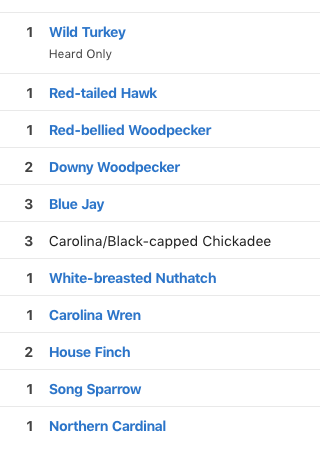
There are no two ways about it. Saturday’s Great Backyard Bird Count installment on The Quarry Farm was cold; 0 degrees F cold. Beautiful, with thick frost and snow and blue sky for the walk, but the cold filtered through Thinsulate, wool and whatever else each of us could layer over our pasty winter skins. To quote Jean Shepherd’s Randy, I couldn’t move my arms. But I could move my fingers well enough to record the different species of birds that chattered at us as we hiked the main nature preserve trails.
Our first sighting as a group was of a Downy Woodpecker in the great oak south of Red Fox Cabin. It’s feathers were so fluffed that I was sure it was a Hairy Woodpecker, a larger Downy look-alike that forages along trunks and main branches of large trees. Our frequent-flyer birders Deb Weston and Linda Houshower corrected me. Since I had made the first official recording of the morning–a group of European Starlings who shelter each February and March in the vent above our bathroom shower, I licked my frozen ego and left further identification to the experts. After all, that is one of the things we do here: invite people to share their own areas of expertise with everyone who wants to learn more about the natural world from different perspectives.

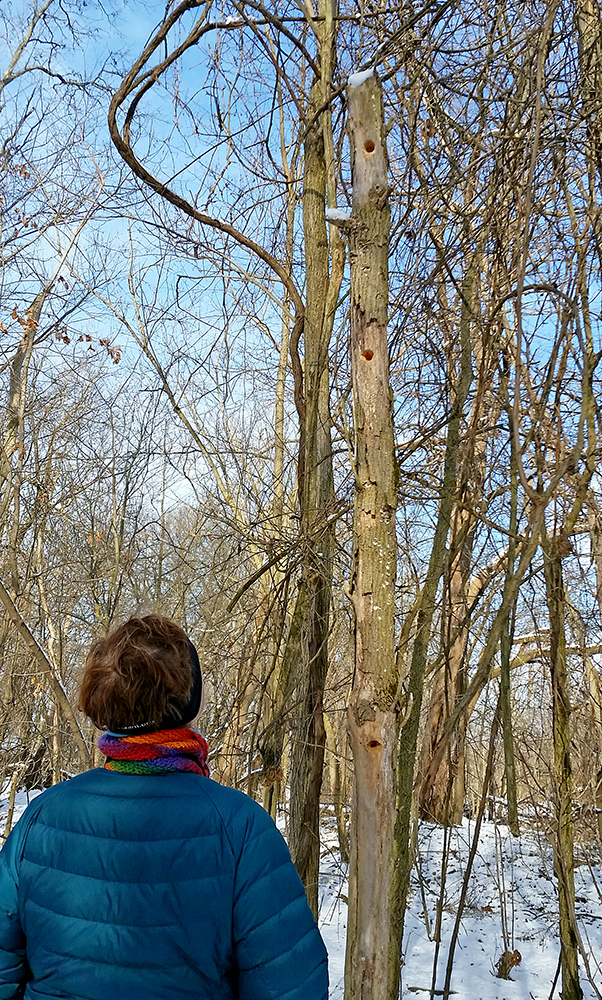
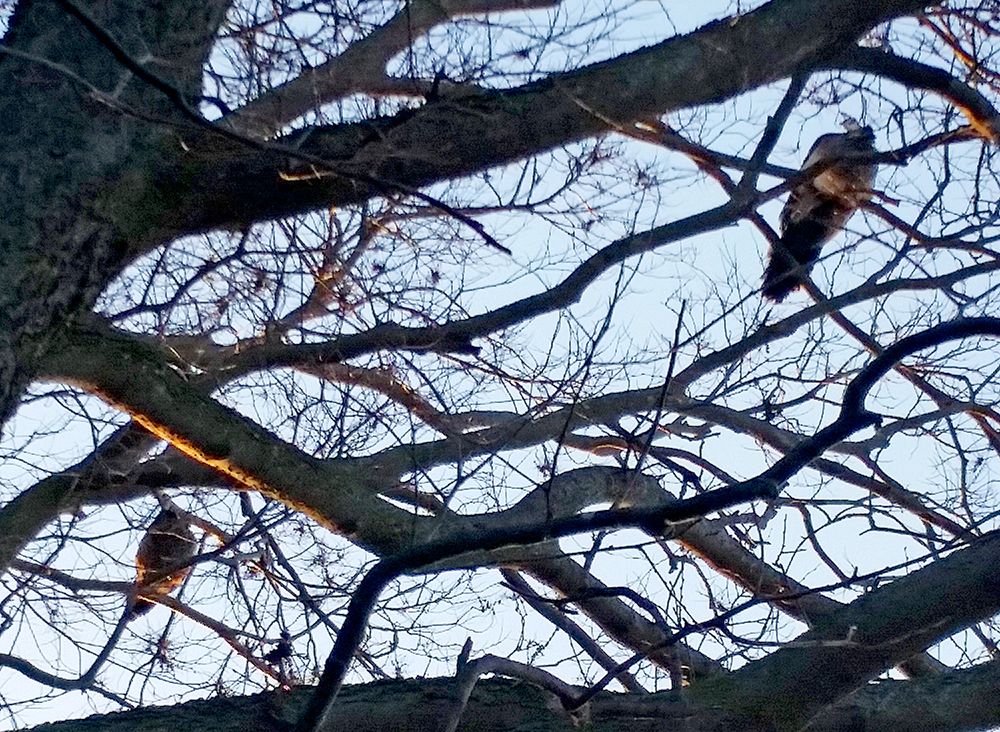
Down in the floodplain along Cranberry Run, Brown Creepers and White-breasted Nuthatches circled tree trunks and bobbed in and out of habitat piles created by David Seitz’s ongoing bush honeysuckle and grapevine removal. Bright, berry-red Cardinals chirped and sang. Wild Turkey foot and wing drags crossed the upland path. Woodpeckers left freshly-drilled holes in dead trees for us to find. A Red-bellied Woodpecker who flew above the canopy was one possible culprit. I thought I heard the Red-tailed Hawk that Steve had seen earlier that morning. Instead, it was a sassy Blue Jay mimicking that raptor and everything else his or her big bird brain has mastered.
Our count from Saturday and another done on Monday is now part of the official GBBC 2020 observation list. Deb and her friend David blazed a birding trail of their own on Thursday. They added their findings to the eBird count. Deb and David will lead the Spring Migration Bird Hike here on April 25.
This morning was a balmy 18 degrees F. The exotic peahens who arrived here recently sat high in a hackberry as the slightly less exotic chickens, donkeys, pigs, goats, geese, ducks, and a llama murmured, snuffled and scuttled from food pellet to seed and hay. The two big birds stared down at me as I left food at the base of their tree, not so much waiting for a chance to eat, but for the frost to melt from the window that they preen in front of as the wilder creatures go about their march to spring.
The scent of raindrops are in the air. Did you know you can watch the nature preserve bridge project from Google Earth? Engineer David does.
We do need rain/snow—maybe not all at once, but it is frighteningly pleasant for January in Northwest Ohio. The National Weather Service reports that we will have it as long as that green band of precipitation doesn’t rapidly shift southeast.
Board President Laura recalled the burnt toast odor that permeated the outdoors during the Summer of 1988. I remember that, as well as the smell of decay. As I ran the trails at Wildwood Metropark in Toledo, a doe walked out of the woodland of dried leaves and cracked soil. She didn’t run but feinted a few steps into the tree line and back out again. I have always regretted not following her. There was little I could do at the time to help, but I could have offered. I think of her every time I try to do so now.
How easily what is happening in Australia could happen to us. Our inland waterways could save us, as long as we save them.
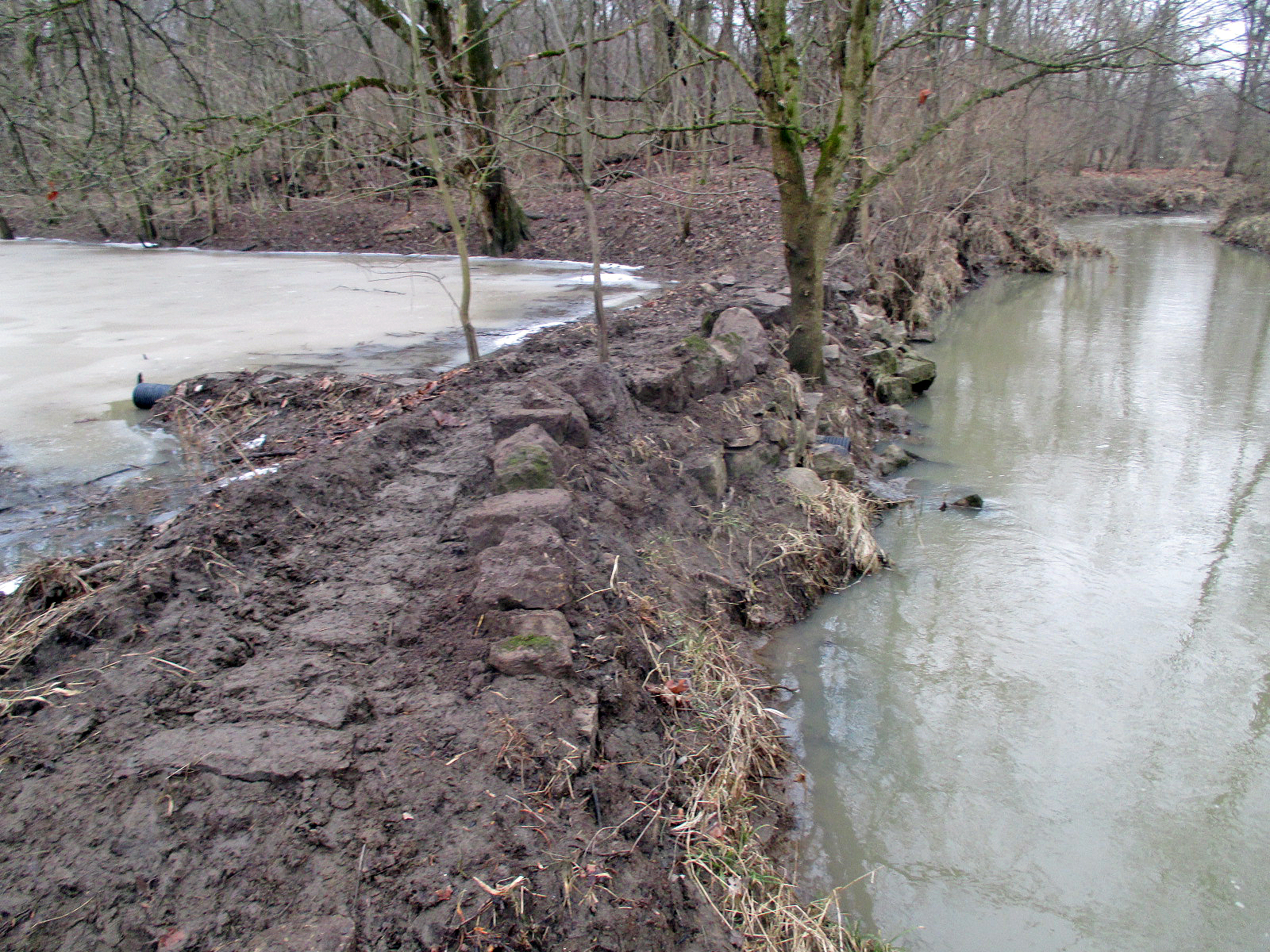
Speaking of which, stellar Friend of The Quarry Farm Dave is forging ahead with his efforts to protect the old stone quarry wetland from sediment overload produced during flood events. The land bridge between Cranberry Run and the quarry provided a great nighttime path for the Girl Scouts last month, with the young explorers spotting fish and all manner of shadows through the thin film of ice over the stream. This spring, participants in water and plant quality studies to contrast the wetland and the Run will now have a flagstone deck. Here’s the latest from our favorite engineer:
“Nice day down by the quarry. Built up the bank a bit, at the north side of the culvert. Just wasn’t wide enough. Shoveled about 2 hours. Wide enough now.

What’s more fun than a winter hike? A winter NIGHT hike, naturally.
On the eve of the Winter Solstice, 7 Girl Scouts, their leaders and sibs, earned their Hiking badge in the nature preserve. We set out at 6 p.m., flashlights in mittened and gloved hands. The sky was a little hazy, but we could see Cassiopia and the Big Dipper, with flashlights off, from our seats in the new Nature’s Classroom. Venus, the dazzling evening “star” of December, greeted us on the return hike up the hill south of Red Fox Cabin.
The hike was lively, with the questions and observations that are some of the best things about sharing the trails. We didn’t hear or see wildlife but they undoubtedly saw us. Turkeys had been there first, leaving trails with their wingtips in the snow. Squirrels had crossed the paths, leaving little prints at the top of one hill where its looked like they took a breather before moving on. We saw tiny hoof prints and larger padded paw marks left by a fox or Stitch, the large neighbor cat who stops by when children are onsite.
Thanks to the troop for bringing apples, carrots and potatoes for the residents of the farm animal sanctuary.
On Friday, as we walked the main trail, one of the scouts asked me if I best liked hiking during the day or at night. Come on over and decide for yourself on Saturday, January 11, from 8 to 9 p.m. We will hike under January’s Full Wolf Moon named after howling wolves who are, tragically, no longer here. But we can imagine and celebrate what is and what may be. Please bring a flashlight and dress for the weather. Call 419-384-7195 or email thequarryfarm@gmail.com by Friday, January 10, at 4 p.m. to tell us you are coming.
I keep getting offers for winter getaways to someplace(s) warm and sunny; blossomy and sun-kissed. I could sail away in a hotel on the water—a hotel of the sea with a chlorinated pool suspended several stories above the ocean’s surface. I could languish on a groomed beach with a drink in each hot little hand.
No thank you. I doubt that any flu shot will stave off the no-see-ums contained within those floating marine petri dishes. And beaches are best wild and untamed.
My feet do miss the feel of warm grass splayed beneath and between their toes. Steve came dancing inside before this morning’s sunrise. He had been gifting Nemo with her morning potato, thinking that his bare feet wouldn’t object too painfully to the inch of snow on the deck. Certainly not for a journey of several giant steps. They did take umbrage. I’m sure we will both do it again before spring because shoes can be such a pain, you know?
A friend who feels oncoming winter with and intense shade of mental gray was lamenting the cold season. “One more winter; I can do this.” Daylight is short and temperatures low. Time is lost to layering clothes and the aforementioned shoes. Flowers and leaves are shriveled to husks that whisper in wind chill.
There are still flowers, tiny blooms of sorts that bud with the cool humidity.
And there are leaves, of sorts, upon lost leaves.
The donkeys and goats, stand with their faces to the sun, eyelids half-mast. Their winter coats are woolly with prisms of guard hair. The turkeys and chickens turn the snow and dried leaves for stray seeds and insects that surface in the insulated layers near to the ground. Their winter feed is higher in protein than in the summer, but they prefer the diverse smorgasborg sustained in leaf matter.
The roosters stand guard in their feathered jackets, like sentinels in coats embroidered in jewel-tone threads.
And the sunsets…you just have to be there.
When an illustrated print or pattern is framed as home decor, the accompanying mat is usually selected to highlight s color from the piece or to match the floorcover or curtains. A work of art—now that’s a different story. A work of art is matted in white or black. Black and white are not colors because they do not have specific wavelengths. Instead, white light contains all wavelengths of visible light. Black, on the other hand, is the absence of visible light. A work of art stands alone. Winter is the mat for nature’s art.
That’s my story and I’m sticking to it. I have enough sweaters to frequent this Northwest Ohio gallery. I’m sending you a scarf, Russ.