Where are You, Woolly Bear?

Have you noticed, as we have on The Quarry Farm, an absence of Woolly Bear caterpillars this fall? Typically, the fuzzy black and brown creatures are a common sight in late summer/early fall, crawling on the warm pavement of our country road. Not so this year. Here’s a brief look at the life of our fuzzy, bristly friend, to know it better and attempt to understand why its scarcity matters.

Woolly Bears are the caterpillar form of several related moth species, including the orange-yellow Isabella Tiger Moth (Pyrrharctis Isabella), which ranges across the U.S, and Southern Canada. The moth typically produces two broods a year. It lives about two weeks, nectaring on a wide variety of flowers. It mates, lays eggs, and dies. The caterpillars we see in the fall are the second brood. They’ve grown fat on leaves such as violets, nettle, sunflower, maple, and elm, and green grasses, and they may have shed five or six times while growing. When the fall brood is ready to pupate, it finds protective winter cover under leaf litter or logs or rocks. During the winter it pupates in a cocoon made from its bristly hairs and emerges as an adult in the spring. The cycle repeats to produce a summer brood.

The second-generation caterpillars that we see in the fall (in a normal year) have eaten their fill, are preparing to hibernate, and are out and about because they’re looking for cover. They are not going to poison us if we pick them up (although they can feel prickly). And sadly, they can’t predict our winter weather—by coloration or by size of the brown band around their middle. Those features are influenced by stage of development, belonging to a particular tiger moth species, and diet. There is no special little weather sensor embedded under the fuzz.

So why are we seeing so few Woolly Bears? First and foremost, no doubt, is the serious decline of many moth species worldwide—for all the reasons that we know too well and are struggling to deal with: climate change, habitat loss, light pollution in populated areas, pesticide and herbicide use. Also, we could look around us recently at a bleached, drought-ridden landscape and see little food for Woolly Bears preparing to hibernate. Their absence matters because, as pollinators and a major food source for birds and other animals, moths are an important link in the food chain that sustains us.

—The Gardener at The Quarry Farm

Savoring signs of life

DSC_0748Earlier this month, friend Kathy Doty taught me how to spot the difference between male and female Monarch butterflies. Visually, it’s really not that different than humans. I kept hearing that little girl who was a YouTube sensation several years back, her sing-song show-and-tell voice explaining to her classmates, “Boys have theses, see.” I’ve sat through a lot of PowerPoint presentations about Monarchs. I know the right way to hold them as you apply a tracking tag prior to release. But no one has every told me who has what. Kathy also displayed a young Praying Mantis and a viable Swallowtail chrysalis, anchored in place by one tiny gossamer lasso of swallowtail thread. She spotted both eggs and caterpillars in the Red Fox Cabin gardens. The sightings never cease to thrill.

Several days later, a steady stream of visitors to Summer 2019 Family Day watched monarchs, bumblebees and more dragonflies than I have seen since the June 2012 floor wax discharge decimated the variety of dragonfly nymphs one could sample in Riley Creek. It was hot, hot, hot in the sun. Steady breeze and ice water kept those of us anchored to the ground cool enough to take pleasure in flighted creatures who have the wherewithal to catch thermals.

With double-digit degrees less outside, Deb Weston walked the trails with her Debbie and a camera on Thursday. They spotted an Ebony Jewelwing damselfly, a female Baltimore Oriole, a Painted Lady butterfly, a Monarch, and two Rose-breasted Grosbeaks, birds I haven’t seen since I picked wild raspberries along the cut-off oxbow to sell at Andy’s IGA in Pandora.

I could wax on. How about I share Deb’s photos instead?

This slideshow requires JavaScript.

Color run

It took the dregs of July, the last real rain to percolate through the cracked ground, to get us through three weeks of no rain. A mustard haze hovered over the corn field across the road. Any bit of breeze brushed it into the water pans and left a brown coating on grass that was already crispy. Water in the cabin rainbarrel was conserved used sparingly.

In the floodplain, Cranberry Run didn’t run. Darters, minnows, crayfish and blue gill duked it out in pools, the survivors left to feed the great blue herons by day and raccoons by night.IMG_2139 (1)A week ago, rain–rain we needed so very much–came and went, leaving fungi of all sorts sprouting and the rainbarrel full. The drought dried up the mosquito swarms, leaving perfect conditions for outdoor art workshops. There’s no better time to paint in watercolors than when water drips from the eaves of the shelterhouse, eh?IMG_2122
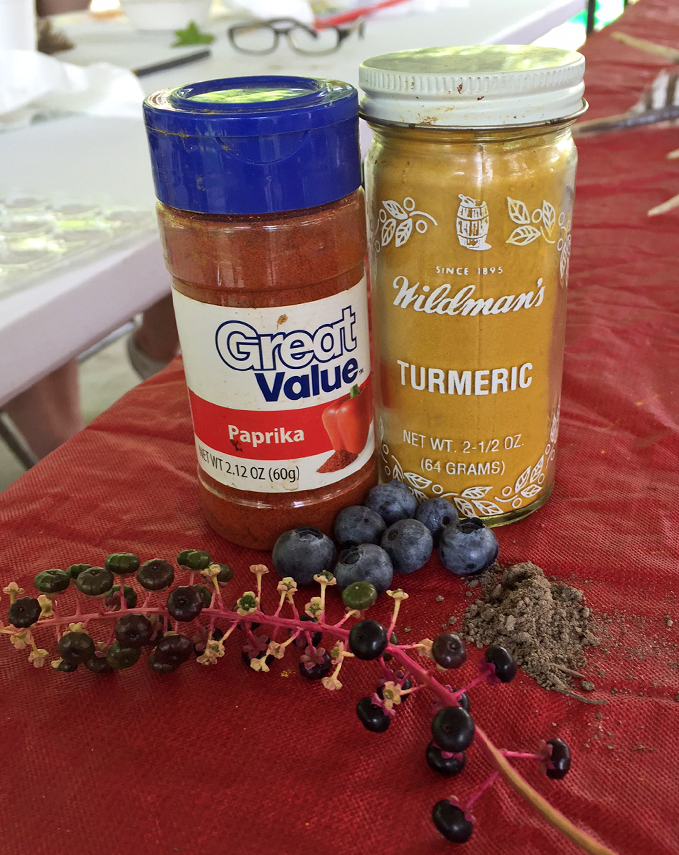
On August 20, we dug through the kitchen cupboard, the garden and its edges to pool a palette of natural pigments with which to paint still lifes and landscapes. The Saturday class includes individuals from right here in Putnam County to a Tennessee visitor. Using rich colors derived from paprika, turmeric, blueberries and poke berries (plus black coffee, something that’s part of every workshop here), participants developed pieces lush with late summer color. Store-bought paints were also available and most everyone washed the first layer of a second work.

This slideshow requires JavaScript.

There were visitors of different species, including an unidentified caterpillar and two haywagons-full of riders shuttled by neighbor Daryl Bridenbaugh. When paints were put away, the creative mood was still fresh. Board President Laura shared a slurry of shredded, soaked paper, mixed in some concrete plus a little dab of this and that so those that could stay onsite could make papercrete containers.

On this last day of August, one pot has traveled home to North Carolina while the others are still drying in Ohio. Instead of yellow dust, there is fog.

And it’s raining.

Small Triumph

Sandhill Cranes, 2014 Garden, Pipevine Swallowtail Larva 023

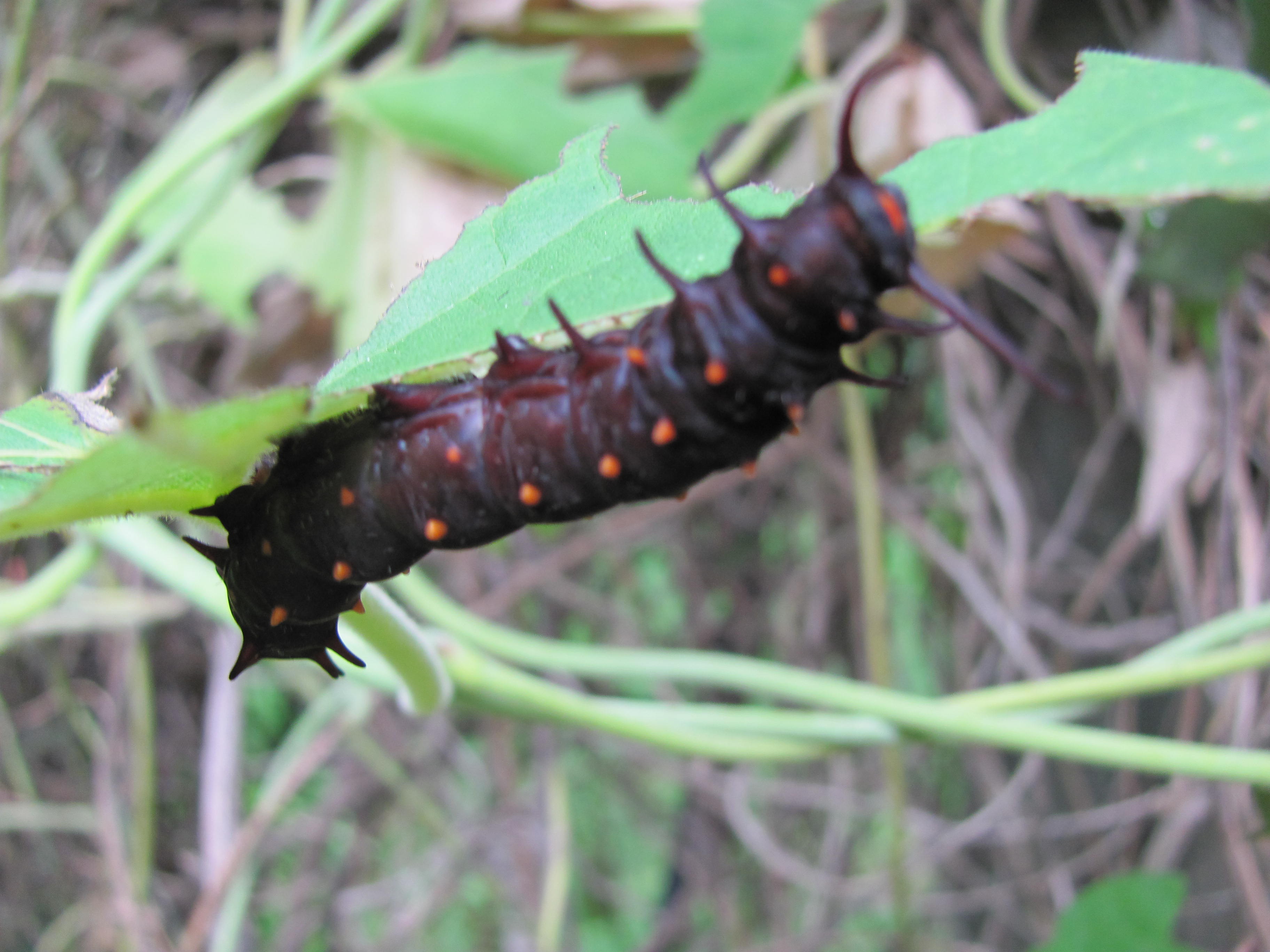
Why would a gardener be happy, overjoyed even, to discover an army of fat, black, spikey-looking caterpillars with red polka dots pillaging a prized ornamental vine?  Answer:  When the marauders are Pipevine Swallowtail butterfly larva and the vine is Dutchman’s Pipe (aristolochia macrophylla), one of their host plants.

For the ten summers and more since husband Gerald planted two pipe vines in the garden at Red Fox Cabin, we have kept watch on them.* We’ve admired the cute little Dutchman’s pipes they bear and checked the foliage for ragged holes that would give away the presence of larva. We’ve peered at black with blue swallowtails, hoping to spot the distinctive coloration of the Pipevine, inky black forewing and iridescent blue hindwing.  However, sightings have been extremely rare and none have chosen to lay eggs on the beautiful Dutchman’s Pipe. Until this July.

Sandhill Cranes, 2014 Garden, Pipevine Swallowtail Larva 016Last Saturday evening as I was walking my Jack Russel, Lefty, or rather as he was leading me where he wanted to go, he tugged me toward the rear of the log cabin, where one of the pipe vines grows luxuriantly on a porch pillar.  Lefty was intent on the rabbit or cat or whatever that he scented underneath the porch, but I was halted in my tracks by the sight of that vine, no longer luxuriant, but ragged, nearly defoliated, and crawling with the aforementioned fat black caterpillars–at least twenty.  Thrilled by the sight and the realization that our vine had finally been discovered by a passing Pipevine Swallowtail, I rushed home with a disappointed Lefty to grab my camera and my Peterson’s field guide to caterpillars, for confirmation.

Sandhill Cranes, 2014 Garden, Pipevine Swallowtail Larva 012According to the guide, predators avoid Pipevine Swallowtail caterpillars because the vine that feeds them is toxic and makes them unpalatable.  Also, when they are ready to pupate they tend to crawl away from their host plant and find other places to attach a greenish chrysalis with a silken thread.  So, the total disappearance of the caterpillars two days later was not as alarming as it might have been.  Photos and a ravaged vine prove they were there.  Quite likely, somewhere on the Quarry Farm later this summer, a Pipevine Swallowtail, or maybe twenty, will emerge from its chrysalis and sail into the butterfly garden to dine, and with luck someone will be there with a camera.  A photo of the shimmering beauty will be a fitting tribute to Gerald, who inspired us with his love of butterflies and planted the Dutchman’s Pipe so many years ago.

*[Pipe vines are native  in some parts of the Northeast but not in Putnam Co., Ohio; ornamental pipe vines were common in Victorian gardens but are less so today. Pipevine Swallowtails can complete their life cycle only if they happen to find a host pipe vine or a Virginia Snakeroot growing wild or deliberately planted.  Adults might stop to nectar in a flower garden but will move on if a host plant is not available.]