Snow Day

This morning, bands of clouds the color of dust stretched from the horizon to the sky. I know that sounds strange: of course the clouds stretched to the sky. What I mean to say is that the clouds didn’t lay horizontally across the heavens. No. Instead they seemed to start at some point on the horizon and launch themselves into space, like rocket trails or streamers of toilet paper. And when I say that they were the color of dust, I don’t mean gray. They were more beige with a little bit of peach thrown in, somewhere between a very light brown and red. And even though they weren’t red, I couldn’t help but think, “Red sky in morning, sailor take warning.”

As it turns out, that was more than a little melodramatic. But even so, the day had its moments. Every little bit a snow squall would blow through with heavy flakes swirling about making it hard to see, or with small, hard, almost-pellets of snow that would sting your face and hands. And it’s been cold, and growing colder as the day progresses. Thankfully, we held our Backyard Bird Count event (and more about that tomorrow) before the worst of it rolled in. Short, hard snowfalls offer interesting opportunities photographically, so we decided to take a few shots of the animals that live close to the house. These, then, also give us the chance to relate an anecdote or two, to introduce you to some of the animals that live here.

So. Here we go.

Gigi

Gigi

Gigi and Louise are two of four geese that live here on The Quarry Farm. Anne brought them home from Van Buren State Park near Findlay. She was there to give a presentation on water quality and macroinvertebrates about a year and a half ago when the naturalist who organized the event, Natalie Rossman Miller, conscripted Anne in an effort to trap two geese that were dumped at the park. Suffice it to say that, ultimately, they were successful, and Anne brought them here. Gigi is an Embden goose and, despite the name, entirely male (we’re not great at sexing birds at a distance; we once named a rooster Miss Kitty). Louise is an African goose and very much female.

Louise

Louise

These two, along with Henry, the other female goose (I know, I know) on the property, serve as our early warning system. On those occasions when the mail carrier has a package to bring to the house, or American Electric Power has come to read the meter, or someone has simply come to visit, these three make enough noise so that, even in the house we know that we have guests. And if we’re being completely honest, they make enough noise so that our neighbors a quarter of a mile away know that we have guests.

While we’re on the subject of geese, here’s Johnny. Johnny is a Canada goose. He was found oiled in Lima, Ohio. A local veterinarian took him on, cleaned him up and treated him for about a month before calling Nature’s Nursery Center for Wildlife Rehabilitation and Conservation Education. Over the course of that time, Johnny imprinted on humans.
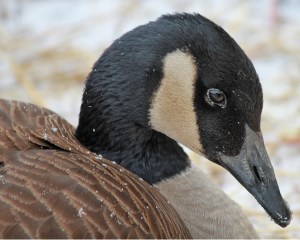
Johnny

Johnny

In addition to that setback, Johnny also has a congenital wing defect; his left wrist never developed properly and consequently the end of his wing protrudes at a right angle to the rest of his body, precluding any possibility of flight. In Johnny’s plus column, however, is one of the sweetest dispositions of any animal, anywhere. This bird just doesn’t know the meaning of ill-tempered. When we pull into the drive, he greets us with a honk characteristic of all Canada geese, then rises up and beats his wings.
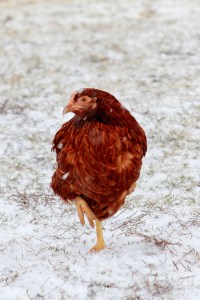
Little Red

Little Red

Nearly a month ago, we were provided with the opportunity to expand our flock of chickens.  A local farmer received an unexpected bonus shipment of pullets that increased his flock beyond his capacity to safely maintain. We took on fourteen of the hens, the most the farmer would allow us to acquire. In the overcrowded conditions to which the birds were temporarily subjected, they inflicted no small degree of damage to one another. Feathers were pulled loose until many of the birds were half-plucked. Their skin was raw and sore and, in some cases, infected. Despite our best efforts, four of the hens died. But, being the kind of people who believe that the glass is half full, ten survived and are thriving. One of them, a Rhode Island Red, is particularly friendly. She’s the first to bound out of the coop each morning and will run across the yard to greet us when we arrive back home. We call her Little Red.

(from left) Buddy, Marsh and S'more

(from left) Buddy, Marsh and S’more

Finally, at least for the purposes of this post, there are the boys: Buddy, Marsh and S’more. Marsh and S’more, two Nigerian Dwarf goats, came to us first, arriving in July of 2o11. They came to us from a family in Cincinnati. Although the family loved them their two large dogs didn’t and made life miserable for the brothers. In seeking a home for them, they contacted the American Society for the Prevention of Cruelty to Animals, and through them, us. Buddy, a miniature donkey, came from closer to home. A Putnam County couple kept Buddy as a companion for their horse. When it became too difficult for them to continue caring for the horse, they found it a new home. Sadly, the people who took the horse weren’t interested in Buddy. According to his old family, without companionship, Buddy began to waste away. They contacted us and Marsh and S’more became Buddy’s new buddies. And while they get along phenomenally, that doesn’t mean that they don’t have issues. Jonelle Meyer, a young woman who volunteers here at The Quarry Farm, recently told us of one such incident. As she was currying Buddy, the goats kept wandering up looking for attention. Buddy grew increasingly impatient with this until finally, when S’more refused to take the hint, he reached out, took the brush from Jonelle’s hand, smacked S’more in the face with the brush, then returned it to Jonelle so she could get back to what was really important: taking care of him.

So. Routines.

Routines. We’re governed by them. The side of the bed we sleep on, the way we rise in the morning, break our fast, brush our teeth, the routes we take to work, slog through the day, reverse the route to work back home, eat our meals, play our games, relax, watch television, listen to music, then climb back into bed. Routines are comfortable. Routines are safe.

But they tend to engender complacency.

And then, all hell breaks loose.

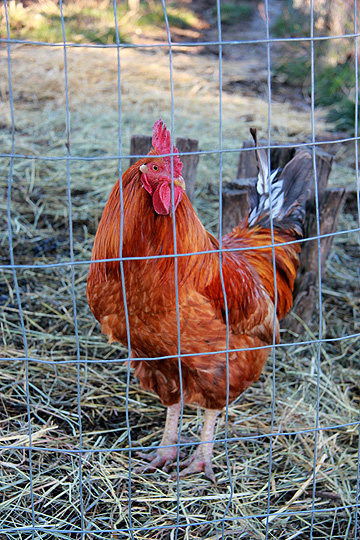
BuddyHere’s a tidbit of information you may or may not know about The Quarry Farm: we practice a pretty rigid little bit of gender segregation where the outside farm animals are concerned. The girls, mostly the hens, live in their coop and are allowed free range of the property, at least the domesticated part of the property. The boys (and by “the boys” I mean Buddy, the miniature donkey, Marsh and S’more, the Nigerian dwarf goats, and Jeff, Ralph and Bernie, three production red roosters) live in a fenced-in paddock on the north side of the property. We keep them contained because Buddy, Marsh and S’more are always up for a short road trip (something the neighbors don’t always appreciate) and because the roosters are, well, roosters. Not only are their affections not always welcomed by the hens, they tend to get a little protective, a little aggressive toward anyone who gets near “their” girls. So there’s a fence. Think of it as a very large, communal chastity belt.

So. Routines.

In the evenings, as the sun begins to set, we work the property: the hens are enticed back to the coop, the duck and the geese are, likewise, encouraged into their shelters and the boys get a little more food, just a little bit of something to tide them over until morning. Yesterday, as we started our evening routine, Marsh and S’more were outside the paddock, roaming the property. While not the ideal situation and not how every day plays out, it’s not unusual for them to go over the wire. We’ve seen it before and we’ll see it again and there’s a routine for dealing with this, as well. Rather than tend to the chickens before visiting the paddock, the boys get their evening snack first. After all, the girls won’t go in with Marsh and S’more leaping in and out of their coop so we have to lure the boys back to the paddock. We trundle out a flake or two of hay and the boys trot along with us, occasionally rearing up and butting heads and practicing all of the other endearing behaviors that make goats such interesting animals.

GoatsEverything was going along according to routine: we had the hay and the goats had gamboled along with us back to the paddock and had run on in when the gate was opened. We carried the hay in, spread it out in their shelter and stepped back. Typically, Buddy will wade in at this point and control the feedlot. Typically. And here’s where complacency leaps up and bites: when you add a vowel and the typicalbecomes atypical. Because Buddy’s behavior is so uniform, so predictable, we’re sometimes careless about the gate. So, even as the goats were jumping to their meal, Buddy bee-lined over, pushed on by and out the open gate behind us.

Understand this: Buddy on the loose is a joy to behold and the epitome of frustration. He will trot by within hand’s reach, head high, ears back and then stop to crop grass, waiting until you’re certain he’s going to let you catch him up before taking to his hooves and trotting just out of reach. Watching him, you’ll swear he’s laughing as he passes by, nudging you in the process. And he can do this for hours, leading you on a merry chase across the property and beyond.

Last night, thankfully, it was a short romp.

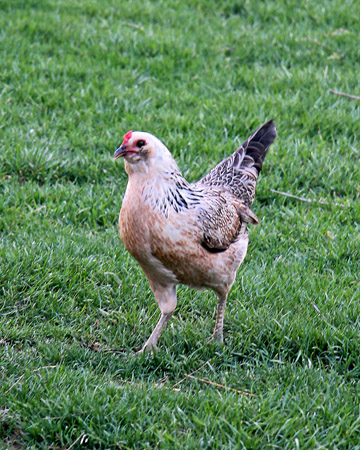
With Buddy back in the paddock, we were back to routine: making sure the chickens were safe in their coop. There are thirteen hens: Karen, a Production Red; Barbara, a Black Australorp; Big Girl, an Ameraucana; and the ten remaining Priscillas, all of them Hubbard Golden Comets and the first chickens to come to The Quarry Farm. As part of the routine, we count them each night. Thirteen girls in the coop mean that none are at risk from any of a number of predators looking for an easy meal. Thirteen, for us, is a lucky number.

So we counted.

And came up with fourteen.

JeffDuring our episode with Buddy, Jeff made good his escape and slipped in with the girls. He’s done it before and we’ve even allowed him to stay in the coop for a night or two. But, as noted earlier, roosters get a bit possessive and protective of the hens they consider their own. So we decided to catch him up and take him back to his enforced celibacy. Jeff’s a docile bird, so getting him in hand wasn’t terribly difficult. Then it was simply a short walk and a quick drop over the fence. Done and done, right?

Not exactly.

As it turns out, Jeff wasn’t the only rooster interested in busting out. As we approached the paddock, Jeff in hand, we noticed Bernie scratching in the tall grass on the wrong side of the fence. Bernie, too, is a fairly docile bird, so long as there are no hens to battle over and you’re not wearing red. Having said that, he’s a bit less inclined to permit any kind of truly close contact than is Jeff. In other words, he’d greatly prefer it if you kept your hands to yourself and he’ll do whatever it is that he needs to do to keep it that way. For a third party, watching someone chase a chicken is slapstick the equal of anything that Hollywood has ever conjured up. For the one doing the chasing, though…well, that’s a completely different set of experiences. Chickens duck and jive as they run, juking this way and that in a series of quick dashes intended to confuse whatever predator happens to be chasing them. Couple that with the gathering dark and it took a good long while before Bernie was back with the boys.

As is the routine, here on The Quarry Farm.

POSTSCRIPT: Some of you may remember the storm that blew through the region this past summer. Last July, a derecho tore this county apart. While the damage inflicted on our little piece of the county paled in comparison to others, we did suffer one significant loss: Little Chicken.

little chickenLittle Chicken was a bantam hen that split her time between The Quarry Farm and a little-used outbuilding on the property immediately adjacent to ours. She would come most frequently in the mornings and evenings, those times when we put out fresh food and water for the chickens that live here full time. The derecho caused significant injury to her nesting spot, the barn next door, and, after she failed to show up for over a week, we assumed her either an immediate casualty of the storm or easy pickings for some predator.

Last Sunday, we learned differently.

It turns out that Little Chicken, pushed out by the storm, wound up at the home of an acquaintance that lives about a mile away. Whether blown there or because she wandered there seeking new and more appropriate sleeping arrangements, we’ll never know. What we do know is that she’s found a wonderful new home, a home where she’s watched over and cared for.

So, apparently, the old adage is true: it’s an ill wind that doesn’t blow some good. And for the Siefkers, that good took the shape of Little Chicken.

They call her Clucks.

When the Frost Is On the Donkey

There was a hoary frost this morning. Donkey and goats were the first to be watered and fed, mostly because Buddy’s braying echoed resoundingly across the fields to bounce off the neighboring homes and farms. Buddy must have been at his post in the southeast corner of the paddock, watching the house for signs of movement for some time since a thick layer of frost iced his back. Once the boys were satisfied with fresh hay and the roosters had their feed, I had to run for the camera.

I figured I would take another photo on my way back for more water buckets. Just one more. The sunflowers still have a few seeds to feed the birds. Almost to the front door at the top of the path that leads to the nature preserve, Gertie’s blankets hung to dry. The bright contrasts of orange, yellow and green struck against the crystal grays, blues and browns of the treeline.

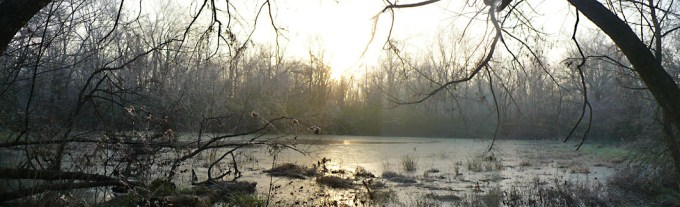
Although there are few this year, the osage orange trees have dropped their fruit beside Cranberry Run. The only green otherwise are the dreadful invasive honeysuckle, but the red berries of the shrub are undeniably jewels for the returning slate-colored juncos and other snowbirds. I made it to the old stone quarry in time to capture the mist and sunrise above the wetland. Photos never do their subject true justice, but there you have it at the top of the post.

The frost layers have peeled away and are snowing to the ground. The sun is high enough that some of the frost is more like cold rain, at least under the trees. The hens have eaten their fill for now and Beatrice is on cleanup. I’m off to the road myself.

It’s the little things (that show you care)

Here on the farm sanctuary of the Quarry Farm, you all know by now that we have chickens. Of those chickens, four are roosters. One rooster, Sid, doesn’t count because he is fancy and that keeps him docile and slow-moving. Bernie, Jeff and Ralph are birds of a different feather altogether.

These three probable Rhode Island Reds have three different origins that shall remain a mystery to us. But all three will live their lives together in the paddock with Buddy the miniature donkey and Nigerian dwarf goats S’more and Marsh. Sid has the roam of the rest of the place where he is tolerated by the hens who can easily out-manuever  him. The three other roosters have an easy truce between themselves as long as the hens keep out of the paddock. And when no one is in there with Mr. Shovel.

Unfortunately Mr. Shovel must make an appearance every morning in order to remove the donkey, goat and rooster leavings from the previous day. Bernie, the original rooster, does not care for Mr. Shovel. Nor does he particularly care for the person who is wielding Mr. Shovel.

If you have ever been spurred by a full-grown rooster, you know it results in white-hot searing pain that bleeds like nobody’s business. The kick that accompanies the spur usually leaves bruises. I myself actually suffered my first severe ankle sprain after a confrontation with Bernie. Since chicken dinner is not on the menu here on the farm sanctuary (so don’t even go there) I have learned: A) not to wear bright red around Bernie; B) keep Mr. Shovel between myself and Bernie; C) make sure Ralph is keeping an eye on Bernie.

At first Bernie was very friendly, but sometime during the course of the second year he became aggressive, mostly with me. Steven claims it is because I wore a bright red rain jacket around him. The jacket went to Goodwill, but Bernie still came after me every time my back was turned. So Bernie was banished to the paddock so he wouldn’t go after anyone else. That helped until he took a dislike to Mr. Shovel. Enter Ralph.

Ralph came to live with us about two years after Bernie did. He was adopted with a group of hens, all unwanted by an Allen County landowner. So as to give the hens here a relatively stress-free existence, we put Ralph in the paddock, too. Ralph and Bernie duked it out for a while and Ralph came out on top. Jeff joined the fray some time later the same summer. Ralph remained the dominant rooster, so much so that Bernie’s comb diminished and he became quite tame. For about a season.

This spring, Bernie again decided that I am not to be trusted and indeed am to be chucked out of the paddock at every opportunity. But Ralph doesn’t feel that way. My little red-combed savior will keep himself between Bernie and me, even driving Bernie off to the far corner of the paddock. Ralph will also break up private trysts between Jeff and a hen named Barbara, but that’s a different story.

Just a few minutes ago, Ralph came to my rescue again. After posting this, I am going to take him a slice of yellow squash.

By the way, the photo of the horned worm has nothing to do with this story. Steve took this last week as these voracious creatures were being hand-eradicated from the tomato patch at Red Fox Cabin. I just thought it was a cool shot.

Buddy’s Big Day

Tiger in the garden

The Junior Master Gardeners of Continental (Ohio) graced The Quarry Farm with their presence on July 11, the first group to visit since the big wind blew through. Although there are still a couple of downed trees here and there, the paths were clear and mowed in time for the travelers to arrive.

Led by Charlene Finch, the group of 20 adults and children of varying ages drove in around 10 a.m. to beat the afternoon heat. They divided into three groups to rotate through three different learning and activity stations.

Mints and other herbs and flowers are bundled

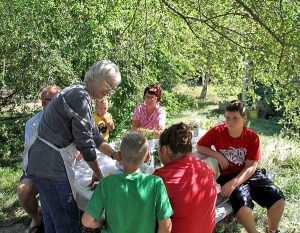
Group #1 met under the shady zelkova in front of Red Fox Cabin. From Board President Laura they discovered the history of the cabin and the grounds, the gardens and made herb bundles from cuttings gathered there.

Group #2 circled next to the ash stumps, recent victims of the invasive emerald ash borer. This was the perfect spot to hear Steve the Insect Guy talk about stream ecology, perfect because his roundtable included a meet-and-greet with riverine beneficial insects that grow up to combat harmful insects.

Meeting a dragonfly nymph

Group #3 walked to the farm animal sanctuary where they were heartily welcomed by Buddy the miniature donkey. Despite the white-hot rising sun, Buddy held his post at the southwest corner of the paddock and brayed greetings to each group, keeping up the conversation throughout their stay at the station. One volunteer in each group was assigned to pet Buddy so that he would keep quiet long enough for Beatrice the pygmy pot-bellied pig to come out and meet the kids. This event was the first educational outing for Beatrice. She took a special shine to a gentle boy named Brandon, allowing him to feed her a piece of apple. Geese and chickens checked out the group from a distance, as did the goats.

Buddy greets a gardener

After all groups had rotated through the stations, everyone met at the cabin for cookies, lemonade, ice water and a group photo on the front porch. Some strolled through the gardens to see the blooms of drought-tolerant flowers and to scout for butterflies and dragonflies. Many thanks to Board Secretary Rita for photographically recording the event and for sharing them for this post.