You don’t have to be a star (but it’s really fun)

The new greenhouse north of Red Fox Cabin was of interest to the Owens class as they are considering one of this size for a butterfly house.

The new greenhouse north of Red Fox Cabin was of interest to the Owens class as they are considering one of this size for a butterfly house.

Been awhile, but with good cause. Seems as though weekly (or biweekly) posts may be the new norm of spring at the Quarry Farm.

On May 29, seven people from Owens Community College, Toledo Campus, drove down I-75 and made their way here, despite the Road 7L sign being missing from the turn off State Route 12. Jeannie Wiley Wolf, Findlay Courier reporter, almost didn’t find us to do an interview for an article that appeared in that newspaper on May 28. Steve says the sign mysteriously disappeared some time ago. Anyway, Owens’ Associate Professor Joanne Roehrs got the van here.

Owens2The students are working to obtain the Urban Agriculture and Sustainability Certificate, a new offering at Owens. All of them have sweat-equity in the urban community gardens in Toledo, especially in the Robert J. Anderson Agriculture Training Center and greenhouses (900 Oneida Street; Toledo, OH 43608) which are projects of Toledo GROWs, the community gardening outreach program of Toledo Botanical Garden. The Anderson Center is used as an educational forum for Owens Community College students who are studying urban agriculture. The Center is also an open-air classroom where under-privileged youth are educated on growing sustainable nourishment.

While on the Quarry, Roehrs and her Livestock Animal Husbandry students focused on the organic gardening projects, the wild bee boxes and the farm animal sanctuary. They study beekeeping through the hives at the Anderson Center. We were able to tell them what not to do with bees, from firsthand experience, and of plans for new bees in 2014. Beatrice of the whirligig tail was our model sanctuary adoption success story as she greeted all with charming, intelligent porcine loveliness.

If you are, or know of someone who is looking at new, relevant career option investment, this is a program to explore: http://catalog.owens.edu/preview_program.php?catoid=3&poid=634&returnto=158

From that point until 11:59 a.m. on June 6, preparations were made for the arrival and tour of 90 individuals, mostly K-8 graders, from Columbus Grove Local Schools’ after-school summer program. For coverage of that Quarry Farm landmark event, I’ll let the press do the talking. Diane Myer of Black Swamp Raptor Rehabilitation Center, Stacey Cook of Hometown Station WLIO, Nancy Kline of the Voice and Alex Woodring of the Putnam County Sentinel, volunteers Cathy, Shannon, Jonelle, Brendon, Cherie and Dakota, you all wear superhero capes. As long as the links hold, here’s the news from June 6:

Putnam County Sentinel: http://putnamsentinel.com/main.asp?SectionID=1&SubSectionID=1&ArticleID=15695

The Lima News/Putnam Voice: http://www.limaohio.com/news/putnam_county/article_8053fd5a-cf9d-11e2-807c-0019bb30f31a.html
plus photo gallery: http://limanews.mycapture.com/mycapture/enlarge.asp?image=47607266&event=1665851&CategoryID=65761

Couldn’t ask for more. Maybe sleep. But that’s OK, more than OK. As WLIO’s anchor Jeff Fitzgerald noted, “They say it should  be shared.” And we do.

Snow Day

This morning, bands of clouds the color of dust stretched from the horizon to the sky. I know that sounds strange: of course the clouds stretched to the sky. What I mean to say is that the clouds didn’t lay horizontally across the heavens. No. Instead they seemed to start at some point on the horizon and launch themselves into space, like rocket trails or streamers of toilet paper. And when I say that they were the color of dust, I don’t mean gray. They were more beige with a little bit of peach thrown in, somewhere between a very light brown and red. And even though they weren’t red, I couldn’t help but think, “Red sky in morning, sailor take warning.”

As it turns out, that was more than a little melodramatic. But even so, the day had its moments. Every little bit a snow squall would blow through with heavy flakes swirling about making it hard to see, or with small, hard, almost-pellets of snow that would sting your face and hands. And it’s been cold, and growing colder as the day progresses. Thankfully, we held our Backyard Bird Count event (and more about that tomorrow) before the worst of it rolled in. Short, hard snowfalls offer interesting opportunities photographically, so we decided to take a few shots of the animals that live close to the house. These, then, also give us the chance to relate an anecdote or two, to introduce you to some of the animals that live here.

So. Here we go.

Gigi

Gigi

Gigi and Louise are two of four geese that live here on The Quarry Farm. Anne brought them home from Van Buren State Park near Findlay. She was there to give a presentation on water quality and macroinvertebrates about a year and a half ago when the naturalist who organized the event, Natalie Rossman Miller, conscripted Anne in an effort to trap two geese that were dumped at the park. Suffice it to say that, ultimately, they were successful, and Anne brought them here. Gigi is an Embden goose and, despite the name, entirely male (we’re not great at sexing birds at a distance; we once named a rooster Miss Kitty). Louise is an African goose and very much female.

Louise

Louise

These two, along with Henry, the other female goose (I know, I know) on the property, serve as our early warning system. On those occasions when the mail carrier has a package to bring to the house, or American Electric Power has come to read the meter, or someone has simply come to visit, these three make enough noise so that, even in the house we know that we have guests. And if we’re being completely honest, they make enough noise so that our neighbors a quarter of a mile away know that we have guests.

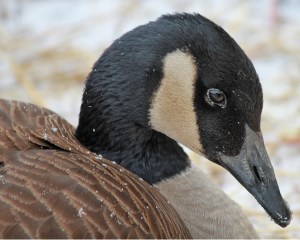
While we’re on the subject of geese, here’s Johnny. Johnny is a Canada goose. He was found oiled in Lima, Ohio. A local veterinarian took him on, cleaned him up and treated him for about a month before calling Nature’s Nursery Center for Wildlife Rehabilitation and Conservation Education. Over the course of that time, Johnny imprinted on humans.

Johnny

Johnny

In addition to that setback, Johnny also has a congenital wing defect; his left wrist never developed properly and consequently the end of his wing protrudes at a right angle to the rest of his body, precluding any possibility of flight. In Johnny’s plus column, however, is one of the sweetest dispositions of any animal, anywhere. This bird just doesn’t know the meaning of ill-tempered. When we pull into the drive, he greets us with a honk characteristic of all Canada geese, then rises up and beats his wings.

Little Red

Little Red

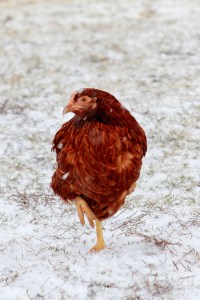
Nearly a month ago, we were provided with the opportunity to expand our flock of chickens.  A local farmer received an unexpected bonus shipment of pullets that increased his flock beyond his capacity to safely maintain. We took on fourteen of the hens, the most the farmer would allow us to acquire. In the overcrowded conditions to which the birds were temporarily subjected, they inflicted no small degree of damage to one another. Feathers were pulled loose until many of the birds were half-plucked. Their skin was raw and sore and, in some cases, infected. Despite our best efforts, four of the hens died. But, being the kind of people who believe that the glass is half full, ten survived and are thriving. One of them, a Rhode Island Red, is particularly friendly. She’s the first to bound out of the coop each morning and will run across the yard to greet us when we arrive back home. We call her Little Red.

(from left) Buddy, Marsh and S'more

(from left) Buddy, Marsh and S’more

Finally, at least for the purposes of this post, there are the boys: Buddy, Marsh and S’more. Marsh and S’more, two Nigerian Dwarf goats, came to us first, arriving in July of 2o11. They came to us from a family in Cincinnati. Although the family loved them their two large dogs didn’t and made life miserable for the brothers. In seeking a home for them, they contacted the American Society for the Prevention of Cruelty to Animals, and through them, us. Buddy, a miniature donkey, came from closer to home. A Putnam County couple kept Buddy as a companion for their horse. When it became too difficult for them to continue caring for the horse, they found it a new home. Sadly, the people who took the horse weren’t interested in Buddy. According to his old family, without companionship, Buddy began to waste away. They contacted us and Marsh and S’more became Buddy’s new buddies. And while they get along phenomenally, that doesn’t mean that they don’t have issues. Jonelle Meyer, a young woman who volunteers here at The Quarry Farm, recently told us of one such incident. As she was currying Buddy, the goats kept wandering up looking for attention. Buddy grew increasingly impatient with this until finally, when S’more refused to take the hint, he reached out, took the brush from Jonelle’s hand, smacked S’more in the face with the brush, then returned it to Jonelle so she could get back to what was really important: taking care of him.