Truthfully, this Winter 2026 newsletter doesn’t include any moss. Click on the cover to download to the left to see what we did have room to include. The beauty of a blog is that there is room to add those photos and finds that don’t fit on a 2-sided, 11 x 17 piece of paper.
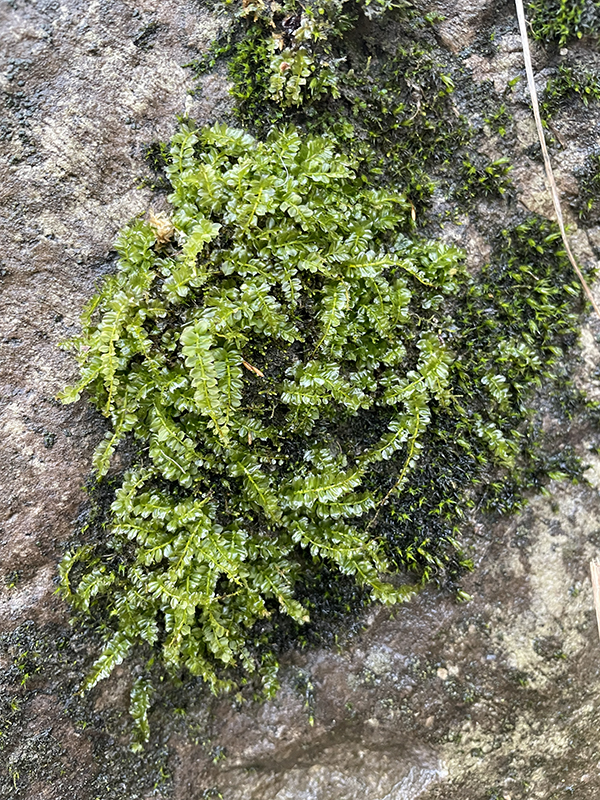
There is finally water in Cranberry Run after a drier-than-dry summer and fall. On a walk to treasure the leaf-tannin-rich flow, we saw a lovely quarry boulder sporting a moss that we hadn’t seen before. I turned to Bill Schumacher, former neighbor-over-the-creek and current mosses, lichens, and liverwort expert. Although Bill is busy with a water quality project in Bangladesh, he responded generously to my “What is this?”
Plagiomnium cuspidatum
“To confirm definitely would need to look at myself. But this one it looks to me like Plagiomnium cuspidatum (woodsy thyme moss or baby-toothed moss). Note the oval shape of the individual leaves. It has a costa (midrib) that goes to the top with a pointy end outside the leaf. Also, the leaf should be toothed in the upper half but not in the bottom half. Plagiomnium cupidatum is a common moss that is in the woods and by the creek. I saw quite a bit of it when we did the moss survey on The Quarry Farm. Although common, it is one of my favorite mosses. Think it is very beautiful, and greatly accentuates the forest system.”
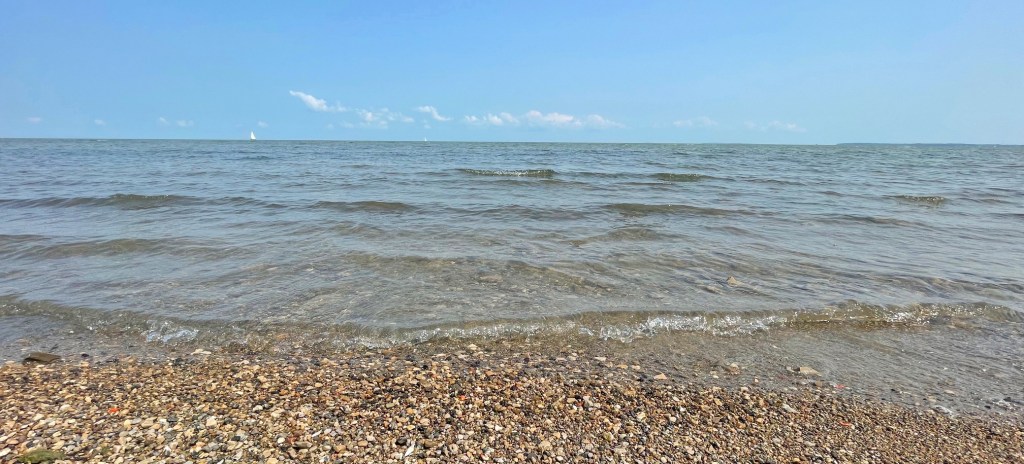
There was an outdoor art festival on the shore of Lake Erie last weekend. The show was one with a 20-year history and inexpensive. The latest round of tariffs had plunged the S&P so we had no expectations for sales. However, we had the tent, framed pieces and prints, and a need to get away for a bit so we packed up and drove north.
Except for smoky wildfire haze, the weather was lovely for August in the Midwest. Gulls and a pair of bald eagles cased the shoreline. White caps rolled, keeping the beach closed to swimming but open to big boats in full sail. A steady stream of people perused the festival, eating expensive flavored ices and walking major four-legged investments. I made the mistake of asking a man if his dog was a Brittany Spaniel. He looked at me like I had dribbled ketchup in his latte.
“She is actually an Aussie.” I apologized, muttering something about just noticing the blue eye and freckles on her nose and wondering what was offensive about having a Brittany Spaniel even though they are not currently a trendy breed. There were Dachshunds, French Bulldogs, Golden Retrievers, a Great Dane, a Greyhound, a Jack Russel Terrier, Cavalier King Charles Spaniels, Corgis, Lhasa Apsos, Chihuahuas in strollers and backpacks, and many more Aussies. The only dog that was in the middle of one minor altercation was the Jack Russell. Steve and I laughed about how the two country canines in our family would (not) behave in a crowd. And we loved on the one mutt that we saw during the two full days at the lakeside.
Please don’t misunderstand me. I adore dogs of all stripes and spots. Just as there are with humans, there are jerks in the canine club. But by and large, dogs are open and honest with their feelings. Animal shelters are full of purebreds as well as mongrels, all in need of love and good, forever homes. There is a rescue for every breed.
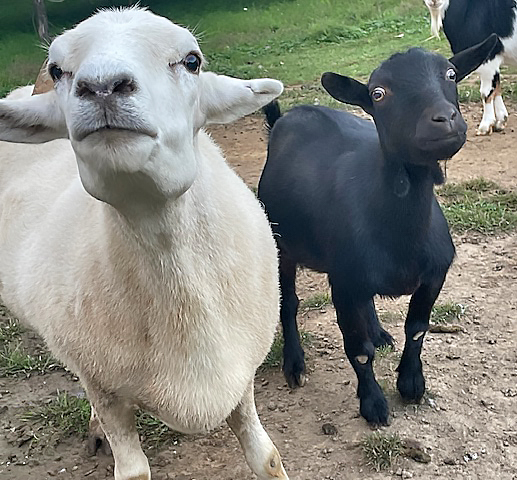
When we got home Sunday evening, we took a few minutes to listen and watch the variety of stripes and spots that mark the furred and feathered ones that share The Quarry Farm. We always do after being away for a time. There are mixed breeds and purebreds in the pastures and trees. Some are clearly of a certain pedigree, with the scripted markings, structure and gait of textbooks. Four of the goats faint when startled. Their limbs lock, sometimes causing them to fall over until blood flow returns. When this happens, the muttier goats stare at them and walk away. Some are “fancies” without the proper trimming, like Sidney the Silkie Rooster who lacks the curly feathered feet of snowbirds. Thank goodness for this because those luxurious boots bog down in weather and prevent the birds from walking. Bare-booted Sid is a fast force to be reckoned with no matter what the forecast brings.
Genetics is a wondrous field of study. Genetic modification can increase yields, lifespan, ear and nose shape, etc. I planted a golden Coleus in the garden this spring. This morning, I saw that the gold blooms were being replaced by a triumph of its magenta stock. Pockets, a marvelous red, brindle and white rooster of indeterminate parentage strutted through the plants on long, strong legs while Patches the Cow Goat (so named because he looks like the offspring of Holstein cow and a Nigerian Goat) munched on spent snow pea vines.
Two Canada geese named Johnny and Stella introduced us to the richness of a life shared with wildlife educational ambassadors. I would say the introduction was a gentle one, and it was, until we found Stella’s body floating in their water tank. No one could tell us why. She looked fine externally. Wild animals naturally fight tooth, nail, beak, bill, and claw to stay away from humans, probably because humans are at the top of the food chain and every other species knows to keep their distance. If wild things allow humans to approach, there is something not quite right internally, in their nature or nurture. Their most natural state of being has made them vulnerable to our opposable thumbs, our intelligence, or lack thereof. A lifetime of living with other species makes me certain of the latter, especially as I write this there are military maneuvers going on in the sky outside my window.
Estella
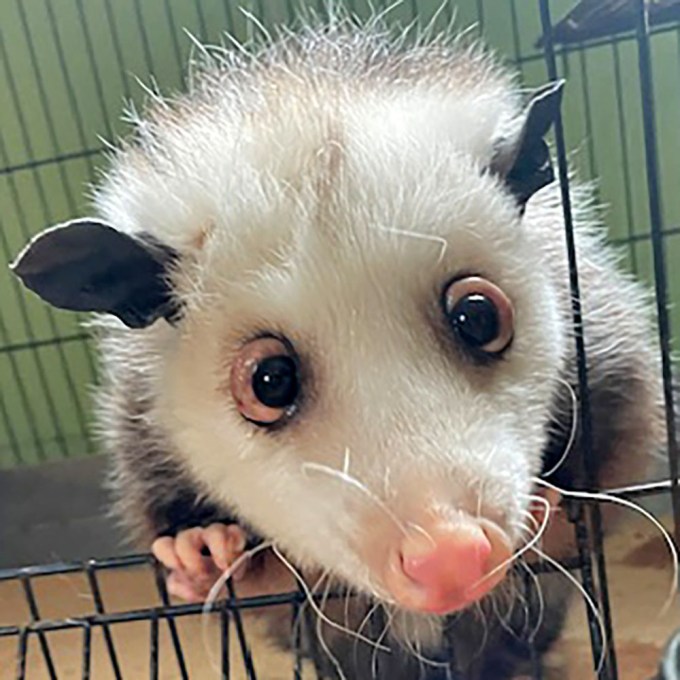
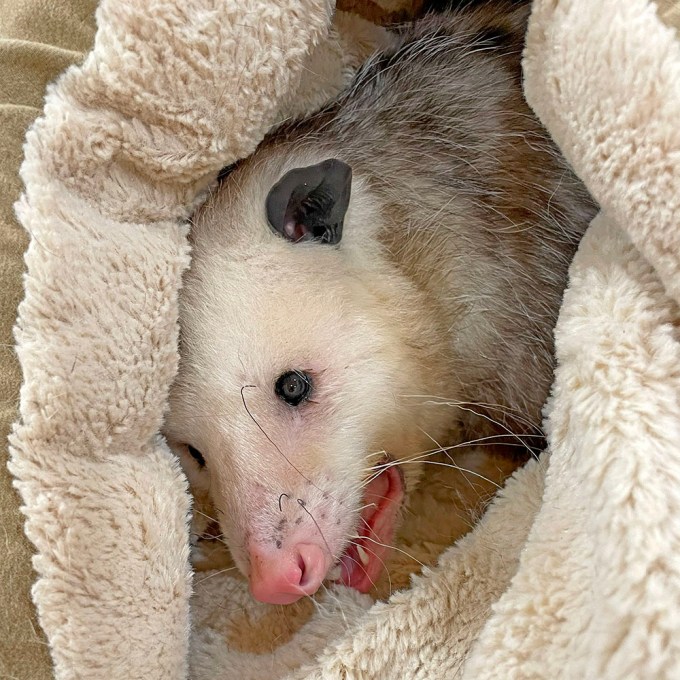
Although it is tragic thing when a wild animal can’t live safely in wildness, it is a gift to spend some part of one’s human lifetime in their company. Some live for a few years. Others for a decade or more. Right now, we often tearfully refer to the farm animal sanctuary as the geriatric home. It’s been 14 years since Johnny and Stella moved in. Many mammals and birds have lived what remained of their lives here. The last 12 months have been hard on our hearts as several friends have, as we say, “gone over the fence.” This month, as we planned for an all-day offsite event about living side-by-side with wild creatures, we intended to feature Estella the Virginia Opossum. Estella was almost 4 years old, pretty ancient for this marsupial. She died in her sleep on Sunday.
Winston
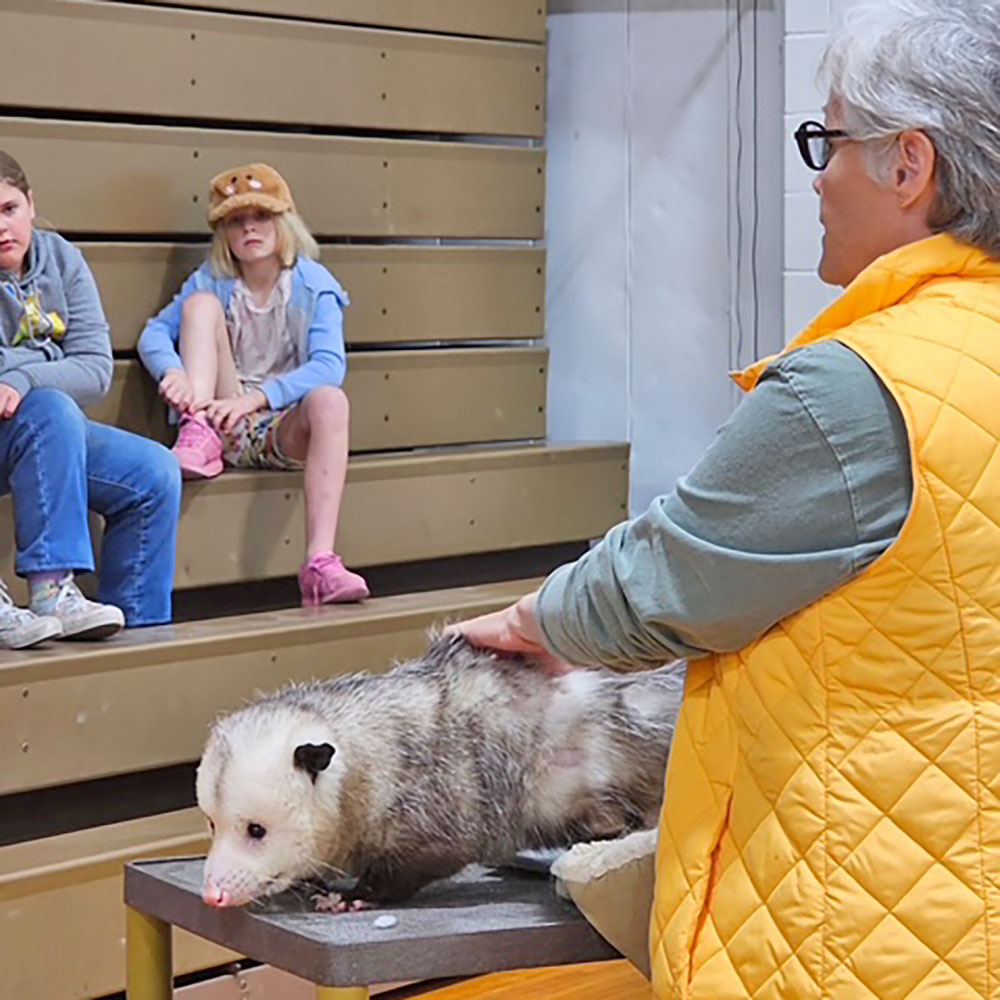
In February, while I was in Columbus for a conference, my phone pinged with a text regarding an adult male, caught-by-dog Virginia Opossum. A Proctorville wildlife rehabilitator rescued him in the Fall. Angie named him Winston, and healed his severe wounds and fought infection. He weathered several veterinary appointments and possible pneumonia. But Angie got him through. Because Winston has mobility issues and hairless scarring on his hindquarters due to his injuries, it was decided that he could have a good future as an educational ambassador. Three weeks ago, I met Angie and Winston in Columbus for adoption.
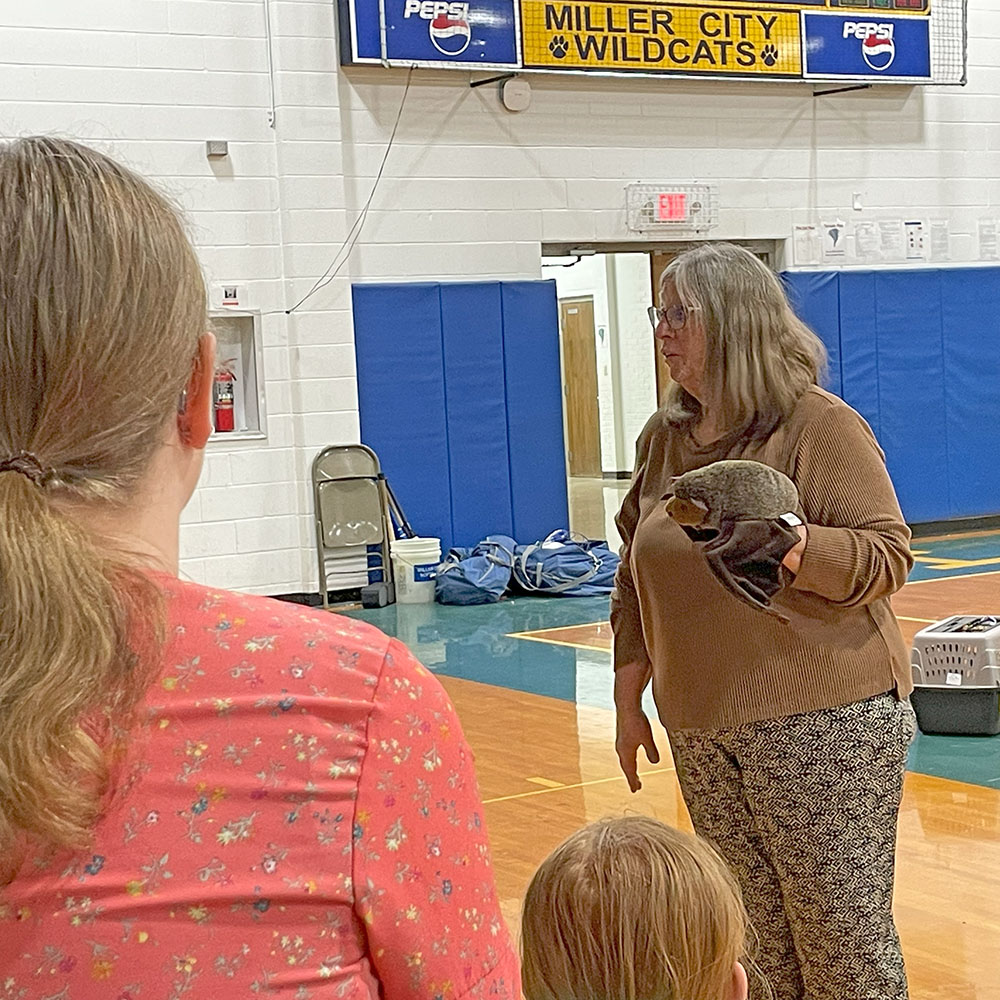
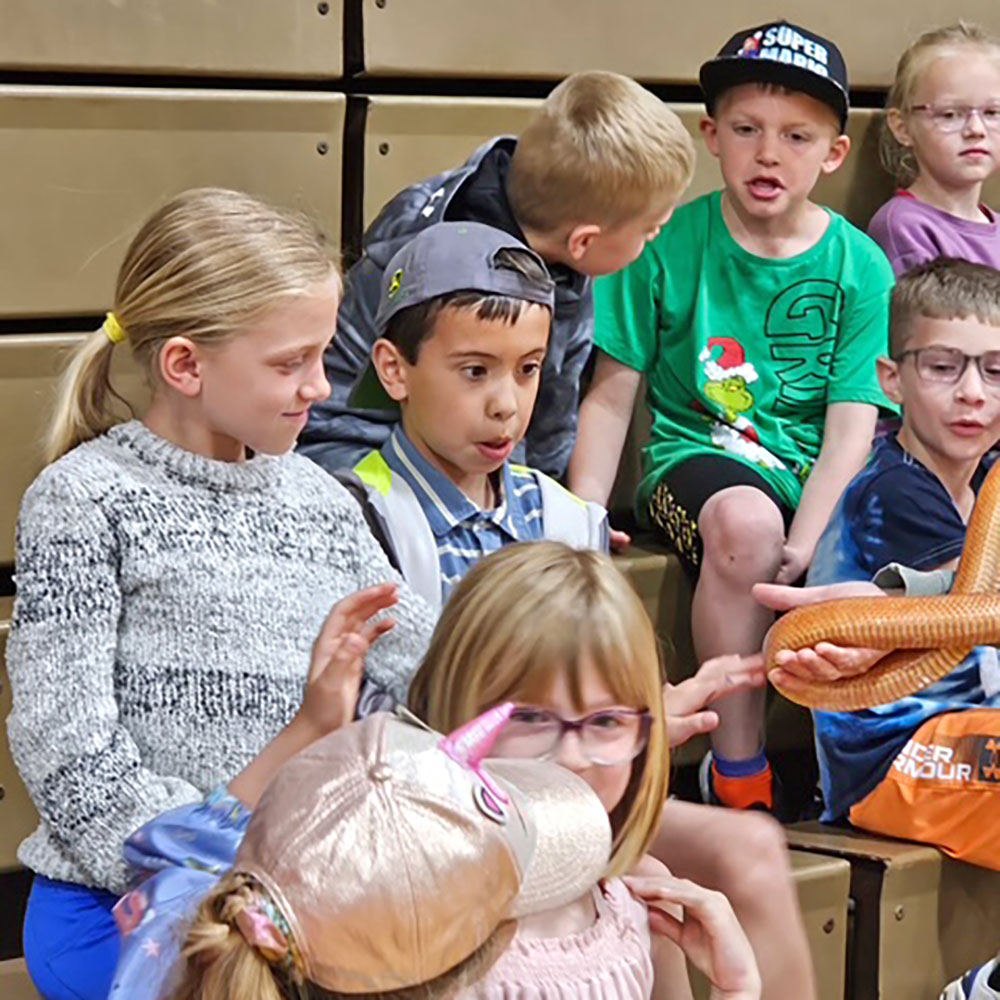
On Tuesday, May 13, Winston represented his amazing, vital species at Miller City-New Cleveland Elementary School’s “School is Cool” event. Board Member Rita used owl and bat puppets to demonstrate the horrors and harm of using traps and poisons to control wildlife. Tyree the cornsnake, all shiny coral from a recent shed, represented the benefits of encouraging snake residents on a farm and in your garden. Winston growled a bit at first, but his scars are itchy. With ongoing scritches, he settled into his ambassadorship. No one knows exactly how old Winston is, but he will be comfortable and at peace at The Quarry Farm for as long as he will give.
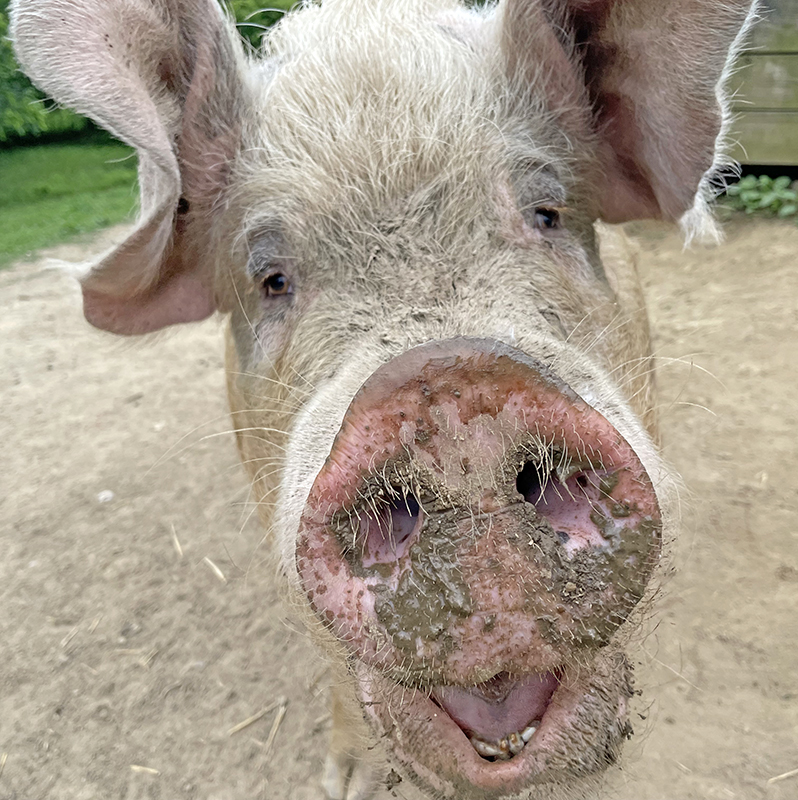
Nemo the Pig has been featured in this space before. She came to us in 2015 as a tiny shoat. She was scraped, bruised and broken from a fall onto I-270 from a transport truck in Columbus. A kind, determined person rescued her, nursed the piglet’s wounds and brought her to us. For a couple of weeks, we socialized little Nemo by carrying her around to programs in a baby sling. She housebroke easily, although she outgrew the house and was unable to turn around in hallways. At six months of age, the age that young pigs are typically “finished” and loaded into a crowded transport to be “processed,” Nemo was spayed at Ohio State University. For the first few years of her life, she was one of the first farm animal sanctuary residents to greet visitors.
Click to download your copy
“I’ve never seen a pig that big,” everyone still says when they see her for the first time. There’s a reason that they haven’t.
Nemo excavated a mud wallow that is so deep and wide that the geese and ducks swim in it when rainwater fills it to the brim. She made friends with Carlton the Pot-bellied Pig, a buddy system that continues to this day. They allow the other pot-bellied pigs, the geese, ducks and the occasional chicken to use their mud wallow.
Seven years on, visitors don’t often see Nemo, especially when the sun is high and the air is hot. Children love to see her, but she doesn’t often run to greet them, even when we mention the word “apple.” I did coax her out to see third-grade students from Ottawa Elementary in May. She walked out of her favorite building, stared across the pasture at the kids waving at the fence, then turned and walked away to her muddy spa. “Not today,” she seemed to say. I explained to the students that, while they could shed their coats and put on sunscreen, Nemo can only protect her fair skin and floppy ears with sparse, fair pig bristles, cool mud and shade.
For those lucky enough to visit on a cool day, Nemo allows a soft jowl rub. She sighs the deep, rumbling sigh that one would expect to emanate from a body such as hers, closes her blonde lashes and rolls over for a belly pat.
Ylvis is a Norwegian comedy duo consisting of brothers Vegard and Bård Ylvisåker. They are the creators of the viral song and video The Fox (What Does the Fox Say?) that I did listen to after I lost count of how many kids and parents brought it up after meeting Quinn, The Quarry Farm’s rescued fox and educational ambassador for her species.
I can tell you that most foxes do not have blue eyes and I’m not sure what the Ylvisåker Brothers did to have a fox assigned to them as a guardian angel. That is one spirit/bodyguard that is going to melt away into the landscape at the first sign of trouble. But before it takes off, it’s going to pick your pocket, race away with the goods, stash them in a secret location, and urinate on whatever it is to lay everlasting claim. Items that we have found in Quinn’s “secret” hideaway (a litterbox in the basement) include: socks, underwear, dog toys, peanuts, a jar of peanut butter, potholders, dog collars, cat treats, baby carrots, potatoes, Fig Newtons, buttered toast, and whole bags of bread and rolls of toilet paper.
As far as what the fox says, Quinn says a whole lot. I’ve never heard her ring-ding-ding, although she did snatch a bell off the Christmas tree and that rang mightily until it was buried in kitty litter. The Ylvisåkers really didn’t reproduce much of Quinn’s vocalizations in their 2013 earworm, although she did mutter fraka-kaka-kaka when I changed the litter box and a wrapped stick of butter fell out into the garbage bag. And after she grabbed a second stick of butter from the box I hadn’t yet emptied, she screamed a-hee-ahee ha-hee while she ran up the stairs with her reclaimed treasure.
Click on the newsletter at right to download the Winter 2022 newsletter.
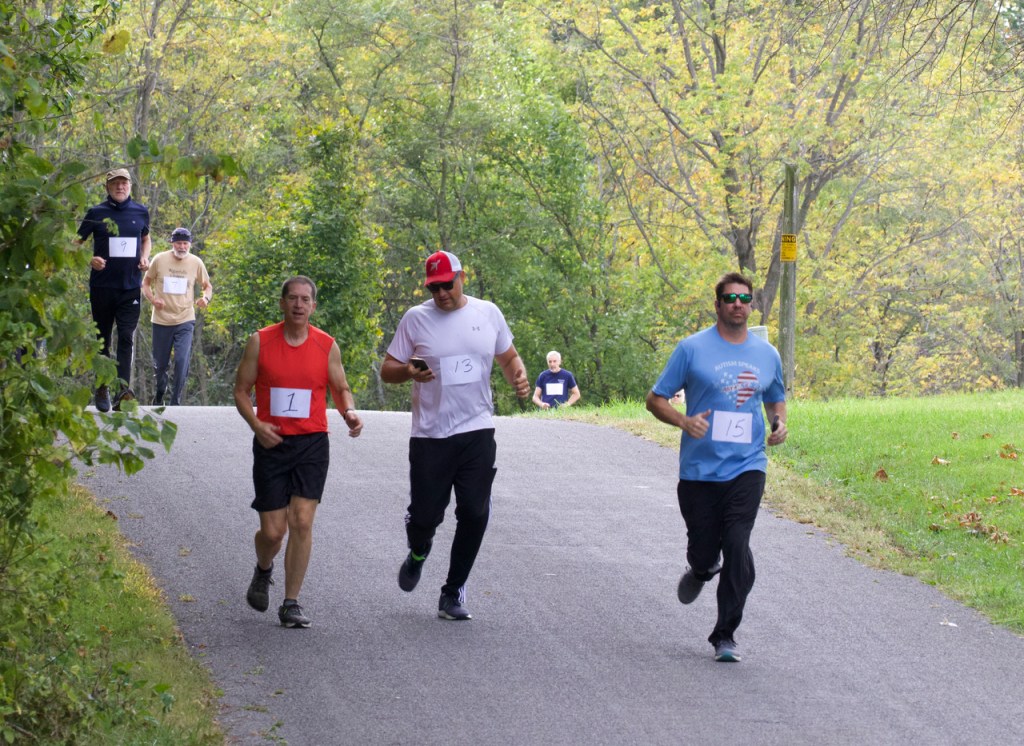
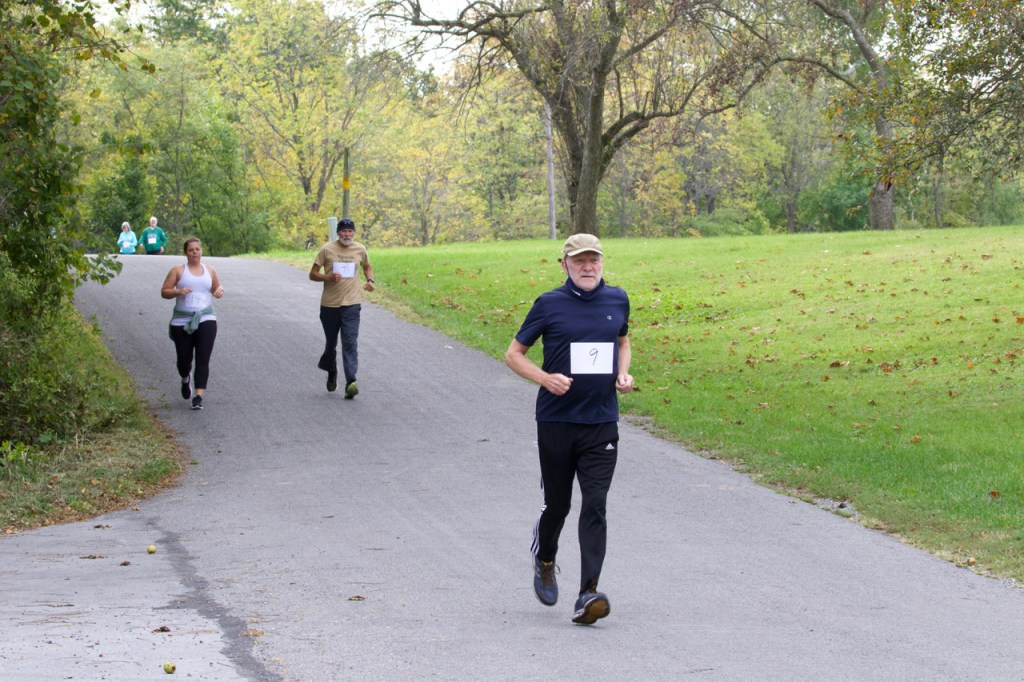
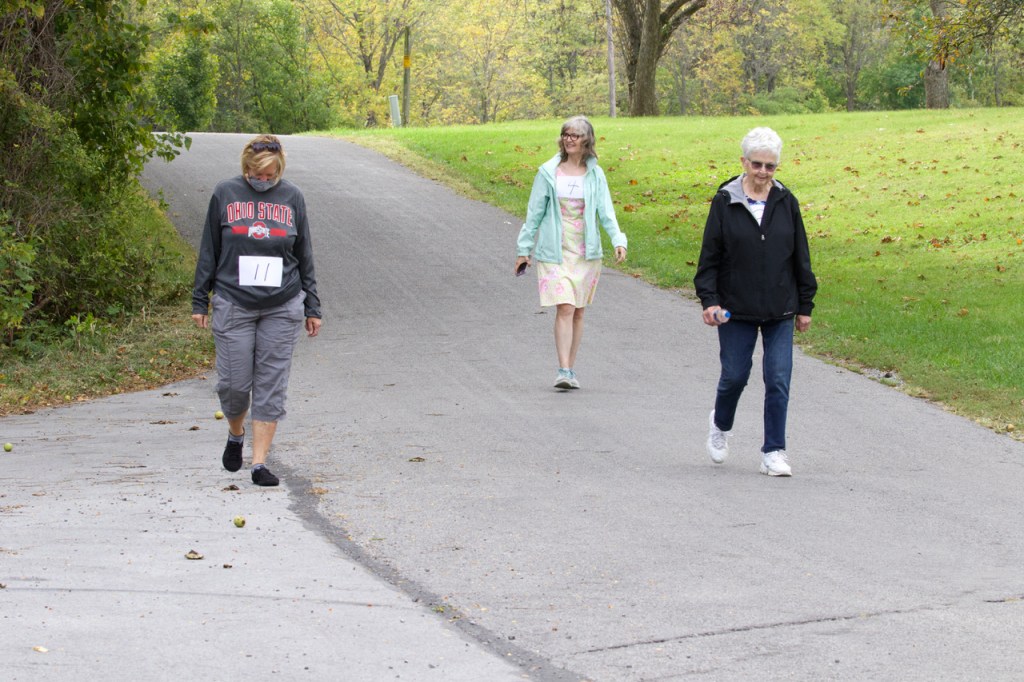
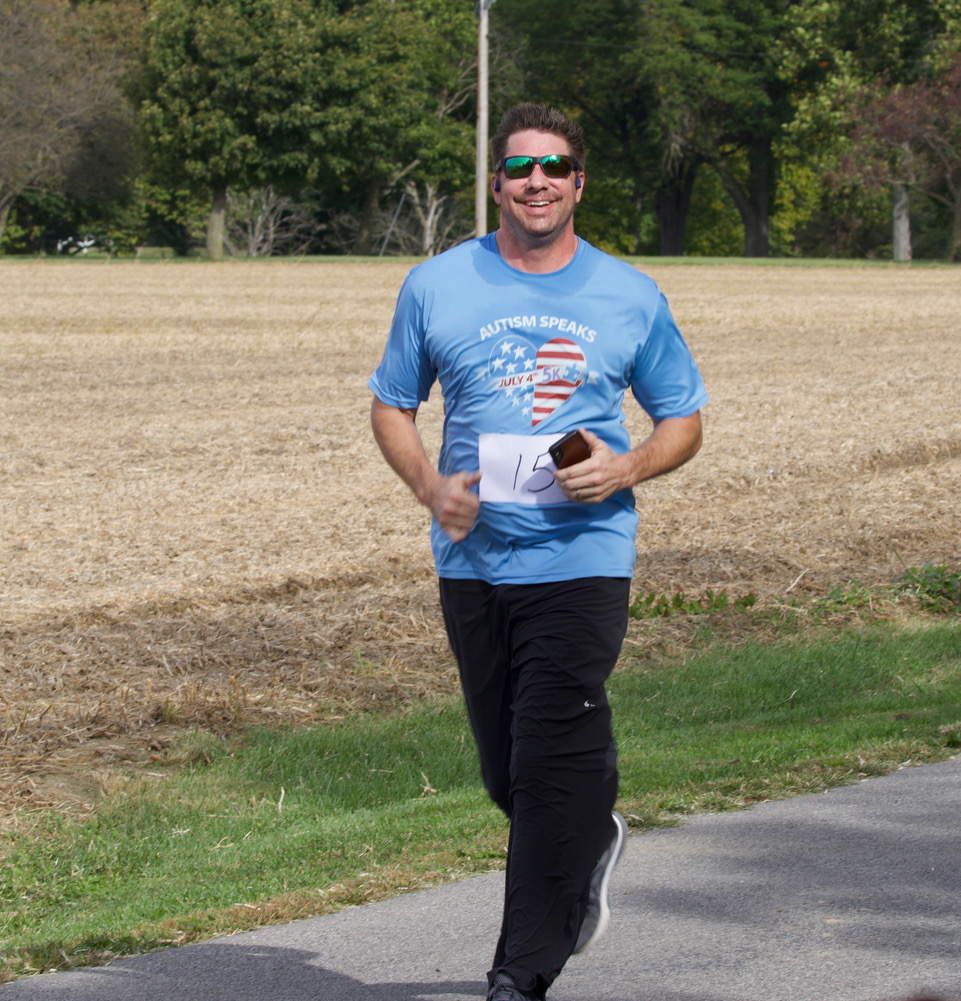
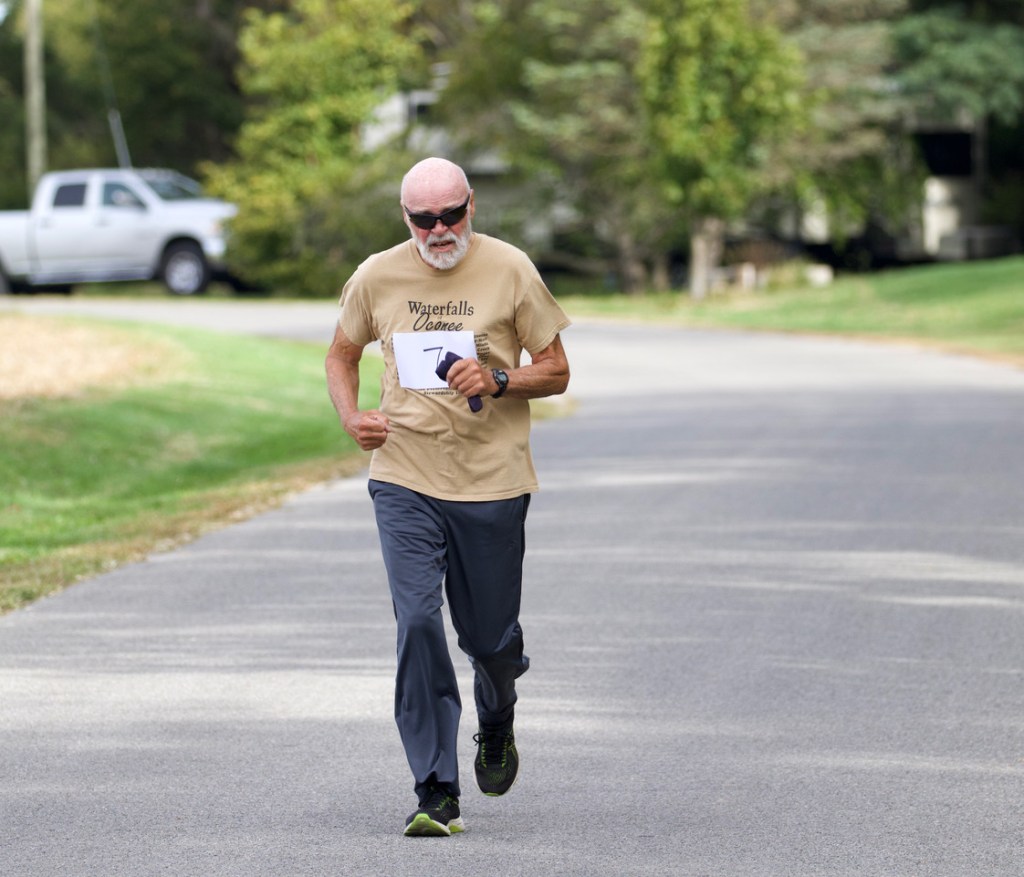
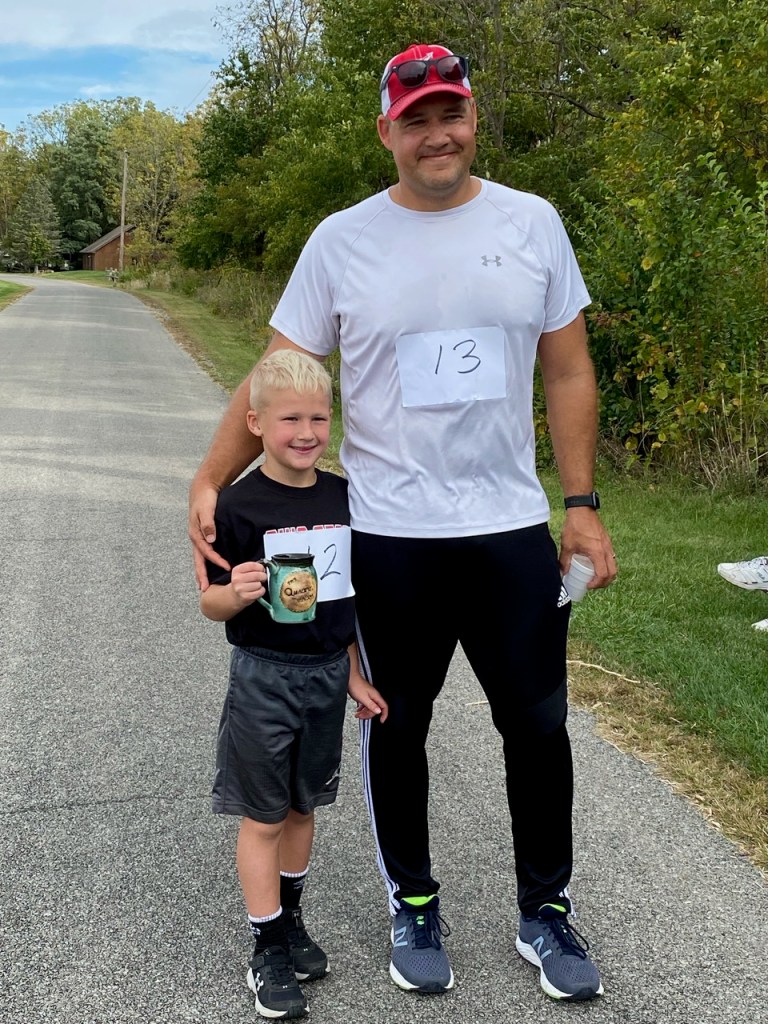
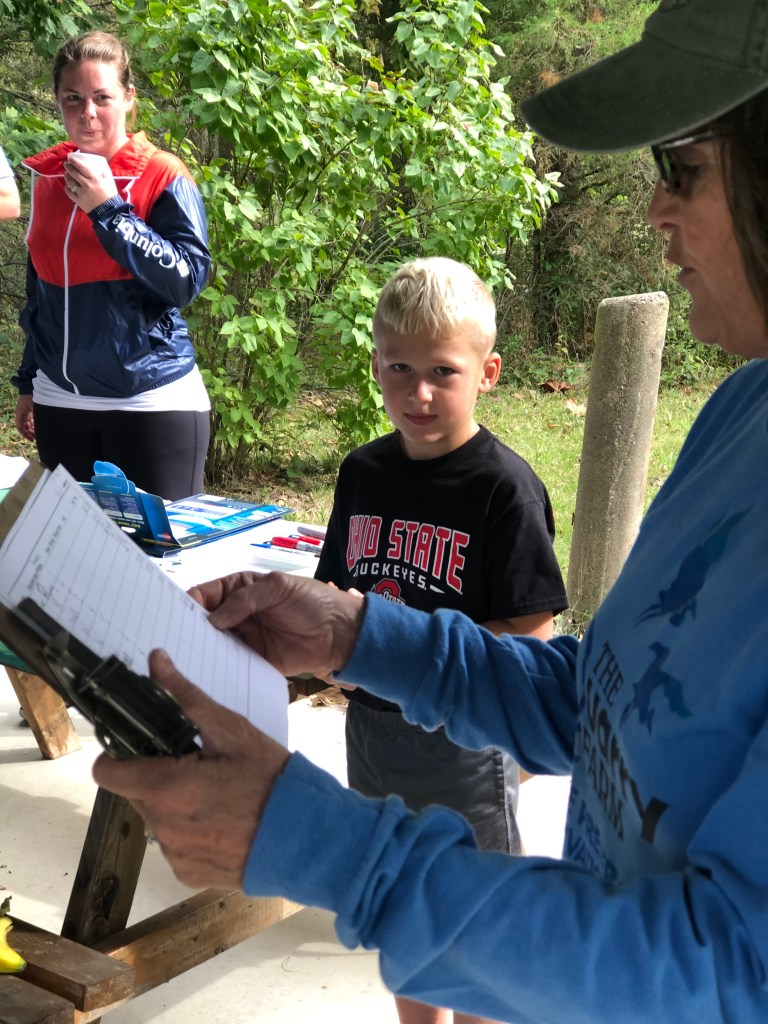
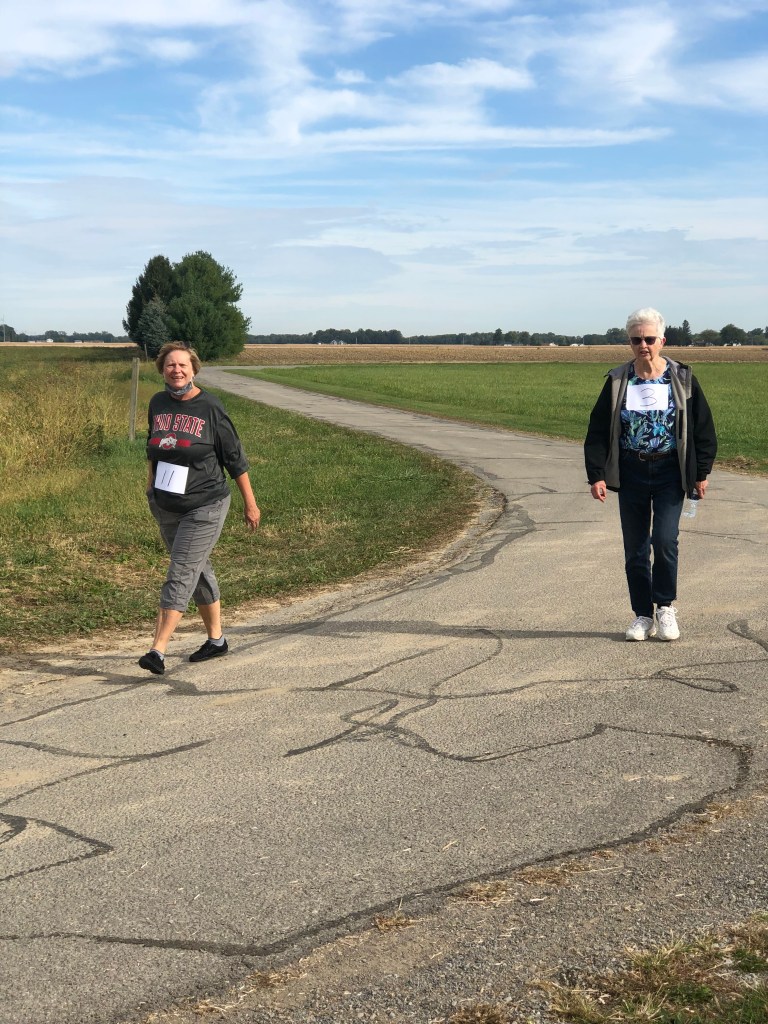
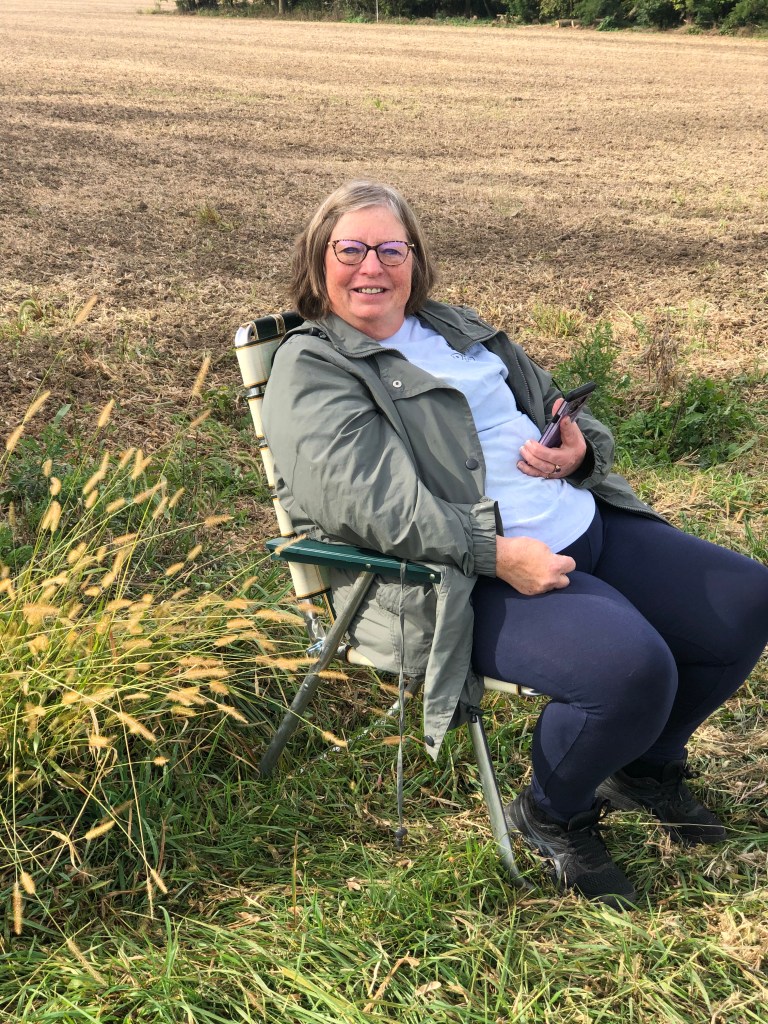
This morning at 10 a.m. EST, skies were blue and a west windy breeze made for good running/walking conditions for this year’s Quarry Farm 5K. Participants passed Birder Deb who played the theme from Rocky at the Mallaham Bridge. They navigated through one goodly gust of soybean dust kicked loose from a harvesting crew, turned around at the halfway point where Rita called out split times, then returned to cow bells at the finish line.
FIrst Run Finish, Men: Frank Ordaz First Run Finish, Women: Erin Firch First Walker Finish, Men: Jay Shapiro First Walker Finish, Women: Lois Seitz First Child Finish: Titus Haselman First Team Finish: Lois Felkey, Phyllis Seitz, Susan Seitz
There is rain this afternoon to tamp down the bean dust. Still a few oatmeal/white chocolate/dried apricot cookies, too (but not many). Much thanks to everyone who came out in support of a beautiful day and what we do.
About 20 years ago, I planted a ground cover that was all the rage at the time. I decided that glossy, dark-green euonymus fortunei, a native of Asia, would be ideal to fill in prettily around shrubs and to block weeds. As years went by, a patch in Red Fox Garden succumbed to scale, and the euonymus at my house had a rude habit of climbing up the garage siding and suckering in until pulled down. However, its dense cover did block weeds, and I liked the look of it.
Download the Fall 2021 Newsletter
So, I was not prepared when Cousin David, who has spent years clearing invasive shrubs and vines from the Quarry Farm nature preserve, reported an unfamiliar branching vine climbing in a cluster of trees deep in the woods, well beyond my house and garden. It was neither poison ivy nor wild grape vine, and its leaves looked a little like myrtle, only larger. I made a discomfiting discovery: The invader was euonymus fortunei, my pretty ground cover gone rogue. Looking it up on the internet, I was shocked to learn that euonymus is now generally considered an invasive species, a landscaping no-no.
Horticultural websites discuss the aggressive nature of euonymus fortunei. One example is this from North Carolina State University Extension: “Some cultivars may be more of a vine and others more of a small shrub, but the vining cultivars and some shrubs can both be invasive… Climbing euonymus readily escapes into native forests and has no trouble dominating medium-sized trees. [It] is listed as invasive in North Carolina and in other states of the southeast and northeast. When used as ground cover for the showy leaves, it tends to climb if given support. . . .When this vine climbs trees it produces aerial rootlets along its branches. [Its small white berries] are eaten by some birds which is how the plant is spread and often how it becomes more invasive.” This is surely how euonymus flew from my garden into the woods of the preserve.
My experience with euonymus fortunei has been another hard lesson learned about plant selection over the years. When perusing catalogs and nurseries, I should try harder to temper my feverish impulses with some cautionary reminders: Choose natives to the area, more likely to settle companionably into the landscape. Don’t make impulsive purchases based solely on glowing descriptions, especially if a plant is an introduction, sometimes even a “new, improved” cultivar. Know soil (sand, loam, and/or clay), moisture and light preferences. Know how a plant propagates and spreads, so it can be contained if it sends out runners or produces thousands of seeds per plant. In general, know how it interacts with other plants and wildlife.
Better knowledge about such issues might have prevented invasions of bush honeysuckle and multiflora rose, and too many others, which were thought decades ago to have beneficial uses as wildlife food and cover and as living fencing, but became scourges to field and forest, including The Quarry Farm.
This weekend is the 22nd Annual Great Backyard Bird Count, four days when, world-wide, people peer through binoculars and add apps to their phones (speaking from personal habit) to help them identify what birds are at their feeders or watering troughs from February 16-18, 2019. I can hear European starlings above our bathroom ceiling, so we started the count right off with that species. We really need to fix the cover on that vent.
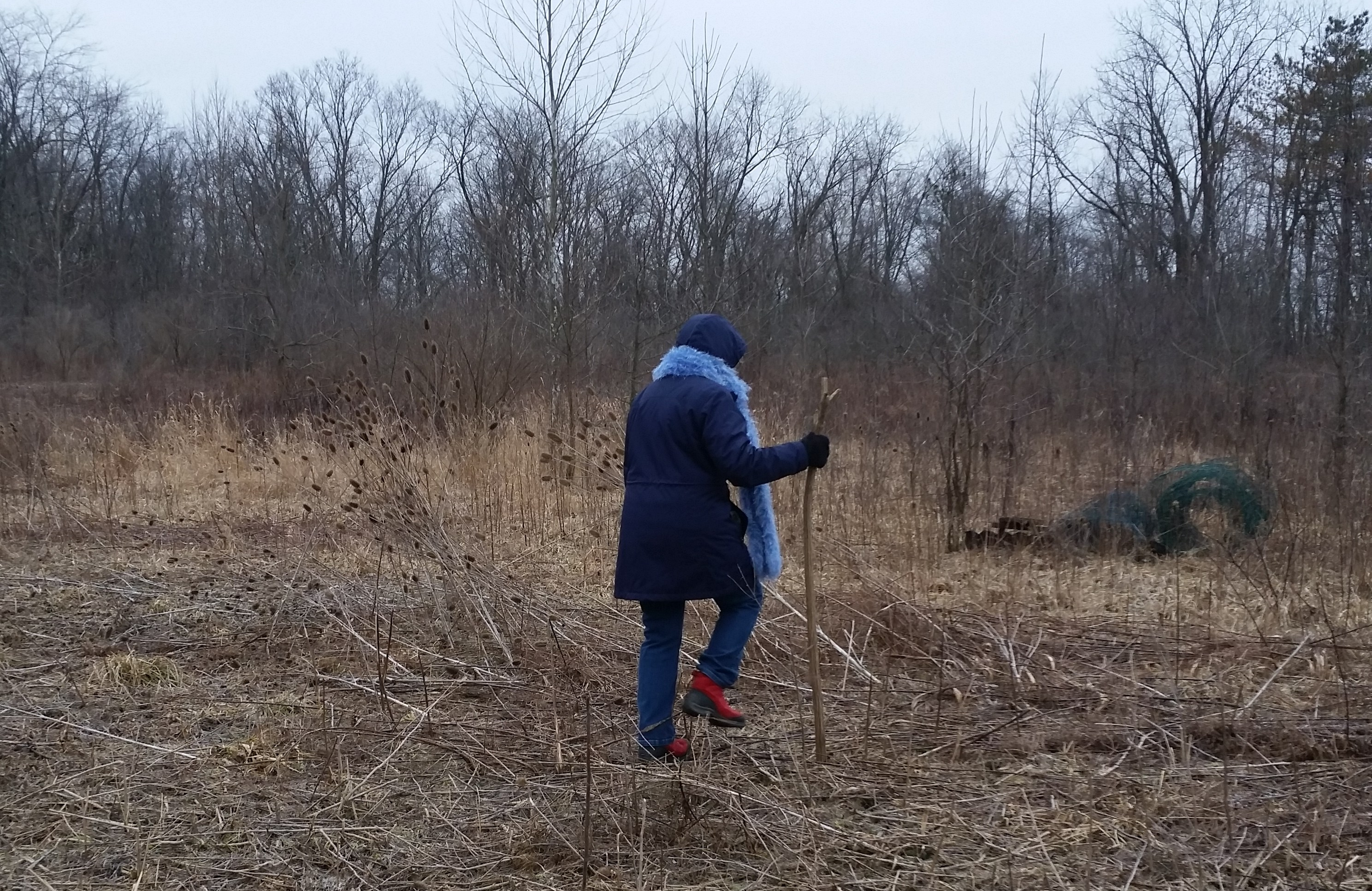
Saturday morning, two Debs, one Maya, one Terry and one Mandy joined in The Quarry Farm count. At 8:08 a.m. we headed across the footbridge to listen and look for what birds would venture out with us into the cold. Not many, as it turned out. Red-bellied woodpeckers hammered in the north along Riley Creek. Horned larks chimed in the field. White-breasted nuthatches scolded. We saw or heard a downy woodpecker, two goldfinches, robins, a male cardinal, bluejays and two Canada geese.
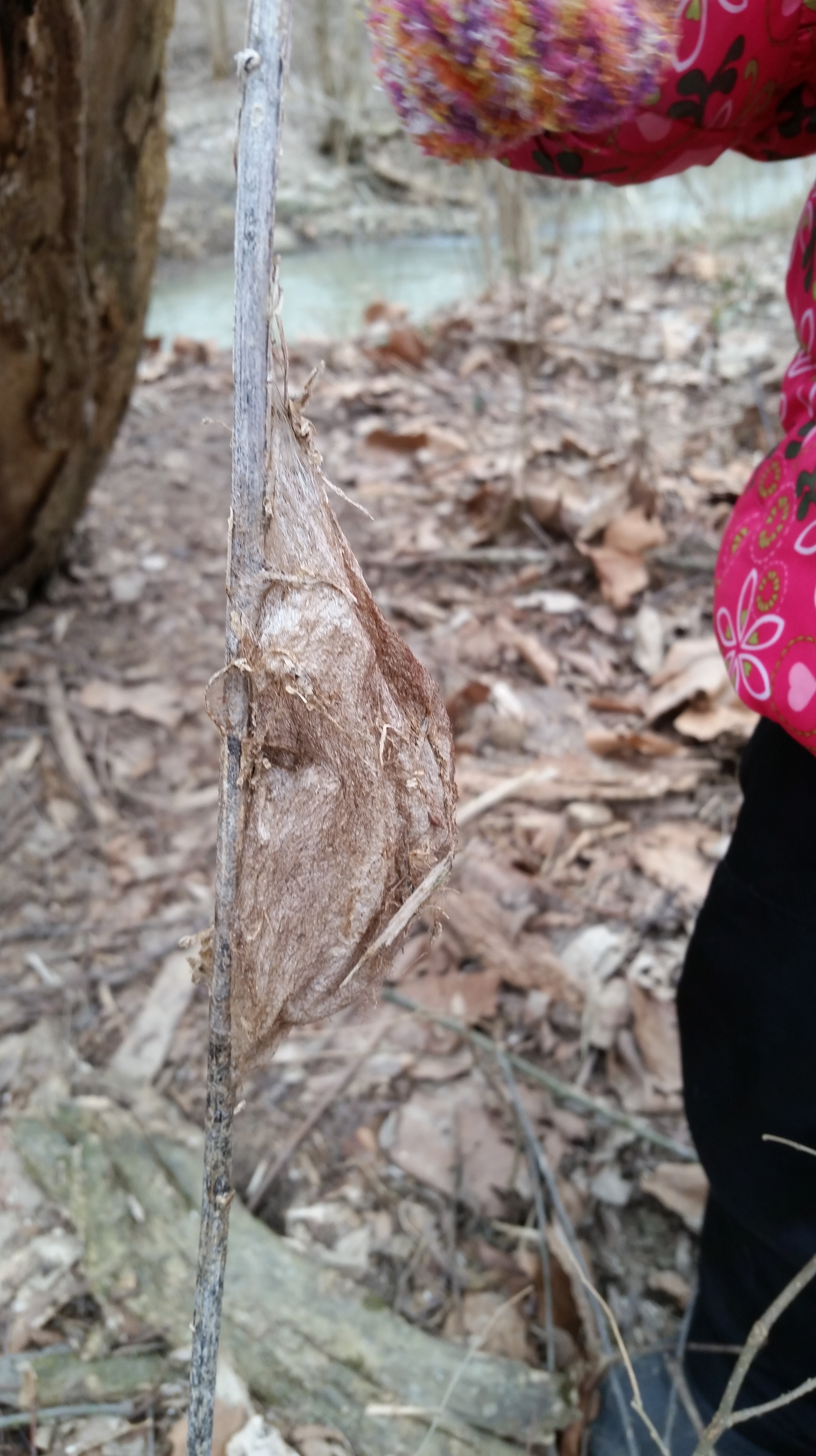
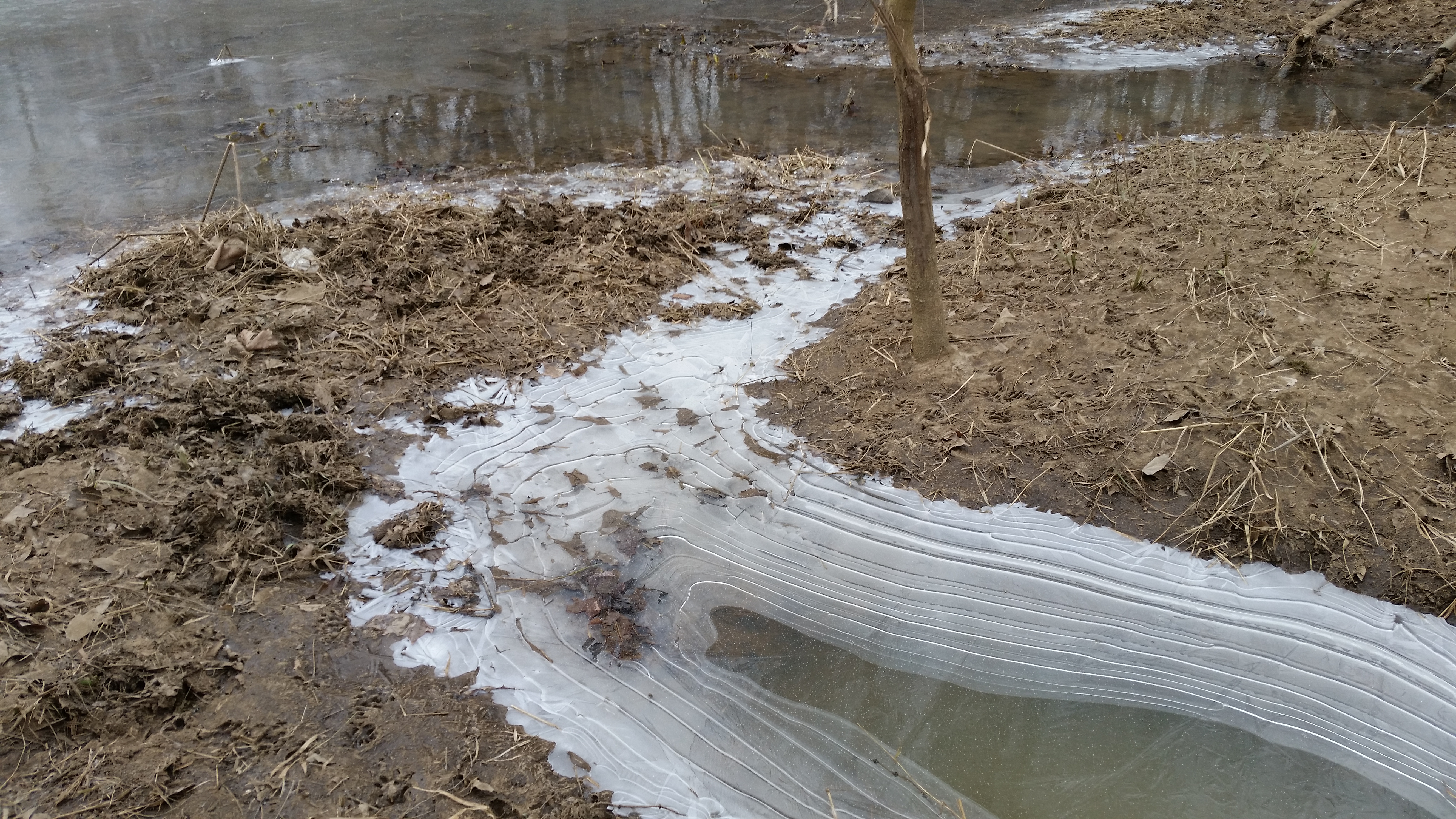
The air was heavy with impending snow. We kept out toes moving and warm by exploring for nonfeathered treasures. There were tracks frozen in the floodplain, reminders of floodwaters that covered it earlier in the week. Fungi bracketed trees and downed limbs. Puddles were flash-frozen in rings as waters receded. Mandy spotted a cocoon of some kind that we have yet to identify but is probably this. And Laura was thrilled to see that the Indian hemp, also commonly called dogbane, has spread in the back 10.
The promised snow falls in icy pellets. A crow flew over this morning, calling as he scouted, his caws echoing in the cold sky. There isn’t much movement otherwise. I sit at the sewing machine, securing goat coat straps in place. S’more ditched his yesterday during an hour or two of warm sun. Now he is piled under straw in Sophie’s barn. From my perch at the sewing machine, I can watch for birds. The winter is frighteningly in need of visitors.
We’ll listen for owls tonight. Until then, the hot chocolate and tea are warm and plentiful for watching whomever flies.
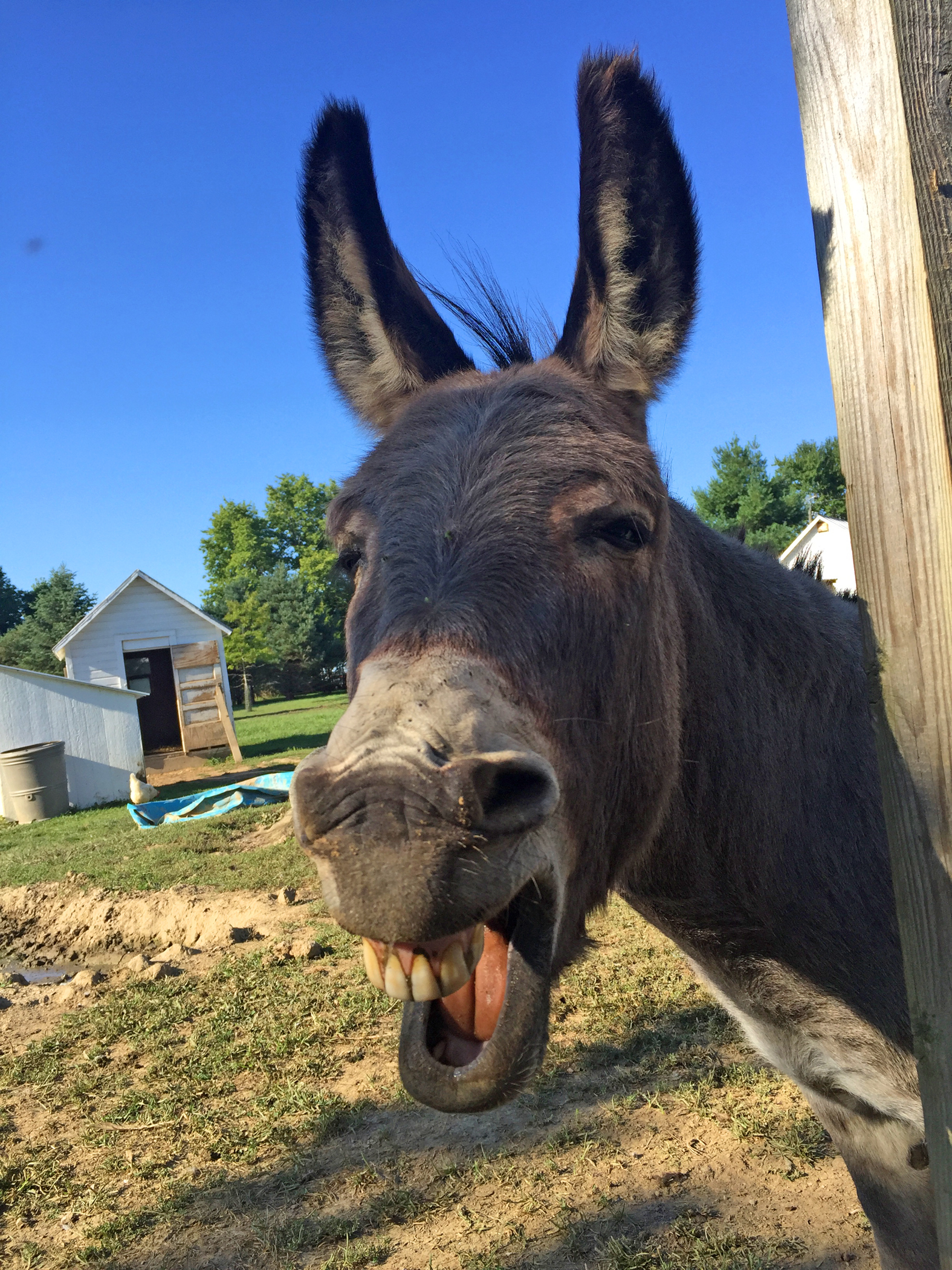
Much as I tried, I couldn’t leave this photo to its own devices. Buddy was indeed yawning, not braying the classic “hee haw.” Donkeys don’t, at least the two here, don’t. They “hee-hee-hee” and “ho-o-o-o-nk” and blow raspberries, but declare nothing for Buck and Roy to play along with.
Sunday morning, as I filled the water pans, Buddy followed me to make sure no carrots lurked in my pockets. I saw his lower lip begin to tremble and readied the camera just in case a toothy grin was on its way..
This morning before work (so sometime between 6:30 and 7 a.m.), Anne came in as I was going out. Well, intending to go out. She wouldn’t let me leave, wanted to show me something.
And she did.
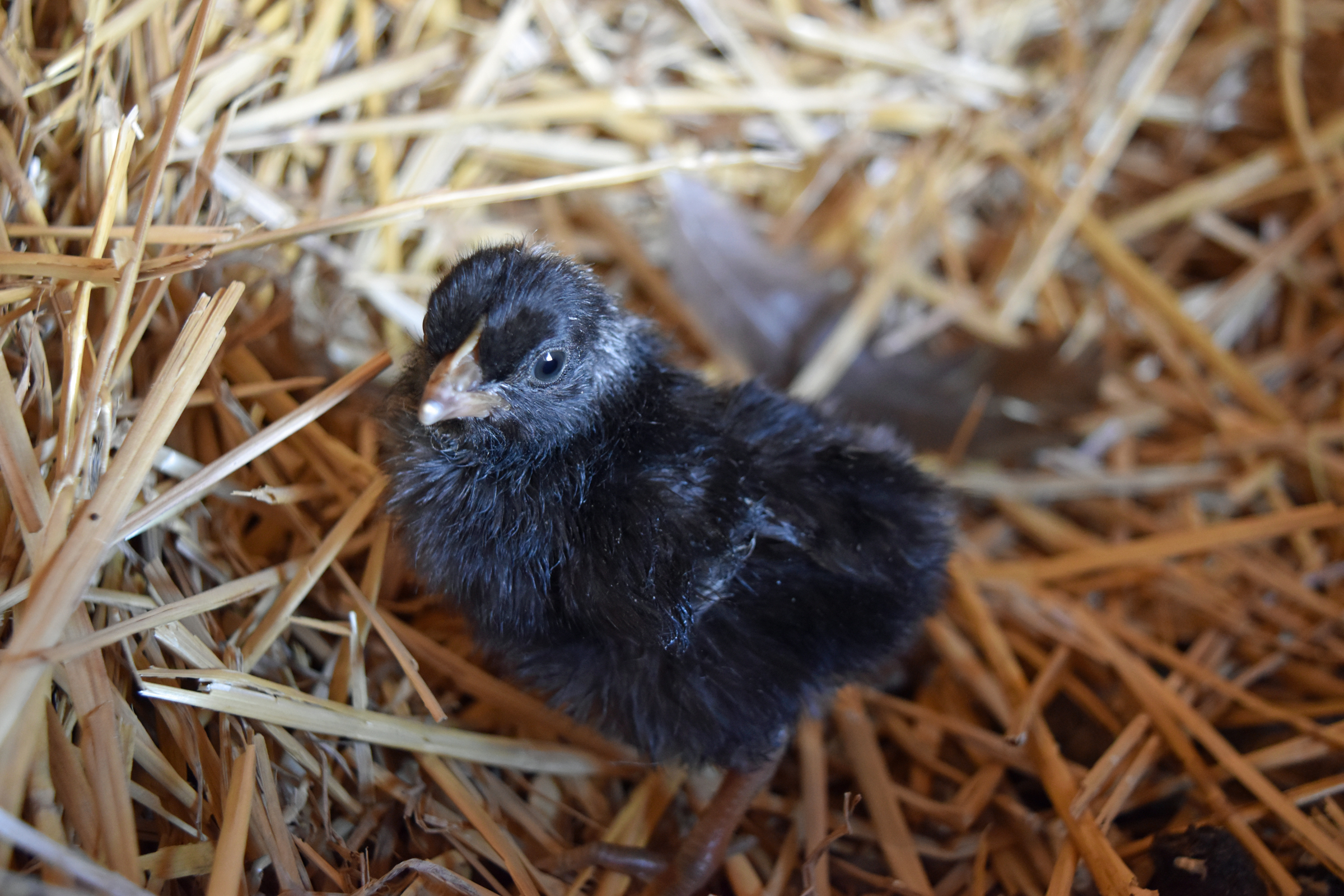
Welcome, then, to this little chick; the first live domestic birth here on The Quarry Farm.















 This weekend is the 22nd Annual Great Backyard Bird Count, four days when, world-wide, people peer through binoculars and add apps to their phones (speaking from personal habit) to help them identify what birds are at their feeders or watering troughs from February 16-18, 2019. I can hear European starlings above our bathroom ceiling, so we started the count right off with that species. We really need to fix the cover on that vent.
 Saturday morning, two Debs, one Maya, one Terry and one Mandy joined in