What’s Your Sign?

Group in Field

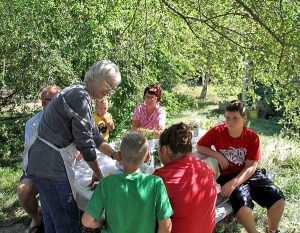
Alicia and Andrew Phillips review a winter star chart before leaving Red Fox Cabin for the trails.

Alicia and Andrew Phillips review a winter star chart before leaving Red Fox Cabin for the trails.

Astronomers have posited that if you were to count each and every grain of sand on all of the world’s beaches, you still wouldn’t come close to the number of stars in the sky. As a matter of fact, it’s suggested that you’d have to multiply that number by ten before you’d even come close. So it should come as no surprise, then, that the human imagination has configured the stars into any number of shapes over the thousands of years that we’ve been staring skyward. This past Saturday night, a group of participants in The Quarry Farm’s first Star Walk had the opportunity to view a few of these constellations.

It was nearly a perfect night for such an event. Although cloud cover had made star-gazing next to impossible for most of the week, a cold front moved in late Saturday afternoon and swept the sky clear. And while still chilly, the woods that surround the big back field provided a windbreak and pulled the teeth of the worst of the cold. While the wind howled outside the preserve, some stargazers even removed an outer layer.
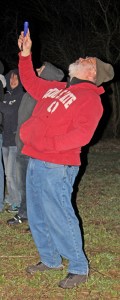
Mike Erchenbrecher looks to the stars

Mike Erchenbrecher looks to the stars

Mike Erchenbrecher, an award-winning retired Franklin County science teacher and avid amateur astronomist, escorted more than a dozen people through the woods and back to the big eleven-acre field where we all turned our faces up. Mike immediately pointed out the Hunter’s two dogs, Canis Major, the big dog, and Procyon, the little dog, and then the Hunter himself, Orion, with his belt of three stars. His finger traced a giant W as he talked about Cassiopeia, the Queen, who is forever chased by Cepheus, the King. And then, of course, there were the zodiacal constellations. At this time of year, the most readily recognizable of such is Gemini, with its two bright stars, Castor and Pollux. Taurus is also recognizable, as well as Cancer.

Some closeups of what we saw:

  • The constellation Cygnus the Swan, which contains Cygnus X-1, the first object identified as a probable black hole
  • jupmoon4Jupiter and its moons*…we could make out a moon on either side of bright Jupiter overhead.

  • Orion NebulaThe Orion Nebula** below Orion’s Belt appeared to us as a hazy spot.
  • Core of Andromeda GalaxyOur Milky Way was outshown by the half moon, but the Andromeda galaxy** was visible to the north.


Mike handed out star charts and independent-study over hot chocolate and cookies. Here are satellite passes for the next few days:

International Space Station

Brightness                 Start                 Highest point                 End                 Pass type
                [Mag]                 Time                 Alt.                 Az.                 Time                 Alt.                 Az.                 Time                 Alt.                 Az.
20 Jan -0.8 06:11:53 13° N 06:11:53 13° N 06:13:03 10° NNE Visible
21 Jan -0.9 06:56:32 10° NNW 06:58:23 14° N 07:00:13 10° NE Visible
22 Jan -0.8 06:08:04 13° N 06:08:04 13° N 06:09:28 10° NNE Visible
23 Jan -1.2 06:52:31 11° NNW 06:54:49 18° NNE 06:57:12 10° ENE Visible
24 Jan -0.9 06:04:09 15° N 06:04:14 15° N 06:06:16 10° NE Visible
25 Jan -1.8 06:48:34 13° NNW 06:51:01 29° NNE 06:53:57 10° E Visible
26 Jan -1.4 06:00:13 21° NNE 06:00:27 21° NNE 06:03:04 10° ENE Visible
27 Jan 0.1 05:11:53 11° NE 05:11:53 11° NE 05:12:04 10° ENE Visible
27 Jan -3.0 06:44:40 18° NW 06:46:56 62° NNE 06:50:11 10° ESE Visible
28 Jan -2.2 05:56:22 37° NNE 05:56:25 37° NNE 05:59:30 10° E Visible
29 Jan 0.0 05:08:06 13° ENE 05:08:06 13° ENE 05:08:37 10° E Visible
29 Jan -3.0 06:40:53 24° WNW 06:42:33 50° SW 06:45:44 10° SE Visible

Iridium Flares
OK, so what’s an iridium flare? Iridium flares are relatively new ultra bright objects in the sky, produced by the glancing reflection of the sun’s rays off a particular type of satellite–the Iridium satellite. Because the main mission antenna are pointing towards Earth, at predictable points in their orbit, they pickup the sun’s glare and direct it towards the Earth, producing the “flash”. Because they flash so quickly, here are the dates and times to look fast:

Time                     Brightness                     Altitude                     Azimuth                 Satellite                 Distance to flare centre                 Brightness at flare centre                 Sun altitude
Jan 22, 18:18:55 -0.5 31° 198° (SSW) Iridium 46 33 km (W) -7.0 -7°
Jan 23, 18:12:57 -2.6 31° 200° (SSW) Iridium 49 17 km (W) -6.9 -6°
Jan 23, 19:48:44 -0.9 34° 155° (SSE) Iridium 58 34 km (W) -7.6 -24°
Jan 24, 19:42:42 -3.7 35° 156° (SSE) Iridium 55 14 km (W) -7.6 -22°
Jan 25, 19:36:36 -0.1 34° 155° (SSE) Iridium 31 40 km (E) -7.6 -21°

For these and other updates realted to satellites (natural and human-made): http://www.heavens-above.com/?lat=40.94806&lng=-83.96111&loc=Pandora&alt=227&tz=EST

To find out where the International Space Station is in relation to you, enroll at http://spotthestation.nasa.gov/ to get alerts for your specific area

Find yourself looking at the night sky with your cell phone in hand? Use to “GoogleSky” to help you navigate the view.

* Michael Stegina/Adam Block/NOAO/AURA/NSF

** Satellite images taken by the Advanced Camera for Surveys (ACS) aboard NASA/ESA Hubble Space Telescope

A Shoot, a Release and a Puzzle Solved

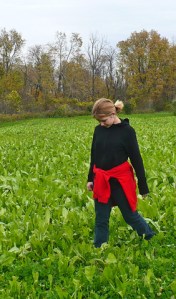
As the woods back on the quarry develops, the trees that make the forest are changing. Where there were hawthorne and honeylocust and hackberry, now sugar maples are the prevailing tree. In autumn, these maples provide the brilliant bursts of color that make New England the tourist destination that it is. What better time, then, for The Quarry Farm’s third photo shoot and nature walk?

For those of you that missed it – and you did indeed miss it; it was yesterday – it was just about as good a day as we could have asked for: warm, but not too warm; slightly overcast, but just enough so that it enhanced the lighting for photography; and breezy but not windy. Diane Myers, the rehabilitator behind Black Swamp Raptor Rehabilitation, came for the second time and brought a trio of birds. Included in the mix were a screech owl, a short-eared owl and a barred owl. These birds are permanent residents at her facility and as such are more accustomed to people than their wild counterparts, making image captures a whole lot easier.  The shooting of the birds went as expected, with Diane setting up shop on the grounds near Red Fox Cabin, leashing the birds to tree limb perches so as to increase the impression of a more natural environment. As a bonus, Diane also brought along two rehabilitated birds for release, a red-tailed hawk and a screech owl. In addition to the birds, aquatic macroinvertebrates were on hand, as well as a juvenile Virginia opossum.

The walk back onto the quarry proper was beautiful, but uneventful. We did, however, have a mystery resolved. While on last winter’s photo shoot and walk, we discovered a vole skewered in a hawthorne tree. There was a lot of conjecture at the time as to how the vole could have come to such a state and we settled on the idea that something most likely stashed it there. Well, we were right. According to Dr. Biehl, a naturalist and falconer who was along for this fall’s walk, the vole was stashed there by a loggerhead shrike (http://www.allaboutbirds.org/guide/loggerhead_shrike/id.).

Long Sleeve Weather

In the upland with Tri-Moraine Audubon

The air was chill but the sun was high on Saturday, October 6 for the “Wetland Wonderland” (see WORKSHOPS AND PRESENTATIONS) Tri-Moraine Audubon Society field trip to The Quarry Farm.  The group was led by Quarry Farm Friend Dave Betts.  All the Thursday rain put water back in the oxbow, enough to yield a sampling of aquatic macroinvertebrates that included a scud. This freshwater crustacean was the first such mini-shrimp seen and held by participants. Got to love that. I did.

Want to know more about scuds? Come to the Quarry Farm in the spring, but check them out here while ice covers the vernal pools: http://www.fcps.edu/islandcreekes/ecology/scud.htm

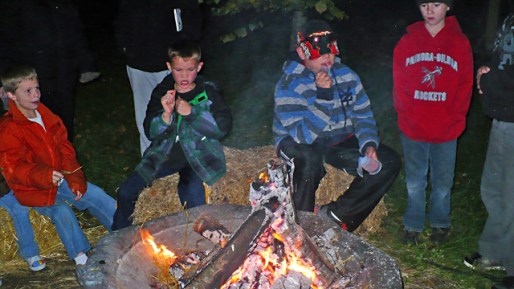
The water continued to rise in Cranberry Run while the Tri-Moraine Audubon Society walked the trails on Saturday. But by Monday, October 8, the creek had dropped back into its banks in time for 30 Pandora Cub Scouts, accompanied by their siblings and parents, to visit for a presentation and a tour. The “show” consisted of meet-and-greets with Buddy, aquatic macroinvertebrates, a juvenile opossum, a walk to the creek, cabin, and a cider-and-cookies finish around the fire bowl. What are some of the things that we hope the Scouts learned? That fish leeches won’t drain your arm of blood, that baby dragonflies eat lots of baby mosquitos, that opossums are nature’s garbage collectors, and that Northwest Ohio sunsets are the best. What did we learn? That you can cover a lot of ground in an hour. Beautiful night.

After cider fire

Crow’s Work Is Never Done

This morning Steve was unable to locate Blackie the American Crow’s food dish. Through no fault of Blackie’s, certainly, as his roommate Jo is the crow with the mostest if she has any say.

I took fresh bowls of water in and tried my hand at locating the missing dish. I got down on my hands and knees and looked under the couch, table, cages and under newspaper before giving up. As I cleaned the old newspaper out from the cages, Jo perched on my back for a bit and jumped off when I turned to Blackie. Jo skittered around behind me. When I turned around to leave the room, there sat the missing dish on the floor in front of me.

Crows vocalize at ranges that we can’t always hear. I’m pretty sure that Jo’s subsonic chuckle followed me out the door. Typical.

Being outsmarted by Jo is a frequent occurrence. Not as common are these special events. Come one, come all to:

Be Our Neighbor

This past Sunday, September 16, neighbors from up and down Road 7L and from various points around the block visited for an open house. All gathered under the red roof of the Seitz Family Pavilion for cookies, muffins, sandwiches and lemonade.

The sky was blue, blue and more blue, the goldenrod positively gilded and the butterflies flitted on cue. Plenty of mosquito repellent was applied to skin, enough to allow for guests catch up with friends, and for others to walk the gardens and the trails of the nature preserve.

Truly was a beautiful day for the local unveiling. The door is open for many more educational programs, photo and sketch walks, family and group meetings, or just a day or an hour away for one or two.

If you haven’t checked out the ABOUT or WORKSHOPS AND PRESENTATIONS pages here at http://www.thequarryfarm.com, I think this photo from Sunday speaks louder than most words. But don’t let that stop you from perusing the menu anyway.

Monarchs and More

Yesterday was a gorgeous late summer day, the kind with clear blue sky and clouds so clearly defined that you could almost reach up and pluck one right out of the sky. We were honored on this golden day to present once again at the Fulton County “Monarchs and More” event just north of Pettisville at a wetland/prairie owned by Ed Nofziger.

“Monarchs and More” is sponsored by Fulton County Soil and Water Conservation District and Ed and Carol Nofziger. Presenters yesterday included Pat Hayes, Cheryl Rice, Diane Myers, Black Swamp Raptor Rehab, The Quarry Farm, and Pheasants For Ever. Attendees got to visit with a bald eagle and a red-tailed hawk, tag and release monarch butterflies, learn about raingardens, and check aquatic inhabitants.

Ed Nofziger is a generous, adventurous man who went out on a limb years ago and enrolled some of his acreage in the Conservation Reserve Program (CRP) http://www.fsa.usda.gov/FSA/webapp?area=home&subject=copr&topic=crp in order to establish a pollutant-sponging natural area along State Route 2. Although CRP enrollees do benefit financially from the program, this is still a step from the norm for many farmers. But families and folk from throughout Northwest Ohio benefit from Nofziger’s leap of faith, as do school groups who participate in various science excursions to his property on State Route 2. The county commissioners encourage the annual “Monarchs and More” open house.

Thanks, Ed. And Amanda. And everyone who held a crayfish, dragonfly nymph and/or a leech at our station. Before you say, “ew”, did you know that only 10% of leeches actually suck blood, and that dragonflies continually eat their weight in mosquitoes, even as larva growing up in wetlands and streams? So there.

Videographer Steve Lauber of Lauber Digital captured great footage of the afternoon. 

The gloves are off

Peter Noyes and his camera lead the way down the hill from the upland trail

The rains finally came and the trees, grasses, birds and animals with every number of feet collectively sighed with relief. Most joyously, the rains fell throughout the day of July 19 and stopped just long enough for the Allen County Ohio Certified Volunteer Naturalists (OCVN) to hold a meeting at Red Fox Cabin and walk the floodplain and upland forest trails. As the group emerged from the nature preserve and reassembled on the cabin porch for cookies and lemonade, the sky opened up for another dousing. Photographer Peter M. Noyes recorded the OCVN visit. Check out his website at http://www.naturebypete.com/ for that album as well as more from his portfolio. Good stuff all around.

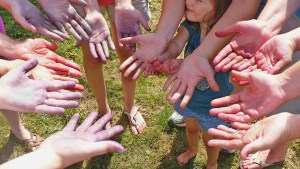
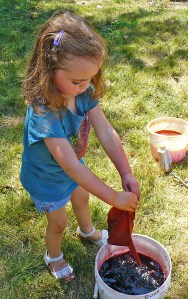
Today was quite literally of a different color. Many colors. A major tie-dye event produced a gallery of hats, shirts, cloths and even a few onesies that are now drying on tree branches and chairs at the neighboring Seitz farmhouse. A few hands were dyed in the process, as pictured above.

 Meanwhile back on the Quarry Farm, the shelter house is rising as a Seitz family crew is now in its third day of adding timber to the pad poured last month. Chief architect and foreman Keith Seitz designed the shelter house to blend aesthetically with the natural environment. The facility will be the site for many future gatherings, workshops and meetings, open to all by reservation appointment.

Buddy’s Big Day

Tiger in the garden

The Junior Master Gardeners of Continental (Ohio) graced The Quarry Farm with their presence on July 11, the first group to visit since the big wind blew through. Although there are still a couple of downed trees here and there, the paths were clear and mowed in time for the travelers to arrive.

Led by Charlene Finch, the group of 20 adults and children of varying ages drove in around 10 a.m. to beat the afternoon heat. They divided into three groups to rotate through three different learning and activity stations.

Mints and other herbs and flowers are bundled

Group #1 met under the shady zelkova in front of Red Fox Cabin. From Board President Laura they discovered the history of the cabin and the grounds, the gardens and made herb bundles from cuttings gathered there.

Group #2 circled next to the ash stumps, recent victims of the invasive emerald ash borer. This was the perfect spot to hear Steve the Insect Guy talk about stream ecology, perfect because his roundtable included a meet-and-greet with riverine beneficial insects that grow up to combat harmful insects.

Meeting a dragonfly nymph

Group #3 walked to the farm animal sanctuary where they were heartily welcomed by Buddy the miniature donkey. Despite the white-hot rising sun, Buddy held his post at the southwest corner of the paddock and brayed greetings to each group, keeping up the conversation throughout their stay at the station. One volunteer in each group was assigned to pet Buddy so that he would keep quiet long enough for Beatrice the pygmy pot-bellied pig to come out and meet the kids. This event was the first educational outing for Beatrice. She took a special shine to a gentle boy named Brandon, allowing him to feed her a piece of apple. Geese and chickens checked out the group from a distance, as did the goats.

Buddy greets a gardener

After all groups had rotated through the stations, everyone met at the cabin for cookies, lemonade, ice water and a group photo on the front porch. Some strolled through the gardens to see the blooms of drought-tolerant flowers and to scout for butterflies and dragonflies. Many thanks to Board Secretary Rita for photographically recording the event and for sharing them for this post.

When life gives you apples

On the morning of June 29, the apple trees here were loaded with a promising crop. That afternoon, the derecho left most scattered across the grounds of the farm sanctuary.

So as to keep a fair share of the windfall for human consumption (and to keep Beatrice the pygmy pot-bellied pig from gaining more than the 15 pounds she quickly added from chowing on little green apples) we put up a batch of green apple jelly.

If you happen to be at the Bluffton Farmer’s Market tomorrow morning, stop by and pick up a jar of this tangy goodness. We’ll also have other items and jellies of the season, including wood violet, chocolate mint and dandelion. All proceeds benefit the work we do here on the Quarry Farm.

Recipe Share?

Help us combat voracious invasives in the kitchen! Or, as The Quarry Farm’s Board President Laura says, “If you can’t beat ’em, eat ’em” (thinly-disguised, blatant plug for one of the Quarry Farm’s presentations–see WORKSHOPS AND PRESENTATIONS).

I’m asking you to share any and all recipes using invasive flora. For instance, did you know that garlic mustard (Alliaria officinalis) is a year-round salad green?

Check out RECIPES FOR SUSTAINABILITY in the menu bar on The Quarry Farm home page. I’ll post shared recipes to that page as I receive them. Recipes don’t have to be for edibles. Who knows? Maybe your great-great aunt passed down a tried-and-true mosquito-repellent ointment recipe using juniper berries.

The Appalachian Forest Heritage Area offers the downloadable “Garlic Mustard: From Pest to Pesto, a Culinary Guide”. Now if we can just find a good use for Japanese honeysuckle… http://www.afha.us/garlic_mustard/gm_recipes.pdf