Raptor Rehabilitation and Release

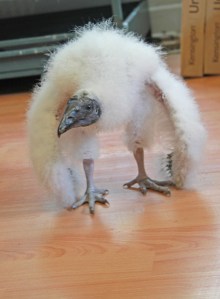
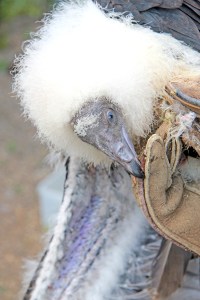
One of two pre-fledgling turkey vultures surrendered to Black Swamp Raptor Rehab.

This past weekend, we were offered the opportunity to do something a little bit different. As part of our function at The Quarry Farm, we often serve as transporters for several area wildlife rehabilitation centers. Laura Zitzelberger, director of operations at Nature’s Nursery Center for Wildlife Rehabilitation and Conservation Education, contacted us and asked if we’d serve as courier and chaperone for two pre-fledgling turkey vultures. The barn the two birds were nesting in was destroyed by the storm that tore this area apart in late June. Since then, the birds had been under the care of Diane Myers at Black Swamp Raptor Rehab. Nature’s Nursery had taken in a nestling turkey vulture and were excited at the chance to properly socialize their charge by introducing it to the two birds from Black Swamp.

Despite some rather unsavory habits, turkey vultures are social, intelligent animals (http://www.allaboutbirds.org/guide/turkey_vulture/id).

The nestling turkey vulture surrendered to Nature’s Nursery.

Sadly, these positive attributes create a challenge for rehabilitators. Imprinting becomes an even more serious concern as their social nature makes them more prone to identifying with their caregivers. This can prove disastrous for any animal and can even prevent their successful release back into the wild. In an effort to offset their natural inclination to bond with their caregivers, the three birds were brought together in the hope that they would bond with each other. Although they can’t be housed together because of a significant difference in age and size, the three birds will be kept adjacent to each other and share a common wall; two on one side, one on the other. It’s hoped that all three birds will benefit from this situation, improving their chances for a successful release.

And speaking of releases, not only did we transport two raptors up, but we also brought one back with us.

Early last autumn, we were called on to pick up a red-tailed hawk in nearby Miller City, Ohio. The bird had been on the ground for a couple of days and the homeowner in whose yard the hawk was sitting had called Nature’s Nursery. We’re not entirely sure what was wrong with the bird, but it was in sorry shape when we arrived. Emaciated and dehydrated, the hawk had no energy to defend itself and we simply walked up to it, wrapped it in a blanket, put it in a carrier and transported it north. After months of exceptional care, the bird’s appearance and attitude had changed drastically and the rehabbers at Nature’s Nursery asked if we’d return her to the county of her birth.

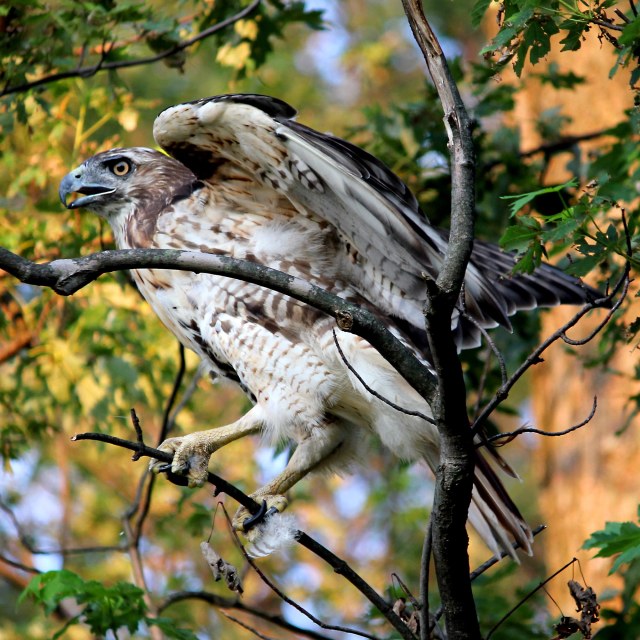
The red-tailed hawk perches shortly after release.

The hawk was slow to realize its situation and initially only flew far enough to perch in the nearest tree. But after a bit and the pestering of several camera-wielding humans, it finally took to wing and flew away and out of sight. I won’t say it was a picture-perfect release, but it certainly was a success.

We hope for the same results for the turkey vultures. When it happens, you’ll be the first to know.

Buddy’s Big Day

Tiger in the garden

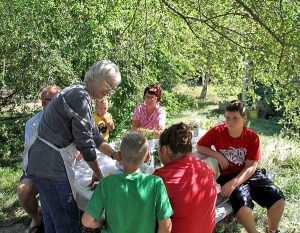
The Junior Master Gardeners of Continental (Ohio) graced The Quarry Farm with their presence on July 11, the first group to visit since the big wind blew through. Although there are still a couple of downed trees here and there, the paths were clear and mowed in time for the travelers to arrive.

Led by Charlene Finch, the group of 20 adults and children of varying ages drove in around 10 a.m. to beat the afternoon heat. They divided into three groups to rotate through three different learning and activity stations.

Mints and other herbs and flowers are bundled

Group #1 met under the shady zelkova in front of Red Fox Cabin. From Board President Laura they discovered the history of the cabin and the grounds, the gardens and made herb bundles from cuttings gathered there.

Group #2 circled next to the ash stumps, recent victims of the invasive emerald ash borer. This was the perfect spot to hear Steve the Insect Guy talk about stream ecology, perfect because his roundtable included a meet-and-greet with riverine beneficial insects that grow up to combat harmful insects.

Meeting a dragonfly nymph

Group #3 walked to the farm animal sanctuary where they were heartily welcomed by Buddy the miniature donkey. Despite the white-hot rising sun, Buddy held his post at the southwest corner of the paddock and brayed greetings to each group, keeping up the conversation throughout their stay at the station. One volunteer in each group was assigned to pet Buddy so that he would keep quiet long enough for Beatrice the pygmy pot-bellied pig to come out and meet the kids. This event was the first educational outing for Beatrice. She took a special shine to a gentle boy named Brandon, allowing him to feed her a piece of apple. Geese and chickens checked out the group from a distance, as did the goats.

Buddy greets a gardener

After all groups had rotated through the stations, everyone met at the cabin for cookies, lemonade, ice water and a group photo on the front porch. Some strolled through the gardens to see the blooms of drought-tolerant flowers and to scout for butterflies and dragonflies. Many thanks to Board Secretary Rita for photographically recording the event and for sharing them for this post.

Belle’s Goodbye

Four weeks ago, Belle, a shih tzu who came to live with us on The Quarry Farm some five years ago, was diagnosed with a particularly aggressive form of cancer. The word “inoperable” was used more than once as her condition was explained to us, though whether or not that was a consequence of her assumed age and the belief that she wouldn’t survive the surgery is a question I never asked.

I was once told that cancer is the embodiment of chaos. I’m not sure who said it or if it was even remotely accurate, but it stuck with me. In this particular case, it was about as true a statement as was ever made. The cancer attacked her lymph nodes and grossly distorted the lower half of her face. As the disease rapidly progressed, tumors swelled the glands on either side of her jaw and ripened until they began to intrude into her mouth, pressing her tongue to the side and interfering with her ability to eat (mark that I said, “interfering”; her appetite was huge and she ate well and as often as she wished, though with a bit more difficulty than she had before her cancer). Her doctor assured us that she wasn’t in any particular discomfort and that she would enjoy life for a little while longer, possibly as long as a couple of months.

 When she stops eating, he told us, it’s time.

 Last Thursday, she stopped eating.

 On Friday, we took her in.

 We brought what was left of her, her biomass, home and buried it at the base of a Kentucky coffee tree that graces the area just outside our front door. Heat and drought had turned the ground into something much harder than simple earth and it took an old railroad pickaxe to loosen the dirt enough to shovel it aside. Eventually we placed her in a hole that seemed much too small for her. Tiny as she was physically, she was possessed of a huge personality and could, when she chose, fill a room. We further marked the spot with a slab of dolomite and placed pieces of granite and quartz and red shale on and about the stone in celebration of a life that was our great good fortune to share. We then went inside and wondered at how much smaller our house seemed to be.

 Less than an hour later, as a headline in our local newspaper so colorfully put it, the area was “blown to pieces.”

 The storm that swept through was deemed a derecho (http://www.weather.com/news/weather-severe/derecho-explainer-20120612). Straight-line winds in excess of ninety miles per hour tore through the region, uprooting and snapping trees, tearing roofs from buildings and, in some cases, leveling the buildings themselves. Power and telephone lines were cut by flying debris and the poles to which they were attached were battered to the ground. While there were reports of multiple tornadoes in neighboring counties to the west, none touched down here. Even so, the area suffered some of the most significant widespread damage in its history. Nearly every homestead was affected, including ours.

The Quarry Farm fared better than some, worse than others. In the domestic areas of the farm we lost about a dozen trees, mostly evergreens, and several shrubs. Shingles were blown from the roof of one outbuilding and the door to the chicken coop was ripped from its hinges and beaten to splinters. A big, wooden outdoor storage cupboard was teased out from under the eaves of our house and torn apart. A window was blown loose in the big shed and smashed. The bee hive was reduced to its component parts and scattered across the yard and even though the hive was already failing, it was a hard sight to witness. In the woods and along Cranberry Run, dozens of trees were left bent and broken. The largest and oldest of the trees, the ones that reached above the common canopy, bore the greatest insult. Limbs as large as some of the less mature trees on the property were rent free and fell, dragging smaller limbs and even some smaller trees with them. Honey locust, sycamore and black walnut trees were affected the most and their limbs and trunks fell and blocked many of the paths that we have so arduously cut through the woods.

 Even so, we were lucky. Our homes came through the storm unscathed and, more importantly, no one was hurt. Buddy and the boys, S’more and Marsh, seemed nonplussed. The chickens made a last second mad dash to the coop and, despite the flying debris, beat the odds. Even the duck and geese came through it without a scratch, all of whom weathered the storm out in the open despite immediate access to shelter. They simply faced into the storm and made themselves as small as possible, holding their wings tightly to their sides and pressing themselves into the earth, riding the storm out as best they could. As did we all.

 The biggest part of me recognizes that this was strictly an atmospheric event, an accumulation of physical conditions that culminated in a significant release of energy. I know that, should I choose to, I can go online and research this until I know each and every factor – heat, humidity, air pressure, ocean currents, whatever – that played a role in the creation of this storm. I know that this was a cause and effect scenario.

I know this.

 Even so, there’s a part of me that thinks that maybe there was something more to it than just pressure systems and cold fronts. That maybe this was a release of energy of a completely different Nature. That maybe, just maybe, this was more personal than that. Maybe this was Belle’s exuberant release, her nod to us as she went wherever it was that she wanted to go.

 That’s how I’ll remember it, anyway, despite logic and Carl Sagan. After the shingles are replaced and the chicken coop door is repaired. After the debris is raked up and put aside and the paths are cleared. After all of the electrical and telephone lines are restrung and the grid is whole and fully functional once again. After the fallen trees are reduced to neatly trimmed and stacked piles of drying wood and even after that wood has eventually dried and is burned in some future fire, that is how I’ll remember last Friday.

 It was the day that Belle said, “Goodbye.”


POSTSCRIPT

I was going to leave this for another day, but I find that I can’t. I have a couple of final thoughts I’d like to express. First, my soapbox. When Belle came to us, she was broken. Literally broken. Both eyes were severly scarred, particularly the right, which was all but entirely closed with scar tissue. At some point, she had broken her jaw and it had never healed properly. I never understood the mechanics of it, but her veterinarian explained that there was a gap in her lower jaw that had never closed. She was constantly on edge. Vague movements sent her scrambling, and with her eyesight, all movements were vague. She lived in constant fear, her bladder emptying in uncontrollable spasms of fright. Worst of all, I think, was the tattoo in her left ear: the number 25 writ in large block numerals. Again, her veterinarian explained that the number was a means of identification. Not to assure her safe return should she come up missing, but as a simple means of differentiating her from any other shih tzus that the person (and I use that term conditionally) who had her before us may have, must have, kept.

She was Bitch Number 25 and that may well have been the only name she had before coming here. She had been bred and bred and bred and bred until there was almost nothing left. Just that tattoo in her ear.

And now my plea. Should you have to live with a specific breed of dog, if a pure breed is what you must have, please check first with the rescues. There is one for every breed. If that’s not enough, not something you want to pursue, please go to great lengths to assure that the breeder with whom you are working is responsible. And please do go to a breeder. Don’t buy from a store. You just never know. http://www.humanesociety.org/issues/puppy_mills/

And now, as we so very often hear on Monty Python’s Flying Circus, for something completely different. As a consequence of the storm, power was out for most of the region for varying amounts of time (and there may still be those whose power has yet to be restored). We lost ours for four days. Four days without power meant four days without water. Thankfully, we have good neighbors. Casey and Dan Walker, realizing our predicament, offered us the use of an old well on their property that has a manual pump. Without that, tending to the hydration needs of the ducks, geese, goats and donkey that live here would have been extremely difficult, at the very best. So to the Walkers, our most heart -felt thanks. You exemplify the best in good neighbors.

Live and Learn

As with nearly every other environmentally-minded organization that I can think of, a big part of The Quarry Farm’s mission is education. We hold teacher workshops here, host programs both in-class and on-site for school groups, conduct tours for civic organizations and offer hands-on, guided workshops in organic gardening, water quality assessment, macroinvertebrate identification and a wide variety of other similar programming.

Yesterday, the shoe was on the other foot.

Representatives of The Quarry Farm attended the annual meeting of the Ohio Odonata Society (http://www.marietta.edu/~odonata/officers.html) in the Buehner Center at Oak Openings Metropark (http://www.metroparkstoledo.com/metro/parksandplaces/index.asp?page_id=510). Highlighting the day’s events were trips to two sites where participants photographed and collected odonates.

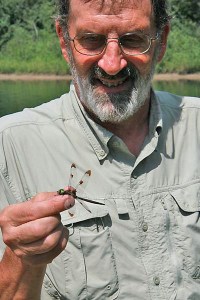
Bob Restifo, secretary-treasurer for the Ohio Odonata Society, examines a Prince Baskettail.

Now I suppose that there are a few of you feeling more than a bit smug right now since you already know what an odonate is. For those of you who don’t have nearly as much spare time as the aforementioned, we’re talking about dragonflies and damselflies. And they were teeming. While we did see more than a few species that we have yet to record here at The Quarry

Cedar Waxwing

Farm, such as the Unicorn Clubtail and the Prince Baskettail, most are common visitors and residents along Cranberry Run, in the eleven-acre back field and on the quarry. Among the more common species were Blue Dashers, Black Saddlebag, Common Whitetail, Widow and Twelve-spots. What wasn’t nearly as common were the sheer numbers of dragonflies, both in the number of different species present and the number of individuals within those species. And with that increase in numbers came a similar increase in the activity of animals that feed on odonates. Bullfrogs leapt from wetlands and cedar waxwings swooped over grasses snatching these aerial predators for their own meals. In fact, at one of the two sites the cedar waxwings clearly used us to improve their chances of catching a quick bite. They stalked us as we walked the verge of a wetland, waiting until we’d disturbed newly hatched dragonflies from their hiding places and then catching them as they flitted up and away.

Bullfrogs leapt from the water to prey on passing odonates.

We’d like to take this opportunity to thank the Ohio Odonata Society for the opportunity to spend a day in such an interesting fashion. We’d also like to single out three men in particular:  providing a great deal of insight and information were Bob Restifo, secretary-treasurer of the OOS, and Bob Glotzhober, member at large and a former president of the society, both of whom have spent decades studying and collecting odonates; we’d also like to thank Dave Betts, without whose input we’d have missed this incredible opportunity.

This slideshow requires JavaScript.

Raiding the Pantry, Old School

When I first started reading, after the picture books but before Tolkein and Bradbury and Ellison, I was drawn to stories like The Swiss Family Robinson and My Side of the Mountain. They were tales about people who basically fell off the map, who by accident or design no longer had access to civilization. To me, in great part, civilization meant grocery stores, because, hey, you can always find shelter, build a fire, weave a poncho out of leaves, design a method for extracting potable water from the air. That’s easy, right? But food? Come on, what are you gonna do if you can’t jet down to the local 7-Eleven or Krogers or Piggly Wiggly and grab a loaf of Wonder Bread and a jar of Peter Pan?

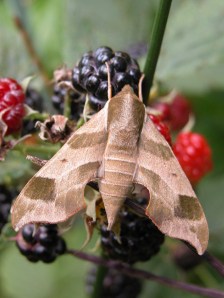
Virginia Creeper Sphinx Moth on black raspberry bramble

As it turns out, you make the whole world your larder. Man, but that grabbed by imagination; that a person could just walk out and pick breakfast, unearth lunch and chase down dinner was about the coolest thing I could think of. I used to hide bananas and bologna sandwiches (safely wrapped in plastic baggies) in our back yard. Then I’d set out in search of food, knowing that if I failed, I’d surely starve. Those were great days and, not surprisingly, given all the melodrama I invested in the whole process, that was some of the best food I ever ate. And now, well, I have the opportunity to do it for real.

So I do.

Right now, the raspberries are starting to come in. It’s early for them. I usually don’t start seriously picking until around the 4th of July. This year, however, they’ve been coming on since the beginning of June. You’ll probably hear me say this a lot this year, but it’s the weather: the mild winter, the rain we had earlier this spring and the hot and dry conditions we have now. Everything’s early. We had red-winged blackbirds on the property in March, blossoms on the blackberry brambles in late April, grasshoppers in the bottom land in mid-May and now, black raspberries.

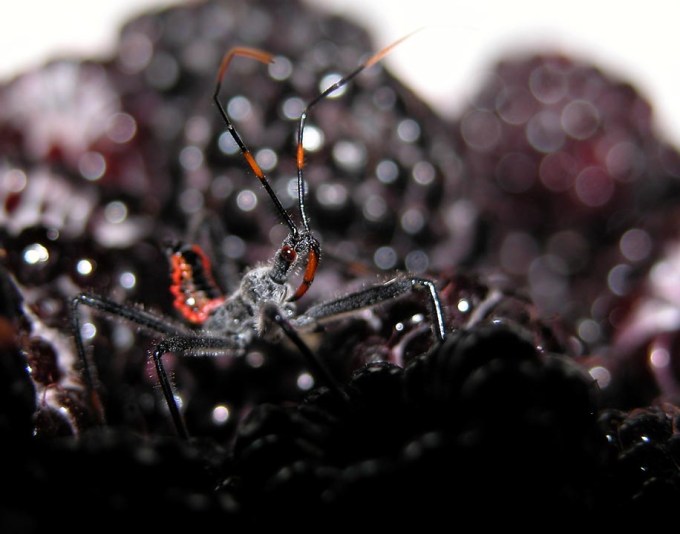
Berry patches are rife with macroinvertebrates. Here, an immature wheel bug perches in a bowl of black raspberries.

Now I get to go and play castaway, claw my way through the wilderness until I’ve gathered enough sustenance to keep me alive for a few more hours. It’s hard and dangerous work, but food is life.

On the other hand, if the berries don’t pan out, there’s always that loaf of Wonder Bread and the jar of Peter Pan.

An Hour On the Quarry

We, here at The Quarry Farm, have the great good fortune of living on a piece of land that provides a host of possibilities. Because of the forward thinking of a few remarkable people (and here I’m going to name names: Carl Seitz, Joyce Seitz, Gerald Coburn and Laura Coburn), we have houses and gardens and driveways and such. But we also have an area that, for the past 40 years at any rate, has had the opportunity to go Nature’s way.

For me, there’s a definite split, a line where domestic ends and wild begins. Here is where we keep the chickens, chase the pig, run the dogs, elude the duck and other happy little domestic activities. There is where the wild things are. Here: yard. There: not yard. It’s a convenient line, too, because it’s visible: a strip of trees that divides here and there. I include the line itself, the trees, in the there category, as part of the wild area of the Quarry Farm. From the tree line on is where Nature looms. That’s where Cranberry Run snakes through the property, where the turkeys make themselves known with gobbles and great splay-footed tracks, where great blue herons heave themselves from the water with complaining voices that Hollywood stole for Jurassic Park, where the occasional coyote howls and the foxes yip and the tree frogs sing and the squirrels, raccoons and skunks argue amongst themselves and with anyone or anything else that happens to grab their attention. It’s loud, it’s messy, it’s chaotic and it is absolutely beautiful. It’s a place I love to go. And today, in a very small way, I’m going to share. I set myself a challenge, gave myself one hour to walk along and across the stream, past the quarry and through the trees to the big field, then loop back along the path, across the stream and home again. In that time and along that walk, I took photographs. Fifty-nine photographs, to be precise. I’m not going to burden you with all of them, but I do want to share a few. And it all started in the tree line.

My first photo op fell into the “well, you just don’t see that every day” category. Before passing from here to there, I paused to try and get a shot of a widow skimmer dragonfly. While in the process of completely failing to do that, I heard a rustling in the grass in the treeline. Rabbit, I thought. Then rethought, because I heard a bit of scrabbling as it ran up a tree. Squirrel, then. Nope. I’d heard of groundhogs climbing trees, but that was the first time I’d ever seen it up close and personal. It was a juvenile and had obviously found something tasty (as evidenced by the leaf dangling from the corner of its mouth) that drew it just a little too far from a bolt hole. When it realized that I was coming in its direction, it took the best avenue of escape open to it. Up.

I was pleased to find that the wood duck who had nested on the quarry was still in place along with her brood of four ducklings. They’re skittish birds, quick to run at the first sign of possible trouble. As I came up on them, mother went one way and the four little ones, another. Even so, I caught a quick glimpse of them as they fled across the duck weed. The little ones have grown enough so that they are nearly fully feathered. Their wings whickered as they half-flew, half-ran across the water.

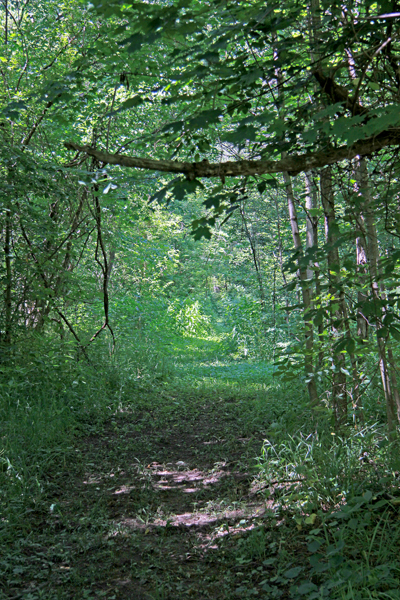
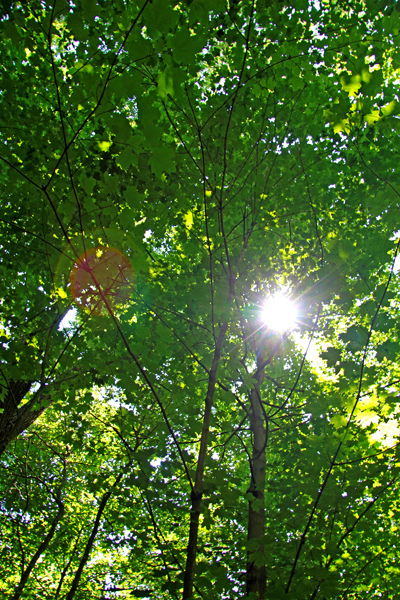
Although it was hot today – temperatures here were pushing 90 degrees – the main trail leading to the big back field was relatively cool. Over the course of the past four decades, the property surrounding the quarry has undergone significant changes. In many places, scrub and thick undergrowth is giving way to hard woods: in most cases, sugar maple trees. Where a relatively short time ago jersey cows grazed, there is now a full-blown second-stage forest. This year in particular, with its mild winter and wet spring, seems to have fostered growth. The trees form a canopy that filters the sun, dappling the ground with shifting patterns of light.

The big back field is nearly as varied in its habitats as the whole of the property. The greatest part of the eleven acres could easily be considered meadow, though there are, spotted here and there, scrub trees and brush. It is surrounded on all four sides by verdant growth: the forest that is the bulk of The Quarry Farm. Black raspberry and blackberry brambles tangle at the edges with wild rose and grape vines reaching out from the woods. On this particular day, a red-tailed hawk spun about the field in ever-widening circles. She screamed as she flew, though I’m not sure why. Maybe calling to a mate or to young offspring in nearby trees, or possibly just announcing her presence.

It’s a source of pride for us that we have such a healthy macroinvertebrate population on the property. This time of year, we see all manner of dragonflies and damselflies.

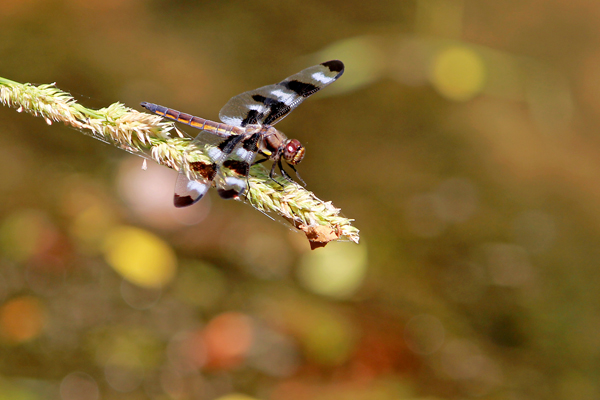
Twelve-spotted skimmer

They swarm up and down the stream, hunting, procreating and laying eggs, and they teem in the back field where there are plenty of prey species for them to feed on. While there are all manner of stories suggesting that dragonflies and damselflies are a nuisance, possibly even life-threatening, they are simply not true.

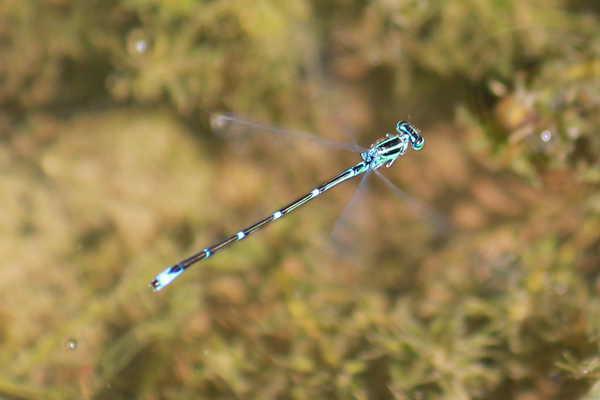
Bluet damselfly on rose cane

The fact is that these members of the order Odonata are some of the most beneficial insects out there, eating their weight every day in mosquitoes, midges and other annoying insects.

Ebony jewelwing damselfy

I was fascinated by them as a child, though I rarely had the opportunity to see them.

Now, generally beginning in late April, I go for a walk and there they are. When I see them, I can’t help but think of how cartographers, when they were filling in uncharted areas on maps, would write, Here Be Dragons. And they were probably right.

So there it is. One hour on the quarry. But you don’t have to take my word for it. It’s not necessary to limit yourself to two-dimensions. Contact us and make an appointment to see it in 3D. We’re not only happy to show it to you, but, in many ways, doing precisely that is who we are and certainly what we do. Contact us. Please. We’re counting on it.

Bluet damselfly hovering over Cranberry Run


CAPTION THIS! Winners

We’ve been remiss in announcing the results of The Quarry Farm’s first CAPTION THIS! competition. Truth is, we were torn. So, instead of sacrificing one over another, we decided to have two winners. Without further ado, here are the submissions presented by Joan Hahn and Laura Zitzelberger (and, yes, the entries appear in that order):


Is that Aramis you’re wearing?

I really feel that Kierkegaard was the father of the existentialist movement…don’t you?

Thanks to everyone who played and watch for future opportunities to CAPTION THIS! with The Quarry Farm.

A Bird of an Entirely Different Feather

I spend a good deal of my time looking down. I mean, that’s where the chickens usually are, right? Not to mention my feet, which need more than a little governance. But, head down, I miss a lot. I manage to stay on my feet, which is good, and not step on one of the girls, which is even better, but the wonders of the world frequently pass me by. So I’m amazed that on one of those rare occasions that I do look up, I spot something breathtaking, something beautiful.

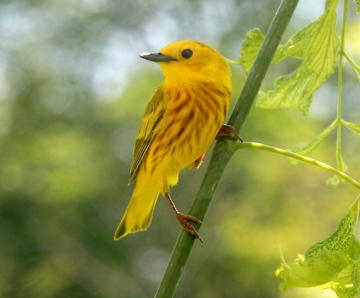
According to the University of Michigan Museum of Zoology Diversity Web, yellow warblers are common in North America. Declining numbers have been noted here and there, generally because of land clearance and herbicide and pesticide use. Usually when riparian corridor (a healthy number of trees and plants along a river or stream) is allowed to recover, these beautiful summerbirds make a good comeback. Cranberry Run passes through The Quarry Farm on its way to Riley Creek, with trees, grasses, and blackraspberry brambles to feed warblers. http://animaldiversity.ummz.umich.edu/site/accounts/information/Dendroica_petechia.html

Rain!

A lovely, much-needed rain greened this morning. Can almost hear the trees sighing, and the birds…the birds!

Sid is sporting a new wet look for the day. What do you think? Let’s have a little creative writing contest here. There’s a free Quarry Farm t-shirt for the winner. The most descriptive commentary will be awarded a shirt in the author’s size. You have until June 1 to weigh in here on www.thequarryfarm.com.