
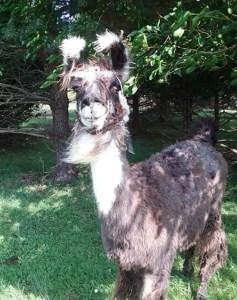
Mosaic
Llamas can reach speeds up to 35 mph. No humans kept that pace during The Quarry Farm 3rd Annual 5K on October 6. Chablis and Mosaic, llama dams who arrived at the farm animal sanctuary the night before the run/walk, didn’t run that fast either. Instead, the matronly camelids watched people trot past on the south leg of the course (more to come about the llamas in The Quarry Farm 2018-2019 Newsletter.)
I woke before dawn on Saturday to the sound of a torrential downpour, lightning and thunder. My alarm went off a few minutes later. I pulled the covers up and over, sure that we would be cancelling the 5K. The clouds lifted briefly so I set off for my own run at 7 a.m. and got drenched for my efforts. By 8:30, blue sky peeked through gray clouds, cleared by a breeze from the west. Remembering that Gran always said to look out for wind from the east (attributed to “When the wind is in the east, ’tis neither good for man nor beast”) we set up parking signs, registration, coffee and cookies.

Upstream view from Mallaham Bridge, October 6, 2018, 10:15 a.m.
The west wind remained true. By 11 a.m., 21 participants had passed the first tree in the Road 7L catalpa corridor, crossed over the historic Mallaham Bridge (and smiled for my camera), turned around at Bridenbaugh Schoolhouse and crossed the finish line in front of Red Fox Cabin.


By noon, we had coffee dregs, three lemon cookies and plenty of photos to help us remember. We had our four first finishers: Jeremy Haselman, Christine Meeker, Martha Erchenbrecher (5K Birthday Award) and (under 12) Asher Haselman. We also had three lessons for the 4th Annual 5K:
- Keep the color run option, but don’t use the little gel paint balls. They don’t break unless you really bean your target (not a good idea.)
- Ask Steve to make more French macaron with blueberry, lemon and raspberry curd.
- Get the word out early (mark Saturday, October 5, 10 a.m. start on your calendar—spread the word.)
Thank you to everyone who turned out and to anyone who crosses their own finish line to raise funds in support of what we do here and in educational settings in Northwest Ohio.
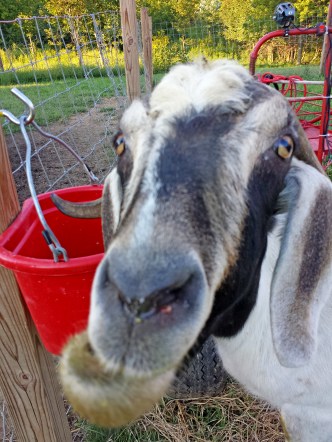 Bill took to the increased menu with relish. After a week of antibiotics, he was strong enough to say no way to the syringe. He licked his bucket clean before joining the other goats to nibble tall goldenrod and mulberry leaves in the lowland. But there was more going on inside his barrel chest, after all. Several days ago, Billy couldn’t stand. It took two of us to walk him to a bed under the pines where he could be in shade and good company. Dr. Babbitt was scheduled for a Friday house call. The plan was to fill Bill’s red bucket with taste treats before a final injection and release.

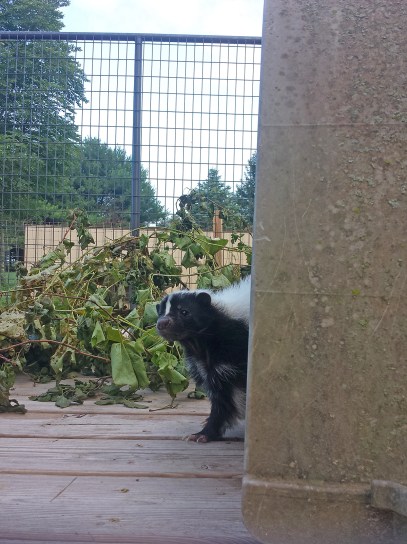 With great sadness, we report the death of Sebastian from a probable stroke in mid-August. No one knows just how old this miniature skunk was, as he was found in a tiny cage in a basement in Northeast Ohio during a home intervention. Estimates are anywhere from four to six years of age.
 Saturday, October 6 at 10 AM – 12 PM
 Thanks to Blanchard River Watershed Partnership for coordination support and to Ted’s Market for supplying water and snacks!
 This is a year of dragons. Saddlebags, skimmers, twelve-spots and white tales dive-bomb the farm animal sanctuary yard, plucking mosquitoes before they latch onto exposed skin. It has been stupid-hot of late, enough to keep the dragonflies under cover at mid-day. But in the evening, their wings shimmer position for hovering and steep dives.

 My ears popped as we climbed out of the Mississippi River Valley and rolled through greening hills and fjords toward Rice County, Minnesota.
 This land that we two-leggers call The Quarry Farm has been in family hands for a long time. I remember walking up the trail toward what we still call ‘The Cut-Off.’ My Uncle Carl led the way. He was a teenager and I was pretty sure he would get us home. This wetland, an oxbow severed by 1950s-era engineers from the free-flow of Cranberry Run, was the outer reaches for me. I had faith that teenage Carl, a grown-up to grade-school me, would know the way back.
 Around the time that Carl and I took that walk, I decided that my mission was to preserve this 50-acre island. I know how lucky I am to have this memory. After adult years of looking for my purpose in life, I realized that my small self was right. I came to my senses in time for my child to create her own memories among the native flowers, trees and cricket frogs that sing of wild spring here. Luckily, My Steven agreed.
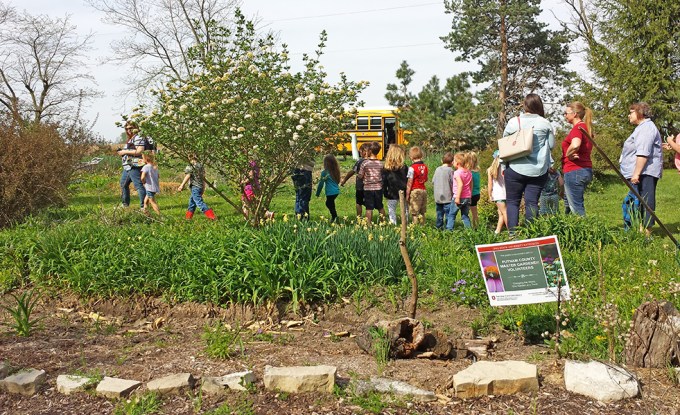
 Last week, we introduced The Quarry Farm to children, teachers and parents from Patrick Henry Preschool. On May 9 and 10, they made lasting leaf shirts from the foliage of blooming buckeye trees. They took a “Smelling Hike” of Red Fox Cabin gardens to enjoy the scents of mint, costmary, and viburnum. They saw the inhabitants of Cranberry Run and were greeted at the farm animal sanctuary gate by pigs Nemo, Carlton and Beatrice.


