 We’ll be jammin’ at 6 under the red roof. Bring a chair and jam, too. At least tap your toe and sing along.
The rain is moving through now and will leave us with cooler air, and there are cookies; always.

We’ll be jammin’ at 6 under the red roof. Bring a chair and jam, too. At least tap your toe and sing along.
The rain is moving through now and will leave us with cooler air, and there are cookies; always.
 In between cookie batches for Saturday’s annual music Jam, the call of the nature preserve was answered. So were Lolly and Cady, both of whom stared out toward the tree line, rolling their big brown eyes soulfully and wagging their tails each time someone with opposable thumbs walked in the direction of the front door.
Sunday, the door was opened. Summer drought and temperatures in the upper 80s laid mosquitoes to rest; no repellent was pocketed along the way.
 I always forget what late summer does to the natives. Minnows, small bass and other fishes circle in the pools that are Cranberry Run during much of the year. This year there are clots of decaying algae to suck the oxygen from their gills. The bed has been dry for so long that purple ironweed grows below the waterline. The old quarry is diminished to a green duckweed center.
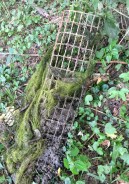 I pulled a muskrat trap from the bed of the stream. Its wire frame lifted with a strong coating of fertilized creekbed. Neither traps nor fertilizer are welcome in this waterway. One is easily removed, though, and went the way of garbage pick-up.
Leaves hang dull green and brown-edged from the trees. Twigs–whole limbs, sometimes–drop with the hot wind that puffs down the bluff into the floodplain. A willow that, even though it died some years back still hosted ichneumon wasps and other helpful predators, leaned its last before our arrival. A chunk of trunk crumbles over the path. A new bracket grows on what still stands.
The back field is golden under heated air open to sunshine but little current. Few insects sift through the artichokes and bullthistles. There should be so many this time of year. Their absence is sobering. It’s a relief to see a bumblebee and sulphur butterfly. I tried to take the bees photo, but all but his back legs and a bit of yellow fluff are caught in the frame to the left of a cluster of yellow flowers.
Flattened grasses indicate that somethings do rest and feed here. We get a whiff of proof when both dogs roll in scat and carry it with them back through the upper woods toward home and baths.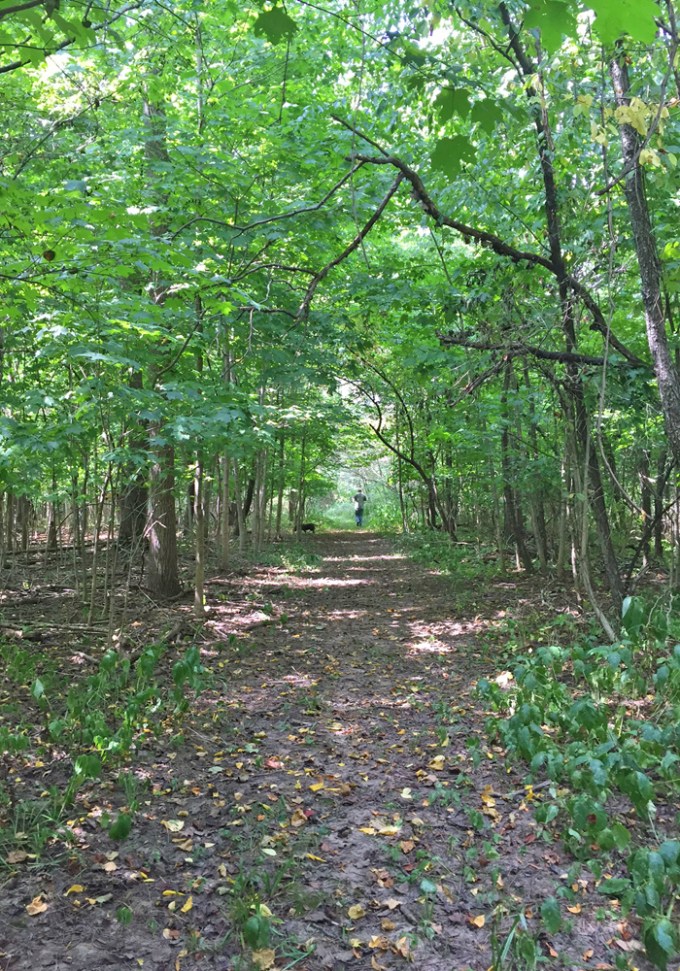

Much as I tried, I couldn’t leave this photo to its own devices. Buddy was indeed yawning, not braying the classic “hee haw.” Donkeys don’t, at least the two here, don’t. They “hee-hee-hee” and “ho-o-o-o-nk” and blow raspberries, but declare nothing for Buck and Roy to play along with.
Sunday morning, as I filled the water pans, Buddy followed me to make sure no carrots lurked in my pockets. I saw his lower lip begin to tremble and readied the camera just in case a toothy grin was on its way..
It took the dregs of July, the last real rain to percolate through the cracked ground, to get us through three weeks of no rain. A mustard haze hovered over the corn field across the road. Any bit of breeze brushed it into the water pans and left a brown coating on grass that was already crispy. Water in the cabin rainbarrel was conserved used sparingly.
In the floodplain, Cranberry Run didn’t run. Darters, minnows, crayfish and blue gill duked it out in pools, the survivors left to feed the great blue herons by day and raccoons by night. A week ago, rain–rain we needed so very much–came and went, leaving fungi of all sorts sprouting and the rainbarrel full. The drought dried up the mosquito swarms, leaving perfect conditions for outdoor art workshops. There’s no better time to paint in watercolors than when water drips from the eaves of the shelterhouse, eh?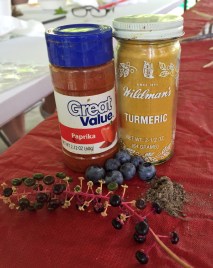
On August 20, we dug through the kitchen cupboard, the garden and its edges to pool a palette of natural pigments with which to paint still lifes and landscapes. The Saturday class includes individuals from right here in Putnam County to a Tennessee visitor. Using rich colors derived from paprika, turmeric, blueberries and poke berries (plus black coffee, something that’s part of every workshop here), participants developed pieces lush with late summer color. Store-bought paints were also available and most everyone washed the first layer of a second work.
There were visitors of different species, including an unidentified caterpillar and two haywagons-full of riders shuttled by neighbor Daryl Bridenbaugh. When paints were put away, the creative mood was still fresh. Board President Laura shared a slurry of shredded, soaked paper, mixed in some concrete plus a little dab of this and that so those that could stay onsite could make papercrete containers.


On this last day of August, one pot has traveled home to North Carolina while the others are still drying in Ohio. Instead of yellow dust, there is fog.
And it’s raining.
Funny story. A man crafted a pretty little flyer that he thumb-tacked to the check-out bulletin board at the neighborhood market. The ad simply stated that he liked to tinker with old lawnmowers and was looking for a new project. The posting included his address and phone number.
He came home from the grocery store and found a half-acre-full of lawnmowers in various conditions on his half-acre of land.
This is why we do not share our address prominently on this website, on Facebook or any other easy-to-locate location.
 This is Bob. Bob is happy. Carlton is standing behind him, as are several hens of various histories and ages. They are happy, too. When Bob came here, he was not happy. He was recovering from abandonment, starvation, frostbite and likely a whole other host of horrors. Some of those chickens came with him. They survived because they found shelter from the coldest winter of the decade under the frozen carcasses of their flock. Carlton was abandoned by someone anonymous. We’re betting that they found out piglets–even pot-bellied minis–don’t fit in the palm of your hand forever.
If our address was easy to find, we would have more Bobs, Carltons and chickens that we could care for, no matter how hard we try. By no means whatsoever do I mean to suggest that Bob, Carlton, Beatrice, Lucy, Buddy, Freckles or any of the animals here on the farm animal sanctuary on the same level as a lawnmower. Lawnmowers we can load up, take to recycling and use the recycling funds to pay for food and medical care for the animals. These animals, however, trust us to provide for them for the rest of their lives, lives that we pledge to be existences of peace and contentment. That’s the least we can do to make up for what some of our fellow human beings have put them through.
So…
If you call us and we don’t answer right away, please leave a message. We will return your call as soon as everyone is tucked in or a scheduled program is completed. If you have an animal that you cannot care for, we will refer you to someone who can if we are unable. That is part of our mission.
Better yet…
Join us on October 1 for the first ever Quarry Farm 5K (registration info is listed under Events) and be part of that mission! You’ll walk, run or bicycle right past the gate.

Brenda Fawcett mixes papercrete
Despite the heat, only one paint mixer drill bit and mosquitos aside, three programs happened onsite this past week. Monday, Putnam County Master Gardener Brenda Fawcett led a make-and-take wherein participants created planters out of papercrete (a sort of papier mache combination of Portland cement and paper strips.) Tuesday saw the return of the Hardin County Herb Society.
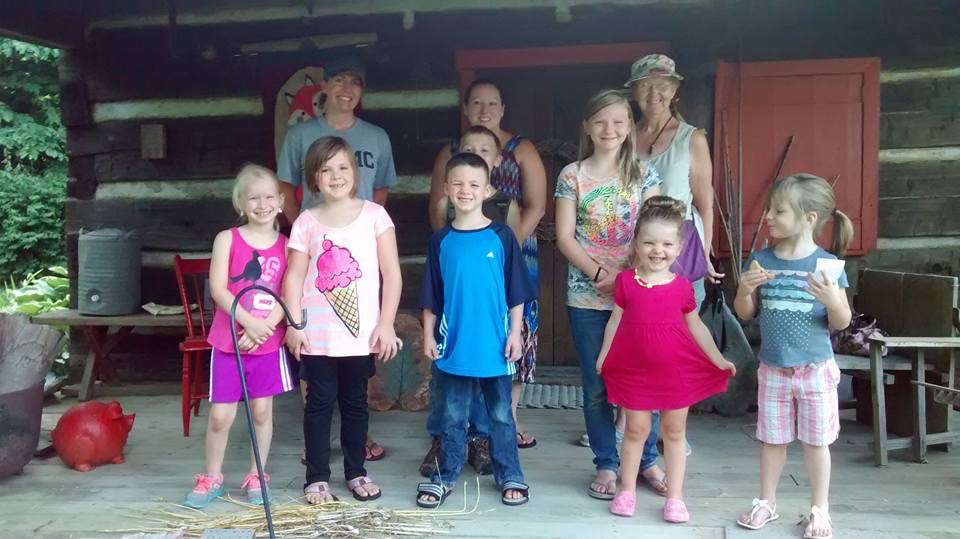
On Saturday, “the hottest day of the year” according to local weather forecasters, Charlene Finch and the 2016 Continental Jr. Gardeners made the group’s annual trek from the northwest corner of Putnam County. If you scroll back through this blog, you’ll see that Finch’s crew have been here just about this time every summer for several years. After partaking in a scavenger hunt for pollinators, the young green thumbs posed on the front porch of Red Fox Cabin for their annual portrait (thanks to Miranda for sharing this snap.) They also visited with the farm animal sanctuary residents, helping to cheer up S’more as he’s been pretty withdrawn due to the loss of his brother this week.
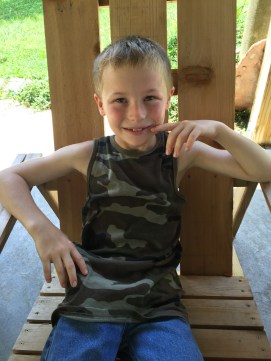
That pollinator search led to quite a list of creatures. The team of Nathan and his mom Lindsay won the scavenger hunt with a list of 21, as follows:
Nathan, Pollinator ID Champion
1. baby green grasshopper
2. people
3. wasps
4. cabbage moth
5. dragonfly
6. wood bee
7.big brown beetle
8. fly
9. bumblebee
10. flying ant
11. mosquito
12.ash bugs
13. sweat bee
14. black cricket
15. honey bee
16.black wasp
17. Japanese beetle
18. black beetle
19. big brown camo moth
20. gnat
21. red lightning bug with reddish brown black spots
Teams didn’t have to be specific with names as long as they could describe their finds. As a group, we corrected some names and identified others as described. For instance, #19 was a skipper butterfly.
You’ll also note that not all on the list are technically pollinators: hummingbirds, bats, bees, beetles, butterflies, and flies that carry pollen from one plant to another as they collect nectar. However, all of Saturday’s finds carry pollen, not to mention seeds and other insects, in their journey from place to place. That includes humans, whether we intend to or not.
You may also see that the notorious, voracious invader Japanese beetle made the list. They may spread pollen around as it clings to their scarab-like bodies, but they more than make up for this by decimating green goods. But there’s hope from the skies, control provided by a European transplant that’s been here so long that the New World is as much theirs as it is ours.
Eat up, European starlings. There’s ketchup in the shelterhouse.
noun: anthropomorphism
the attribution of human characteristics or behavior to a god, animal, or object
On Thursday, we buried a friend of ours: Marshmallow, a Nigerian dwarf goat whose gentle disposition touched a lot of lives. I’ve already related this, clumsily fumbled my way through a post that was part eulogy, part obituary and completely inadequate in relating the true nature of this incredible being, how important he was to all of us here on The Quarry Farm and to those who had the good fortune to interact with him, however briefly. Something happened, though, while we were burying him, the relating of which I hope will make up for my failure.
Yesterday, I dug a hole. If you follow these posts, then you already know this. I dug the hole, then I drove the seventy-some miles to Marysville to pick up the husk that was Marsh. Marsh’s brother, S’More, was lounging near the gate, watching as I left, and he was still there roughly three hours later when I returned.
I pulled in, closed the gate, then maneuvered my car over to the site we’d chosen to return our dear friend’s biomass to the Earth.
It took me a few moments to jockey the body from the backseat, ease it into the hole and manipulate it into position, muttering apologies the whole time. That Marsh wasn’t there to hear me was apparent. I was simply pouring sound into absence.
As I took up the shovel, scooped the first blade of dirt, I saw S’more come up on my left between me and the now not entirely empty hole. He was agitated, his tail flicking furiously as he paced the circumference of the pit. Every few steps, he’d stop and lean down toward the shell of his brother. His nostrils would pulse and he’d falter a bit, one foot pawing tentatively at the open air between them.
I waited until he was on the far side of the hole before I threw the first shovelful of dirt, then three more in rapid succession. As I was reaching for the fourth, S’More rounded the corner, stepped up to me and leaned the crown of his head against the handle of the shovel, holding it in place. I rubbed his neck for a moment, easing him away, then threw a fifth, and then a sixth shovelful. Turning for another, I found myself surrounded by all five goats who live here: Willow, Elora and Madmartigan, the three pygmies; Mister Bill, the giant Boer-mix; and S’More.
While the pygmies paced the pit, nostrils flaring, Bill gently hooked me with one horn. This isn’t unusual behavior. Bill loves to rub the side of his face up and down whomever will stand and tolerate it. In the process, his curled horn will lock a body in place, glide up and down a hip or leg or side as he rubs. This time, though, he simply applied a gradual pressure that pushed me away from the dirt, away from the hole and, by necessity, the body in it.
For a few minutes, I soothed them all: rubbing the spot between Bill’s horns that he most dearly loves rubbed; stroking S’More’s neck and gently scratching his rump; talking quietly to Willow, Elora and Martigan, none of whom are overly fond of physical contact.
When I resumed my task of shifting dirt from mound to cavity, the herd wandered off together and took up observance from the top of a small hill of dirt-filled tractor tires, a form of enrichment that Rowan constructed during her last visit home, some sixty feet away. They stayed there, all five of them, until I’d finished. Then, once I’d climbed the steps to the deck on the west side of our home, they left their perch and moved to surround the grave, staying there for several minutes before moving off to graze on the opposite side of the property.
It’s been suggested that we can’t truly understand the motivations of animals, that in trying to do so we attribute to them emotional responses that they simply don’t have. But it’s not they who are lacking. It’s not they who fail to understand.
In the end, I know what I know.
I know that they are grieving.
I know that they are sharing that grief.
It took seventy-four minutes to dig a hole this morning; just over an hour, with shovel and pick, to create a nothing four feet by three feet by four feet deep. I had thought it would take longer, prove harder, given the heat and the dry. But, no. Just seventy-four minutes. Time enough to come to terms with the harsh reality of the past thirty-six hours.
In early July of 2010, Marshmallow and S’more, two Nigerian dwarf goats, wethers both and brothers by all accounts (though the two couldn’t be any more different), were delivered to The Quarry Farm by Anne and Rowan, who brought them north from Cincinnati in Anne’s little Scion xA. Their arrival fortified a growing vision of The Quarry Farm as a safe haven, a home and sanctuary for the unwanted and the unloved, the abused and the forgotten.
Which is not to say that all of the animals now living here were unwanted or abused. Buddy and Lucy and Bill and Beatrice all came from loving families who, through circumstances undesired, were simply unable to keep them any longer or believed them better served on The Quarry Farm. And so, too, it was with the brothers (if not by blood, then certainly in spirit). The family that raised them to that point loved them, and dearly. Sadly, the two large dogs that also lived with the family loved them as well, though in an entirely different and specifically threatening way. Thus the trip north.
Marsh and S’more (The Boys as we came to affectionately call them), when they arrived, joined the Priscillas, sixteen Hubbard Golden Comet hens, and Johnny and Stella, two non-releasable Canada geese; the sum and total of The Quarry Farm’s inhabitants (not including the three dogs and eleven cats). S’more, was, and still is, slim and athletic, given to spontaneous bursts of energy that found him bounding sideways and pronging through the yard. It was clear from the beginning, though, that Marsh had issues. While he’d chase after his brother, bash heads and sport about to the best of his ability, he was prone to a constant mild bloating that, despite our best efforts, made it difficult to keep up. On more than one occasion, a visitor would ask if “she” was pregnant. What he lacked in athleticism, though, he more than made up in personality. Frequently the first to greet guests, Marsh was sweet and gentle, curious and approachable and children thronged to him. He’d greet them, and us, with his head tilted up, encouraging any and everyone to stand nose-to-nose with him.
But while willing and even desirous of the attentions of others, particularly when they offered bits of fruit or carrots or peanuts, Marsh was clearly bound to S’More.
Inseparable from the first, the brothers would play together, eat together sleep together and wander the property together, often pressed up hard against one another, shoulder to shoulder, moving about in a coordinated tandem. Now, I ache for the one without the other.
A little less than three years ago, we found Marsh standing in the yard, straining to urinate, but unable to do so. We called Dr. Ron Baldridge, a local veterinarian, who, over the phone, diagnosed bladder stones. Unlike kidney stones in humans, bladder stones in goats, due to their unique and convoluted physiology, will, untreated, prove fatal. Explaining that goats were outside his purview, Ron recommended contacting Ohio State University’s Veterinary Hospital. There, they surgically removed the stones and, after a week, Marsh returned home. Here, we worked to acidify his diet, providing ammonium chloride in periodic drenches and pouring gallons of apple cider vinegar into water troughs. Even so, ten months later, they reoccurred, necessitating another trip to Columbus and a second surgery. And again eight months later.
Wednesday evening, we found him once more, his belly distended. On Thursday, we drove him to the OSU veterinary facility in Marysville. That evening they called with disastrous news. Early Friday, I brought what was left of him home.
It took seventy-four minutes to dig a hole this morning, and even less time to fill it in. But there are holes and there are holes, absences that no amount of effort can ever fill.
So, then, because there is nothing else to do or say, goodbye, Marshmallow. Goodnight and sweet dreams.

 The mountains of Ohio are some distance from here: the highest point is an hour’s drive near Bellefontaine and the Appalachian foothills two hours more to the southeast. The Quarry Farm does house a valley and blue clay walls rise west above Cranberry Run, but the floodplain levels out east for some distance before it marches back up to the ridge trail and the grassland.
The point is that it’s pretty flat on the edge of the Great Black Swamp, just before land starts to pitch and roll a bit. There aren’t many climbing opportunities apart from trees and playground equipment. There certainly aren’t for goats, and most do love a good climb.
So Rowan brought a climb to them. She research designs and materials. She bookmarked wooden platforms with ramps and towers made of giant cable spools. 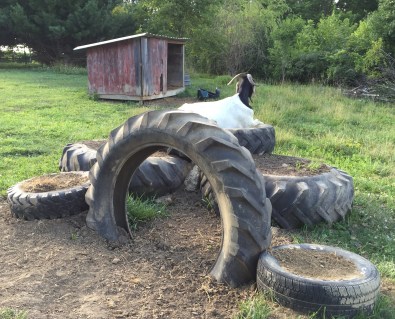 She frowned a lot when I said that head butting and a large pig would probably bash any kind of platform to bits, but she held her ground. She revised her plans, rounded up tractor tires, dug and chipped free sub-baked soil to fill them and created a goat mountain at the edge of the former paddock. There’s also an arch for head-scratching
 After all the hard work and sweat, no one showed any interest in playing on the new station–not in May or June or into July, until this evening when I pulled through the gate and saw Mister Bill gazing out over the hillside from the highest level. He must have got the ball rolling because Martigan tried it out,too…after Billy left the vicinity.
Four years and six days ago, we watched a wall of white march across the field, a roaring mass that stretched from north to south as it blew southeast. We weathered the June 29, 2012 derecho from a basement window, watched the trees bend and debris fly over their tops.
In the end, several hardwoods fell on the nature preserve. Only a few fell over trails, so the others remained where they fell to provide habitat and host. We lost more pines than anything, their shallow foundations not suited to the soil and winds here. Four years later, the Fourth of July weekend provided the right conditions for us to break up the dried pine and safely burn.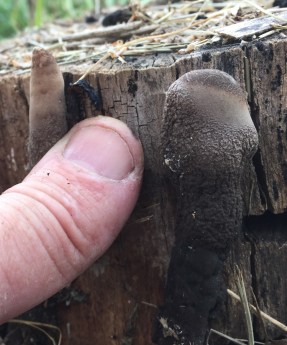

We moved the brush to cleared ground, shaking loose pill bugs, millipedes and a garter snake that is blind as it prepares to shed a worn skin. Old stumps were broken up to make way for school bus parking. A cluster of mottled gray fingers clutched the base of one; a toe pointed skyward against another. I’ve never seen fungi Dead Man’s Fingers in the flesh before today. Makes the delicate jewelweed blooming in the floodplain that much more brilliant in contrast–but what a thing to see.

