Made My Day

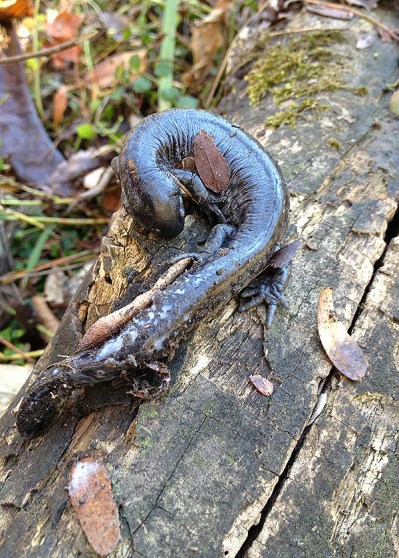
Even though there are over 25 species of salamanders native to Ohio, and we should be able to find them under practically every rock, rotting log and leaf pile, we frequently don’t in much of Northwest Ohio. And that’s why we’re so excited that Quarry Farm friend, volunteer and advisor Alaina Brinkman Siefker shared this photo today. She captured this little guy’s image in the Quarry Farm north floodplain, aka “Coburn’s Bottom”, this past Sunday. This animal looks to be a Jefferson or Blue-spotted salamander, or a hybridization of those two species.

Salamanders, frogs and other amphibians usually require both aquatic and terrestrial habitats. They are born in water, develop and move onto land. Talk about your primordial creature. Much of their natural habitat has been destroyed. Not just around here, but all over the world. And if that habitat hasn’t been wiped away, it has been disturbed or chemically altered. Top that off with an impaired atmosphere and you get severely declining amphibian populations.

Researchers consider amphibian populations an indicator of overall environmental health. The salamander that Alaina and her family saw this weekend tells us that we are doing something right around here. Next spring, look for announcements for the First Annual Quarry Farm Salamander Count.

For more about Ohio’s salamander populations and monitoring program, visit http://www.ohioamphibians.com/salamanders/Salamanders.html.

A Shoot, a Release and a Puzzle Solved

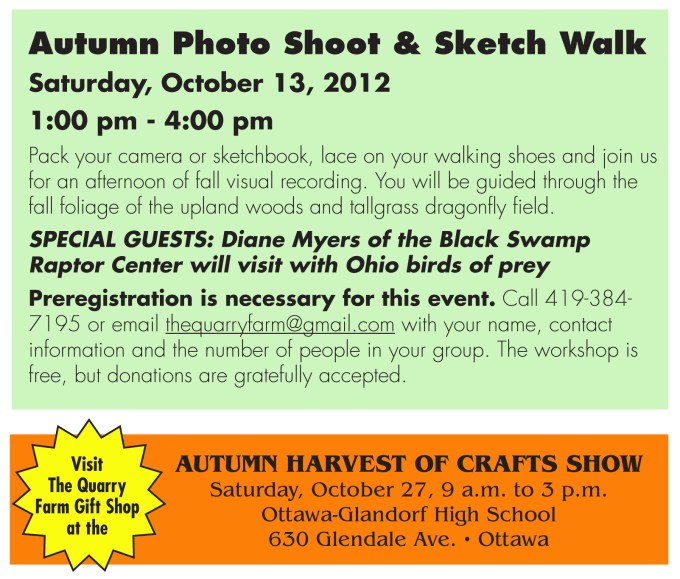
As the woods back on the quarry develops, the trees that make the forest are changing. Where there were hawthorne and honeylocust and hackberry, now sugar maples are the prevailing tree. In autumn, these maples provide the brilliant bursts of color that make New England the tourist destination that it is. What better time, then, for The Quarry Farm’s third photo shoot and nature walk?

For those of you that missed it – and you did indeed miss it; it was yesterday – it was just about as good a day as we could have asked for: warm, but not too warm; slightly overcast, but just enough so that it enhanced the lighting for photography; and breezy but not windy. Diane Myers, the rehabilitator behind Black Swamp Raptor Rehabilitation, came for the second time and brought a trio of birds. Included in the mix were a screech owl, a short-eared owl and a barred owl. These birds are permanent residents at her facility and as such are more accustomed to people than their wild counterparts, making image captures a whole lot easier.  The shooting of the birds went as expected, with Diane setting up shop on the grounds near Red Fox Cabin, leashing the birds to tree limb perches so as to increase the impression of a more natural environment. As a bonus, Diane also brought along two rehabilitated birds for release, a red-tailed hawk and a screech owl. In addition to the birds, aquatic macroinvertebrates were on hand, as well as a juvenile Virginia opossum.

The walk back onto the quarry proper was beautiful, but uneventful. We did, however, have a mystery resolved. While on last winter’s photo shoot and walk, we discovered a vole skewered in a hawthorne tree. There was a lot of conjecture at the time as to how the vole could have come to such a state and we settled on the idea that something most likely stashed it there. Well, we were right. According to Dr. Biehl, a naturalist and falconer who was along for this fall’s walk, the vole was stashed there by a loggerhead shrike (http://www.allaboutbirds.org/guide/loggerhead_shrike/id.).

Crow’s Work Is Never Done

This morning Steve was unable to locate Blackie the American Crow’s food dish. Through no fault of Blackie’s, certainly, as his roommate Jo is the crow with the mostest if she has any say.

I took fresh bowls of water in and tried my hand at locating the missing dish. I got down on my hands and knees and looked under the couch, table, cages and under newspaper before giving up. As I cleaned the old newspaper out from the cages, Jo perched on my back for a bit and jumped off when I turned to Blackie. Jo skittered around behind me. When I turned around to leave the room, there sat the missing dish on the floor in front of me.

Crows vocalize at ranges that we can’t always hear. I’m pretty sure that Jo’s subsonic chuckle followed me out the door. Typical.

Being outsmarted by Jo is a frequent occurrence. Not as common are these special events. Come one, come all to:

Talking Turkey

Five wild turkeys ambled through our yard today, not two hundred feet from our home. We frequently hear them in the morning back on the quarry and occasionally see them in the evening, well behind our house, roosting in the cottonwood and walnut trees. They’ve never come this close before, though, and even though I know that they’re simply wandering to and from the soy bean fields across the road and so are likely to pass close by either here or Red Fox Cabin, it still caused me a bit of concern. I worried that they were becoming less wary, less concerned about our presence and, by association, the presence of other people, as well. I worried about the upcoming turkey season and how they’d prove easy targets if they were comfortable around us.

I worried, that is, until I tried to get a photo.

It was Anne who first spotted them and pointed them out to me. They were walking down a path along the tree line that separates the farm part of The Quarry Farm from the nature preserve side. I grabbed my camera and headed out to where Anne had last seen them. I moved to the far side of the tree line and worked my way up the path on the other side, then down the path on our side of the trees. Then up again. Then down. You’re looking at every photo I was able to get. You see them, right? The photographs, here between the lines of black and white text? Yeah, neither do I. That’s because I couldn’t get any. I can’t say that I didn’t see them. I did, at least in bits and pieces: the glide of a blue-gray head; a bronze-feathered body slipping through brush; a quick flash of red from a wattle. But that was all I got, quick glimpses. They ran me round and round an area about the size of an American football field, always on the other side of the field and always virtually concealed in thick scrub. So, no worries about their growing comfortable with humans. And no photos, either, not of turkeys anyway. But, since a picture paints a thousand words, here’s a shot from the winter before last.

It is autumn, though, and there are plenty of other animals moving about. In the back field, a leopard frog boasted better than average camouflage. If it hadn’t jumped, I never would have seen it. In the woods, the last of summer’s dragonflies are torpid with the cold, allowing for some pretty extreme close-ups. Closer to home, in the crabapple tree some thirty feet from our front door, a wheel bug traveled leaf to leaf, hunting an increasingly rare meal.

This slideshow requires JavaScript.

Looking for White Cat

We’ve been busy here. You’ve been busy there, wherever your ‘there’ may be. So much going on that, like me, you are in danger of missing the gold-tinged greens and amethysts of ebbing August, at least as it is here on the Quarry Farm.

I did almost miss it. We have caught a smattering of the sunsets, the kind that include that frosted-animal-cookie pink. But any noticing has been as we walked past a window or distributed hay to Buddy, Marsh and S’more or put the hens to bed. Then one of us left a door unhinged enough that Beatrice opened the front door and let the cat out.

Although we do have several cats, it was White Cat that slipped out. White Cat is deaf as are many white male cats. While there are plenty of dashing, flying and sparkly sorts of things in the outside to entertain a house cat, there are even more along Cranberry Run and in a 50-acre woods that will feast on feline. One that can’t hear a predator approach is especially vulnerable. So we looked high and low for White Cat. And as we did, we caught late summer.

Wild plums ripen

The wild plums are ripening on the nature preserve. Some hang at eye level beside the rich yellow Jerusalem artichokes and purple ironweed on the stream bank. Most plums are rose gold, but some are beginning to flush to mauve. For the first time, Steve will be able to make wild plum preserves to sell at the Quarry Farm table at the Farmer’s Market. (Warning: shameless plug for funding ahead.) Reserve your jar now through the Gift Shop!

Jewelweed, nature’s cure for the maddening itch imposed by poison ivy, is in bloom in the floodplain. The algae growth that plagues Cranberry Run, as well as most of Northwest Ohio’s waterways, is camouflaged by shimmers of sunlight that ignite the riffles. Higher up, the sun itself glows through the tired summer leaves, although the sunlight is cooling from the white hot of June and July. Better and better.

Bushel gourd on the vine

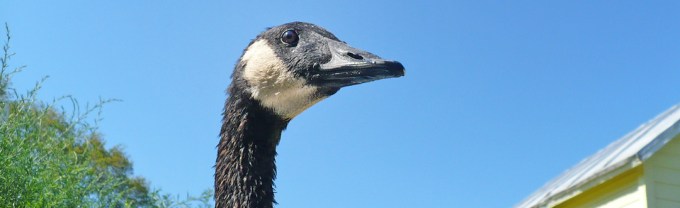
Down low, bushel gourds swell under huge vine leaves. Recent rains have brought on a good crop. The leaves have already been used this summer in a stepping stone workshop. More will be made before the vines wither in frost. The chickens and Johnny the Canada goose find this ground-level search fascinating, especially since disturbed vines yield fat, juicy crickets.

Wounded White Cat and Birdy nose

Even lower, under Buddy’s barn, White Cat is found. The roosters knew he was there; it just took the obtuse humans two days to figure it out. He has earned himself a gash under one eye and a limp, injuries probably inflicted by Buddy. Back in the house, White Cat is thoroughly sniffed before he settles himself in for a good grooming. Outside, the finches and field mice can peacefully ready themselves for the cold months. We will remember to notice.

It’s the little things (that show you care)

Here on the farm sanctuary of the Quarry Farm, you all know by now that we have chickens. Of those chickens, four are roosters. One rooster, Sid, doesn’t count because he is fancy and that keeps him docile and slow-moving. Bernie, Jeff and Ralph are birds of a different feather altogether.

These three probable Rhode Island Reds have three different origins that shall remain a mystery to us. But all three will live their lives together in the paddock with Buddy the miniature donkey and Nigerian dwarf goats S’more and Marsh. Sid has the roam of the rest of the place where he is tolerated by the hens who can easily out-manuever  him. The three other roosters have an easy truce between themselves as long as the hens keep out of the paddock. And when no one is in there with Mr. Shovel.

Unfortunately Mr. Shovel must make an appearance every morning in order to remove the donkey, goat and rooster leavings from the previous day. Bernie, the original rooster, does not care for Mr. Shovel. Nor does he particularly care for the person who is wielding Mr. Shovel.

If you have ever been spurred by a full-grown rooster, you know it results in white-hot searing pain that bleeds like nobody’s business. The kick that accompanies the spur usually leaves bruises. I myself actually suffered my first severe ankle sprain after a confrontation with Bernie. Since chicken dinner is not on the menu here on the farm sanctuary (so don’t even go there) I have learned: A) not to wear bright red around Bernie; B) keep Mr. Shovel between myself and Bernie; C) make sure Ralph is keeping an eye on Bernie.

At first Bernie was very friendly, but sometime during the course of the second year he became aggressive, mostly with me. Steven claims it is because I wore a bright red rain jacket around him. The jacket went to Goodwill, but Bernie still came after me every time my back was turned. So Bernie was banished to the paddock so he wouldn’t go after anyone else. That helped until he took a dislike to Mr. Shovel. Enter Ralph.

Ralph came to live with us about two years after Bernie did. He was adopted with a group of hens, all unwanted by an Allen County landowner. So as to give the hens here a relatively stress-free existence, we put Ralph in the paddock, too. Ralph and Bernie duked it out for a while and Ralph came out on top. Jeff joined the fray some time later the same summer. Ralph remained the dominant rooster, so much so that Bernie’s comb diminished and he became quite tame. For about a season.

This spring, Bernie again decided that I am not to be trusted and indeed am to be chucked out of the paddock at every opportunity. But Ralph doesn’t feel that way. My little red-combed savior will keep himself between Bernie and me, even driving Bernie off to the far corner of the paddock. Ralph will also break up private trysts between Jeff and a hen named Barbara, but that’s a different story.

Just a few minutes ago, Ralph came to my rescue again. After posting this, I am going to take him a slice of yellow squash.

By the way, the photo of the horned worm has nothing to do with this story. Steve took this last week as these voracious creatures were being hand-eradicated from the tomato patch at Red Fox Cabin. I just thought it was a cool shot.

A Swift Release

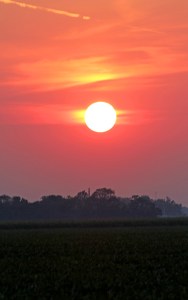
Sunset from The Quarry Farm.

This has been a strange year, a difficult year, in some respects. An overabundance of spring rain gave way to summer drought and a flurry of fierce storms. The storms, in particular, have proven hard on the living and arguably hardest on the birds. Strong winds shredded trees and the nests to which they offered insufficient protection. For many wildlife rehabbers in the area, the storms brought a rain of orphaned and abandoned birds. This past weekend, Natalie Miller, education and rehabilitation specialist with Nature’s Nursery, brought two of these foundlings to The Quarry Farm. The birds were chimney swifts and they are a welcome addition to the fauna here.

One of two chimney swifts brought to Red Fox Cabin for release.

Chimney swifts (http://www.chimneyswifts.org/) are insectivores. Incredibly fast flyers, hence their name, they wheel about as sunset approaches, snatching meals of flying insects. And, again as their name suggests, they nest in chimneys, such as the one at Red Fox Cabin. Finding established populations of chimney swifts is becoming increasingly difficult. Abandoned or rarely used chimneys, the kinds of places where swifts can set up house unmolested, are rare. So it was worth the hour-long trip south to release these birds here, where others of their kind can help them learn the skills they’ll need to survive.

Red Fox Cabin

We took both birds out to the cabin just about mid-evening. Although there was no immediate sign of the resident swifts, they’re a common sight here. As it turns out, we only released one of the birds (the video of that release accompanies this post; don’t blink or you’ll miss it). As the released bird swept up and over the tree line along the road, five of the Red Fox Cabin swifts flew in from over the quarry and herded the newest member of their flock away from the soy bean field and back to The Quarry Farm. As for the second swift, it still needs a little more care, a bit more time to grow, before it’s ready for release. For now, it’s in the capable hands of Rita Seitz, and probably will be for at least another week. When the time comes for it to join the others, we’ll be sure to let you know.

Buddy’s Big Day

Tiger in the garden

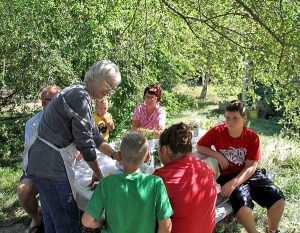
The Junior Master Gardeners of Continental (Ohio) graced The Quarry Farm with their presence on July 11, the first group to visit since the big wind blew through. Although there are still a couple of downed trees here and there, the paths were clear and mowed in time for the travelers to arrive.

Led by Charlene Finch, the group of 20 adults and children of varying ages drove in around 10 a.m. to beat the afternoon heat. They divided into three groups to rotate through three different learning and activity stations.

Mints and other herbs and flowers are bundled

Group #1 met under the shady zelkova in front of Red Fox Cabin. From Board President Laura they discovered the history of the cabin and the grounds, the gardens and made herb bundles from cuttings gathered there.

Group #2 circled next to the ash stumps, recent victims of the invasive emerald ash borer. This was the perfect spot to hear Steve the Insect Guy talk about stream ecology, perfect because his roundtable included a meet-and-greet with riverine beneficial insects that grow up to combat harmful insects.

Meeting a dragonfly nymph

Group #3 walked to the farm animal sanctuary where they were heartily welcomed by Buddy the miniature donkey. Despite the white-hot rising sun, Buddy held his post at the southwest corner of the paddock and brayed greetings to each group, keeping up the conversation throughout their stay at the station. One volunteer in each group was assigned to pet Buddy so that he would keep quiet long enough for Beatrice the pygmy pot-bellied pig to come out and meet the kids. This event was the first educational outing for Beatrice. She took a special shine to a gentle boy named Brandon, allowing him to feed her a piece of apple. Geese and chickens checked out the group from a distance, as did the goats.

Buddy greets a gardener

After all groups had rotated through the stations, everyone met at the cabin for cookies, lemonade, ice water and a group photo on the front porch. Some strolled through the gardens to see the blooms of drought-tolerant flowers and to scout for butterflies and dragonflies. Many thanks to Board Secretary Rita for photographically recording the event and for sharing them for this post.

Live and Learn

As with nearly every other environmentally-minded organization that I can think of, a big part of The Quarry Farm’s mission is education. We hold teacher workshops here, host programs both in-class and on-site for school groups, conduct tours for civic organizations and offer hands-on, guided workshops in organic gardening, water quality assessment, macroinvertebrate identification and a wide variety of other similar programming.

Yesterday, the shoe was on the other foot.

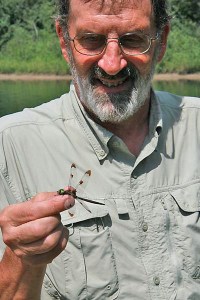
Representatives of The Quarry Farm attended the annual meeting of the Ohio Odonata Society (http://www.marietta.edu/~odonata/officers.html) in the Buehner Center at Oak Openings Metropark (http://www.metroparkstoledo.com/metro/parksandplaces/index.asp?page_id=510). Highlighting the day’s events were trips to two sites where participants photographed and collected odonates.

Bob Restifo, secretary-treasurer for the Ohio Odonata Society, examines a Prince Baskettail.

Now I suppose that there are a few of you feeling more than a bit smug right now since you already know what an odonate is. For those of you who don’t have nearly as much spare time as the aforementioned, we’re talking about dragonflies and damselflies. And they were teeming. While we did see more than a few species that we have yet to record here at The Quarry

Cedar Waxwing

Farm, such as the Unicorn Clubtail and the Prince Baskettail, most are common visitors and residents along Cranberry Run, in the eleven-acre back field and on the quarry. Among the more common species were Blue Dashers, Black Saddlebag, Common Whitetail, Widow and Twelve-spots. What wasn’t nearly as common were the sheer numbers of dragonflies, both in the number of different species present and the number of individuals within those species. And with that increase in numbers came a similar increase in the activity of animals that feed on odonates. Bullfrogs leapt from wetlands and cedar waxwings swooped over grasses snatching these aerial predators for their own meals. In fact, at one of the two sites the cedar waxwings clearly used us to improve their chances of catching a quick bite. They stalked us as we walked the verge of a wetland, waiting until we’d disturbed newly hatched dragonflies from their hiding places and then catching them as they flitted up and away.

Bullfrogs leapt from the water to prey on passing odonates.

We’d like to take this opportunity to thank the Ohio Odonata Society for the opportunity to spend a day in such an interesting fashion. We’d also like to single out three men in particular:  providing a great deal of insight and information were Bob Restifo, secretary-treasurer of the OOS, and Bob Glotzhober, member at large and a former president of the society, both of whom have spent decades studying and collecting odonates; we’d also like to thank Dave Betts, without whose input we’d have missed this incredible opportunity.

This slideshow requires JavaScript.

Raiding the Pantry, Old School

When I first started reading, after the picture books but before Tolkein and Bradbury and Ellison, I was drawn to stories like The Swiss Family Robinson and My Side of the Mountain. They were tales about people who basically fell off the map, who by accident or design no longer had access to civilization. To me, in great part, civilization meant grocery stores, because, hey, you can always find shelter, build a fire, weave a poncho out of leaves, design a method for extracting potable water from the air. That’s easy, right? But food? Come on, what are you gonna do if you can’t jet down to the local 7-Eleven or Krogers or Piggly Wiggly and grab a loaf of Wonder Bread and a jar of Peter Pan?

Virginia Creeper Sphinx Moth on black raspberry bramble

As it turns out, you make the whole world your larder. Man, but that grabbed by imagination; that a person could just walk out and pick breakfast, unearth lunch and chase down dinner was about the coolest thing I could think of. I used to hide bananas and bologna sandwiches (safely wrapped in plastic baggies) in our back yard. Then I’d set out in search of food, knowing that if I failed, I’d surely starve. Those were great days and, not surprisingly, given all the melodrama I invested in the whole process, that was some of the best food I ever ate. And now, well, I have the opportunity to do it for real.

So I do.

Right now, the raspberries are starting to come in. It’s early for them. I usually don’t start seriously picking until around the 4th of July. This year, however, they’ve been coming on since the beginning of June. You’ll probably hear me say this a lot this year, but it’s the weather: the mild winter, the rain we had earlier this spring and the hot and dry conditions we have now. Everything’s early. We had red-winged blackbirds on the property in March, blossoms on the blackberry brambles in late April, grasshoppers in the bottom land in mid-May and now, black raspberries.

Berry patches are rife with macroinvertebrates. Here, an immature wheel bug perches in a bowl of black raspberries.

Now I get to go and play castaway, claw my way through the wilderness until I’ve gathered enough sustenance to keep me alive for a few more hours. It’s hard and dangerous work, but food is life.

On the other hand, if the berries don’t pan out, there’s always that loaf of Wonder Bread and the jar of Peter Pan.