when the bough breaks…

Somewhere between two and three weeks ago, we went out and brought back our first squirrels of the season: fox squirrel pups, three of them. They were tiny, nearly hairless and had yet to open their eyes.

IMG_6526The call about them came from a friend in the Village of Continental. One of her neighbors was felling a tree damaged at some point over the winter. What came down with the tree, sadly, was an unnoticed squirrel’s nest and the three little beings inside it. Efforts were made to reunite the pups with their mother, but, again sadly, that didn’t work out. So now they’re here in Rowan’s very capable hands, getting the best that we can offer.

Ideally, though, infants will grow up with their own parents. So, without meaning to sound preachy, if you’re going to do tree work, particularly at this time of year, give a thought to the animals living in the tree in question. If you can, wait until the little ones, whether mammal or bird, have grown and left the nest.

On a different, but related, topic, if you happen to find an infant on the ground, do your best to reunite the little one and its parents. If it’s a mammal, keep an eye on it for up to 24 hours before making the choice to take it in. More often than not, one of the infant’s parents will rescue the little one. With birds, try to work out from which tree the nestling might have fallen. If you do, build another nest out of an old butter tub or some other suitable container and line it with paper towels. Drill holes in the bottom of the container to allow rain water to pass through and tack it to the tree as high as you can safely place it. Then, as with the mammal babies, keep an eye out for the bird’s parents. If you don’t see a parent caring for the nestling bird, then take it in, keep it warm and dry, but do not feed it, and contact a licensed wildlife rehabilitation center to make arrangements for transport.

*A special thanks to Fox Valley Animal Nutrition, Inc., for all their efforts in creating the most effective milk replacement formulas for orphaned and injured wildlife.

043It’s been nearly eight days since the Autumnal Equinox rolled around and in those intervening eight days, a lot has happened. On Thursday past, some 70 home-schooled1275330_10202302158898800_378213994_o children and their parents/grandparents/guardians visited the Farm. As with other groups that have come and gone, they made herb bundles, learned about the waterways around Ohio, got a peek at what lives down under the rocks and the mud in the creek that runs through the Quarry Farm on its way to the Riley and they met many of our two- and four-legged friends and fellows who live here with us. Beatrice has already worked out how to circumvent the fence, so she spent the morning visiting with the groups over by the cabin. Buddy and the goats stayed closer to home and were treated like royalty, which is as it should be.

047On Saturday, we held what we hope was the first of many acoustic nights. Friends and family met in Seitz Pavilion to listen to friends and family play and sing (and, yes, that’s a lot of friends and family). Thanks particularly to Erin Coburn (and Bruce and Beth, of course), Mark Gallimore, Brian Erchenbrecher and Doug and Merilee of 12-String Relief.

If you missed it, we’re truly sorry for your loss.037

This One’s for the Dogs (and the Opossum)

Rowan and OpossumIt’s been a bit longer than we like between posts. But since spring is finally here (knock on wood) you will forgive us since you, like us, are probably running around in today’s sunshine before tonight’s predicted rain.

Silence on the web does not mean it’s been quiet for The Quarry Farm. The new chicks are growing, as is the grass for Buddy and the goats. Fezzik and Inigo are displaying for every female fowl that could conceivably give them the time of day. Inconceivable? Not so for the little red hen that follows Fezzik around. The wild turkey hens on the nature preserve could care less, however.

Eventwise, The Quarry Farm has been on the road for the last couple of weekends. Saturday, April 20 took us up I-75 into Michigan for the Monroe Conservation District Tree Sale. Tim Kwiatkowski, good friend and conservationist for Michigan Agriculture Environmental Assurance Program (MAEAP), invited us, and an assortment of aquatic macroinvertebrates from Cranberry Run as well as an opossum that matured overwinter here, to be part of the Monroe County Earth Day celebration that was held alongside the tree sale pickup.

It was cold and the wind blew. Despite the weather thousands of trees were sold and the buyers learned a little about biological indicators and that Virginia opossums are fantastic garbage collectors. Some even decided the little guy was cute.

He was cute. And we assume he still is, wherever his nomadic opossum ways take him. Once the evenings warmed toward the middle of the week he finally ventured out of his open hutch and into the wild.

Cassie

Cassie poses

Today, we had a short drive to the 6th Annual Mutt Strut and Craft Market sponsored by Putnam Pet Pals to benefit the homeless and neglected dogs of Putnam County and Northwest Ohio. They do good work and put on a great, loud show every year at the Putnam County Fairgrounds. Last year we set up a table at the Strut; it turned out to be one of the best offsite events that The Quarry Farm has ever been part of as we handed out packs of newsletters, talked to some amazing, compassionate people, and produced more canine caricatures than we could track. Although this year’s weather was sunny and warm, a day for breeding garage sales and other such competitions for public attention, the fairground was still hopping.

Better make that barking.

Good times.

The Unbearable Lightness of Turkeys

Rear ViewDon’t let the turkeys get you down. Have you seen this thing? A simple drawing by Sandra Boynton of an elephant driven to its knees by six or seven of the aforementioned birds? It was everywhere for a while a long while ago (and apparently lives on as t-shirts, coffee mugs, posters and greeting cards; but, then, everything that ever was still is somewhere on the internet).

The message was simple: any troubles you have are analogous to turkeys and you shouldn’t let them get you down, those darn turkeys.

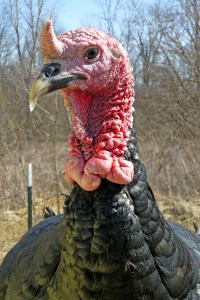
Big GuyYeah? Well, bunk. While I suppose that there are some turkeys out there that are a constant headache, that would do everything in their power to make a person’s life absolutely miserable, the turkeys with which I’ve interacted have been a pure joy. Case in point, the two newest residents at The Quarry Farm.

A couple of months ago, Laura Zitzelberger, operations director at Nature’s Nursery Center for Wildlife Rehabilitation and Conservation Education, contacted us about possibly taking in three bronze turkeys that had been seen wandering in a residential neighborhood in Toledo. And, while three were spotted, once volunteers from the center arrived on-scene, only two were found. Of the two, one was suffering from a variety of injuries (the consequence of getting on the wrong side of a dog). So, after Inigo, Willow and Fezzikrehabbing the bird and determining absolutely that these were indeed domestic and not wild turkeys (bronzes bear a remarkable resemblence to their undomesticated cousins), they contacted us late last week and made arrangements for us to pick them up.

We bundled them into the back of Rowan’s Subaru Forester and made the hour long trek back south to Putnam County where we set them up in the same run as Johnny, the Canada goose, and Andi, the Pekin duck. During the whole of the trip, despite being unceremoniously lifted from the home they had come to know and dragged into a whole new situation, not once did either bird make more than an idle and near-inaudible complaint.

So here they are now, these two birds we’ve dubbed Fezzik and Inigo. And glad we are that they’re here.

Raptor Rehabilitation and Release

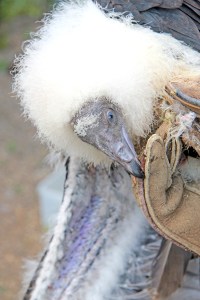
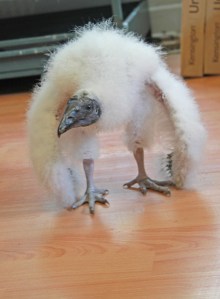
One of two pre-fledgling turkey vultures surrendered to Black Swamp Raptor Rehab.

This past weekend, we were offered the opportunity to do something a little bit different. As part of our function at The Quarry Farm, we often serve as transporters for several area wildlife rehabilitation centers. Laura Zitzelberger, director of operations at Nature’s Nursery Center for Wildlife Rehabilitation and Conservation Education, contacted us and asked if we’d serve as courier and chaperone for two pre-fledgling turkey vultures. The barn the two birds were nesting in was destroyed by the storm that tore this area apart in late June. Since then, the birds had been under the care of Diane Myers at Black Swamp Raptor Rehab. Nature’s Nursery had taken in a nestling turkey vulture and were excited at the chance to properly socialize their charge by introducing it to the two birds from Black Swamp.

Despite some rather unsavory habits, turkey vultures are social, intelligent animals (http://www.allaboutbirds.org/guide/turkey_vulture/id).

The nestling turkey vulture surrendered to Nature’s Nursery.

Sadly, these positive attributes create a challenge for rehabilitators. Imprinting becomes an even more serious concern as their social nature makes them more prone to identifying with their caregivers. This can prove disastrous for any animal and can even prevent their successful release back into the wild. In an effort to offset their natural inclination to bond with their caregivers, the three birds were brought together in the hope that they would bond with each other. Although they can’t be housed together because of a significant difference in age and size, the three birds will be kept adjacent to each other and share a common wall; two on one side, one on the other. It’s hoped that all three birds will benefit from this situation, improving their chances for a successful release.

And speaking of releases, not only did we transport two raptors up, but we also brought one back with us.

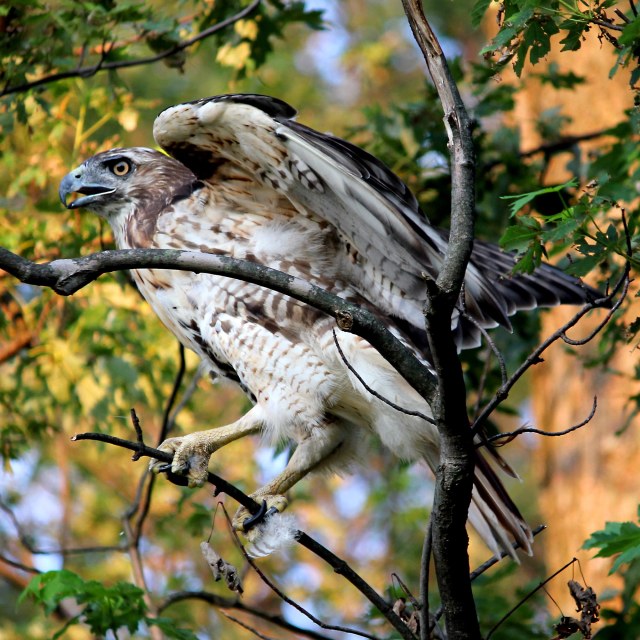
Early last autumn, we were called on to pick up a red-tailed hawk in nearby Miller City, Ohio. The bird had been on the ground for a couple of days and the homeowner in whose yard the hawk was sitting had called Nature’s Nursery. We’re not entirely sure what was wrong with the bird, but it was in sorry shape when we arrived. Emaciated and dehydrated, the hawk had no energy to defend itself and we simply walked up to it, wrapped it in a blanket, put it in a carrier and transported it north. After months of exceptional care, the bird’s appearance and attitude had changed drastically and the rehabbers at Nature’s Nursery asked if we’d return her to the county of her birth.

The red-tailed hawk perches shortly after release.

The hawk was slow to realize its situation and initially only flew far enough to perch in the nearest tree. But after a bit and the pestering of several camera-wielding humans, it finally took to wing and flew away and out of sight. I won’t say it was a picture-perfect release, but it certainly was a success.

We hope for the same results for the turkey vultures. When it happens, you’ll be the first to know.

Belle’s Goodbye

Four weeks ago, Belle, a shih tzu who came to live with us on The Quarry Farm some five years ago, was diagnosed with a particularly aggressive form of cancer. The word “inoperable” was used more than once as her condition was explained to us, though whether or not that was a consequence of her assumed age and the belief that she wouldn’t survive the surgery is a question I never asked.

I was once told that cancer is the embodiment of chaos. I’m not sure who said it or if it was even remotely accurate, but it stuck with me. In this particular case, it was about as true a statement as was ever made. The cancer attacked her lymph nodes and grossly distorted the lower half of her face. As the disease rapidly progressed, tumors swelled the glands on either side of her jaw and ripened until they began to intrude into her mouth, pressing her tongue to the side and interfering with her ability to eat (mark that I said, “interfering”; her appetite was huge and she ate well and as often as she wished, though with a bit more difficulty than she had before her cancer). Her doctor assured us that she wasn’t in any particular discomfort and that she would enjoy life for a little while longer, possibly as long as a couple of months.

 When she stops eating, he told us, it’s time.

 Last Thursday, she stopped eating.

 On Friday, we took her in.

 We brought what was left of her, her biomass, home and buried it at the base of a Kentucky coffee tree that graces the area just outside our front door. Heat and drought had turned the ground into something much harder than simple earth and it took an old railroad pickaxe to loosen the dirt enough to shovel it aside. Eventually we placed her in a hole that seemed much too small for her. Tiny as she was physically, she was possessed of a huge personality and could, when she chose, fill a room. We further marked the spot with a slab of dolomite and placed pieces of granite and quartz and red shale on and about the stone in celebration of a life that was our great good fortune to share. We then went inside and wondered at how much smaller our house seemed to be.

 Less than an hour later, as a headline in our local newspaper so colorfully put it, the area was “blown to pieces.”

 The storm that swept through was deemed a derecho (http://www.weather.com/news/weather-severe/derecho-explainer-20120612). Straight-line winds in excess of ninety miles per hour tore through the region, uprooting and snapping trees, tearing roofs from buildings and, in some cases, leveling the buildings themselves. Power and telephone lines were cut by flying debris and the poles to which they were attached were battered to the ground. While there were reports of multiple tornadoes in neighboring counties to the west, none touched down here. Even so, the area suffered some of the most significant widespread damage in its history. Nearly every homestead was affected, including ours.

The Quarry Farm fared better than some, worse than others. In the domestic areas of the farm we lost about a dozen trees, mostly evergreens, and several shrubs. Shingles were blown from the roof of one outbuilding and the door to the chicken coop was ripped from its hinges and beaten to splinters. A big, wooden outdoor storage cupboard was teased out from under the eaves of our house and torn apart. A window was blown loose in the big shed and smashed. The bee hive was reduced to its component parts and scattered across the yard and even though the hive was already failing, it was a hard sight to witness. In the woods and along Cranberry Run, dozens of trees were left bent and broken. The largest and oldest of the trees, the ones that reached above the common canopy, bore the greatest insult. Limbs as large as some of the less mature trees on the property were rent free and fell, dragging smaller limbs and even some smaller trees with them. Honey locust, sycamore and black walnut trees were affected the most and their limbs and trunks fell and blocked many of the paths that we have so arduously cut through the woods.

 Even so, we were lucky. Our homes came through the storm unscathed and, more importantly, no one was hurt. Buddy and the boys, S’more and Marsh, seemed nonplussed. The chickens made a last second mad dash to the coop and, despite the flying debris, beat the odds. Even the duck and geese came through it without a scratch, all of whom weathered the storm out in the open despite immediate access to shelter. They simply faced into the storm and made themselves as small as possible, holding their wings tightly to their sides and pressing themselves into the earth, riding the storm out as best they could. As did we all.

 The biggest part of me recognizes that this was strictly an atmospheric event, an accumulation of physical conditions that culminated in a significant release of energy. I know that, should I choose to, I can go online and research this until I know each and every factor – heat, humidity, air pressure, ocean currents, whatever – that played a role in the creation of this storm. I know that this was a cause and effect scenario.

I know this.

 Even so, there’s a part of me that thinks that maybe there was something more to it than just pressure systems and cold fronts. That maybe this was a release of energy of a completely different Nature. That maybe, just maybe, this was more personal than that. Maybe this was Belle’s exuberant release, her nod to us as she went wherever it was that she wanted to go.

 That’s how I’ll remember it, anyway, despite logic and Carl Sagan. After the shingles are replaced and the chicken coop door is repaired. After the debris is raked up and put aside and the paths are cleared. After all of the electrical and telephone lines are restrung and the grid is whole and fully functional once again. After the fallen trees are reduced to neatly trimmed and stacked piles of drying wood and even after that wood has eventually dried and is burned in some future fire, that is how I’ll remember last Friday.

 It was the day that Belle said, “Goodbye.”


POSTSCRIPT

I was going to leave this for another day, but I find that I can’t. I have a couple of final thoughts I’d like to express. First, my soapbox. When Belle came to us, she was broken. Literally broken. Both eyes were severly scarred, particularly the right, which was all but entirely closed with scar tissue. At some point, she had broken her jaw and it had never healed properly. I never understood the mechanics of it, but her veterinarian explained that there was a gap in her lower jaw that had never closed. She was constantly on edge. Vague movements sent her scrambling, and with her eyesight, all movements were vague. She lived in constant fear, her bladder emptying in uncontrollable spasms of fright. Worst of all, I think, was the tattoo in her left ear: the number 25 writ in large block numerals. Again, her veterinarian explained that the number was a means of identification. Not to assure her safe return should she come up missing, but as a simple means of differentiating her from any other shih tzus that the person (and I use that term conditionally) who had her before us may have, must have, kept.

She was Bitch Number 25 and that may well have been the only name she had before coming here. She had been bred and bred and bred and bred until there was almost nothing left. Just that tattoo in her ear.

And now my plea. Should you have to live with a specific breed of dog, if a pure breed is what you must have, please check first with the rescues. There is one for every breed. If that’s not enough, not something you want to pursue, please go to great lengths to assure that the breeder with whom you are working is responsible. And please do go to a breeder. Don’t buy from a store. You just never know. http://www.humanesociety.org/issues/puppy_mills/

And now, as we so very often hear on Monty Python’s Flying Circus, for something completely different. As a consequence of the storm, power was out for most of the region for varying amounts of time (and there may still be those whose power has yet to be restored). We lost ours for four days. Four days without power meant four days without water. Thankfully, we have good neighbors. Casey and Dan Walker, realizing our predicament, offered us the use of an old well on their property that has a manual pump. Without that, tending to the hydration needs of the ducks, geese, goats and donkey that live here would have been extremely difficult, at the very best. So to the Walkers, our most heart -felt thanks. You exemplify the best in good neighbors.

An Eighth Direction

Preparing shelter house pad

The shelter house project at Red Fox Cabin is underway. A crew from Hovest Construction broke ground on Tuesday, clearing and leveling ground between the posts of the compass garden for 24’ x 24’ concrete pad. The crew finished and sealed the pad on Wednesday and cleaned and leveled the work site this morning. By August, this pad should support a 20’ x 20’ shelter house, the site of many future meetings, presentations and gatherings of all sorts on the Quarry Farm.

For anyone helping to raise the shelter house, there will be food. That includes observers.

Dooryard Garden Club at Red Fox Cabin’s zelkova

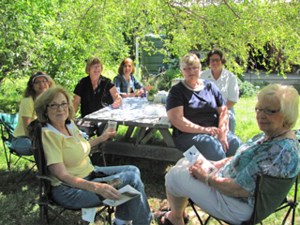
Members of the Putnam County Dooryard Garden Club visited right after Hovest Construction packed up their Bobcat. The group inspected the new project before touring the cabin, walking the Cranberry Run Trail, and meeting Educational Ambassadors Buddy the miniature donkey and Beatrice the pygmy potbellied pig.


Back up! What is a compass garden?

As the official name states, the Quarry Farm includes a nature preserve and a conservation farm. Red Fox Cabin and the gardens that surround it are part of both designations. One of the original gardens developed by Gerald and Laura Coburn was the compass garden. This garden is engineered according to the European navigational instrument that measures directions in a frame of reference that is stationary relative to the surface of the earth. However, the Red Fox Cabin compass garden was also designed in homage to the Coburn clan’s Native American heritage, primarily with traceable roots to the Cherokee Nation.

The Cherokee honor seven sacred directions to encompass a fully-dimensional world rather than one of singular dimension. In addition to the four singular dimension directions (east, north, west and south), there are: up (above), down (below) and center (which is where you are). Each direction is also associated with a season and a color:

  • NORTH is the keeper of winter, the season of survival and waiting. The North is associated with the color blue and the path of quiet.
  • SOUTH is the keeper of summer, the season of warmth. The South is associated with the color white, representing peace, happiness, and serenity.
  • EAST is the keeper of spring, the re-awakening of Mother Earth after a long sleep. The East is associated with the color red and represents victory, power, and war.
  • WEST is the keeper of autumn, the season of death and where it is hidden. The West is associated with the color black.
  • ABOVE is associated with the color yellow and represents peace.
  • CENTER is associated with the color green and represents the here and now.
  • BELOW is associated with orange/brown which represents the chaos and turmoil of the ever-changing Earth.

Note that I speak of the compass garden in the past tense. Invasive plants overran most of the directional plantings. Recently, the Quarry Farm board decided a permanent structure was needed to shelter visiting groups requiring seated onsite presentations since Red Fox Cabin can only hold a limited number of people at a time. The compass garden ground was deemed the most convenient location for such a shelter. The spot also sits just above the old stone quarry-turned-wetland, offering cool summer breezes and good views of butterflies, migratory birds and native trees.

So maybe some of the visual symbols of the old compass garden are missing, but the fully-directional world of the Quarry Farm is still growing. The house wren that is nesting in the apple gourd even stood her ground next to the construction site. She was back at her post this morning, scolding all visitors from her high tower in the zelkova tree.

Find out more about the Cherokee Nation, past, present and future, folklore and tradition, at
http://www.cherokee.org/Default.aspx.

This slideshow requires JavaScript.