Buddy meets a girl

Lucy

Lucy

The oaks, the last trees to lose their leaves in fall, were down to just a few spots of brittle color when we first learned of Lucy.

A family in southwest Indiana sent out a distress signal that life had thrown them a curve, making it necessary for them to rehome a small flock of sheep and their guardian donkey. Bot flies and shearing wool appealed to neither our time nor talents, but the thought of opening our gate to another donkey seemed the ticket for our little Buddy. Six months and a bitter winter later, Lucy and her person made the four-hour journey to Riley Township.

My Steven and I were on the south boundary Saturday replacing old fencing, much to the dismay of two sassy goats whose nimble limbs and twitching noses were turned by the grass on the other side. The job also gave us an excuse to watch for a truck-pulling-trailer with Indiana plates.

I think Buddy knew. As I leaned over to stretch the bottom of the fence, he walked up and laid his head across my shoulder. They always know something’s up, whether it’s a storm or a class trip full of adoring little persons with apple slices and peanuts in their pockets.

Lucy’s wheels rolled up around 1 p.m. The welcoming committee lined up along the fence to meet the driver, except for Buddy. He pressed himself against the fence and stared in the window of the horse trailer. When Lucy was led through the gate and let off the lead, Buddy did an-honest-to-goodness happy dance.

For her part, Lucy was a little stand-offish. Her person Brandi Ireland told us that they lost a donkey to the winter of 2013-14, leaving a sad Lucy to mind the sheep. For the first hour on Ohio soil, she put on a good show of preferring grass and hay over some boy, but she never let that boy get more than a few strides away.

For the rest of the afternoon into evening, Buddy showed Lucy around her new digs, placing himself dutifully between her and the goats. I’m not sure if that was for her safety, theirs, or just Buddy making a statement of ownership.

Through human eyes and sensibilities, it seems that Buddy’s warm brown eyes are brighter and five years lifted from his gait in a few hours’ time. The goats are watching them both to see which donkey will figure out how to open the hay barn doors now that the salad bar next door is off the menu.

That’s not anthropomorphizing; that’s a day in the life with a Buddy boy and his goats, plus one. Better than a Sudoku puzzle to keep any two-legger on their toes.

guess who came in for breakfast…

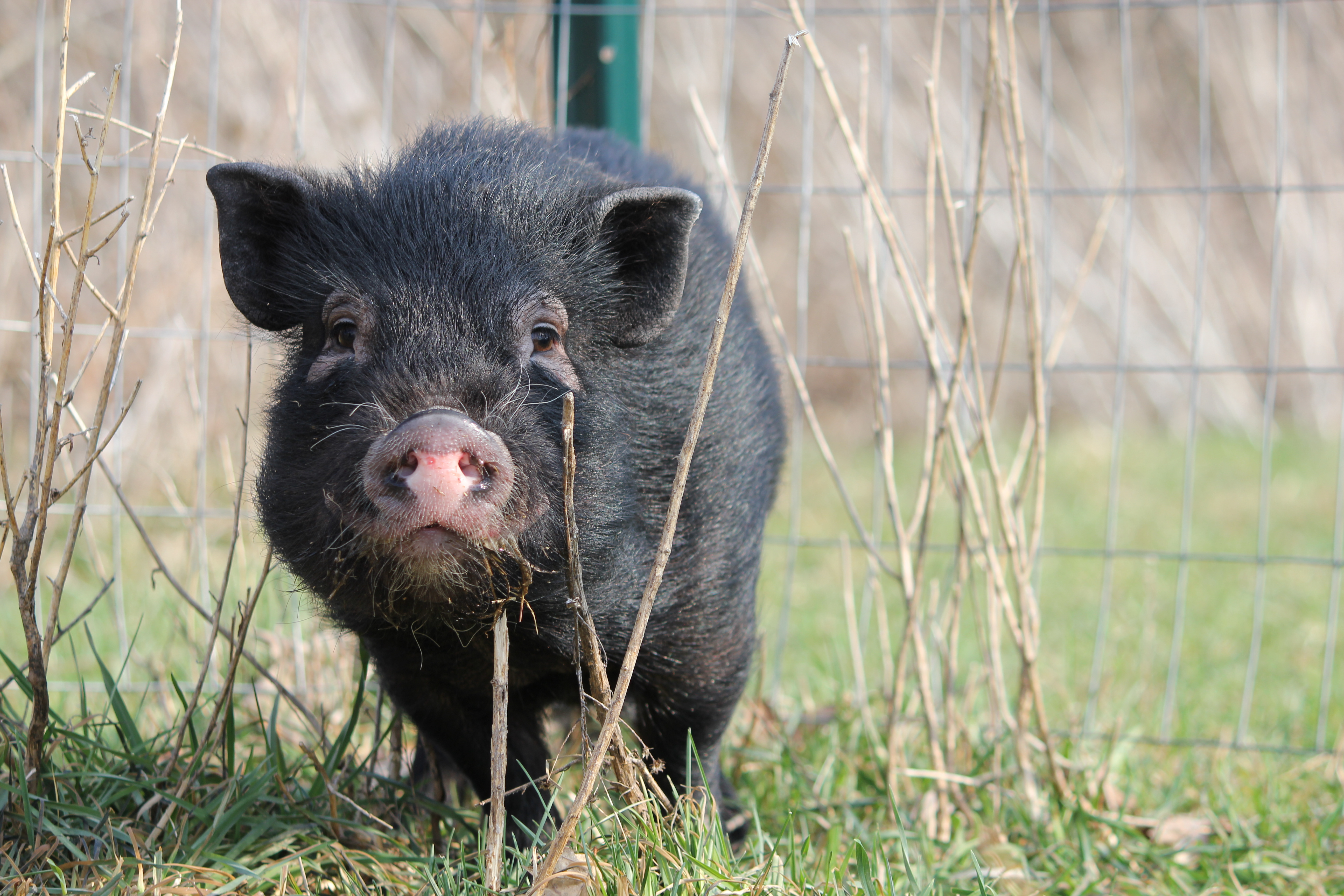
aphonse coming in This morning, after almost nine months on The Quarry Farm, one of the sanctuary’s potbellied pigs decided to expand his territory, see just what exactly makes the other side of the green door such a big deal. It took some coaxing, about an hour of Anne’s time, three apples, a banana and a handful or two of peanuts to get him all the way into the house, but, eventually, Alphonse took the plunge. Bob Barker, his father (at least, we’re pretty sure Bob’s his father; their similarities in appearance are uncanny), watched him slowly make his way in, while Beatrice (aka Little Pig) peered through the slats in her pen at all the goings-on.

Bob and Alphonse are two of the four pigs rescued from a horrific hoarding situation by representatives of the Humane Society of Allen County and the Allen County Sheriff’s office during the depths of last winter’s freeze. Their story isn’t groundbreaking news — we’ve talked about it repeatedly here — but their recovery is a source of joy for all acquainted with these two. Where Bob settled into a routine relatively quickly, Alphonse has retained near total independence, refusing most advances for even the simplest of interactions. And that’s reflective of what they found during his rescue. While none of the animals had adequate shelter, Alphonse, it seemed, had none at all. He was free of any pen, though the drifting snow had created some measure of confinement. He had worn deep alphonsetrenches in the snow and roamed the area within their confines. Following his rescue, he, Bob and Greta and Grits, the other two potbellies who now live on the top of a hill down in Kentucky, were sheltered at HSoAC. Even there, Alphonse was less interested in companionship than he was in regular meals. After all of the legal issues were dealt with and out of the way, Bob and Alphonse came here. After several months of living exclusively out-of-doors, Bob discovered the pleasures of clean floors, soft blankets and nearly constant access to treats. But Alphonse, not so much. He settled into the outbuilding we’d originally constructed for the turkeys and that’s where he stayed, quite content to keep his distance. Of all of us, Rowan had the best of luck with him, though maybe it’s better said that Alphonse has been much more tolerant of her than of any others. Routinely, she was the one permitted to touch him. So it was something of a shock when we noticed him standing on the front porch about three weeks ago, and this with Rowan off to college.

alphSince then, Anne has worked with him daily. Talking to him, coaxing him closer to the house, to the porch to the door. This morning, all that effort payed off and he stepped inside for the first time, possibly ever, anywhere. To prove to him that he was still autonomous, captain of his own ship, we let him back out almost immediately. After, that is, as many peanuts as he could eat in the space of three minutes. It wasn’t long before he was back at the door, asking to come in. And out again. And back in.

He’s back out, out and running wherever and doing whatever within the confines of the four acres that serve as sanctuary for him and the others…but now he knows.

Alphonse, shortly after arriving.

Alphonse, shortly after arriving.

The door is always open.

all roads lead to OH-235 and at the end of the drive…pigs

Yesterday, Anne, Laura and I took half the day and drove south to Yellow Springs. Rowan’s there, engaged in a major of Environmental Sciences at Antioch College. It’s a great place to visit, even a groovy place, Yellow Springs having never entirely given up on hippy culture.

On the way, we crossed OH-235 and Laura made the comment that, seemingly, no matter where you’re going, there’s OH-235. We’d been on it just a few days before, coming back from a funeral, and here, unexpectedly, it was again.

Anne and I arrived home to a message from Laura Zitzelberger, the face and mind behind Nature’s  Nursery Center for Wildlife Rehabilitation and Conservation Education. It seems that a potbellied pig had arrived uninvited at someone’s home and they’d called NN to see what could be done. Laura, in turn, called us and we closed the loop by calling June, the woman with the uninvited guest. She provided us with her address and we agreed to pick up the pig the next day (today, as I write this), Sunday.

In the morning, I input June’s address into mapquest. The recommended route sent me north on OH-235 for roughly an hour.

Go figure.

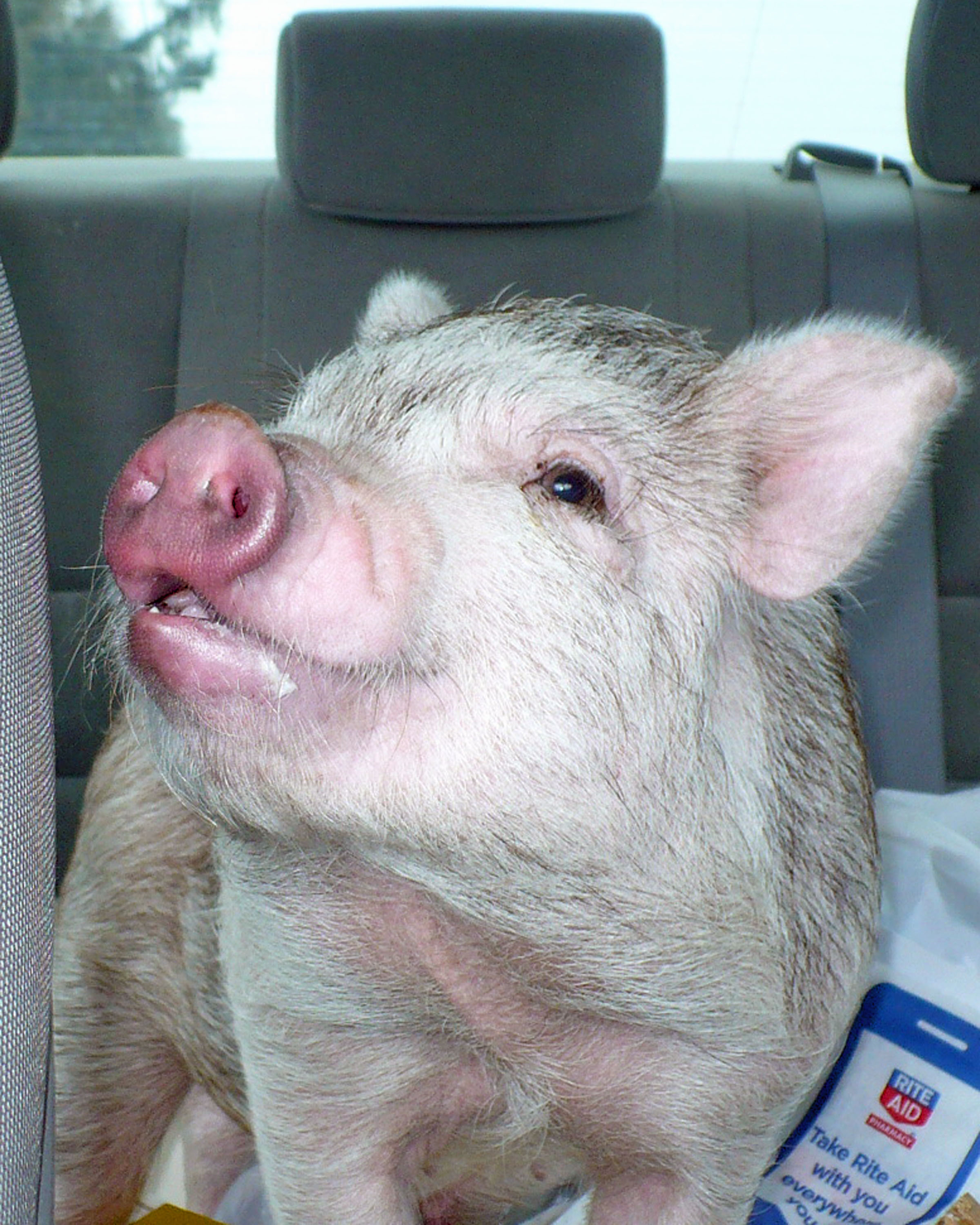
in the carStepping out of the car, I could hear him, the pig. He was quietly grunting, standing at the gate of a small outside kennel; behind him, a thick blanket that had served as his bed for the night. He trotted out, allowed me to scoop him up and we settled into the car for the drive back.

This is the second potbellied pig in less than one week to simply turn up, wandering without direction, without oversight and without hope. And while nowhere near one another – the first was discovered stumbling along State Route 65 in Columbus Grove and the second some 50 miles north – the trend is disturbing. It is, sadly, also not surprising. Visit any domestic animal rescue site and the sheer number of pigs up for adoption is staggering. RescueMe (what is, for us, the preeminent site for finding families and animals in need) is overburdened with people seeking new homes for pigs; not simply in Ohio, but all across the nation. And these are the people who are making an effort to re-home their companions.

Pigs are smart, strong, curious and obsessive. Left to their own devices, pigs will find a way; and, while cute and cuddly when little, most pigs don’t stay small. A low weight for a miniature potbellied pig is 60 pounds, but, while minis can maintain weights below 100 pounds, seeing pigs in excess of 100 pounds isn’t unusual. So, rather than the Chihuahua they were expecting, they wind up with an animal closer in size to a Labrador, or something even larger. All too often, these pigs that have grown bigger than anticipated are simply abandoned, turned out and left to fend for themselves. Within months, even the most docile and diminutive of pigs may revert to a feral state: growing tusks and thicker hair and becoming leaner and more muscular. Pigs returned to the wild, intentionally or not, within three generations will assume the physical attributes of their boar ancestry, no matter their ancestry. This is just as true of potbellied pigs as it is of Chinas and Polands.

But not this pig. He’s here for the long haul, or in another, similar environment.. He’s an intact adolescent male, but that condition won’t last long. Tomorrow, we’ll contact The Quarry Farm’s veterinarian and arrange for a bit of a snip. Tomorrow we’ll also contact the Wood County Humane Society and let them know he’s here.

Just in case someone’s interested.

getting to know you

a different shade of white

woods

In 1911, Franz Boas, an anthropologist who spent years living among the Inuit, published The Mind of Primitive Man. Through it, Boas not only revolutionized anthropology, but sparked a debate that has lasted over a century. Boas famously suggested that the Inuit have dozens, if not hundreds, of different names for snow. Linguists argue back and forth the merits of the claim, some saying that added suffixes to root words are simply individual flourishes while others assert that, yes, each new permutation is, indeed, a separate and distinct word.

Which leads me to my question and my subject…Would the Inuit consider a heavy frost snow?

There was fog in the early morning hours on Wednesday; fog and a whole lot of cold. Combined, the two create what I’ve always considered hoar frost, a consideration that is at least mostly accurate.

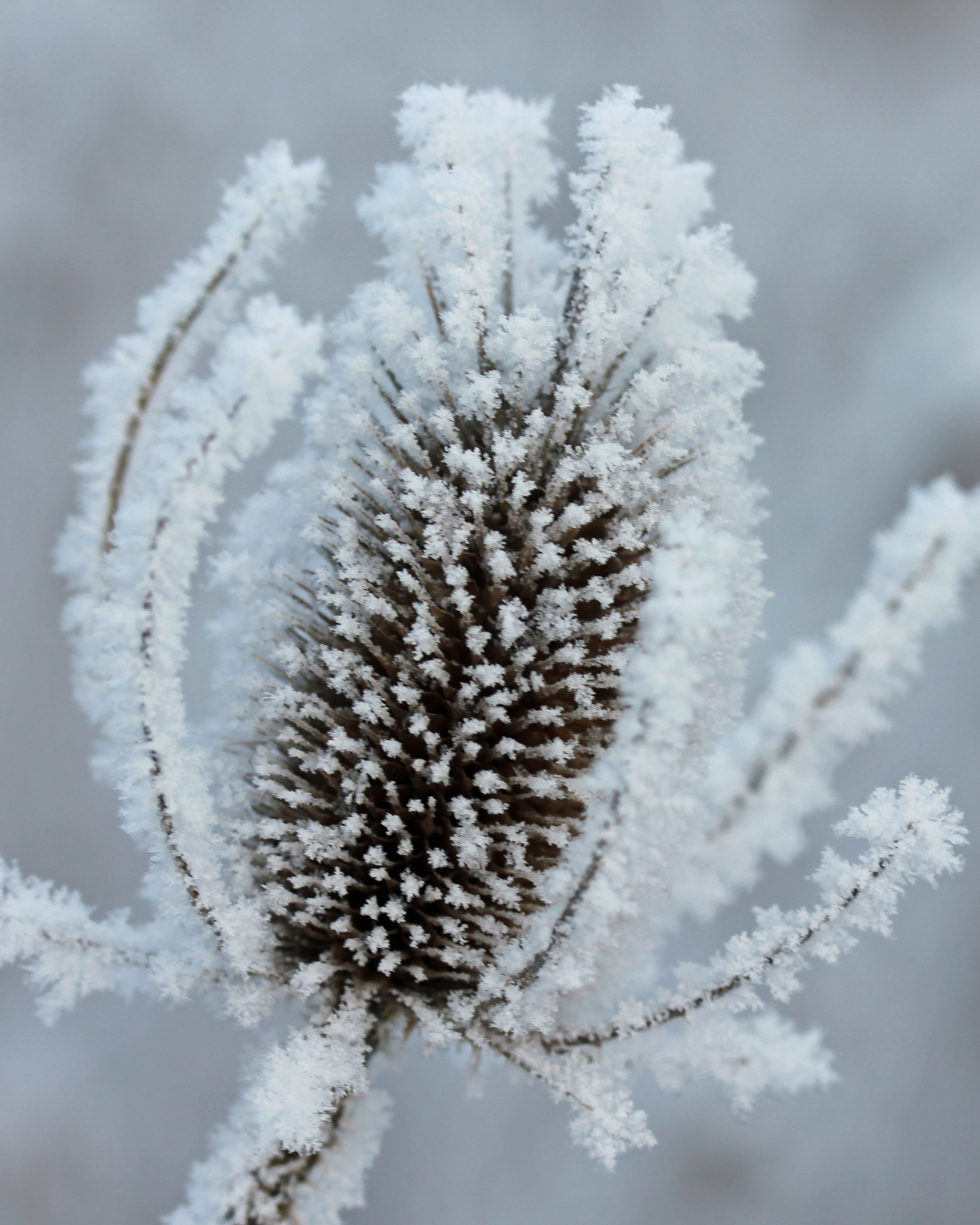
frosted wild teasel

frosted wild teasel

As it turns out, there are six different recognized types of frost – two of which, rime and black, are subject to debate – one of which is hoar. Well, sort of “one of which”. See, there are actually four different types of hoar frost: air, surface, crevasse and depth. Air hoar is the type of frost we experienced today. Tangentially, hoar is a word of Old English derivation, an adjective meaning “showing signs of old age”; in this case, conceivably, it is the fringe of white that conveys senility.

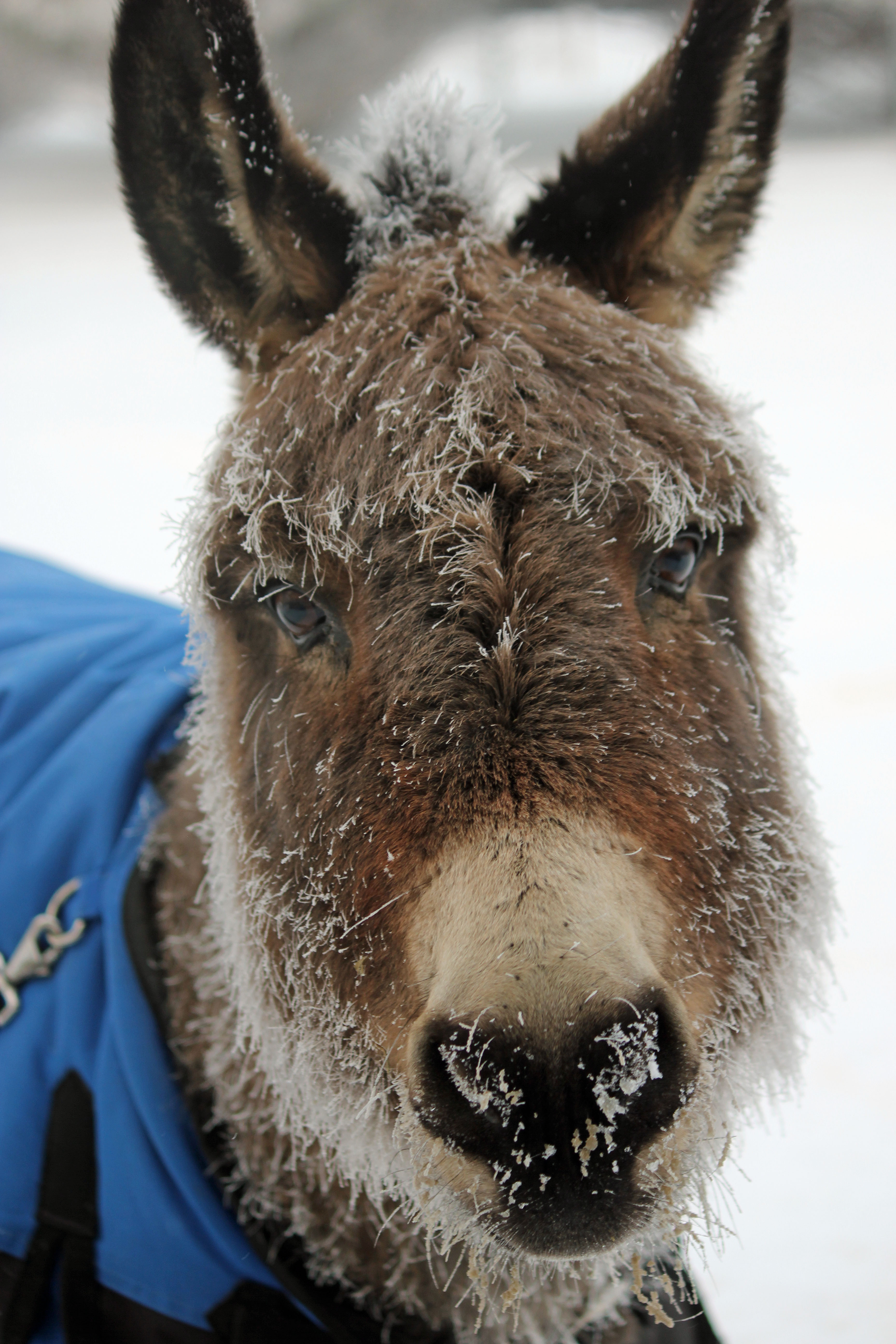
The world seems to froth with it, this thick confection of frozen air. It shrouds tree limbs, coats fences, cars and outbuildings and accumulates on the individual hairs and feathers of the animals that spend a good deal of their time out of shelter.

In the bottom land below our house, the plants and grasses were still, bowed under their burden of frost. The wild teasel (Dipsacus fullonum), an invasive from North Africa and Eurasia that has been here so long that it seems native, carried its coat with grace.

Later, though it never truly grew warm even for this time of year, the rising sun brushed so much frost from tree limbs that, under the canopy, it fell as thick as snow.

So, can anyone tell me? Does anyone know? Make it official…does frost translate to snow?

Buddy

turkeys and some clean, new snow

1551734_10203199240647085_1575429757_n
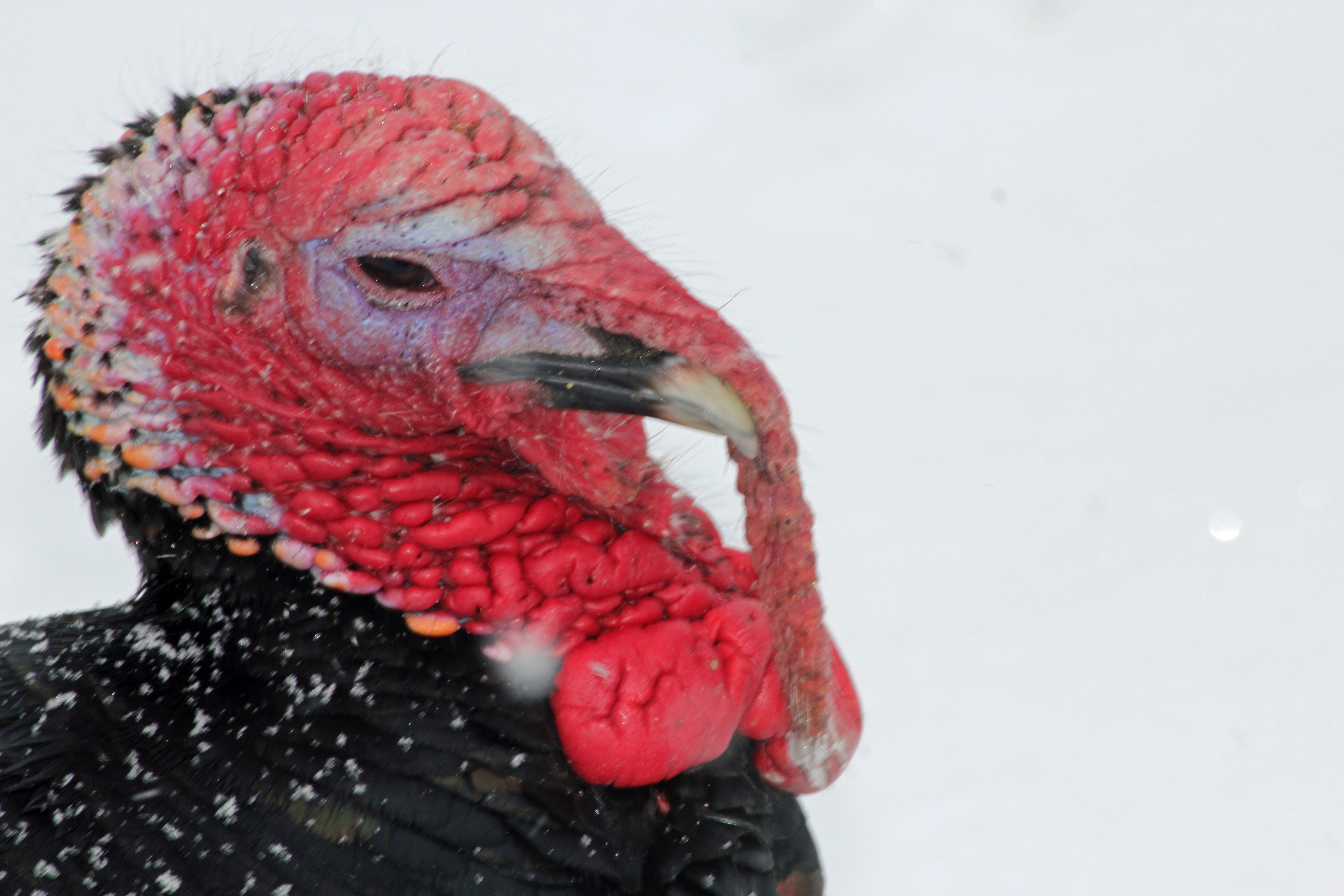
Turkeys woke us up Monday morning, woke us up to at least a couple of inches of new snow.

InygoNot this turkey. This is Inigo, one of the domestic bronze turkeys who live here in the residential neighborhood of The Quarry Farm. And not the turkeys pictured first. Well, probably not them, at any rate. It could be, I suppose; they’re representative of the wild turkeys that live here, but probably not, as that photograph’s at least two years old, possibly four. While turkeys in the wild are known to live to the ripe old age of 14 years, the average lifespan is only three. So, possible, but not probable.

flying turkeyMore likely, it was this one, though it’s a poor likeness. Him and his friends, no doubt. He made himself known late this evening, pacing back and forth along the fence line that separates the sanctuary from the preserve, the domestic from the wild, chortling to himself or to a hen on the other side of the fence. I crept out with the idea of getting a good photograph. He’d have none of that, though, and took to wing.

But back to yesterday morning.

lolly2
Outside the house, through the doors and windows, there was a whole lot of white. All that new snow made Lolly twitchy. For her, it was like a clean canvas to a painter, an empty page to a writer; she just had to go out and make her mark.

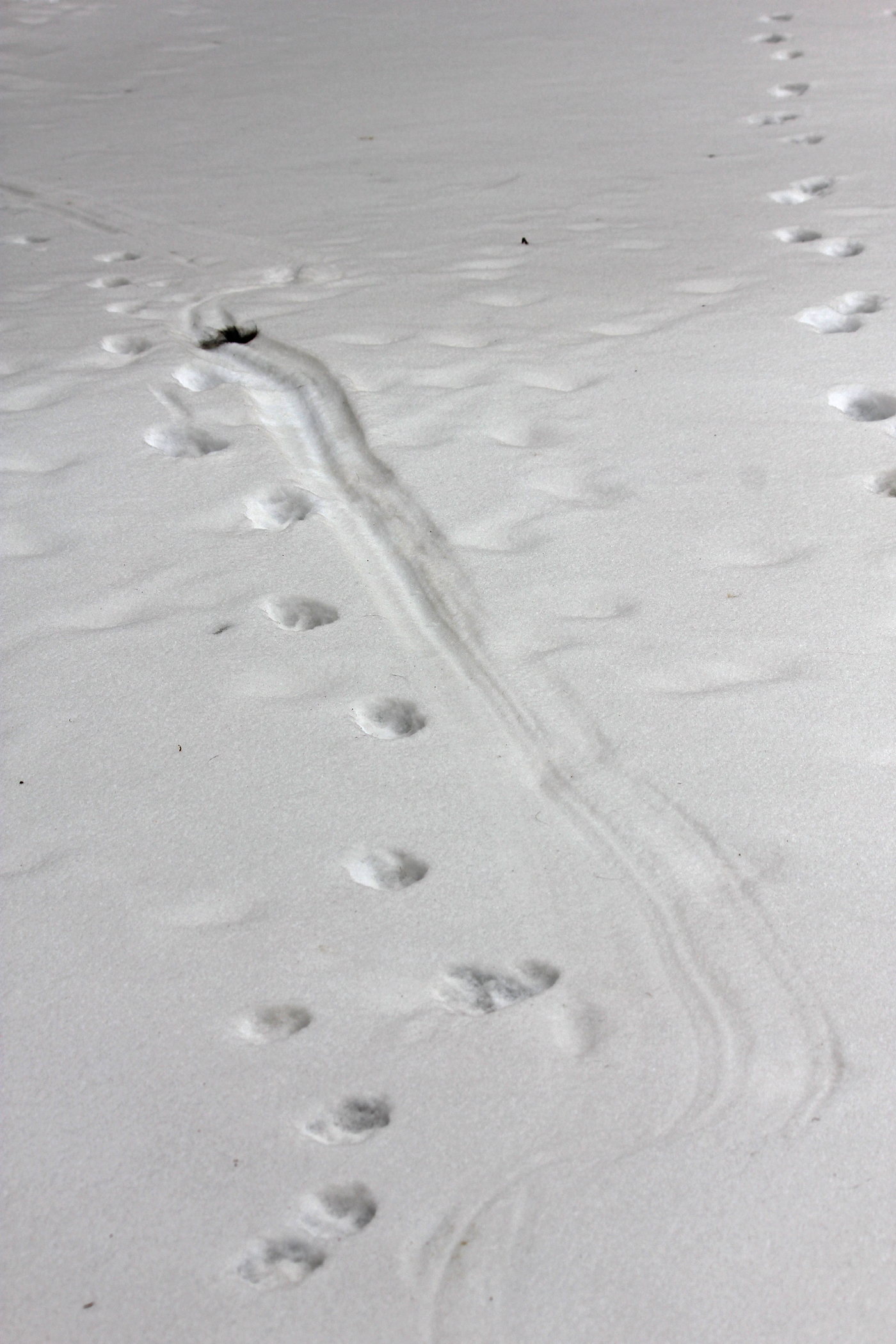
lollyMonday morning’s walk was very much like Sunday’s, though there weren’t as many tracks readily visible as the day before. The new snow had covered the old and there weren’t nearly enough intrepid explorers out and about before Lolly and I got there. We did see some eastern cottontail rabbit tracks and what we assume are fox tracks; at least, that is how they appear to us. Lolly almost first thing scared up an eastern fox squirrel; scared it right up a series of consecutively larger trees, in fact, until it settled in a big, old sycamore that sits just up and off the path.  Lolly must carry herself with a certain amount of menace, because that squirrel left the better part of its hedge-apple breakfast behind. If that squirrel only knew, it would have blown a raspberry and kept right on breaking its fast. Off we went, then, along the path some more and across the bridge and skirting the edge of the quarry, covered in a blanket of white with hardly a mark on it. Just the tracks of that rabbit I mentioned earlier. We could hear the occasional bird, but they were keeping their heads down; down and tucked under a wing, most likely, out of the snow.

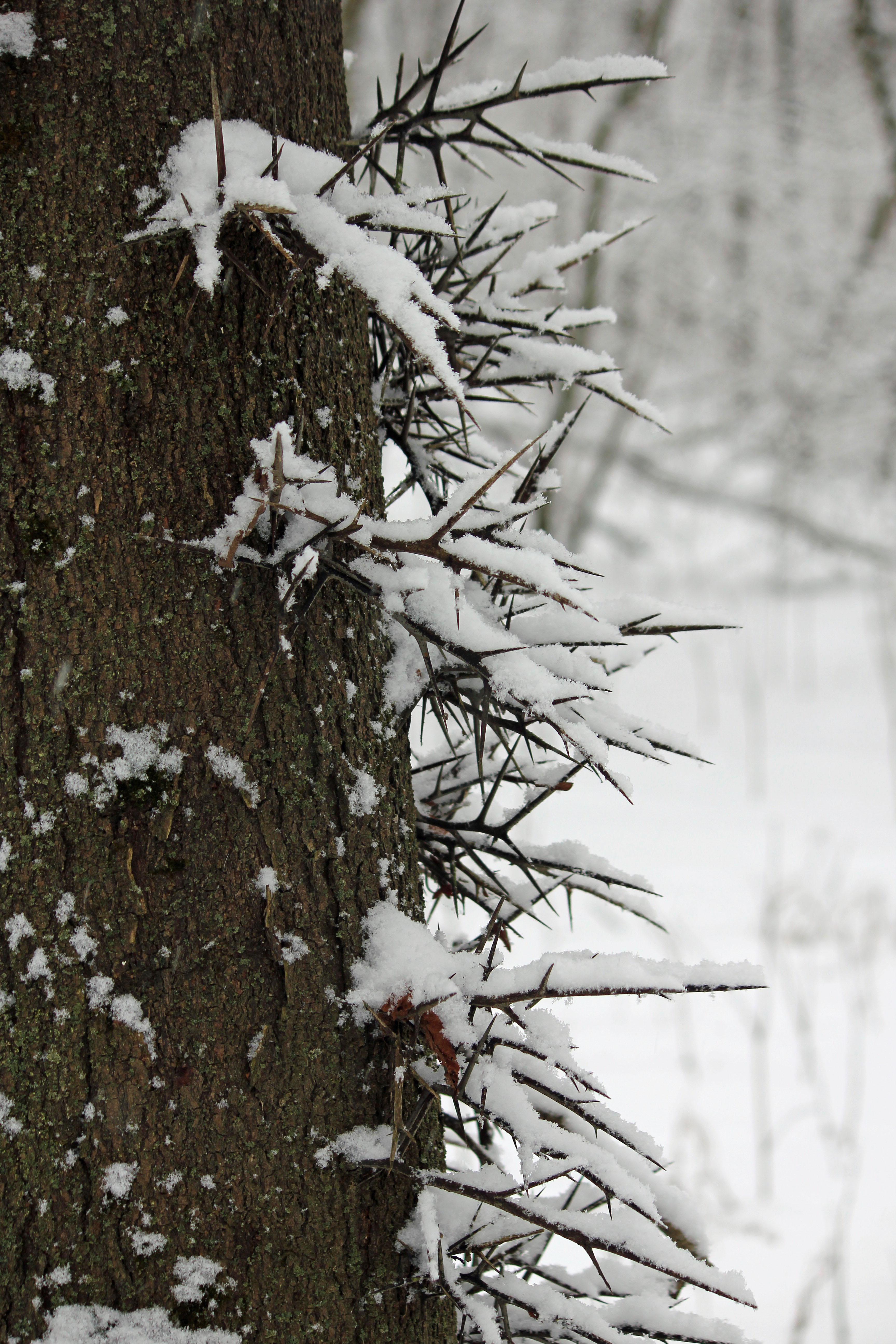
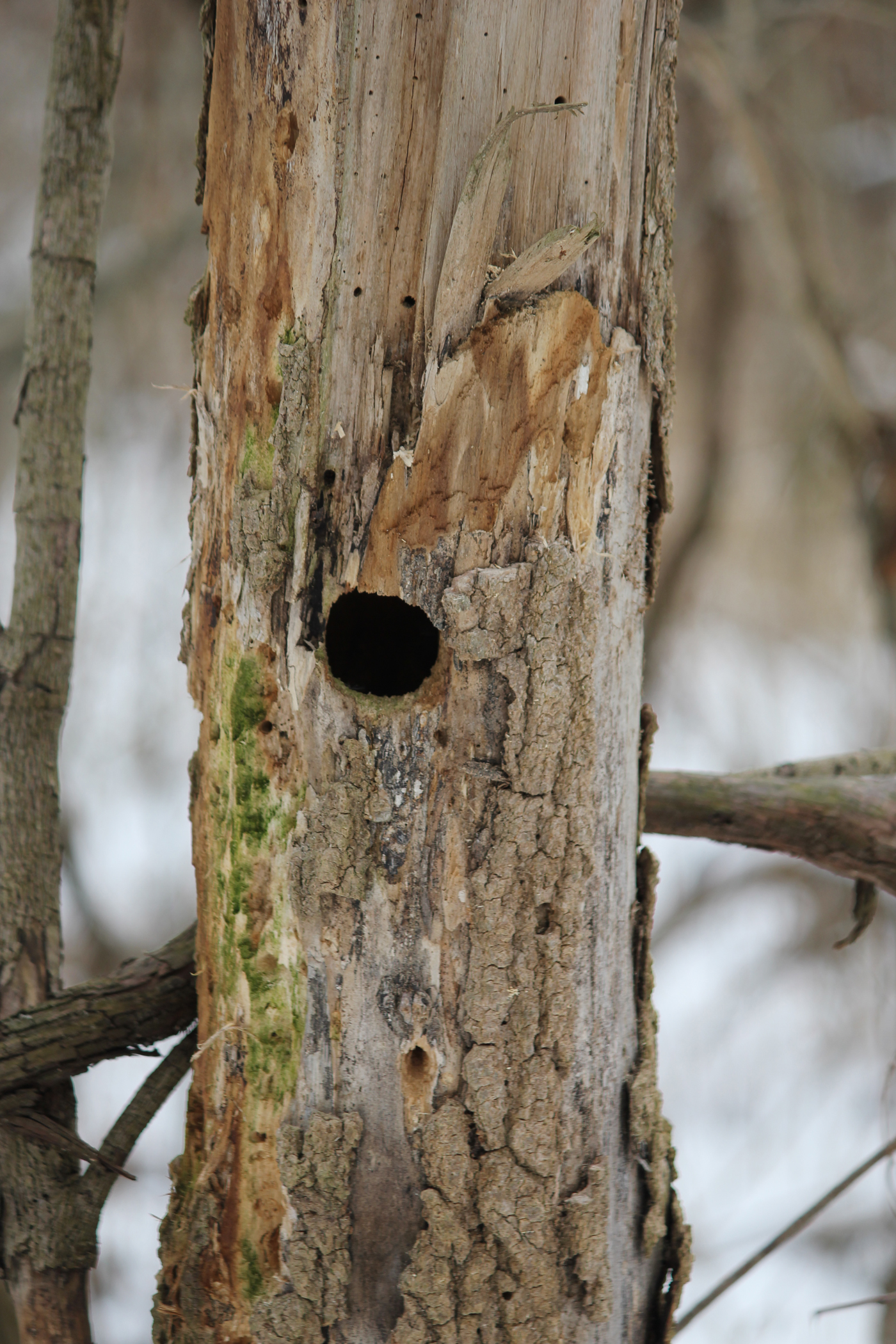
honey locustTree houseThe big back field was as quiet as the quarry and we passed through without seeing much of anything. Rounding back, we took to the path that leads down into what some locals refer to as Coburn’s Bottom. We saw a downy woodpecker or two and signs of them in some still-standing dead trees. The thorns on the honey locust trees (Gleditsia triacanthos) were softened with snow, though you’d sooner want to kiss a porcupine than hug a honey locust; the wild ones, anyway.

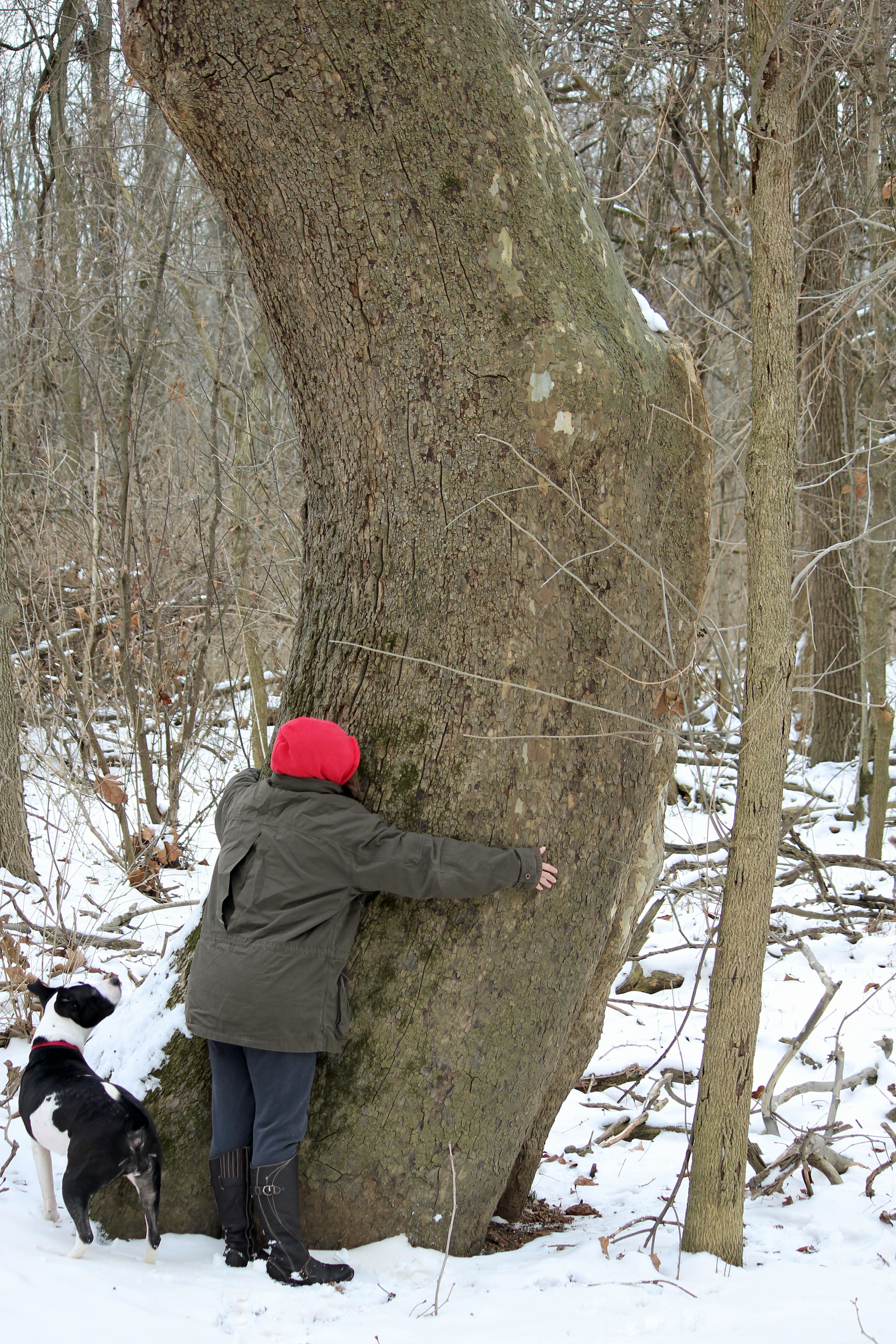
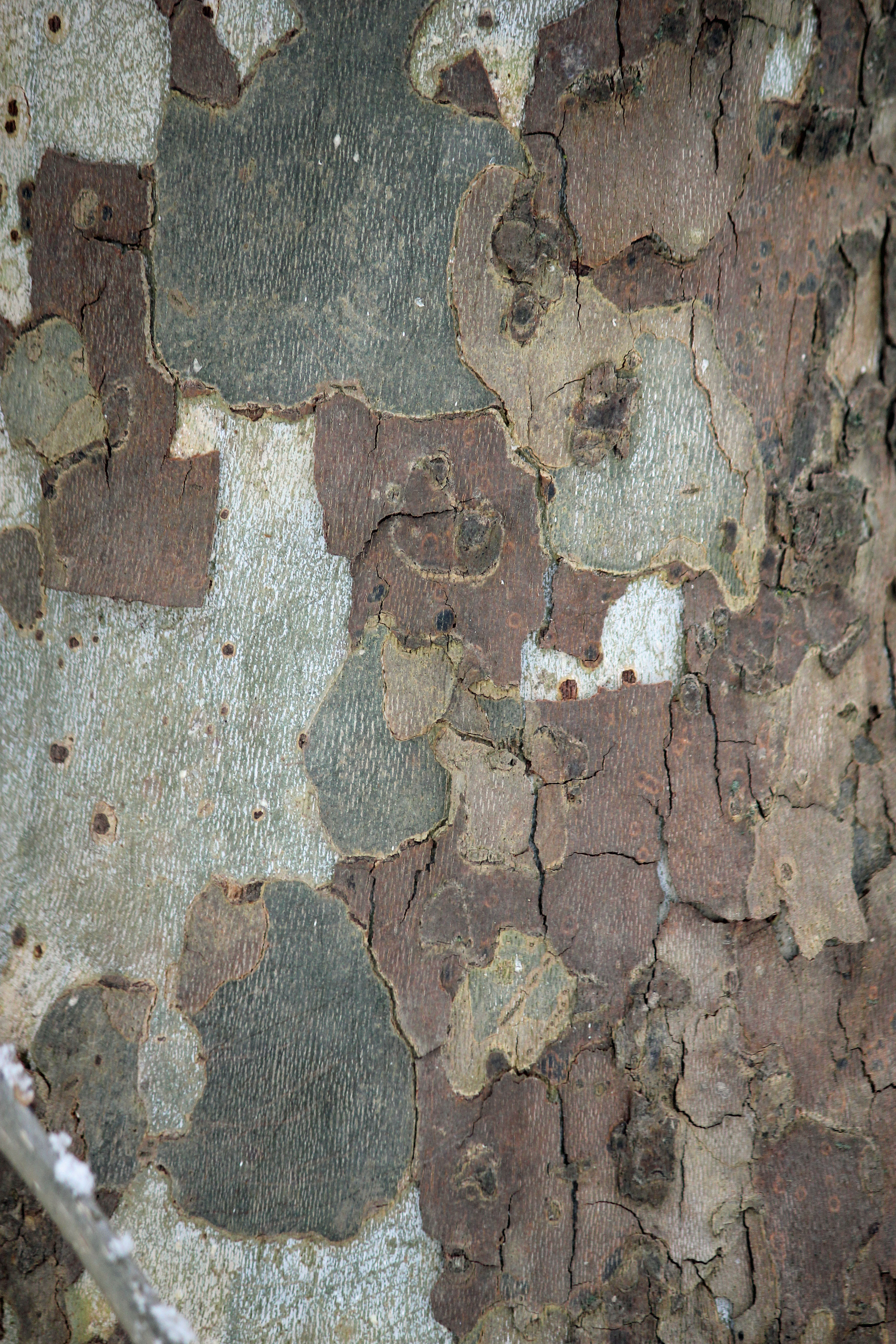
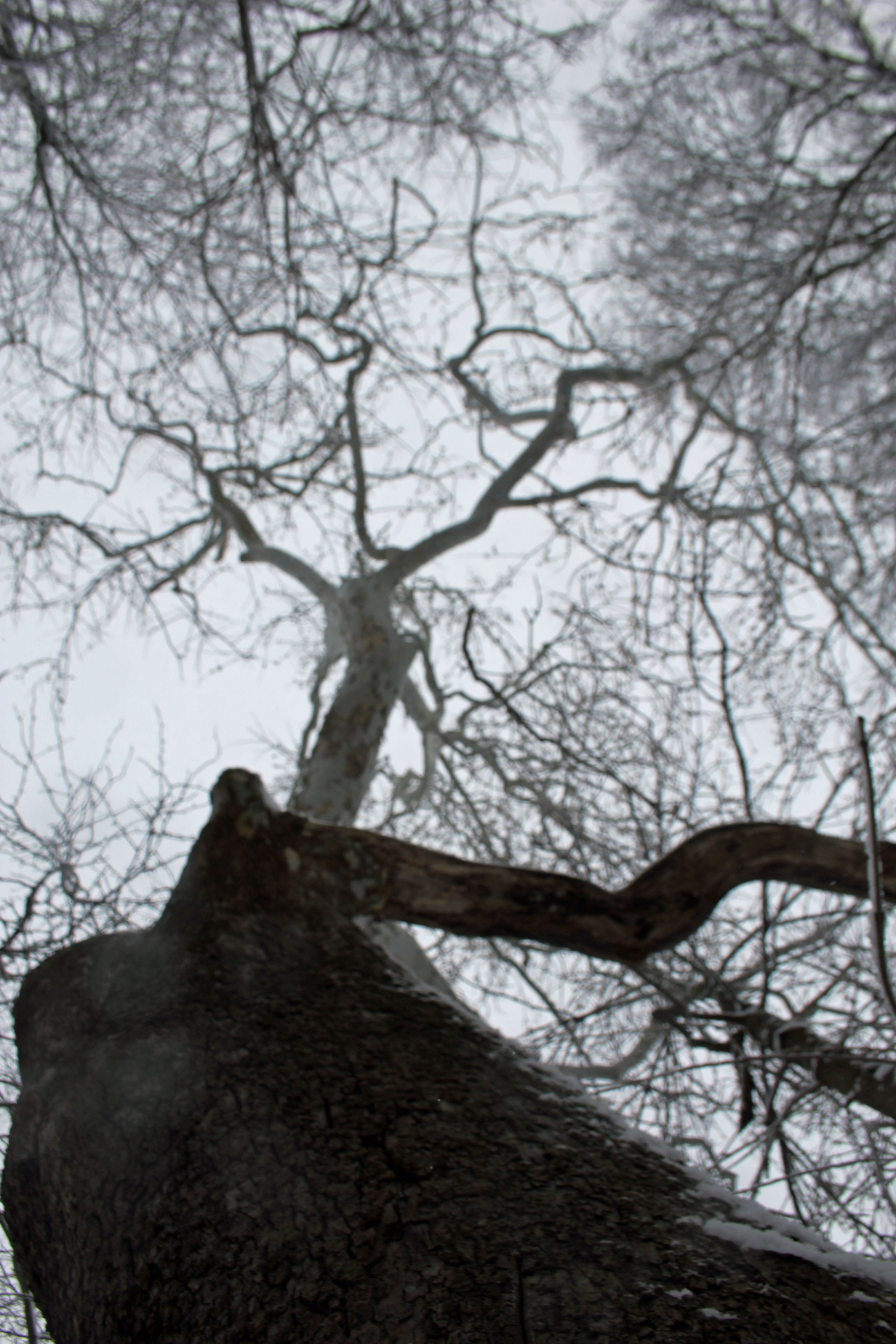
Anne, Lolly and Old Man Sycamoresycamore barkA little farther on and we came to a magnificent old gentleman of a tree; a huge and stately American sycamore that Anne calls by the name of Old Man Sycamore. There are any number of American sycamores (Platanas occidentalis) growing within the riparian areas of The Quarry, and we’re pleased to have them. The trunk and branches are of a mottled color, with reddish brown, pale gray, light green and olive shades of bark setting side by side in irregular patches. This is because the bark of the sycamore isn’t as rigid as the bark of other trees and sloughs off in patches, leaving a pattern created by different layers of bark. A hardwood, sycamores have been used for furniture, siding and even the creation of musical instruments. Because they’re so hardy, they do well in urban and suburban settings, and they do grow quite large; four foot in diameter is common and 70 to 100 feet tall isn’t unusual. Their canopies are welcome on hot summer days and even their stripped branches in winter offer a good deal of shelter from the elements.

sycamore canopy

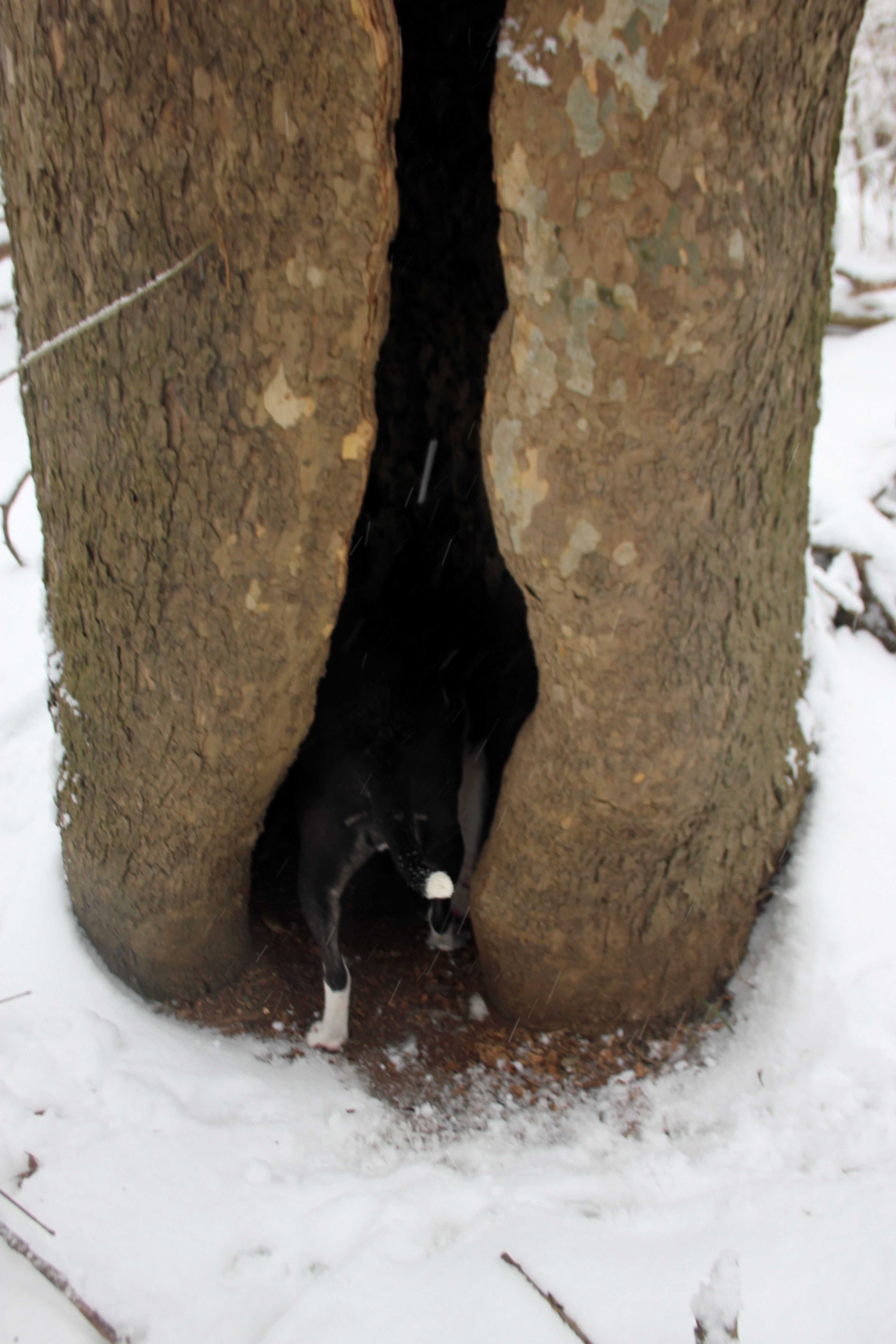
lollly in sycamoreAs for Old Man Sycamore, he’s a good four and a half feet in diameter and fifty feet high. That he’s had to work to get to sunlight is apparent. His trunk has a great bit of a bow to it where he worked his way past a rock, another tree that has long since passed or some other unknown obstacle, and his trunk bears a wide rent in the southern side that opens out into a wide cavity. Lolly just couldn’t keep her nose out of it…then her shoulders. Finally, all but her tail was snug inside.

There’s a nice swale near the Old Man that’s formed by the run-off from the vernal pools down into Cranberry Run and we took advantage of it to walk out onto the stream. Lolly and I followed the Little Cranberry for quite a ways, though every time the ice cracked or popped, Lolly hopped and scurried forward and away. Eventually, though, we made it back to the ford without much incident and out and back up to the house.

And so ended a nice morning walk in the woods, with Lolly curled up on our bed, licking the warmth back into her feet and me easing back with a hot cup of Earl Grey.

IMG_7212

In the footsteps of Fizz

Lolly There’s a man we admire who lives near the Forest of Dean. We are genuinely fond of him, though I don’t even know his name. I simply know him as The Tramp. He walks about the Forest, taking pictures of whatever catches his eye, turns his feet home and then cracks open his head and spills an absolute treasure trove of knowledge about the world around him into the ether (if you’ve not yet met him, haven’t found him through social media or some obscure search or simply missed him through sheer bad luck, here he is: https://atrampinthewoods.wordpress.com/). We do, however, know the name of his companion, his Sancho Panza. I think it’s probably safe to say that The Tramp would find his wanderings considerably less in so very many ways without her. Her name is Fizz and she’s every bit as curious about the world around her as any tramp.

But, why, you ask, are we bothering to discuss these someones that are half a world away? Well, first and foremost, The Tramp’s musings and observations are all of that and so much more. Read. Look. You’ll thank me for it. Thank me and The Tramp. And Fizz? Fizz is…well…Fizz. Second, it’s been said that imitation is the sincerest form of flattery and while I’m not above stealing an idea or three if I think it will help move everything along a bit more smoothly, I do draw the line at failing to give credit where credit is due. Having said that…

Here’s Lolly.Lolly crossing

For those of you not near the here we’re at, it’s been cold; so cold that walks to retrieve the mail are arduous undertakings requiring planning, oversight and at least five layers of clothing. Today, however, (and likely tomorrow, if the forecasters read their scattered bones correctly, scried sincerely their battered leaves of tea), it’s been comparatively balmy; nearly 30° F. On Tuesday, though, we’re back into the basement, temperature-wise. So, given that we’ve been cooped up for the better part of a week, we threw open this window of opportunity and bounded back into the woods, Lolly, Anne and I.

DriftsFirst observation of the day: snow is ever so much whiter under the crust. The winds that have battered this area have stripped the topsoil from all of the surrounding fields and tossed it until it couldn’t be tossed any further. Where it falls it lays in blankets, ribbons and bands of varying shades of brown. Sometimes you don’t even notice it until you’ve taken a step or two, all that dirt being evenly distributed so that there’s just no way of knowing. Other times, you just can’t help but see.

That same wind, though, did interesting things to what little snow has fallen, pushing what must have been little more than two inches of overall snow into two- and three-foot deep frozen waves caught in the process of cascading over the lip and down into the stream bed. Cranberry Run itself is frozen along most its sinuous length, with water breaking through the ice only along the most turbulent runs.Creek sculpture

Tracks on QuarryOn the paths we’ve carved through the woods, down on the frozen stream and across the quarry itself were sign after sign after sign of the many and varied creatures that live here. Tracks of rabbit, squirrel and raccoon crisscrossed those of turkey and deer and a host of songbirds. There were even what we suspect were fox tracks and signs that at least one fox was successful at the hunt. Though we’ve not yet managed to photograph any of the foxes that we know live here (we know of two active dens), we hear them at night, interacting with one another in eerie, high-pitched yowls and sharp, barking yips and growls. We’re researching trail cams, at the moment to help us capture visuals and have acquired some sound equipment with which we hope to record the voices of The Quarry, once I’ve figured out how to effectively use it.

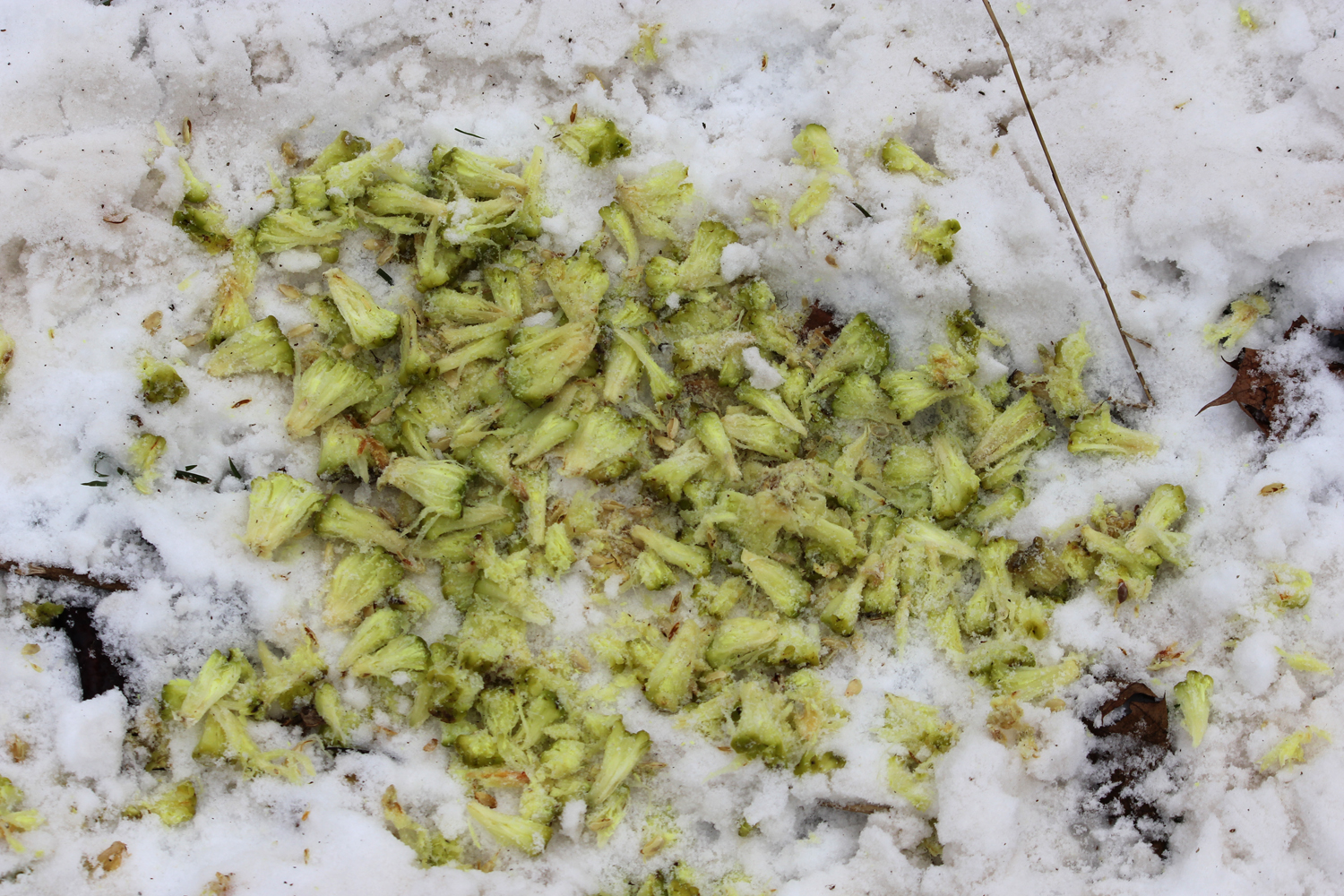
Fox SquirrelIn a tree on the spit of land separating Cranberry Run from the old quarry, a fox squirrel sat on a branch and watched us walk on by. He was fat and sassy and at least one of the reasons for Osage scrapshis good health soon became apparent. Scattered here and there were the remnants of osage oranges, the seed fruit of osage trees. The osage tree (Maclura pomifera), also known as the hedge or hedge-apple tree, is one of the most commonly planted trees in the United States and is used as a field hedge, wind break and to stabilize soils. Unlike apples, pears or cherries, the squirrels tear the tree’s green and yellow fruit apart to get at the seeds, not the flesh. Remnants of their feasts are scattered in oval patches here and there along the stream and back in the woods.

DownySparrowThough there’s little doubt that many simply went unobserved, there seem to be fewer birds about than in past years. We did, however, see various sparrow species, juncos, cardinals, bluejays and several downy woodpeckers flitting from and between the trees.

Tomorrow, if the prognosticators are correct in their prognostications, we’ll probably take the time to do this again.

A New Year’s Day walk below the wind

IMG_2737This new year looks bleak, with harsh, cold wind and an absence of snow. Thursday afternoon, I walked down the lane and had to fight to open the gate against bluster, feeling the cold bite of the latch’s surface through my work gloves. No one followed me to the gate in hopes of treats. I’m sure no apple slices could beat shelter on the sunny side of any outbuilding.

I made it just about 50 yards down the road before ducking down into the lowland along Cranberry Run, where the drop behind Red Fox Cabin blocked the wind. So cold were the trees that they hummed, except for Osage orange trees. These woven, thorny trees make sort of a whirring whine in frigid wind chill (truly exhilarating when one is walking on the trail at night…alone.)

IMG_2736Winter came on so suddenly that many of the Osage fruits are green and whole, their sticky white latex ooze flash-frozen to the ground. The fruit is not poisonous to us mammals, but I hear it’s not much to taste. Further on down the creek, on the east side of the footbridge, I saw something, maybe a fox squirrel, made use of an orange as a food source.

The sun is cold and farther away at the start of the year, a white sun in gray blue sky. Even the bane of the understory, bush honeysuckle, is leafless this year without a snow blanket. No green, other than the Osage fruits, was visible on Jan. 1, 2015. This is a good thing, I know; maybe this will give the maples and oak seedlings a chance to fill in the spaces left where the 2012 derecho took out so many mature trees.

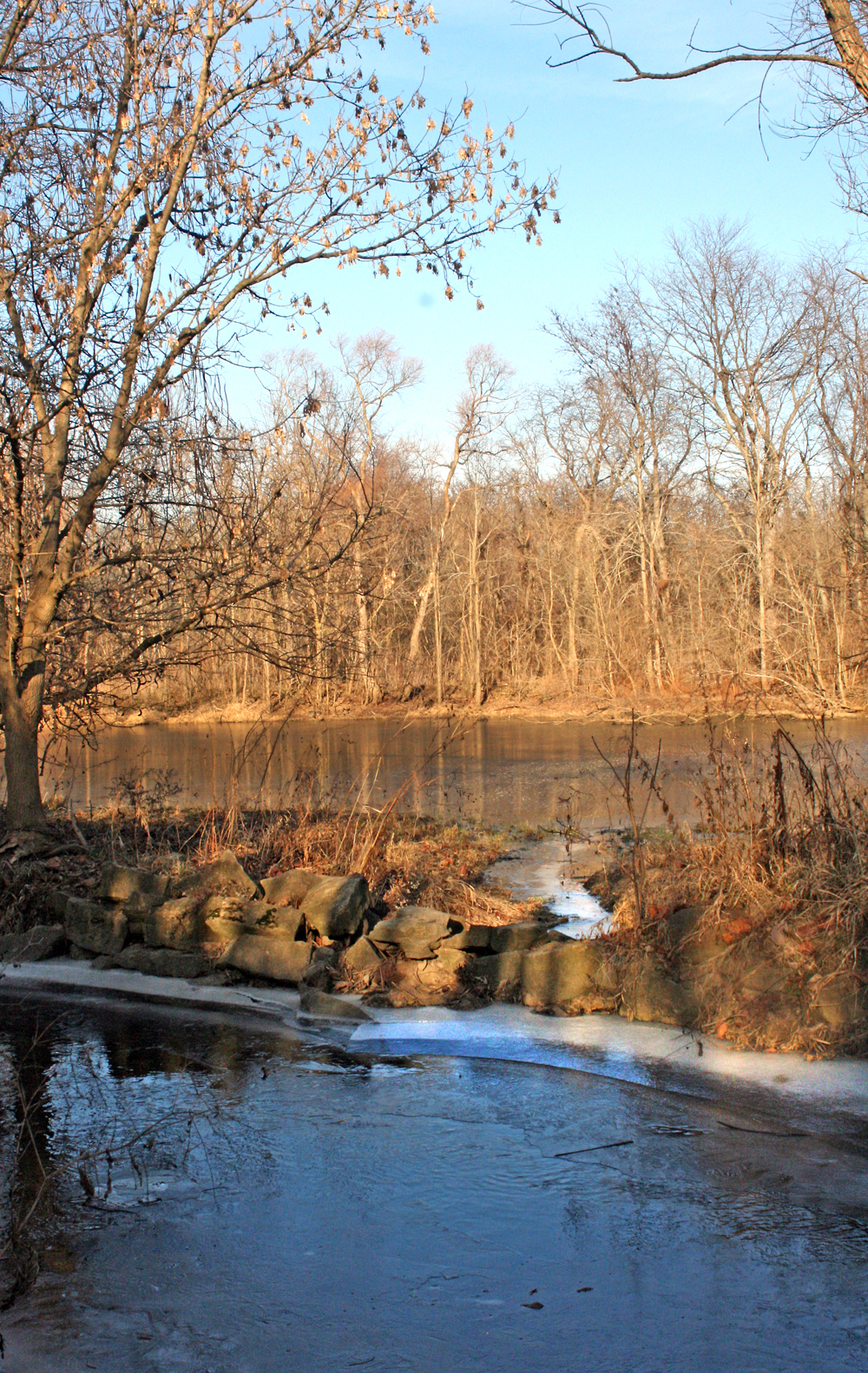
IMG_2739IMG_2734The wind was so high and wild above the creek valley that I saw few birds, not even on the old stone quarry. This winter it is full of water, frozen with reflections of rich, ruddy browns, gold, and sky. There are no breaks in the still quarry’s surface, but Cranberry Run’s riffles keep a brisk pace, leaving open holes here and there, especially below the high blue clay banks at the northwest point of the nature preserve. Two birds, so in shadow that I couldn’t identify the species more than to say they are large songbirds, dipped in the water below a bare root hackberry that has held the top of the bank for as long as I can remember.

IMG_2741The camera, a treasured Rebel of my dad’s, said ‘no more’ to the cold, so I tucked it inside my blanket coat and headed back the way I came. At the top of the hill near The Quarry Farm entrance sign, I tucked my chin closer to the camera, wrapped my scarf around my head and ran for the gate.

With my eyes so adjusted to discerning the different hues of browns, the greeting party under the apple tree was a shock to the senses. Wrapped in new thermal coats, Buddy and the boys were like presents under the tree.

What a happy sight to begin a new year. Rain is promised for Saturday. Luckily, these coats of many colors are waterproof. I think I’ll stay inside and watch.

IMG_2730

You’re The Great Pumpkin, Dave Hilty

There’s a story that makes the rounds every autumn on farms and in fields, and especially here on The Quarry Farm, about the generosity and beneficence of The Great Pumpkin, who rises from the pumpkin patch some time during the month of October and gifts all the good chickens and ducks and donkeys, turkeys and geese and goats and pigs with succulent orange orbs packed full of seeds and strings and goo. And while it’s rumored that the legend of The Great Pumpkin is born of humans, that particular mindset gains little acceptance on the farm, for it’s as the goats say, Humans spend most of their brainpower just maintaining their balance. And for the few that still might think otherwise, the donkey’s argument always prevails, one which he delivers in the most solemn of voices: Schulz, or no Schulz, Peanuts are for eating.

This year, as in years past, the residents here all waited anxiously as the month wore on, staring to the south for a sign of His (though some say Her) coming. Baskets of apples were delivered and pears by the bucketful and truckloads of zucchini and they were greatly appreciated, certainly, and swallowed down to the very last seed. But of The Great Pumpkin, there was no sign. October came and went and…

Nothing.

It’s just as we thought, the geese cried. Great Pumpkin, piffle. Great Poppycock is more like it. To which comment there was general agreement, particularly among the fowl (birds of a feather, you know). The goats made do, browsing the trees and bushes. Buddy, the donkey, cropped grass and chewed hay and if, occasionally, he seemed a bit tearful, nobody said a word. Little Pig, though, kept her own counsel and spent a good bit of each day off alone, walking along the southern fence line, eyes on the horizon, waiting.

And so it was that Little Pig was the first to see him: The Great Pumpkin, sitting in the cab of his red and silver pickup truck and towing along behind him a veritable mountain of pumpkins. A whole week late, he was, the first full week of November having past, but those that live here on The Quarry Farm are quick to understand simple truths: Time is fluid and Better late than not at all, not to mention All that matters is what matters in the end, especially when it’s pumpkins in the end.

The Great Pumpkin pulled in through the gate and up the stone drive before stopping and hopping down from his perch. To either side of the squash-laden wagon he threw the great round balls of sheer joy. The pumpkins bounced and broke and spilled their treasure of seeds and strings and slippery orange goo.

Heaven! Little Pig shouted. Slippery orange heaven!

The pumpkins flew and flew and still they flew and, finally, when the ducks and chickens and turkeys and geese and goats and donkey and pigs were certain that he had finished, when the blue and gray sky was no longer streaked with orange, what they heard him say made them all stop and stare.

How ‘bout if I just leave the wagon, The Great Pumpkin said. I won’t need it again ‘til spring.

turkey

They all looked to the wagon and it was heaped with pumpkins, mounded with pumpkins, buried in pumpkins as if not a single one had ever soared and fallen and broken and exploded in great gouts of seeds and strings and (heavenly) slippery orange goo.

The Great Pumpkin fiddled about a bit at the front of the wagon and then hopped into his red and silver truck.

Give a shout when you’re through, they all heard him say. No hurry, though.

The Great Pumpkin waved as he pulled away and through the gate, moving south until he’d disappeared from sight. Every duck and chicken, goose and turkey, donkey and goat and pig thanked him a big thanks before tucking into their chosen pumpkin. And if Little Pig was a bit greedy, if she pushed aside a goose or three to suckle at the slippery orange goo, nudged out of her way a chicken or a turkey or a duck, well, then, maybe she could find forgiveness in the eyes of those who keep the faith, in the hearts of those who believe.

POSTSCRIPT:
Special thanks to Dave and Jane Hilty, who are this year’s Great Pumpkins at The Quarry Farm.

preparing puffball

Gerald Owen Coburn, the man who first set foot to the path that led to The Quarry Farm as we know it, was, at his very core, an artist. It was with an artist’s eye that he looked on absolutely everything, particularly the natural world; a recurring theme in the body of work that he left, whether in paper, canvas, wood or stone. He was relentless in his desire to understand the world that he took to representing, primarily with brush, methodical and nearly clinical in his efforts to that end. And why not? It’s a fundamental truth that among the very many things that art is, it is most certainly science, peeled and filtered and laid out sideways so as to permit viewing from a different perspective.

One of the first Coburn paintings I had the opportunity to see was a watercolor. It depicted a young boy carrying in his arms what I first mistook to be a large stone, bigger than the boy’s head. It wasn’t a stone, though. It was a puffball, a fungus in the division Basidiomycota. To put an even finer point on it, it was probably Calvatia gigantea, the giant puffball, specimens of which commonly grow to a foot or more in diameter. Even more impressive, when they’re immature they’re not only edible, but supremely tasty. Be sure, though, that you are indeed in possession of an edible mushroom before taking a bite. If you have any doubts whatsoever, caution is the word of the day.

While puffballs are agreeable to most types of preparation, I have a fondness for them cut thick, breaded and sautéed. It’s simple, it’s quick and the results are noteworthy. Here’s how:

  • sliced puffballCut the puffball into ½ to ¾ inch slices. An immature puffball, when cut, will have a uniform white appearance. If they’re turning yellow on the inside, they’re too far gone to eat. Make a slit in the tough, outer skin and peel it away. It should come free quite easily.
  • Heat 2 tablespoons of cooking oil (each imparts its own flavor; choose to your taste) in a skillet over medium heat. Alternatively, use melted butter, but do not brown it. Dependent on the amount of puffball you’re preparing, you may need to add more oil or butter to the skillet as you go.
  • breaded puffballIn a pan large enough to accommodate the puffball slices, combine one egg with 1 ½ tablespoons of milk. On a different plate, prepare a bed of breadcrumbs. I’ve developed a preference for making my own, but store bought will do nicely.
  • Dip both sides of the puffball slices in the egg mixture, then dredge them through the breadcrumbs.
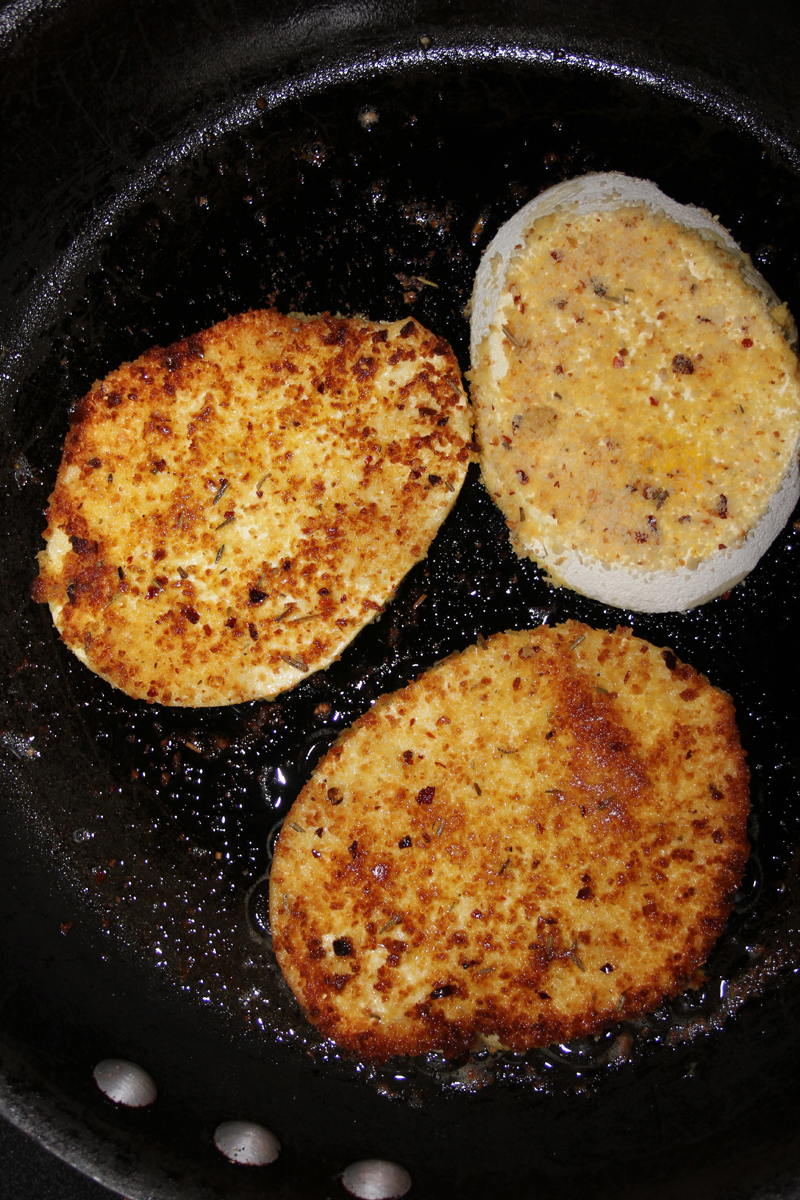
  • Sauté each side until golden brown, then drain momentarily on paper towels. Serve hot.

sautéed puffball

yesterday and today

Life in the DevonianBefore The Quarry Farm in its current incarnation, with Red Fox Cabin and the gardens and a forest and the sanctuary, there was the quarry farm, pasturage for cattle and two ponies. Before the quarry farm, there was a great forest of hardwoods, oak and hickory and maple, on the very southern edge of the Great Black Swamp. Before the forest on the edge of the swamp, there was a glacier that traveled inexorably south, planing everything before it flat. Before the glacier, there was a vast, shallow, warm sea boiling with life in what we’ve come to call the Devonian Period.

And we live there now, on the floor of a sea that died some four hundred million years ago. Even so, the reality of it remains.

crinoid segmentsThe Quarry Farm isn’t simply The Quarry Farm (though, to be honest, there is little simple about it). It is also literally our home. We built here fifteen years ago and when they excavated our basement, they pulled up all manner of wonderful things; bits and pieces of what once lived here that had turned, over time, into stone. There were round chunks of coral, too big to play softball, but too small for soccer, and flat sheets of dolomite speckled with clam-like brachiopods. Later, as we began to seriously explore Cranberry Run, we found smaller pieces of coral, smoothed by time and weather and water, and tiny stone discs and columns of discs: the individual segments and broken sections from the stalks of crinoids. And all of these things were evidence of what had once been, of an ocean with strange and fantastic animals that struggled for survival before ultimately, for some at least, making their way onto land to begin a whole new aspect of life.

Everything changes. Everything evolves.

Turkey VulturesCurrent scientific theory is that present day birds are what remain of the dinosaurs, that over the course of some fifty million years, dinosaurs shrank in size and developed feathers in greater abundance (while it was once thought that only avian dinos had feathers, discoveries in the mid 1990s indicated that even non-avian species, including velociraptors, were feathered to some degree). So, the blue jay in the yard, the crows in the spare bedroom, the turkey vultures that soar over the quarry, the ducks and geese in the stream…all descended from dinosaurs. And, oh yes, the chickens.

I spend a lot of time with the chickens that live here. There is something comforting about them; the nonchalant way that they roam the property looking for food, their quiet crooning. I enjoy their interactions Smart Girland I am particularly appreciative when one, or more, chooses to spend time with me, to sit beside me or in my lap and simply be. I find them calming and inspirational and a source of nearly endless fascination. As odd as it may sound, they bring me peace. Every now and again, though, they remind of me of where they come from, what they once were.

There is one hen in particular, an eighteen-month old Jersey Giant that, when we call her anything, we simply call her Smart Girl. Smart Girl will leap into the apple trees and throw fruit down. This isn’t some phenomenally new behavior; others have done it. But when she climbs, she always throws down enough apples to distract the other chickens, ducks, geese, goats and any other animal swirling about the base of the tree before throwing something down for her. She plans her actions. And, it’s possible, she hunts. On three different occasions, I’ve seen her run across the yard with a small adult bird in her beak. On a fourth, she was carrying either a small rat or a large mouse. It may be that she’s finding these animals, dead, on the ground or stealing them from a neighbor’s cat, but I can’t preclude the possibility that she is actively pursuing prey. Sometimes now, when I’m watching her as she roams the grounds of the sanctuary, I see her differently, her and the property she’s stalking.

Time travel, as it turns out, isn’t all that difficult. All you have to do is squint.

chicken feet 3