Third time’s a charm

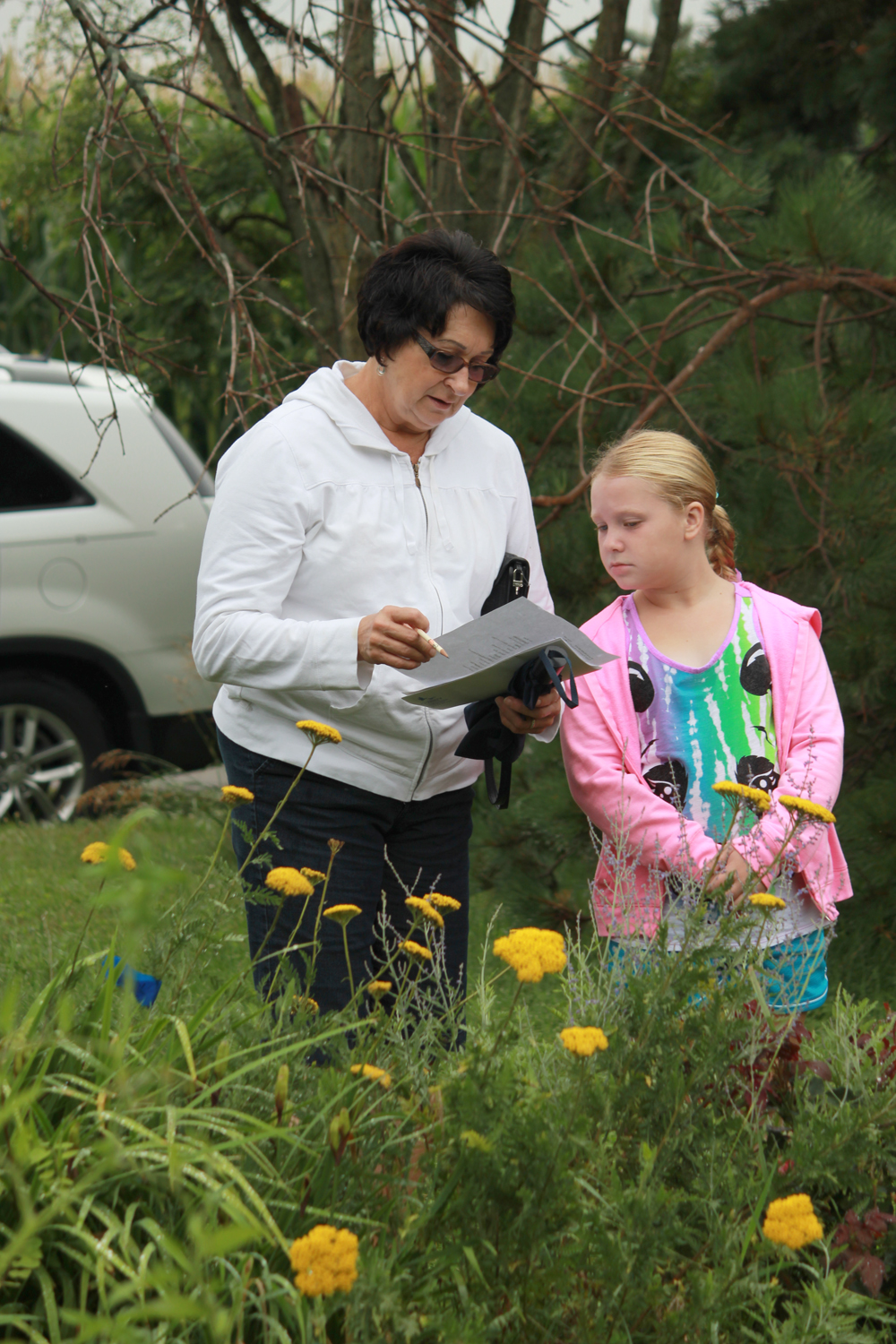
IMG_0826The Junior Gardeners of Continental were one of the first groups to visit The Quarry Farm after we officially opened to the public three years ago. I distinctly remember the initial telephone conversation with organizer Charlene. She had picked up our newsletter and wanted to bring her charges out for a program. She didn’t sound too sure about the whole idea, but her group arrived and we had a fantastic time. Guess they did, too, because they spent two hours with us on Saturday, this time searching for butterfly host and nectar plants on a scavenger hunt.

IMG_1107Beatrice met up again with her good friend Brandon, the first person she would approach of her own accord after her arrival in 2012 as a very young pot-bellied piglet. Although Brandon had some slick new wheels this year and Beatrice was sleepy in the July humidity, she knew him well. So did Buddy.008

Megan Ramey, Program and Partnerships Manager for the Girl Scouts of Western Ohio, arrived just before the Junior Gardeners to talk with us about the possibility of scouts earning various badges here. Thanks to the joyous enthusiasm of Charlene and her crew, a star of a Virginia opossum and Laura’s coffee and sugar cookie bars, we’re in.

Here’s to more face time with the kids from Continental. Special thanks to Junior Gardener Jazlyn Bishop for sharing your photos and video with us. Keep them coming.

This slideshow requires JavaScript.

Small Triumph

Sandhill Cranes, 2014 Garden, Pipevine Swallowtail Larva 023

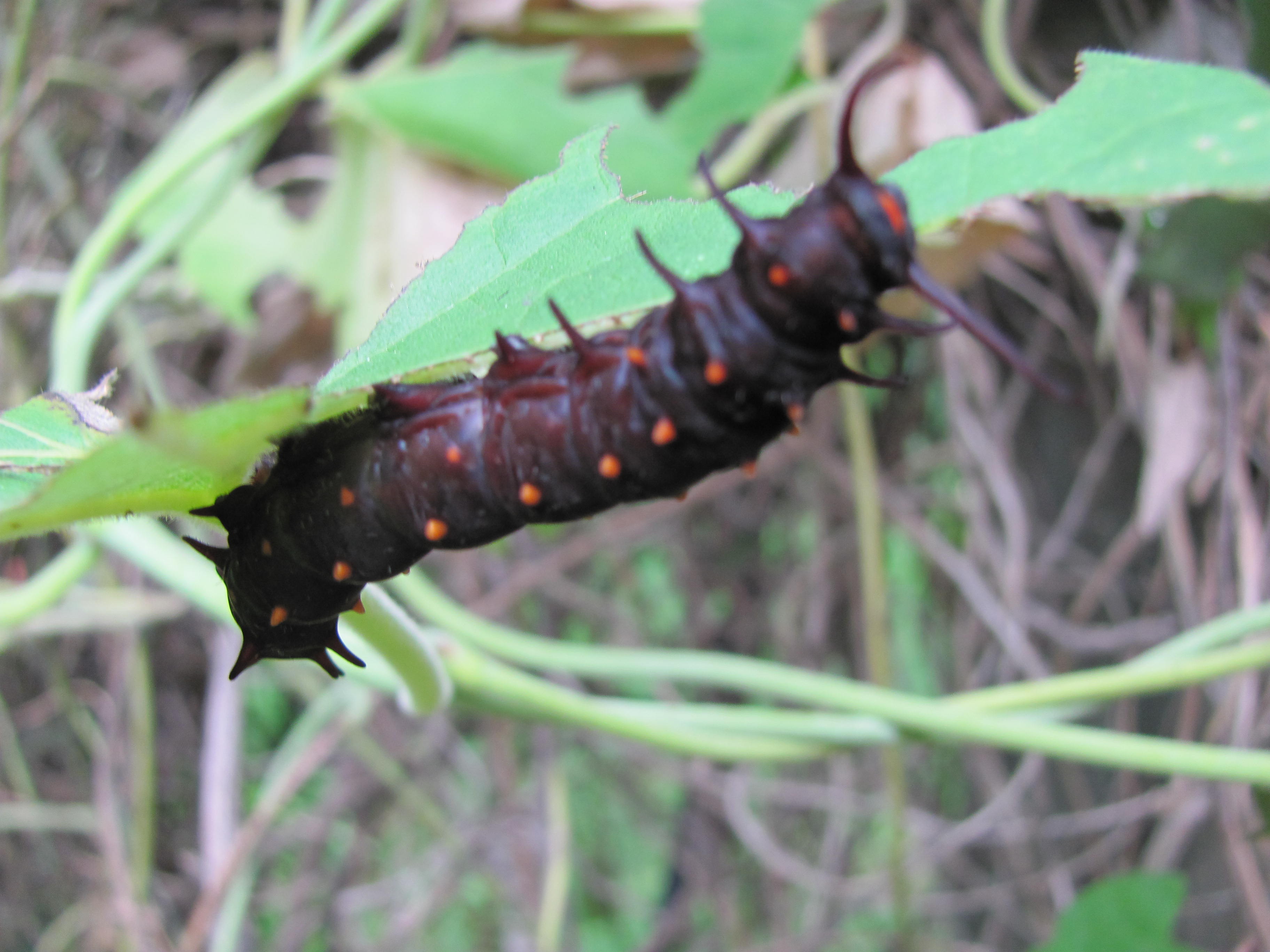
Why would a gardener be happy, overjoyed even, to discover an army of fat, black, spikey-looking caterpillars with red polka dots pillaging a prized ornamental vine?  Answer:  When the marauders are Pipevine Swallowtail butterfly larva and the vine is Dutchman’s Pipe (aristolochia macrophylla), one of their host plants.

For the ten summers and more since husband Gerald planted two pipe vines in the garden at Red Fox Cabin, we have kept watch on them.* We’ve admired the cute little Dutchman’s pipes they bear and checked the foliage for ragged holes that would give away the presence of larva. We’ve peered at black with blue swallowtails, hoping to spot the distinctive coloration of the Pipevine, inky black forewing and iridescent blue hindwing.  However, sightings have been extremely rare and none have chosen to lay eggs on the beautiful Dutchman’s Pipe. Until this July.

Sandhill Cranes, 2014 Garden, Pipevine Swallowtail Larva 016Last Saturday evening as I was walking my Jack Russel, Lefty, or rather as he was leading me where he wanted to go, he tugged me toward the rear of the log cabin, where one of the pipe vines grows luxuriantly on a porch pillar.  Lefty was intent on the rabbit or cat or whatever that he scented underneath the porch, but I was halted in my tracks by the sight of that vine, no longer luxuriant, but ragged, nearly defoliated, and crawling with the aforementioned fat black caterpillars–at least twenty.  Thrilled by the sight and the realization that our vine had finally been discovered by a passing Pipevine Swallowtail, I rushed home with a disappointed Lefty to grab my camera and my Peterson’s field guide to caterpillars, for confirmation.

Sandhill Cranes, 2014 Garden, Pipevine Swallowtail Larva 012According to the guide, predators avoid Pipevine Swallowtail caterpillars because the vine that feeds them is toxic and makes them unpalatable.  Also, when they are ready to pupate they tend to crawl away from their host plant and find other places to attach a greenish chrysalis with a silken thread.  So, the total disappearance of the caterpillars two days later was not as alarming as it might have been.  Photos and a ravaged vine prove they were there.  Quite likely, somewhere on the Quarry Farm later this summer, a Pipevine Swallowtail, or maybe twenty, will emerge from its chrysalis and sail into the butterfly garden to dine, and with luck someone will be there with a camera.  A photo of the shimmering beauty will be a fitting tribute to Gerald, who inspired us with his love of butterflies and planted the Dutchman’s Pipe so many years ago.

*[Pipe vines are native  in some parts of the Northeast but not in Putnam Co., Ohio; ornamental pipe vines were common in Victorian gardens but are less so today. Pipevine Swallowtails can complete their life cycle only if they happen to find a host pipe vine or a Virginia Snakeroot growing wild or deliberately planted.  Adults might stop to nectar in a flower garden but will move on if a host plant is not available.]

043It’s been nearly eight days since the Autumnal Equinox rolled around and in those intervening eight days, a lot has happened. On Thursday past, some 70 home-schooled1275330_10202302158898800_378213994_o children and their parents/grandparents/guardians visited the Farm. As with other groups that have come and gone, they made herb bundles, learned about the waterways around Ohio, got a peek at what lives down under the rocks and the mud in the creek that runs through the Quarry Farm on its way to the Riley and they met many of our two- and four-legged friends and fellows who live here with us. Beatrice has already worked out how to circumvent the fence, so she spent the morning visiting with the groups over by the cabin. Buddy and the goats stayed closer to home and were treated like royalty, which is as it should be.

047On Saturday, we held what we hope was the first of many acoustic nights. Friends and family met in Seitz Pavilion to listen to friends and family play and sing (and, yes, that’s a lot of friends and family). Thanks particularly to Erin Coburn (and Bruce and Beth, of course), Mark Gallimore, Brian Erchenbrecher and Doug and Merilee of 12-String Relief.

If you missed it, we’re truly sorry for your loss.037

“Best field trip ever”

racg041193 031

One young boy shouted this as he was on his way back from the farm animal sanctuary this morning. How could it not be the headline today?

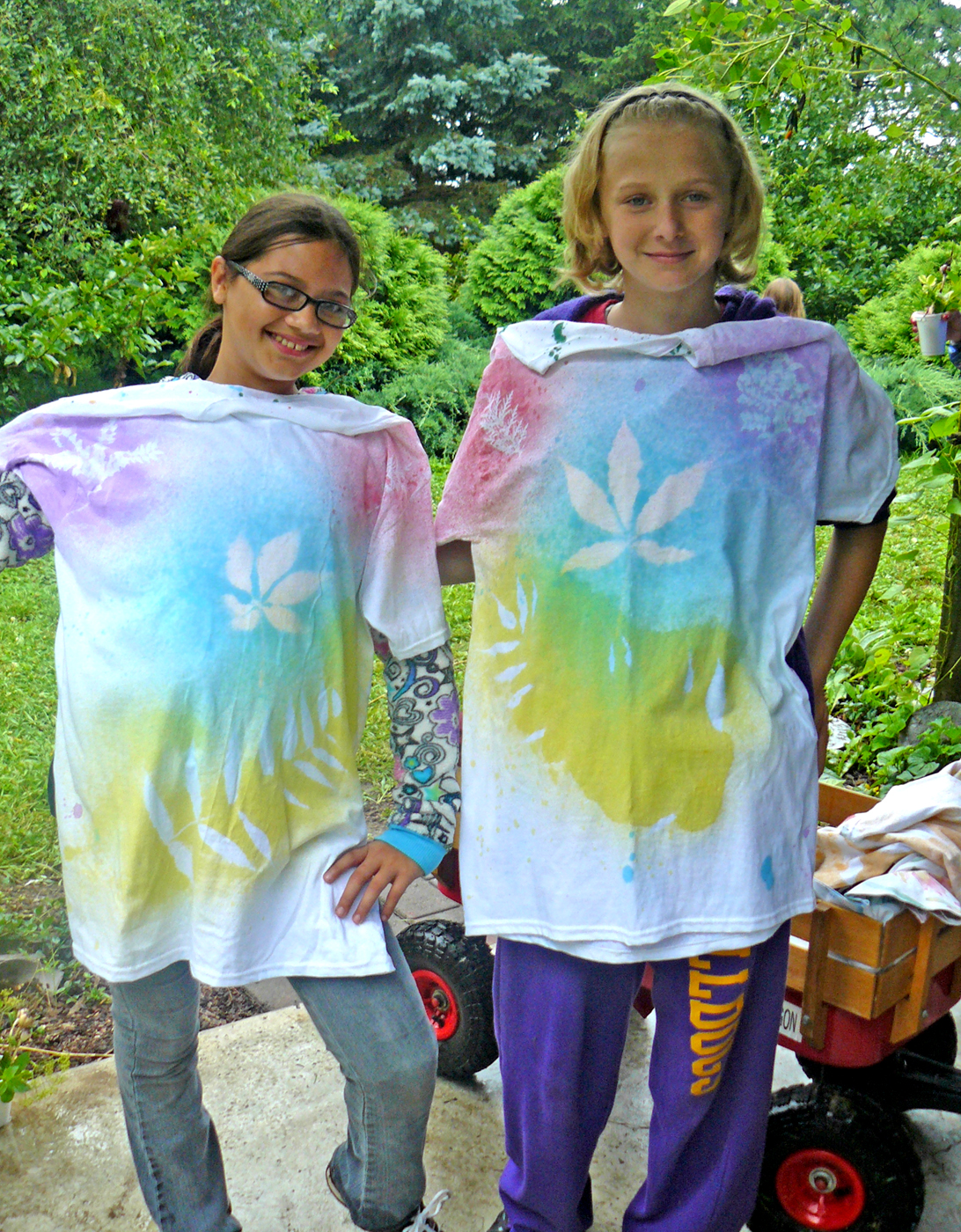
Modeling leaf resist t-shirts

Modeling leaf resist t-shirts

That young man was here with Charlene Finch and her Junior Gardeners from Continental. This was the second year that the group visited the Quarry Farm. They are one of best bunch of people we’ve ever met. Enthusiastic about everything, which is good since their day started here with rain. But since the shelter house went up last summer, the roof was ready and overhead. The new tent curtains were draw to the west and south, so the rain was hampered enough that kids and parents could make leaf shirts and select herbs for culinary, scent and healing bundles.

Charlene and her gardeners make herb bundles

Charlene and her gardeners make herb bundles

Charlene Finch started the Junior Gardeners group four years ago as part of her Defiance County Master Gardeners project. She liked it and the participants so much that she kept at it. Her own pocket paid for materials and seeds at

Costmary, an herb

Costmary, an herb

first. Now the group receives donations, holds 50/50 raffles and sells food at the Continental fall festival to fund summer gardening projects.

During the 2012 visit, Beatrice was just a piglet, a very shy one. Her encounter with Continental Junior Gardener Brandon was a positive turning point for us and Little Pig. Prior to the first trip, she wouldn’t let anyone close. But she liked Brandon. This morning as we all walked up the path to see the animals, Beatrice came at a trot, full grown and not a bit shy. Buddy and the goats were especially happy to see the 50-pound bag of peanuts that the group donated today.

You don’t have to be a star (but it’s really fun)

The new greenhouse north of Red Fox Cabin was of interest to the Owens class as they are considering one of this size for a butterfly house.

The new greenhouse north of Red Fox Cabin was of interest to the Owens class as they are considering one of this size for a butterfly house.

Been awhile, but with good cause. Seems as though weekly (or biweekly) posts may be the new norm of spring at the Quarry Farm.

On May 29, seven people from Owens Community College, Toledo Campus, drove down I-75 and made their way here, despite the Road 7L sign being missing from the turn off State Route 12. Jeannie Wiley Wolf, Findlay Courier reporter, almost didn’t find us to do an interview for an article that appeared in that newspaper on May 28. Steve says the sign mysteriously disappeared some time ago. Anyway, Owens’ Associate Professor Joanne Roehrs got the van here.

Owens2The students are working to obtain the Urban Agriculture and Sustainability Certificate, a new offering at Owens. All of them have sweat-equity in the urban community gardens in Toledo, especially in the Robert J. Anderson Agriculture Training Center and greenhouses (900 Oneida Street; Toledo, OH 43608) which are projects of Toledo GROWs, the community gardening outreach program of Toledo Botanical Garden. The Anderson Center is used as an educational forum for Owens Community College students who are studying urban agriculture. The Center is also an open-air classroom where under-privileged youth are educated on growing sustainable nourishment.

While on the Quarry, Roehrs and her Livestock Animal Husbandry students focused on the organic gardening projects, the wild bee boxes and the farm animal sanctuary. They study beekeeping through the hives at the Anderson Center. We were able to tell them what not to do with bees, from firsthand experience, and of plans for new bees in 2014. Beatrice of the whirligig tail was our model sanctuary adoption success story as she greeted all with charming, intelligent porcine loveliness.

If you are, or know of someone who is looking at new, relevant career option investment, this is a program to explore: http://catalog.owens.edu/preview_program.php?catoid=3&poid=634&returnto=158

From that point until 11:59 a.m. on June 6, preparations were made for the arrival and tour of 90 individuals, mostly K-8 graders, from Columbus Grove Local Schools’ after-school summer program. For coverage of that Quarry Farm landmark event, I’ll let the press do the talking. Diane Myer of Black Swamp Raptor Rehabilitation Center, Stacey Cook of Hometown Station WLIO, Nancy Kline of the Voice and Alex Woodring of the Putnam County Sentinel, volunteers Cathy, Shannon, Jonelle, Brendon, Cherie and Dakota, you all wear superhero capes. As long as the links hold, here’s the news from June 6:

Putnam County Sentinel: http://putnamsentinel.com/main.asp?SectionID=1&SubSectionID=1&ArticleID=15695

The Lima News/Putnam Voice: http://www.limaohio.com/news/putnam_county/article_8053fd5a-cf9d-11e2-807c-0019bb30f31a.html
plus photo gallery: http://limanews.mycapture.com/mycapture/enlarge.asp?image=47607266&event=1665851&CategoryID=65761

Couldn’t ask for more. Maybe sleep. But that’s OK, more than OK. As WLIO’s anchor Jeff Fitzgerald noted, “They say it should  be shared.” And we do.

Three Goats, Two Humans and the Very Small Car

Goat CarFive years ago, while bringing Anne home from a stint on the EPA  vessel Lake Guardian, her car, a seven year old Toyota we bought used to begin with, gave up the ghost in dramatic fashion. As we came into Findlay from the east, the car gave a thump and a shudder and began belching thick, black smoke.

We limped into town and into the first car dealership we came to, then walked the roughly half-of-a-mile down to a second, having seen nothing we were interested in at the first. There Anne spotted a Scion xA and almost immediately fell in love. We had her old Toyota towed to the dealership and used it as a downpayment on what she now fondly refers to as her “little rollerskate.” If you’re unfamiliar with the xAs, they’re a smaller version of the current xD and similar in shape to the Honda Fit. In short, they’re microSUVs.

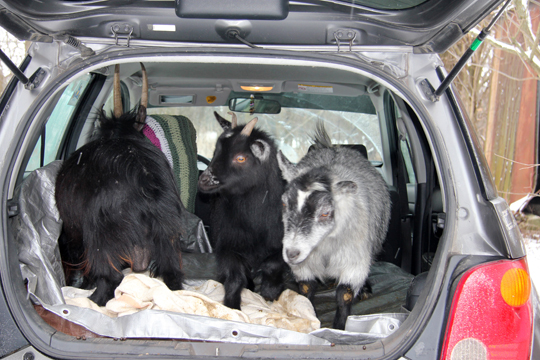
We’ve hauled just about everything in that little car: hawks, falcons, vultures, pigs, dogs, cats, ducks, geese, foxes, opossums, crows, owls over a dozen species of songbird, 55 gallon aquariums, bales of hay and straw and the list goes on. Most recently, Anne’s Little Rollerskate faced what we thought would be its greatest challenge: three pygmy goats.

Willow

Willow

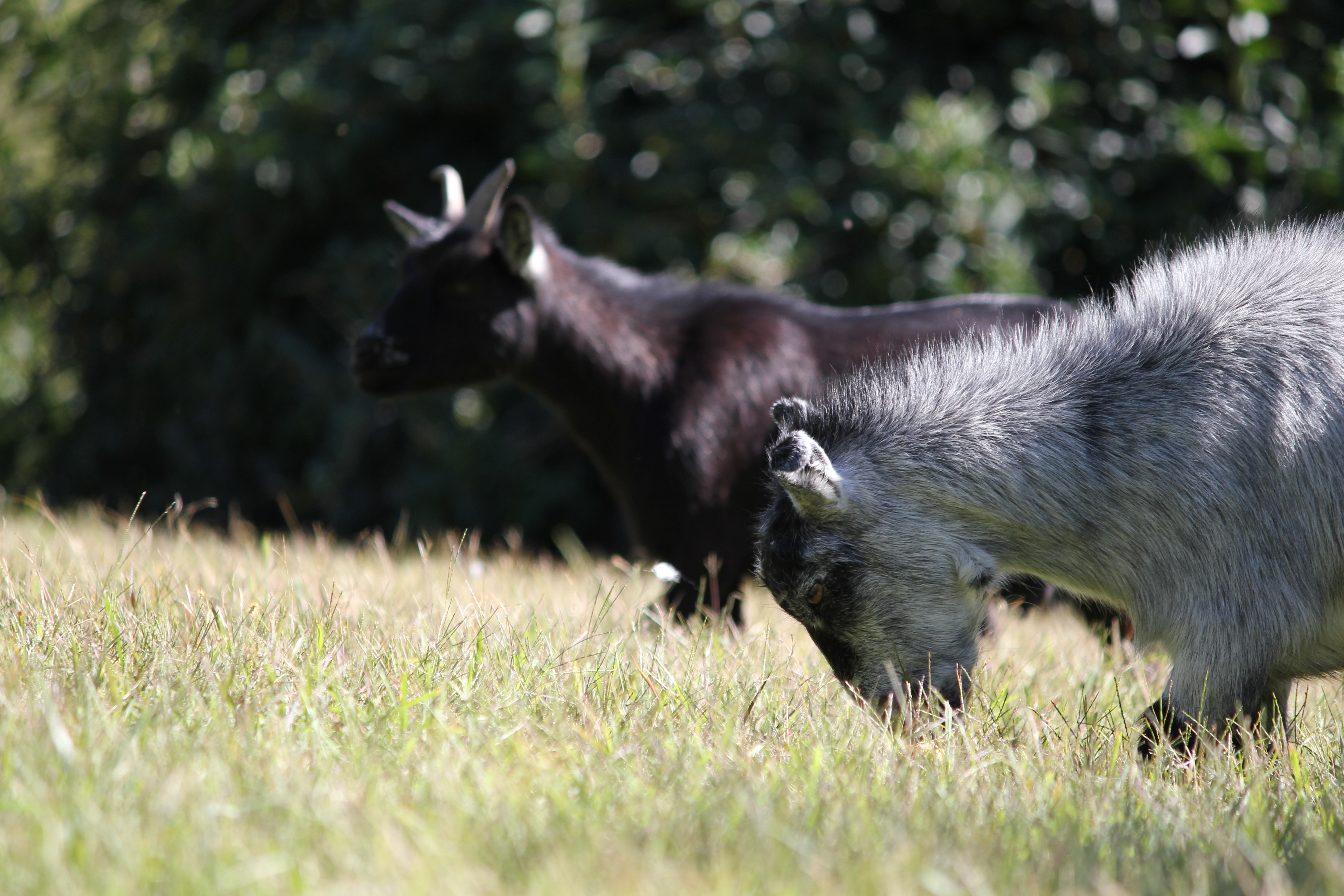
We’ve talked for years about maintaining a small herd of dairy goats, but the closest we’ve come are Marsh and S’more, the two Nigerian Dwarf wethers that have lived on The Quarry Farm for nearly three years now. So, when we were told about these three goats, an intact buck and two does, we contacted the woman with whom they lived. As with so many others, the recession had hit her hard. Having been without work for months and still recovering from a necessary surgery nearly a year ago, she found herself without the means to care for her herd of goats. Most went to a local farm (she lives in Rootstown, south of Ravenna in eastern Ohio), but she was left with these three until she contacted The Quarry Farm.

Alaura

Elora

It was a miserable day for a drive when we left Putnam County. There was just enough snow to make the roads treacherous and it took nearly four hours to make a trip that should have taken only three. Add to that some skepticism on my part that we’d be able to fit three adult goats and ourselves in Anne’s little subcompact and it made for a tense trip.

As it turns out, I should have left my doubts at home.

Martigan

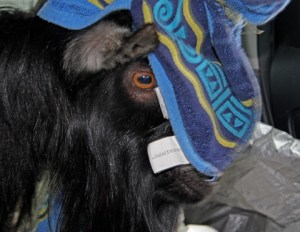
Once we arrived at our destination, we were delighted to discover that the goats were even smaller than we’d imagined. The older doe and the buck, Willow and Madmartigan respectively, stand no taller than eighteen inches at the shoulder, while Elora, the younger doe, is even smaller. Even with a full set of horns, horns that we initially padded turban-like with a towel, Madmartigan could easily stand up straight in the car, and all three were able to move freely around the cargo compartment.

Martigan Home

Martigan

The ride home was uneventful and we introduced all three to their new living quarters. Now they’re permanent members of The Quarry Farm family. And you’re all welcome to come and visit them and the rest of the facility. Just give us a call. We’ll be happy to show you around.

NOTE: Before anyone tells us that we have the wrong kind of goats for milking, we know. The animals that live here on the conservation farm of The Quarry Farm are here because, in almost all cases, they had nowhere else to go and we could offer them a home. Most do carry their weight: goats eat invasive plants, chickens give us eggs, Buddy and the geese guard the property, etc. The pygmies will make it possible for school groups and other visitors to see goats being milked. And we’ll have goat milk.

A Long Overdue (but brief) Introduction

If you have ever had an affinity for writing, someone at sometime has said to you, “Write what you know.” It’s good advice. But what they don’t tell you is that sometimes what you know is what you love and, on occasion, you are so close to what you love that writing about it becomes more than simply difficult. Your love becomes a chasm that words can’t bridge. I’m going to type a word now that, to me, embodies this whole concept.

Crows.

It’s a little word and they are a common bird, but even so, I have been enamoured and fascinated by crows for decades. By those who study animal intelligence, they are widely considered the most intelligent of birds. They aren’t simply tool users, but meta-tool users, designing tools by which they can get a tool to accomplish a task. They raise their young in multigenerational family groups, teach specific lessons to their young who, in turn, teach their own offspring these self-same lessons, communally avoid areas of known danger and may even use the same insecticide (formic acid deliberately obtained from the crushed bodies of ants) they use to rid themselves of lice and other pests to attain a state of inebriation.

That’s right. Crows may get loopy on ant juice.

And here’s the rub: I live with two of them. Literally live with them. In my house. And have done so for over a year. Their names are Blackie and Jo. Both came to us through Nature’s Nursery Center for Wildlife Rehabilitation and Conservation Education. Blackie first and then Jo. Over that time, a day hasn’t passed that one or the other of the two hasn’t done something noteworthy, engaged in behavior that wasn’t worthy of mention. Even so, getting the concept of them down, the enormity of their impact on my life, has proven overwhelmingly difficult. So, although I’ve tried, and there are literally dozens of drafts on this site that support my claim, I haven’t passed along a single anecdote.

Until now.

To get to the meat of it, though, I have to seemingly stray away from the subject. Be patient.

Recently, we took in an additional fourteen hens. We acquired them locally from a pair of farmers who found themselves swimming in chickens. As I understand it, they were told by their supplier that their order of 150 chickens couldn’t be mailed, that they would have to drive to the hatchery and pick them up. Which they did, only to receive, a few days later, a shipment by mail of another 150. They were completely unprepared for so many birds, didn’t have the facility to house them all, although it appeared that they had tried. When we picked up our fourteen, the most the farmers were willing to part with, there were easily 200 hens and several roosters housed in a building no more than ten foot by fourteen. The birds had pecked each other raw, stripping the feathers from one another until many were half-plucked. To make a long story short, two of the chickens we took in have died, the (hopefully) last of them either late last night or early this morning. And now we get back to the crows.
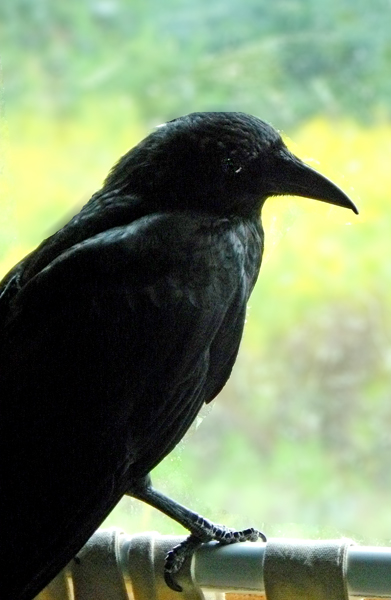
Jo in WindowOf the two crows that live with us, Jo is my girl. We bonded immediately. She greets me each morning, and I, her. It’s a complex thing involving specific crooning vocalizations. We visit with each other and preen one another. And when I’m outside where she can see me, she caws loudly and sits on the windowsill, watching me as I go about whatever task is at hand. Today, the one she watched me perform was the disposal of the body of the chicken that had died sometime during the night. As I was coming back up to the house, in the window of the room where the crows stay, I saw a small blob of brown bobbing in the window. It was obvious that Jo was in the window waving something around, but it took me a moment to figure out what it was.

As I mentioned earlier, crows are highly intelligent and they need a variety of stimulations to keep themselves occupied. We give them puzzles to solve and simple objects that they find interesting. One of Jo’s favorite toys is one of those tiny little plastic ducks, and by little I mean just a couple of inches long and maybe an inch and a half high, that you find all over the place. I’m sure you’ve seen them: little plastic ducks dressed like firemen or doctors or executives or sports figures. At the very least, you get the picture.

Jo's ChickenIn this case, the little plastic duck looks like a little, brown, lifeless chicken.

And she was waving it in the window after watching me walk down the path behind our house with my own little, brown, lifeless chicken.

Think of it what you will. Maybe Jo was just showing off one of her favorite toys, trying to entice me back into the room for a little play time (which, by the way, she succeeded in doing). Maybe it was simply coincidence. It’s possible.

But I don’t think so.

Made My Day

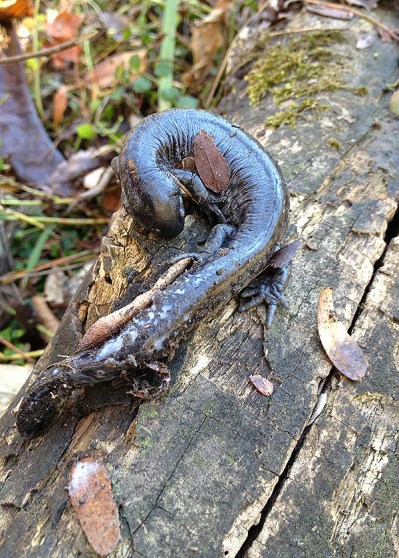
Even though there are over 25 species of salamanders native to Ohio, and we should be able to find them under practically every rock, rotting log and leaf pile, we frequently don’t in much of Northwest Ohio. And that’s why we’re so excited that Quarry Farm friend, volunteer and advisor Alaina Brinkman Siefker shared this photo today. She captured this little guy’s image in the Quarry Farm north floodplain, aka “Coburn’s Bottom”, this past Sunday. This animal looks to be a Jefferson or Blue-spotted salamander, or a hybridization of those two species.

Salamanders, frogs and other amphibians usually require both aquatic and terrestrial habitats. They are born in water, develop and move onto land. Talk about your primordial creature. Much of their natural habitat has been destroyed. Not just around here, but all over the world. And if that habitat hasn’t been wiped away, it has been disturbed or chemically altered. Top that off with an impaired atmosphere and you get severely declining amphibian populations.

Researchers consider amphibian populations an indicator of overall environmental health. The salamander that Alaina and her family saw this weekend tells us that we are doing something right around here. Next spring, look for announcements for the First Annual Quarry Farm Salamander Count.

For more about Ohio’s salamander populations and monitoring program, visit http://www.ohioamphibians.com/salamanders/Salamanders.html.

Be Our Neighbor

This past Sunday, September 16, neighbors from up and down Road 7L and from various points around the block visited for an open house. All gathered under the red roof of the Seitz Family Pavilion for cookies, muffins, sandwiches and lemonade.

The sky was blue, blue and more blue, the goldenrod positively gilded and the butterflies flitted on cue. Plenty of mosquito repellent was applied to skin, enough to allow for guests catch up with friends, and for others to walk the gardens and the trails of the nature preserve.

Truly was a beautiful day for the local unveiling. The door is open for many more educational programs, photo and sketch walks, family and group meetings, or just a day or an hour away for one or two.

If you haven’t checked out the ABOUT or WORKSHOPS AND PRESENTATIONS pages here at http://www.thequarryfarm.com, I think this photo from Sunday speaks louder than most words. But don’t let that stop you from perusing the menu anyway.

The start of something big

Memorial stepping stone

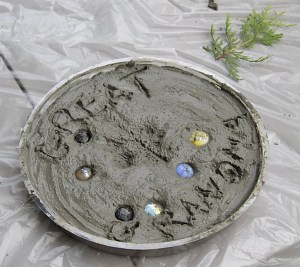
Last April we received an email from Julia “Julie” Mason, Medical Social Service and Bereavement Coordinator for Putnam County HomeCare & Hospice. Julie asked if The Quarry Farm would be open and ready for a visit from attendees of the annual Good Grief Fun Camp. The date was set for July 24, and we set about planning activities with the main event to be the creation of memorial stepping stones.

At the time of the calendar pencilling-in, we figured come rain we would be able to set up some tables on the porches of Red Fox Cabin and round up enough tents and awnings to keep the campers and their artwork dry.

It did rain for a bit, but we had no need of tents, tarps, or other such leak-worthy devices. Instead we had a roof over our heads, the warm red roof of the beautiful new Seitz Family Pavilion, so christened in honor of the clever, generous relatives that devised and constructed it on the site of the former compass garden (see http://thequarryfarm.com/2012/06/14/an-eighth-direction/.)

Just before the gable ends were finished

In fact, the construction crew finished the west gable end just half an hour before the Good Grief Fun Camp bus pulled up in front of the gardens. In honor of their being the very first visitors to use the new shelter house, the 28 kids plus their adult counselors were presented with gold medal sticker badges emlazoned with #1.

Inspecting a false map turtle

The campers learned about aquatic ecology and the life that populates and cycles through Cranberry Run as it passes through the nature preserve. They toured Red Fox Cabin and heard of its 1853 construction in West Virginia and its transport to Ohio in the 1990s. Since the cabin is too small to comfortably fit a tour group of 28+, some stepped out to meet Buddy.

Camp counselors and Quarry Farmers put their backs and arms into mixing concrete so that the visitors could make their stepping stones. Leaves, berries and bright baubles and stones were used to illuminate the words that they inscribed. Lemonade and cookies were shared, the aquatic creatures were released and the big yellow bus was on its way.

So many choices

Architect Keith Seitz and his wife and partner Lois left for North Carolina this morning. His crew of brothers, sisters, nephews and nieces are off to their corners of the country as well. The sun is going under now and the chickens and geese must be put to bed so I will close this with my most heartfelt ‘thanks.’ You have opened the door, several doors, to new Quarry Farm possibilities. Rita and Martha, you take great photos. See you soon.

This slideshow requires JavaScript.