The Answer, a Bit Later Than Intended

Perhaps you recall the quiz that wrapped the January 14 post?

flooded bridgeHere’s a little quiz for you: Your eyes and nose present clues that can help you determine cause and effect. We all know that. When you study the photo above of the flooded foot bridge (click for an enlargement) you can see different kinds of plants, trees, and even water. See the stacked foam along the bridge? What does an accumulation of six inches or more of foam along a water body’s edge indicate?”

Thanks to Daryl Bridenbaugh who pointed out that the answer was not forthcoming the following day as noted in the original post, here’s the rest of the story:

A) Too many toad eggs to count

B) Everyone in the tri-county area did laundry today

C) Something smells fishy!

ANSWER: Both B and C. The foam build up on this particular day was piled up above six inches on the bridge and stream bank and did not break apart easily. It smelled musty…kind of like laundry that been left out on a rainy day. However, there was patchy foam floating in the current.

Some of this foam is caused by naturally occurring dissolved organic compounds. Foam that doesn’t build up very high and that breaks apart easily. This kind of foam sometimes smells fishy.

The day-old-wash stuff may be a different story. It can be a sign of human activity, including detergents and excess nutrients that can increase algae growth, more suspended solids and lower dissolved oxygen for the fish, insects and everything else that makes its living in the aquatic food chain.

Sometimes you don’t need a chemical test kit to get an idea what’s flowing downstream. Just use your eyes, ears and nose. If they tell you something’s fishy (and not in a good way), then it’s time to take a closer look for the source.

For more detailed reading, visit http://www.umaine.edu/WaterResearch/FieldGuide/onthewater.htm.

Another Hour On a Different Day

Seven months ago, I took an hour and wandered through the wild part of The Quarry Farm taking pictures. It was June then and the temperature beneath the green overhang of the woods was pushing 90 degrees. All manner of birds and insects were buzzing, chirping and flitting about and the sky was clear and blue.

Today was a little different.

While there was blue sky to be seen, it was through ragged patches in the cloud cover. There were birds, as well, but they moved about only as needed, making quick trips from the tall grass below our house to the feeders hanging from the cherry tree off our north deck. The temperature was in the middle teens with a wind chill of negative one.

Like I said, different.

Wild TurkeysEven so, there was a lot to see. It all started with Anne exclaiming about turkeys. The Ohio Department of Natural Resource’s Division of Wildlife released about half a dozen near here some ten years ago. Over that decade, they’ve flourished. We’ve seen flocks of more than a dozen moving through the brush below our house and on the other side of Cranberry Run. Today, there were four of them as close to the house as I’ve seen them. In all likelihood, they were eating the seed that had fallen from the feeders.

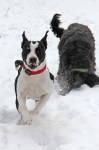
LollyLolly, an American Bulldog mix that we adopted from the Allen County Humane Society shortly before Christmas, joined me on the trek, ranging ahead of me, then back, sniffing at everything and exploring every nook and crannyTurkey's Demise that caught her eye. To the east of the quarry, she brought to my attention a former member of the flock of turkeys that had passed through our yard earlier in the day. It had been there for some time and there was no sign of the cause of its fate. There are any number of predators that could have killed the bird: foxes, hawks, eagles, raccoons, the occasional coyote or dog and, of course, us. Humans.

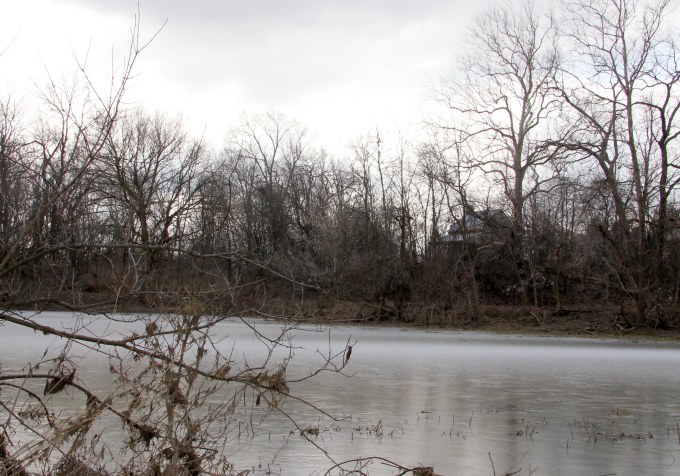
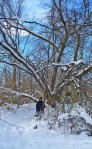
Trees in WinterThe trees that are filling in the wooded area of the property are mostly sugar maples, though there are plenty of honey locusts, walnuts, sycamores and buckeyes, as well. In the summer, their leaves shade the ground below and, at least psychologically, provide some relief from the heat. In the winter, their branches scrape at the sky, catch at the clouds and capture a weak winter sun. The visuals are stark, these dark branches against the fleeting gaps of blue where the clouds are torn apart by the wind. It’s clear why winter trees, stripped of their softening leaves, are often described as skeletal. Even so, it’s beautiful, this contrast of dark on light, darkest brown on blue.

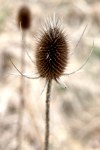
The big back field, over eleven acres of grass grown rampant and thorny brush, is brownTeasel and dry and bitterly cold. There are constant rustlings in the dead undergrowth: possibly the wanderings of mice, voles or field rats. More likely, though, these sounds are the scraping of dried plant against dried plant, pushed together by the wind. Most common in this field of brown are the spiky heads of teasel. They rise up above the dead grass in clusters of two or five or seven or more.

I’ve managed to photograph quite a bit, though possibly more interesting are the things that I’ve failed to capture. Like the pair of bald eagles that rose up out of the southern part of The Quarry Farm and looped over my head while I stood in the back field, hand in pockets against the cold, camera in its bag. By the time I got it out, the camera, they had soared the better part of a mile away to the east. Or the four white-tailed deer that Lolly scared up. All I saw of them were their flashing tails as they bounded leisurely away from Lolly’s spirited chase.

The CabinBy the time all of this has happened, the wind has found both Lolly and me. My hands and face are numb and slow to respond. Even Lolly’s had enough, leading me back to the path that will take us back to the house. I would say “home”, but we are already there. Even here, in the cold.

After all, every bit of it, every twig and branch and frozen patch of ground, is The Quarry Farm.

Buddy and Jeff

A New Year’s Celebration

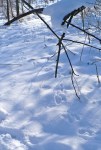
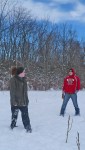
Lolly 3Although we didn’t celebrate a white Christmas on The Quarry Farm, when the snow finally did come, it failed to disappoint. In the last week we’ve received the better part of eight inches and it has transformed the area into a winter scene that would make even Currier & Ives jealous. For Lolly, a recent addition to the farm made possible by the good people at The Humane Society of Allen County, it was also her introduction to the wild part of The Quarry Farm.

We could try to paint a picture for you with words, talk about the stark contrast of the trees against the snow, the blue of the sky, Lolly’s exuberance as she bounded across the back field, but I’d inevitably fall short. So I’ll not even try. Instead, we’ll let the pictures speak for themselves.

Happy New Year, everybody.

Good Morning, All

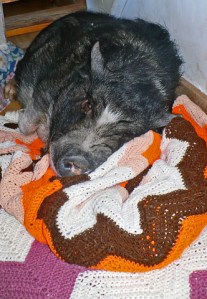
little pig

                   squEEEEEEHUNNNKK

For those of you who don’t speak this particular dialect of pig, Beatrice says, “Happy holidays!” And the same from the rest of us here on The Quarry Farm:

Laura, Anne, Rowan, Steve, Lily, Lefty, Lucky, Tonka, Lolly, Keety, Little Lady, White Cat, Theo, Oscar, Birdy, Ceddy, Pudge, Nina, Dragon, Gertie, Beatrice, Buddy, S’more, Marsh, Ralph, Bernie, Jeff, Barbara, Karen, Big Girl, Priscilla (all ten of them), Johnny, Andi, GiGi, Louise, Henry, Blackie, Jo, The Opossum and the spirits of friends past, present and future.

So. Routines.

Routines. We’re governed by them. The side of the bed we sleep on, the way we rise in the morning, break our fast, brush our teeth, the routes we take to work, slog through the day, reverse the route to work back home, eat our meals, play our games, relax, watch television, listen to music, then climb back into bed. Routines are comfortable. Routines are safe.

But they tend to engender complacency.

And then, all hell breaks loose.

BuddyHere’s a tidbit of information you may or may not know about The Quarry Farm: we practice a pretty rigid little bit of gender segregation where the outside farm animals are concerned. The girls, mostly the hens, live in their coop and are allowed free range of the property, at least the domesticated part of the property. The boys (and by “the boys” I mean Buddy, the miniature donkey, Marsh and S’more, the Nigerian dwarf goats, and Jeff, Ralph and Bernie, three production red roosters) live in a fenced-in paddock on the north side of the property. We keep them contained because Buddy, Marsh and S’more are always up for a short road trip (something the neighbors don’t always appreciate) and because the roosters are, well, roosters. Not only are their affections not always welcomed by the hens, they tend to get a little protective, a little aggressive toward anyone who gets near “their” girls. So there’s a fence. Think of it as a very large, communal chastity belt.

So. Routines.

In the evenings, as the sun begins to set, we work the property: the hens are enticed back to the coop, the duck and the geese are, likewise, encouraged into their shelters and the boys get a little more food, just a little bit of something to tide them over until morning. Yesterday, as we started our evening routine, Marsh and S’more were outside the paddock, roaming the property. While not the ideal situation and not how every day plays out, it’s not unusual for them to go over the wire. We’ve seen it before and we’ll see it again and there’s a routine for dealing with this, as well. Rather than tend to the chickens before visiting the paddock, the boys get their evening snack first. After all, the girls won’t go in with Marsh and S’more leaping in and out of their coop so we have to lure the boys back to the paddock. We trundle out a flake or two of hay and the boys trot along with us, occasionally rearing up and butting heads and practicing all of the other endearing behaviors that make goats such interesting animals.

GoatsEverything was going along according to routine: we had the hay and the goats had gamboled along with us back to the paddock and had run on in when the gate was opened. We carried the hay in, spread it out in their shelter and stepped back. Typically, Buddy will wade in at this point and control the feedlot. Typically. And here’s where complacency leaps up and bites: when you add a vowel and the typicalbecomes atypical. Because Buddy’s behavior is so uniform, so predictable, we’re sometimes careless about the gate. So, even as the goats were jumping to their meal, Buddy bee-lined over, pushed on by and out the open gate behind us.

Understand this: Buddy on the loose is a joy to behold and the epitome of frustration. He will trot by within hand’s reach, head high, ears back and then stop to crop grass, waiting until you’re certain he’s going to let you catch him up before taking to his hooves and trotting just out of reach. Watching him, you’ll swear he’s laughing as he passes by, nudging you in the process. And he can do this for hours, leading you on a merry chase across the property and beyond.

Last night, thankfully, it was a short romp.

With Buddy back in the paddock, we were back to routine: making sure the chickens were safe in their coop. There are thirteen hens: Karen, a Production Red; Barbara, a Black Australorp; Big Girl, an Ameraucana; and the ten remaining Priscillas, all of them Hubbard Golden Comets and the first chickens to come to The Quarry Farm. As part of the routine, we count them each night. Thirteen girls in the coop mean that none are at risk from any of a number of predators looking for an easy meal. Thirteen, for us, is a lucky number.

So we counted.

And came up with fourteen.
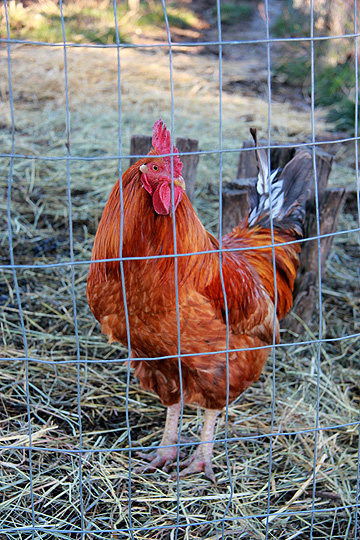
JeffDuring our episode with Buddy, Jeff made good his escape and slipped in with the girls. He’s done it before and we’ve even allowed him to stay in the coop for a night or two. But, as noted earlier, roosters get a bit possessive and protective of the hens they consider their own. So we decided to catch him up and take him back to his enforced celibacy. Jeff’s a docile bird, so getting him in hand wasn’t terribly difficult. Then it was simply a short walk and a quick drop over the fence. Done and done, right?

Not exactly.

As it turns out, Jeff wasn’t the only rooster interested in busting out. As we approached the paddock, Jeff in hand, we noticed Bernie scratching in the tall grass on the wrong side of the fence. Bernie, too, is a fairly docile bird, so long as there are no hens to battle over and you’re not wearing red. Having said that, he’s a bit less inclined to permit any kind of truly close contact than is Jeff. In other words, he’d greatly prefer it if you kept your hands to yourself and he’ll do whatever it is that he needs to do to keep it that way. For a third party, watching someone chase a chicken is slapstick the equal of anything that Hollywood has ever conjured up. For the one doing the chasing, though…well, that’s a completely different set of experiences. Chickens duck and jive as they run, juking this way and that in a series of quick dashes intended to confuse whatever predator happens to be chasing them. Couple that with the gathering dark and it took a good long while before Bernie was back with the boys.

As is the routine, here on The Quarry Farm.

POSTSCRIPT: Some of you may remember the storm that blew through the region this past summer. Last July, a derecho tore this county apart. While the damage inflicted on our little piece of the county paled in comparison to others, we did suffer one significant loss: Little Chicken.
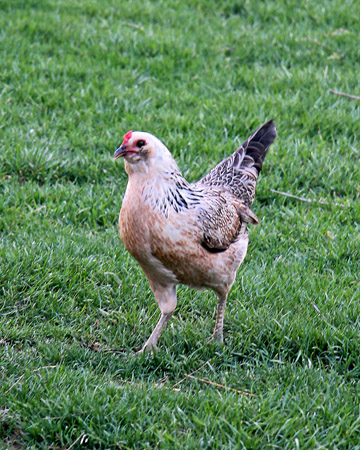
little chickenLittle Chicken was a bantam hen that split her time between The Quarry Farm and a little-used outbuilding on the property immediately adjacent to ours. She would come most frequently in the mornings and evenings, those times when we put out fresh food and water for the chickens that live here full time. The derecho caused significant injury to her nesting spot, the barn next door, and, after she failed to show up for over a week, we assumed her either an immediate casualty of the storm or easy pickings for some predator.

Last Sunday, we learned differently.

It turns out that Little Chicken, pushed out by the storm, wound up at the home of an acquaintance that lives about a mile away. Whether blown there or because she wandered there seeking new and more appropriate sleeping arrangements, we’ll never know. What we do know is that she’s found a wonderful new home, a home where she’s watched over and cared for.

So, apparently, the old adage is true: it’s an ill wind that doesn’t blow some good. And for the Siefkers, that good took the shape of Little Chicken.

They call her Clucks.

Signs of Winter Future

Over the past few weeks, we’ve noticed a number of tells that winter is on its way: the goats, Marsh and S’More, have grown rounder and hairier, as has Buddy, the miniature donkey; the gourd vines have died back to a leathery brown, seeming to leave their fruit abandoned randomly in the garden and surrounding grass; the turkey vultures have fled as have most of the songbirds; and for the squirrels and raccoons, play has become a thing of the past, replaced with a mad dash scramble to gather in as much food as possible. Cold is coming, and with it, the potential for trouble.

This means that we, as the mammals responsible for The Quarry Farm, have to follow the example of our squirrel and raccoon cousins.

This time of year excites a flurry of activity. The gardens, vegetable and floral, have to be put to bed and blanketed with the compost so generously donated by the chickens and Buddy. The various coops – chicken and duck and goose – have to be thoroughly mucked out and inspected for any little space that might allow raccoon or rat or weasel an entryway and thereby a free meal. It’s time, also, to go through the paddock and tease loose any pads of hay or straw that may have collected. While we’re all about fostering wildlife, we’d rather not provide nesting under the feet of Buddy and the boys. Not to worry, though. Those same tufts of straw are simply going over the fence into the tall grass, a little extra insulation for the voles and field mice.

In the old chicken coop, a building donated to The Quarry Farm by Mary K. Mack over ten years ago, we’ve stacked bales of hay and straw. In sealed buckets are cubes of alfalfa: not our first choice for the goats (alfalfa can contribute to bladder stones), but a good emergency food source, nonetheless.

It’s our understanding that this winter may well resemble the last. That is, warm for the season. Even so, there’s no harm in a little preventive maintenance, in preparing for the worst.

Just ask the squirrels. They’ll tell you.

Talking Turkey

Five wild turkeys ambled through our yard today, not two hundred feet from our home. We frequently hear them in the morning back on the quarry and occasionally see them in the evening, well behind our house, roosting in the cottonwood and walnut trees. They’ve never come this close before, though, and even though I know that they’re simply wandering to and from the soy bean fields across the road and so are likely to pass close by either here or Red Fox Cabin, it still caused me a bit of concern. I worried that they were becoming less wary, less concerned about our presence and, by association, the presence of other people, as well. I worried about the upcoming turkey season and how they’d prove easy targets if they were comfortable around us.

I worried, that is, until I tried to get a photo.

It was Anne who first spotted them and pointed them out to me. They were walking down a path along the tree line that separates the farm part of The Quarry Farm from the nature preserve side. I grabbed my camera and headed out to where Anne had last seen them. I moved to the far side of the tree line and worked my way up the path on the other side, then down the path on our side of the trees. Then up again. Then down. You’re looking at every photo I was able to get. You see them, right? The photographs, here between the lines of black and white text? Yeah, neither do I. That’s because I couldn’t get any. I can’t say that I didn’t see them. I did, at least in bits and pieces: the glide of a blue-gray head; a bronze-feathered body slipping through brush; a quick flash of red from a wattle. But that was all I got, quick glimpses. They ran me round and round an area about the size of an American football field, always on the other side of the field and always virtually concealed in thick scrub. So, no worries about their growing comfortable with humans. And no photos, either, not of turkeys anyway. But, since a picture paints a thousand words, here’s a shot from the winter before last.

It is autumn, though, and there are plenty of other animals moving about. In the back field, a leopard frog boasted better than average camouflage. If it hadn’t jumped, I never would have seen it. In the woods, the last of summer’s dragonflies are torpid with the cold, allowing for some pretty extreme close-ups. Closer to home, in the crabapple tree some thirty feet from our front door, a wheel bug traveled leaf to leaf, hunting an increasingly rare meal.

This slideshow requires JavaScript.

Looking for White Cat

We’ve been busy here. You’ve been busy there, wherever your ‘there’ may be. So much going on that, like me, you are in danger of missing the gold-tinged greens and amethysts of ebbing August, at least as it is here on the Quarry Farm.

I did almost miss it. We have caught a smattering of the sunsets, the kind that include that frosted-animal-cookie pink. But any noticing has been as we walked past a window or distributed hay to Buddy, Marsh and S’more or put the hens to bed. Then one of us left a door unhinged enough that Beatrice opened the front door and let the cat out.

Although we do have several cats, it was White Cat that slipped out. White Cat is deaf as are many white male cats. While there are plenty of dashing, flying and sparkly sorts of things in the outside to entertain a house cat, there are even more along Cranberry Run and in a 50-acre woods that will feast on feline. One that can’t hear a predator approach is especially vulnerable. So we looked high and low for White Cat. And as we did, we caught late summer.

Wild plums ripen

The wild plums are ripening on the nature preserve. Some hang at eye level beside the rich yellow Jerusalem artichokes and purple ironweed on the stream bank. Most plums are rose gold, but some are beginning to flush to mauve. For the first time, Steve will be able to make wild plum preserves to sell at the Quarry Farm table at the Farmer’s Market. (Warning: shameless plug for funding ahead.) Reserve your jar now through the Gift Shop!

Jewelweed, nature’s cure for the maddening itch imposed by poison ivy, is in bloom in the floodplain. The algae growth that plagues Cranberry Run, as well as most of Northwest Ohio’s waterways, is camouflaged by shimmers of sunlight that ignite the riffles. Higher up, the sun itself glows through the tired summer leaves, although the sunlight is cooling from the white hot of June and July. Better and better.

Bushel gourd on the vine

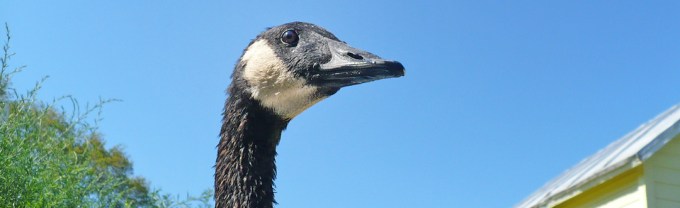
Down low, bushel gourds swell under huge vine leaves. Recent rains have brought on a good crop. The leaves have already been used this summer in a stepping stone workshop. More will be made before the vines wither in frost. The chickens and Johnny the Canada goose find this ground-level search fascinating, especially since disturbed vines yield fat, juicy crickets.

Wounded White Cat and Birdy nose

Even lower, under Buddy’s barn, White Cat is found. The roosters knew he was there; it just took the obtuse humans two days to figure it out. He has earned himself a gash under one eye and a limp, injuries probably inflicted by Buddy. Back in the house, White Cat is thoroughly sniffed before he settles himself in for a good grooming. Outside, the finches and field mice can peacefully ready themselves for the cold months. We will remember to notice.

It’s the little things (that show you care)

Here on the farm sanctuary of the Quarry Farm, you all know by now that we have chickens. Of those chickens, four are roosters. One rooster, Sid, doesn’t count because he is fancy and that keeps him docile and slow-moving. Bernie, Jeff and Ralph are birds of a different feather altogether.

These three probable Rhode Island Reds have three different origins that shall remain a mystery to us. But all three will live their lives together in the paddock with Buddy the miniature donkey and Nigerian dwarf goats S’more and Marsh. Sid has the roam of the rest of the place where he is tolerated by the hens who can easily out-manuever  him. The three other roosters have an easy truce between themselves as long as the hens keep out of the paddock. And when no one is in there with Mr. Shovel.

Unfortunately Mr. Shovel must make an appearance every morning in order to remove the donkey, goat and rooster leavings from the previous day. Bernie, the original rooster, does not care for Mr. Shovel. Nor does he particularly care for the person who is wielding Mr. Shovel.

If you have ever been spurred by a full-grown rooster, you know it results in white-hot searing pain that bleeds like nobody’s business. The kick that accompanies the spur usually leaves bruises. I myself actually suffered my first severe ankle sprain after a confrontation with Bernie. Since chicken dinner is not on the menu here on the farm sanctuary (so don’t even go there) I have learned: A) not to wear bright red around Bernie; B) keep Mr. Shovel between myself and Bernie; C) make sure Ralph is keeping an eye on Bernie.

At first Bernie was very friendly, but sometime during the course of the second year he became aggressive, mostly with me. Steven claims it is because I wore a bright red rain jacket around him. The jacket went to Goodwill, but Bernie still came after me every time my back was turned. So Bernie was banished to the paddock so he wouldn’t go after anyone else. That helped until he took a dislike to Mr. Shovel. Enter Ralph.

Ralph came to live with us about two years after Bernie did. He was adopted with a group of hens, all unwanted by an Allen County landowner. So as to give the hens here a relatively stress-free existence, we put Ralph in the paddock, too. Ralph and Bernie duked it out for a while and Ralph came out on top. Jeff joined the fray some time later the same summer. Ralph remained the dominant rooster, so much so that Bernie’s comb diminished and he became quite tame. For about a season.

This spring, Bernie again decided that I am not to be trusted and indeed am to be chucked out of the paddock at every opportunity. But Ralph doesn’t feel that way. My little red-combed savior will keep himself between Bernie and me, even driving Bernie off to the far corner of the paddock. Ralph will also break up private trysts between Jeff and a hen named Barbara, but that’s a different story.

Just a few minutes ago, Ralph came to my rescue again. After posting this, I am going to take him a slice of yellow squash.

By the way, the photo of the horned worm has nothing to do with this story. Steve took this last week as these voracious creatures were being hand-eradicated from the tomato patch at Red Fox Cabin. I just thought it was a cool shot.

A Swift Release

Sunset from The Quarry Farm.

This has been a strange year, a difficult year, in some respects. An overabundance of spring rain gave way to summer drought and a flurry of fierce storms. The storms, in particular, have proven hard on the living and arguably hardest on the birds. Strong winds shredded trees and the nests to which they offered insufficient protection. For many wildlife rehabbers in the area, the storms brought a rain of orphaned and abandoned birds. This past weekend, Natalie Miller, education and rehabilitation specialist with Nature’s Nursery, brought two of these foundlings to The Quarry Farm. The birds were chimney swifts and they are a welcome addition to the fauna here.

One of two chimney swifts brought to Red Fox Cabin for release.

Chimney swifts (http://www.chimneyswifts.org/) are insectivores. Incredibly fast flyers, hence their name, they wheel about as sunset approaches, snatching meals of flying insects. And, again as their name suggests, they nest in chimneys, such as the one at Red Fox Cabin. Finding established populations of chimney swifts is becoming increasingly difficult. Abandoned or rarely used chimneys, the kinds of places where swifts can set up house unmolested, are rare. So it was worth the hour-long trip south to release these birds here, where others of their kind can help them learn the skills they’ll need to survive.

Red Fox Cabin

We took both birds out to the cabin just about mid-evening. Although there was no immediate sign of the resident swifts, they’re a common sight here. As it turns out, we only released one of the birds (the video of that release accompanies this post; don’t blink or you’ll miss it). As the released bird swept up and over the tree line along the road, five of the Red Fox Cabin swifts flew in from over the quarry and herded the newest member of their flock away from the soy bean field and back to The Quarry Farm. As for the second swift, it still needs a little more care, a bit more time to grow, before it’s ready for release. For now, it’s in the capable hands of Rita Seitz, and probably will be for at least another week. When the time comes for it to join the others, we’ll be sure to let you know.