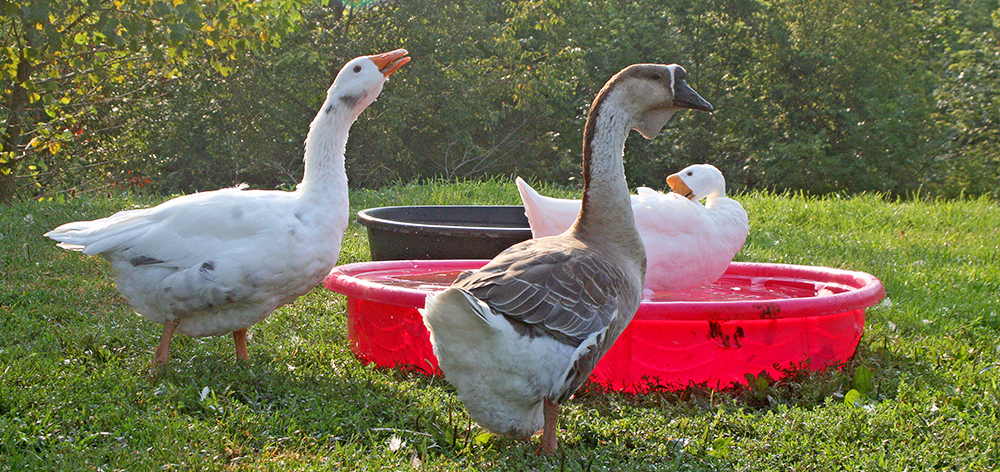
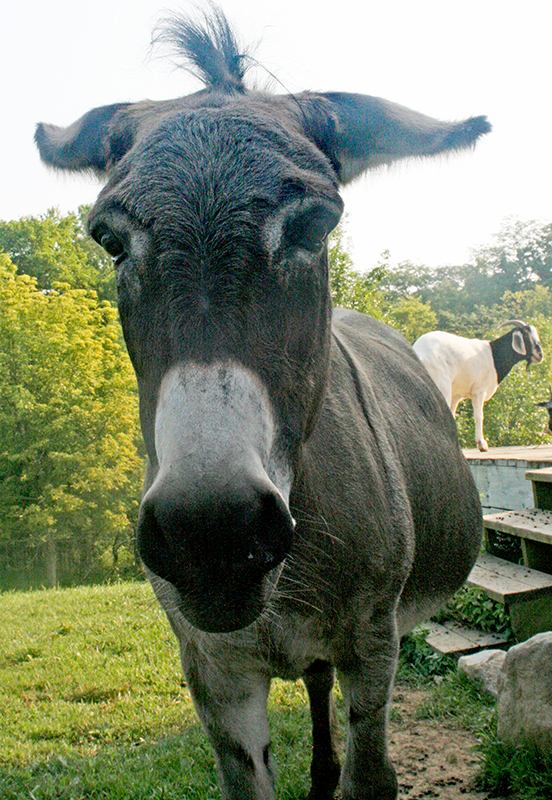
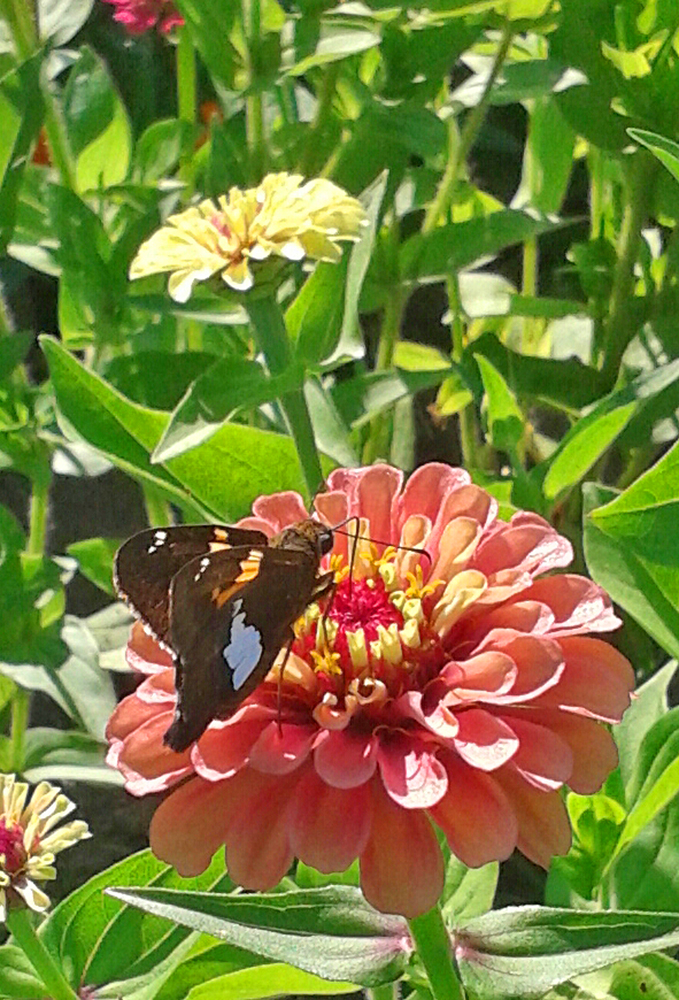
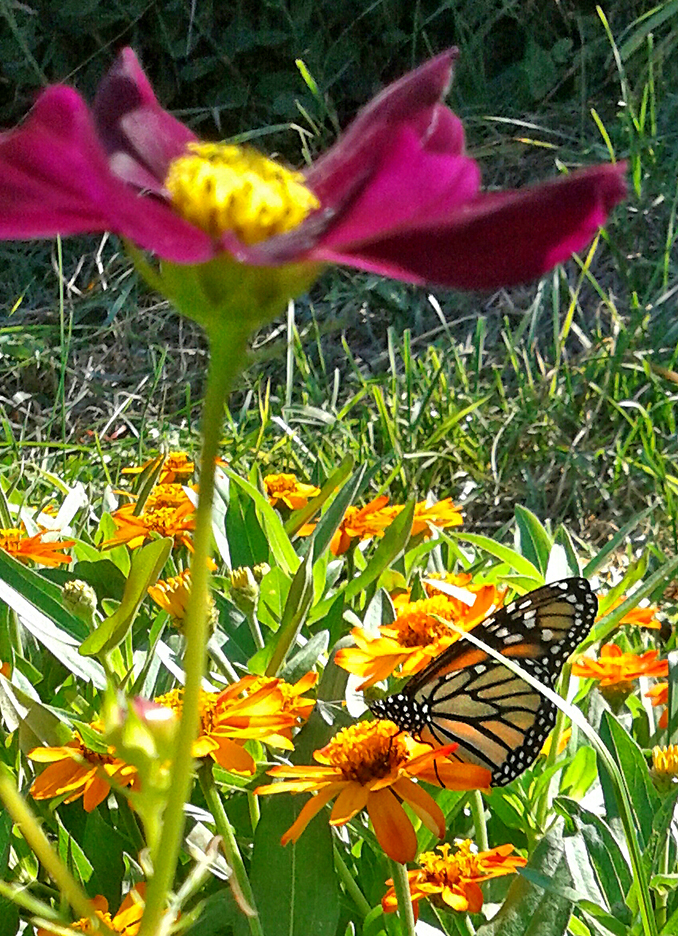
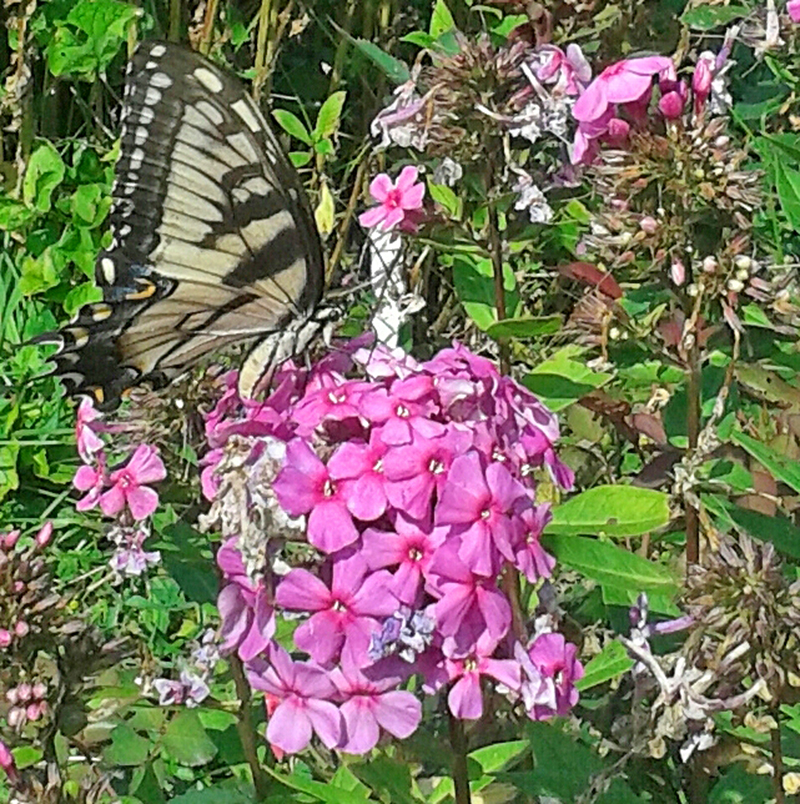
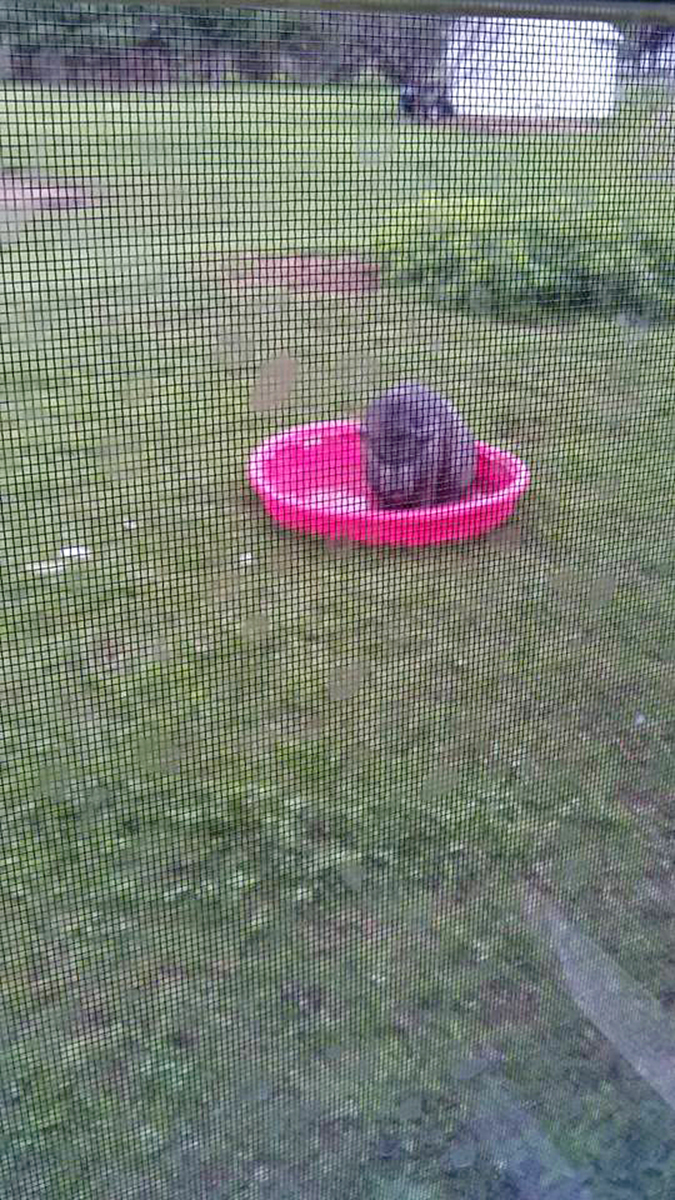
With Beatrice and Lucy watching cautiously from a distance, Carlton joyfully expressed his way through a garden house shower on a hot, humid August 17.
Creativity in the garden
The Seitz Family Pavilion resembled a construction site this morning as bags of concrete, vermiculite, and vinyl patch were piled under its roof in preparation for a make-it-take-it workshop at The Quarry Farm.
Under the tutelage of Board President Laura, the Gardening Basket Herb Society, with members from Putnam, Hancock, and Hardin counties, made a variety of containers and stepping stones for use in their gardens.

Plastic buckets and pails of concrete were stirred with great big spoons and paddles to make steppers and then decorated with everything from glass beads to shells and aquarium stone. More concrete was pressed over leaves arranged on sand mounds to create leaf bowls.
Slurries —concrete ‘gravy’ — were dabbed and poured over draped towels and other cloths to make fabric pots.
There were also marbles, glass pebbles, press letters and crockery bits with which to ornament the finished containers, if the students so chose. Unbeknownst to the group, these sparklies had been perused on Wednesday night by a couple of juvenile raccoons. I heard them chattering from next door as I was putting the chickens to bed.
I think the masked marauders were unimpressed. Although one bag of marbles was on the grass off the concrete pad, all the shiny bits were contained.
Butterflies beyond the heat islands

There is no better cure for a bad case of the Mondays than a brisk walk in the open air. If your feet take you beyond the water cooler and out of doors to a concrete sidewalk, perhaps this virtual walk in The Quarry Farm butterfly gardens will transport you beyond your August Ohio heat island.
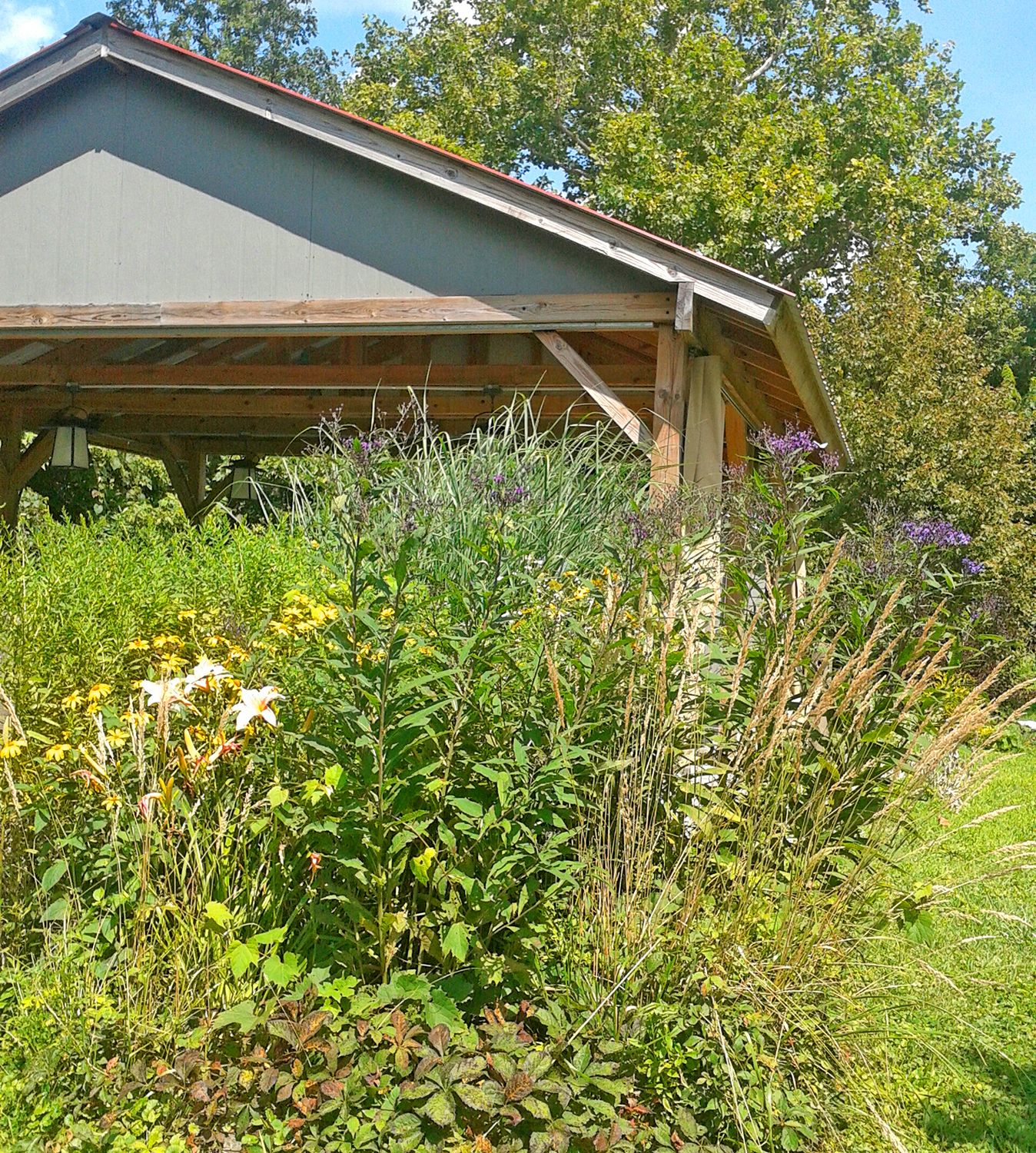
Late summer in Northwest Ohio means sweat that never dries, elephant-eye-high corn, even this year after months of heavy June and July rain, and the golden greens of mature plant leaves, the rich amethysts of ironweed and Joe Pye and the hot reds, oranges and burgundies of lilies, cosmos, Susans, zinnia and echinacea. The Gardener would likely list many more flora, but since she’s otherwise occupied in the gardens themselves, you are stuck with those plants that I can identify around the Seitz Family Pavilion.
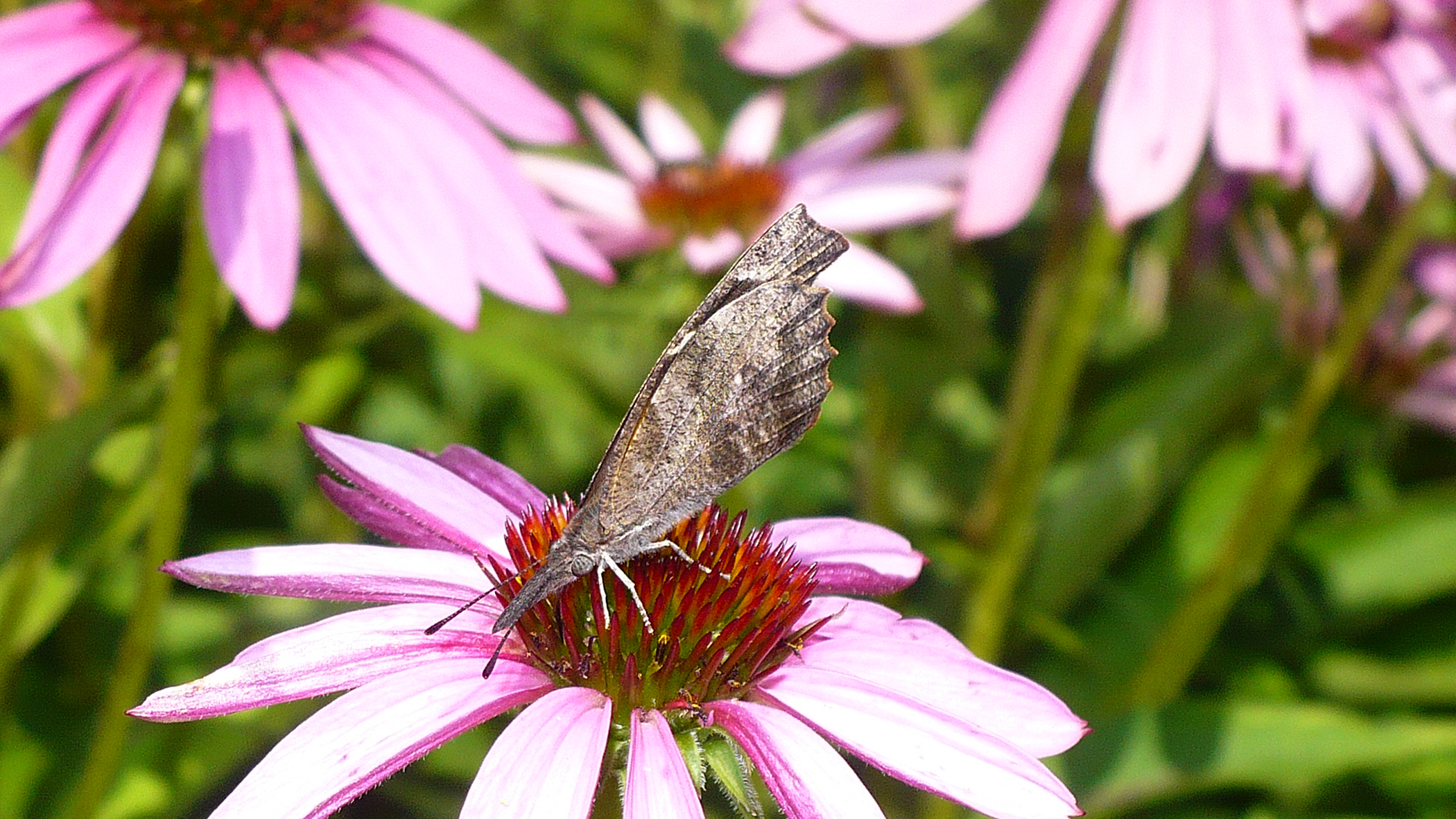
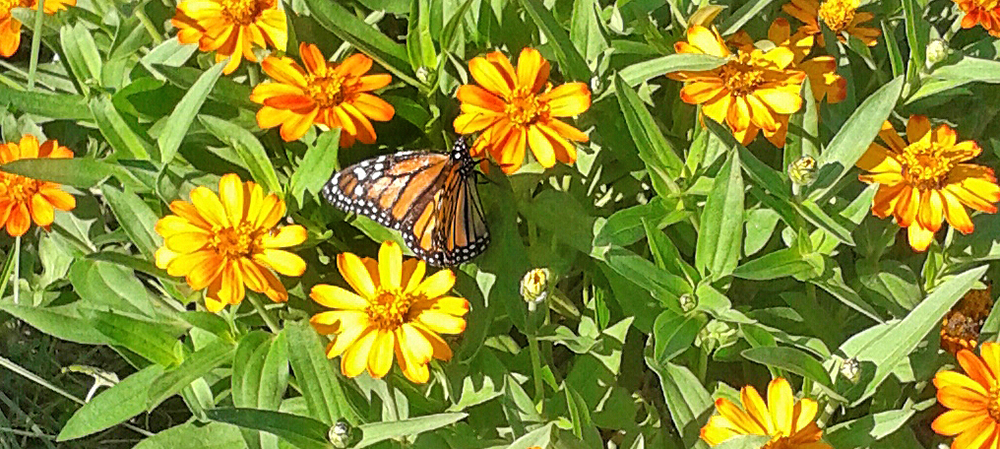
Lucky for all of us, she always carries her phone. And because she does, she took photographs of the better-late-than-never butterflies that are moving from flower to flower.
Better still, she took video. So, find a park bench or an open window and take a virtual butterfly walk in the warm August sunshine. There is breeze today to keep the virtual mosquitoes at bay.
Our first number is, “The Dance of the Tiger Swallowtails.”
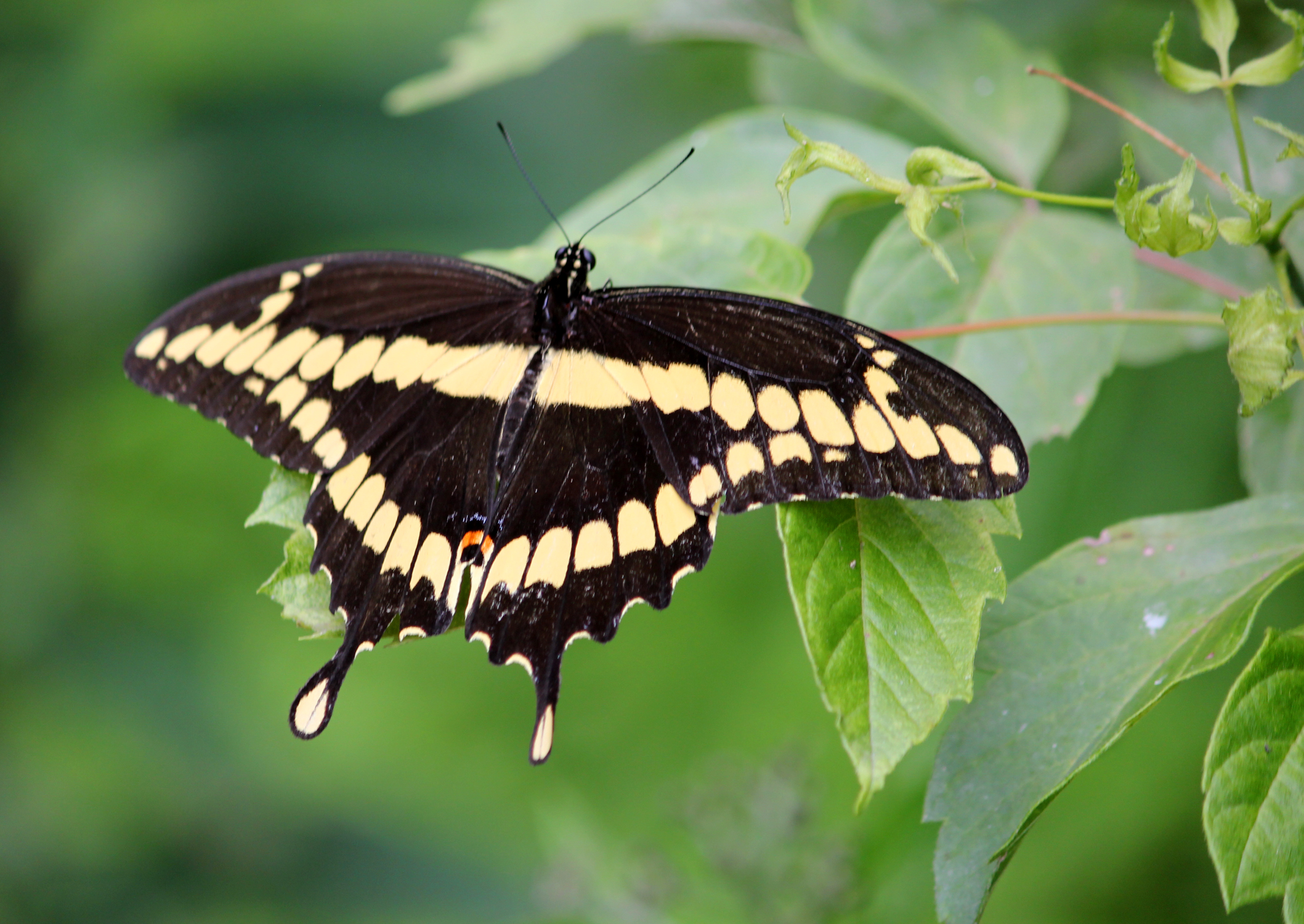
And what better image to leave you with, for today, than a giant swallowtail doing its level Lepidopteran best to pollinate every plant in the north bed?
Now go back to work, full in the knowledge that there are still butterflies in the world.
Sophie’s gate opens
That tail hasn’t stopped wagging.
Carlton goes to college and other colorful stories
We’re six days and counting with no rain. The morass is drying and the butterflies and other pollinators have landed, flitted, and flown in greater numbers than we have seen in these parts yet this year. Before summer’s end, I may need all 10 fingers to count monarch butterflies. The milkweed keeps sending out its rich fragrance. We can hope.
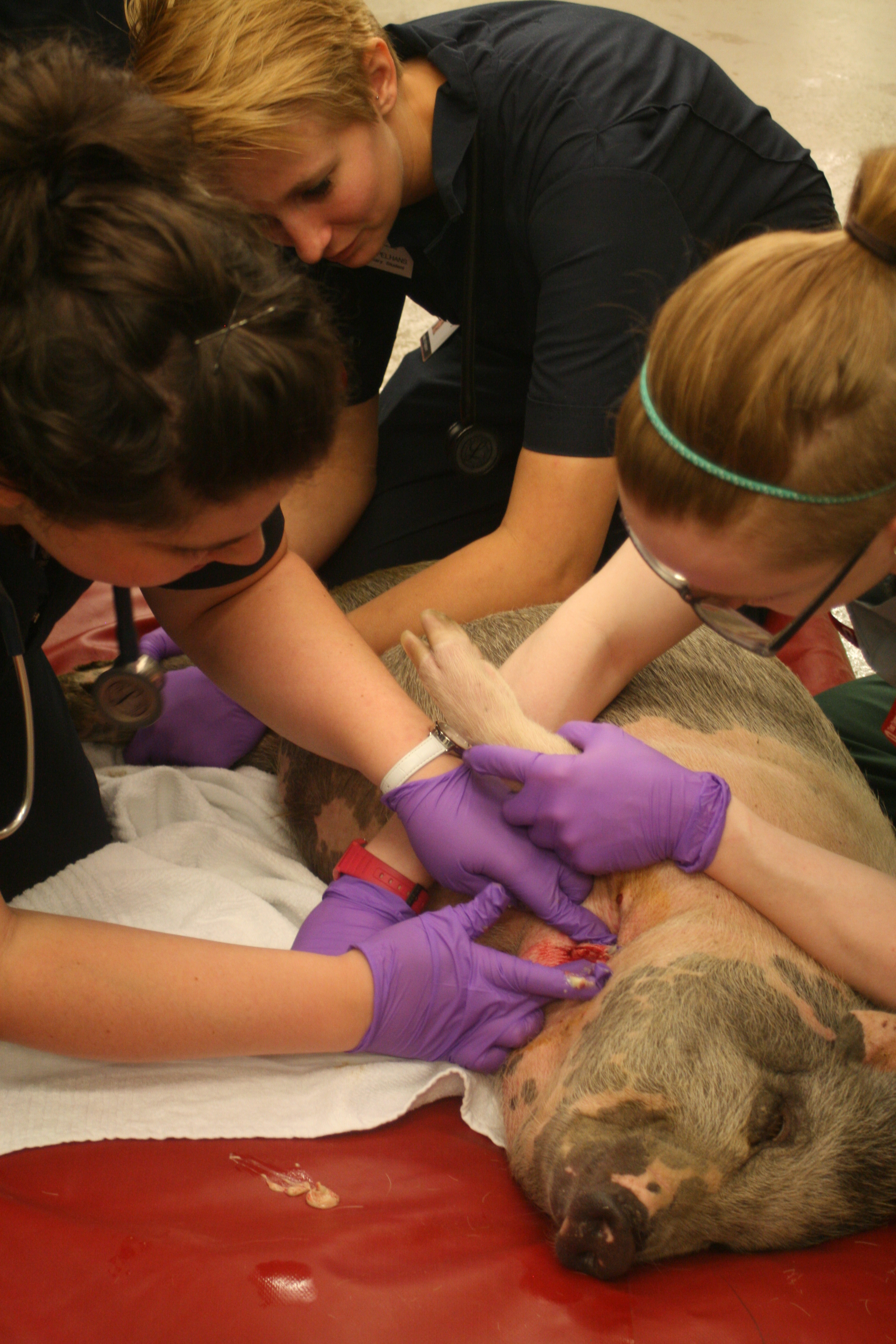
In between butterfly counts, we loaded a crated Carlton into the car and took him down to the Veterinary Medical Center at Ohio State University. What started out as a solid mass that wrapped under his right foreleg had settled into three abscesses. Fearing a pernicious parasite, we made the trip that
we’ve made twice now with Marsh the Nigerian dwarf goat.
I love that place — if not the reason for going, but for the experience. The veterinary students and faculty and are curious, kind and thorough. On Thursday, with a dozen or so students gathered around, Erin “won” the opportunity to lance the most problematic abscess. It was truly spectacular, so productive as to elicit a burst of, “Ah-ohhhhs!” and applause. Dr. MacKay announced, “I don’t trust anyone who doesn’t appreciate a good abscess.” That right there is a bumper sticker in the making.
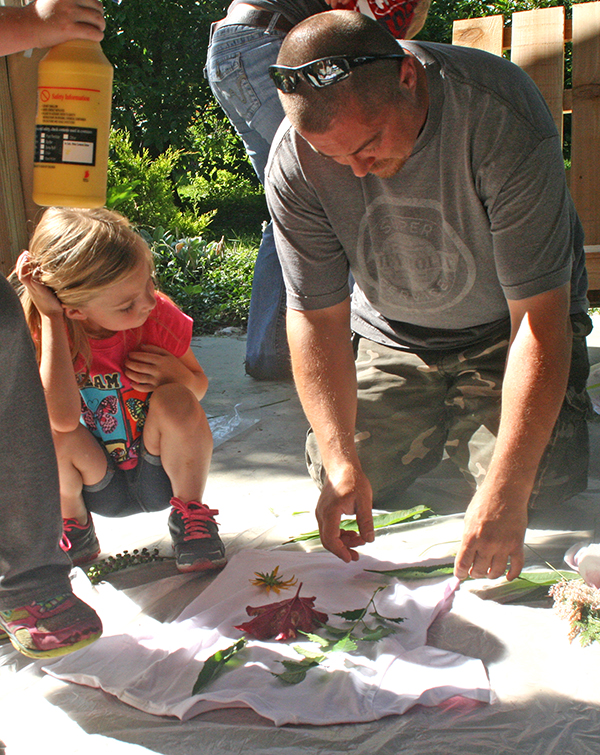
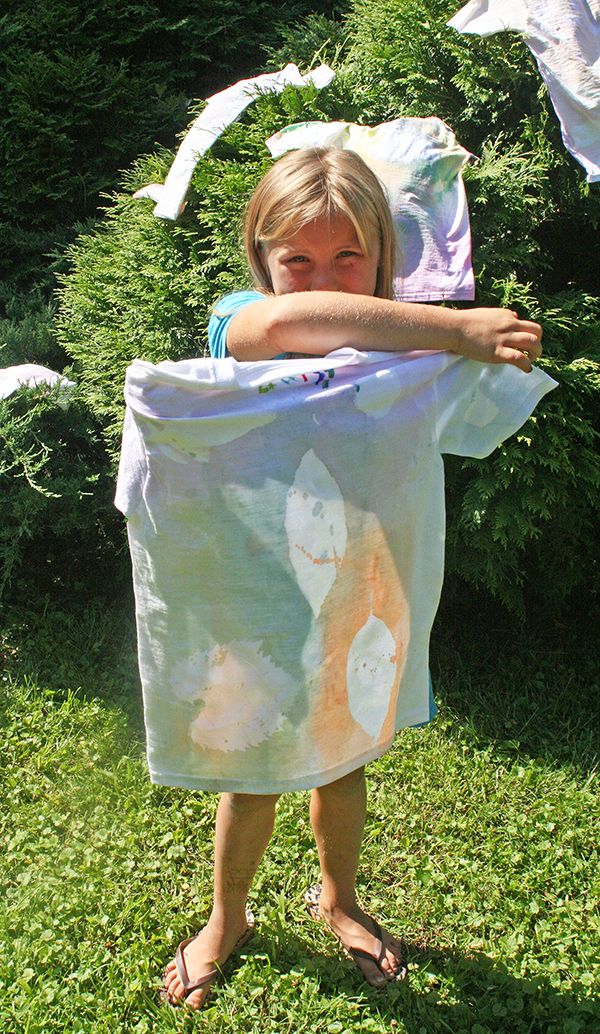
On Friday, more color, of a very different kind, arrived here on The Quarry Farm. The Continental Junior Gardeners visited for the fourth year. There were many new faces this year, although some came into focus as we realized they were the siblings of children who visited in the past. They gathered leaves and arranged them on white t-shirts, then sprayed diluted acrylic paints on the shirts to create one-of-a-kind designs. Leader Charlene Finch said they will wear them in the Continental Fall Festival parade in September. 
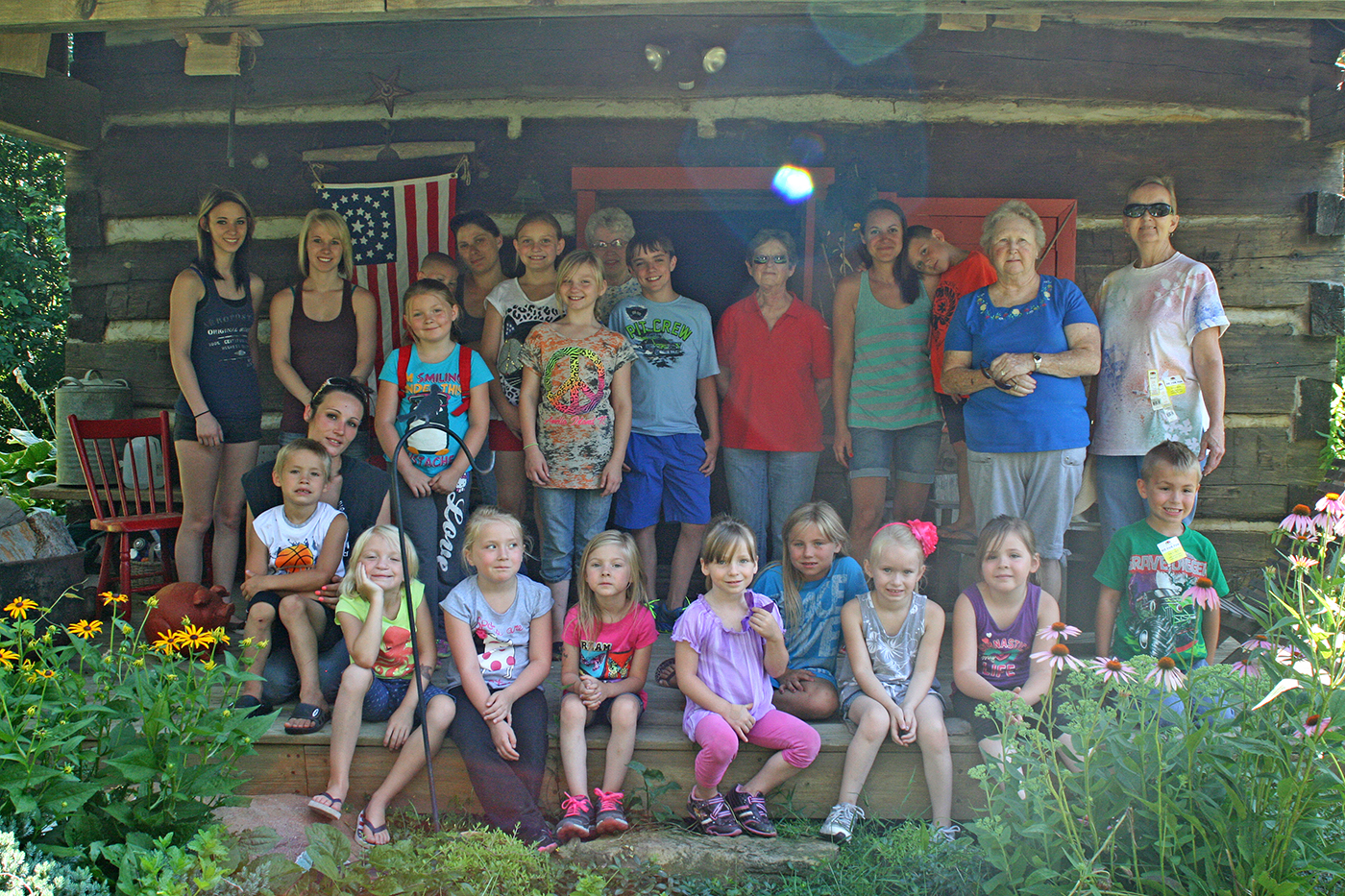
After lemonade and cookies, they walked through the butterfly gardens and visited the farm animal sanctuary. The turkeys claimed the group as their own and gentle giant goat Mr. Bill smiled for several cameras. Before they left us for another year, all but one camera-shy dad posed on the red Fox Cabin front porch for their annual portrait.
The sun continues to shine today. Damselflies and dragonflies are on the move, lessening the hum of mosquitoes bred in the recent floods. With paint left in the spray bottles, I think a few more t-shirts will be made this afternoon. Pick up a t-shirt of your own and come on by around 3 p.m.
Can’t promise there will be any cookies left, but there are butterflies and a much happier pig next door.
A long week with not enough time
Beginning with an 11 a.m. appointment with a room full of children and a few adults at the main branch in Ottawa, we visited every Putnam County District Library location in the county. In this case, “we” is not a royal “we” but rather two humans, a middle-aged Virginia opossum and a bucket of freshwater macroinvertebrates.
Two weeks ago, we drove an hour east to Honey Creek, a Seneca County tributary to the Sandusky River. Our mission was to collect hellgramites, the impressive predatory aquatic larva of the terrestrial and flighted dobsonfly. By all rights, or if all was right with the world, we should have been able to find them in Cranberry Run as it passes through The Quarry. Underneath all the silt of the stream and Riley Creek into which it flows — even the bigger Blanchard at the end of the Riley — there is a river bottom of cobbles and boulders, prime habitat for hellgrammites. But there’s that silt, smothering everything.
Like I said, we drove to Honey Creek in between heavy rains and flood events and did net a few dobsonfly larva as well as two large dragonfly “babies”: a spidery skimmer and a froglike darner. Here at home, we collected leeches, snails, and half of a freshwater clam shell, its mother-of-pearl lining worn smooth. We set up an aquarium for their stay.
Each weekday morning, Captain John Smith was loaded into a carrier and as many macros as we could fish out of the aquarium were placed in a bucket for transport. No dragonflies made the bucket because, a few days after their arrival in Putnam County, the hellgrammites ate them.

It was a good week. We met new people, the Captain made a favorable impression for his kind, and I got to play with leeches. One young man suggested that leeches are kind of like shape-shifters. I like that. I’m going to remember that for our next gig. Two more suggested that the Captain’s tail looks like corn on the cob. Never though about that before, and they’re right.
Today is Saturday, and we are kind of tired. It seemed like a long week, what with two speaking engagements per day on top of day jobs, slogging buckets and straw through rain and mud here on the farm and in parking lots and nursing one of the potbellies through a mysterious spate of abscesses until his appointment next week at Ohio State University Veterinary Clinic.
But I realized, after finishing Sy Montgomery’s The Good, Good Pig, that two speaking engagements per day for five days wasn’t nearly enough time to point out the importance of Virginia opossums and hellgrammites in our human lives. You need a lifetime of appreciation.
Nor is it enough time to admire the intricate, delicate patterns that trace the exoskeletons, especially across the backs of their heads. One glance in a bucket at the boneless athleticism of a swimming leech is just not enough, not enough for anyone.
We hope it was at least enough to leave everyone wanting to learn more. As Ms. Montgomery noted in her book, maybe a one-off was enough to lead some to a new way of thinking.
Burdock, concrete, and brown butter icing (not all in the same bowl)
Thursday, it rained. Friday, it rained. Saturday, it didn’t rain.
At 10 a.m. on July 11, the clouds were scarce enough that some blue shown through, a good thing for many reasons not the least of which was that 10 people were involved in the annual leaf-making workshop in the Seitz Family Pavilion.
Because they are large with strong vein definition, burdock leaves are nurtured prior to each summer leaf casting. Two buckets held the giant cut leaves. After play sand was mounded to the shape desired by each leaf maker, the sand mold was covered with plastic cling wrap. The selected leaf topped that and concrete was layered on. Some added river stone or beach glass.
Although everyone walks away from these events with a lasting leaf with which to feed and/or water birds and other wildlife, to use as a garden stepper or to display on a coffee table, we on The Quarry Farm love watching the creative process. And on Saturday, we were the grateful recipients of apples and huge bags of peanuts for the farm animal sanctuary residents, as well as a generous check from the Putnam County Master Gardeners.
We won’t see the final leaves for a week or so, since the rain picked up again on Sunday and Monday to slow the drying process. But we experience the results of generous support everyday. In fact, I think everyone who shared in Saturday’s experience did as butterflies flitted in and out of the open-air classroom, damselflies and dragonflies nabbed mosquitoes and a little bullfrog sounded off in the full raingarden pond.
Oh, and here’s the recipe for those cookie bars that were on the snack table.
Frosted Butter Pecan Bars
2 cups all-purpose flour
2 pkg. (3.4 oz. each) instant butterscotch pudding mix
1/2 cup sugar
1 tsp. baking powder
1/2 tsp. salt
1 egg
1/2 cup butter, melted
1/2 cup canola oil
1/4 cup water
1 tsp. vanilla extract
1/2 cup chopped pecans
FROSTING
3 oz. cream cheese, softened
1/4 cup better, softened
1 tsp. vanilla extract
1/8 tsp. salt
3 cups confectioners’ sugar
[Optional: Use a frosting that doesn’t have to be refrigerated. I use browned butter frosting. See below.]
1. Preheat oven to 350 degrees. In a large bowl, whisk flour, pudding mix, sugar, baking powder and salt. In another bowl, whisk egg, melted butter, oil, water and vanilla until blended; stir into flour mixture. Stir in pecans. (Dough will be stiff.)
2. Press dough into a greased 13 x 9-in. baking pan. Bake 20-25 minutes or until edges begin to brown. Cool completely in pan on a wire rack.
3. In a bowl, beat cream cheese, butter vanilla and salt until blended. Gradually beat in confectioners’ sugar. Spread over top. Sprinkle with more chopped pecans, if desired.
Cut into bars before serving. Store in refrigerator.
BROWNED BUTTER FROSTING
1/4 cup butter
2 and 1/2 cups confectioners’ sugar
1 tsp. vanilla
3 tablespoons milk
1. In a small saucepan, melt butter over medium heat and cook, stirring constantly, until butter turns a caramel-brown color. Be careful not to burn. Allow to cool.
2. Combine all ingredients and beat until creamy. Add a little milk, if necessary, to reach spreading consistency.
Steamed heat

If you look very closely, in the middle and toward the top of this photo, you’ll see a Canada goose cutting a ‘v’ through a temperate rainforest river. That’s our Johnny, and her river cruise was the second in one month that she and the other three Quarry Farm geese took before the river receded into the banks of Cranberry Run, beyond the fence.
Late June and July heat baked the slick coating of flood silt to the ironweed, wild roses, sedges, and other floodplain plants. Now the hens and geese chase insects born from the ooze, at least until the latest downpour fills the lowland again. Probably will happen this evening.
Until then, here’s Carlton, cooling his jets.
And speaking of cooling off, I had one of those conversations yesterday. A colleague has a theory that canals will solve the nitrate problems which, combined with phosphate-loaded runoff, are contributing to harmful algal bloom in Ohio waterways, the Great Lakes, and pretty much everywhere else within driving distance.
“You know, the canal systems that Ohio had? That was some of the greatest engineering, and it was only just getting started when they fell into disrepair. A good series of canals could just carry those nitrates on out to the deep sea where the phytoplankton could eat them.”
Me: What?
“Yes, they drained the swamps because you couldn’t get through and those canals took the erosion away [or something like that] and canals take nitrates away. When the canals were abandoned, we started having all those nitrate issues.”
Me: (sputtering) Do you know what else used to be here, before they were cut down to make canals? Trees. Ohio was covered with trees.
“There were not. This was swamp. Trees don’t grow in that kind of soil.”
Me: I want you to read this book called The Trees by Conrad Richter. It’s part of a trilogy. The next book is called The Fields, after they cut the trees down. Then there’s The Town, which is what we have now. It’s fiction — you’ll like it.
Then there are these:
http://forestry.ohiodnr.gov/history
The scary part is that this person has a college degree.
Deep breath.
Here’s Beatrice. She makes sense.
2015 Summer Newsletter
There are three events scheduled for the next three months here on The Quarry Farm, two of which will motivate the creative side of your brain. The third will help get your sillies out while you help us clear an invasive plant to make way for native wildflowers, tree, and grasses
Click on the cover to the left for the full newsletter. And stay tuned to this site as well as “The Quarry Farm” on Facebook for more summer happenings. If the weather permits, there may be a star walk on the calendar.
Horseless carriages pony up to Red Fox
We knew they were coming. But at 9:30 a.m. when the Model Ts, Plymouths and at least one Wolseley rolled south on 7L, it was still an unexpected, thrilling sight.
Not one of the historic automobiles that were part of the 2015 National 1 & 2 Cylinder Millstream Road Oilers tour came off assembly after 1913, we were told. The 28 horseless carriages and their drivers stopped first at Diane Myers’ Black Swamp Raptor Rehab Center several miles east of here before making their way west to see Red Fox Cabin, the butterfly gardens and the residents of the farm animal sanctuary on their way to Kalida.
Because they came from the north instead of south, the drivers had to loop through the neighboring Walker family’s driveway. It was a surprise photo op for the neighbors and for us.
Because the summer is upon us, hot and heavy, Carlton and Beatrice gave a brief ‘hello’ before wagging into the undergrowth for wild raspberries and shade. But Lucy was the gracious hostess for the morning.

Because high winds aren’t due for another few hours, a zebra swallowtail, a red-spotted purple, a red admiral butterfly, two saddlebag dragonflies and a flock of pondhawks flitted and zipped through the gardens.
Safe travels, and thank you for the generous donation to help us on our way.