
That tail hasn’t stopped wagging.
Carlton goes to college and other colorful stories
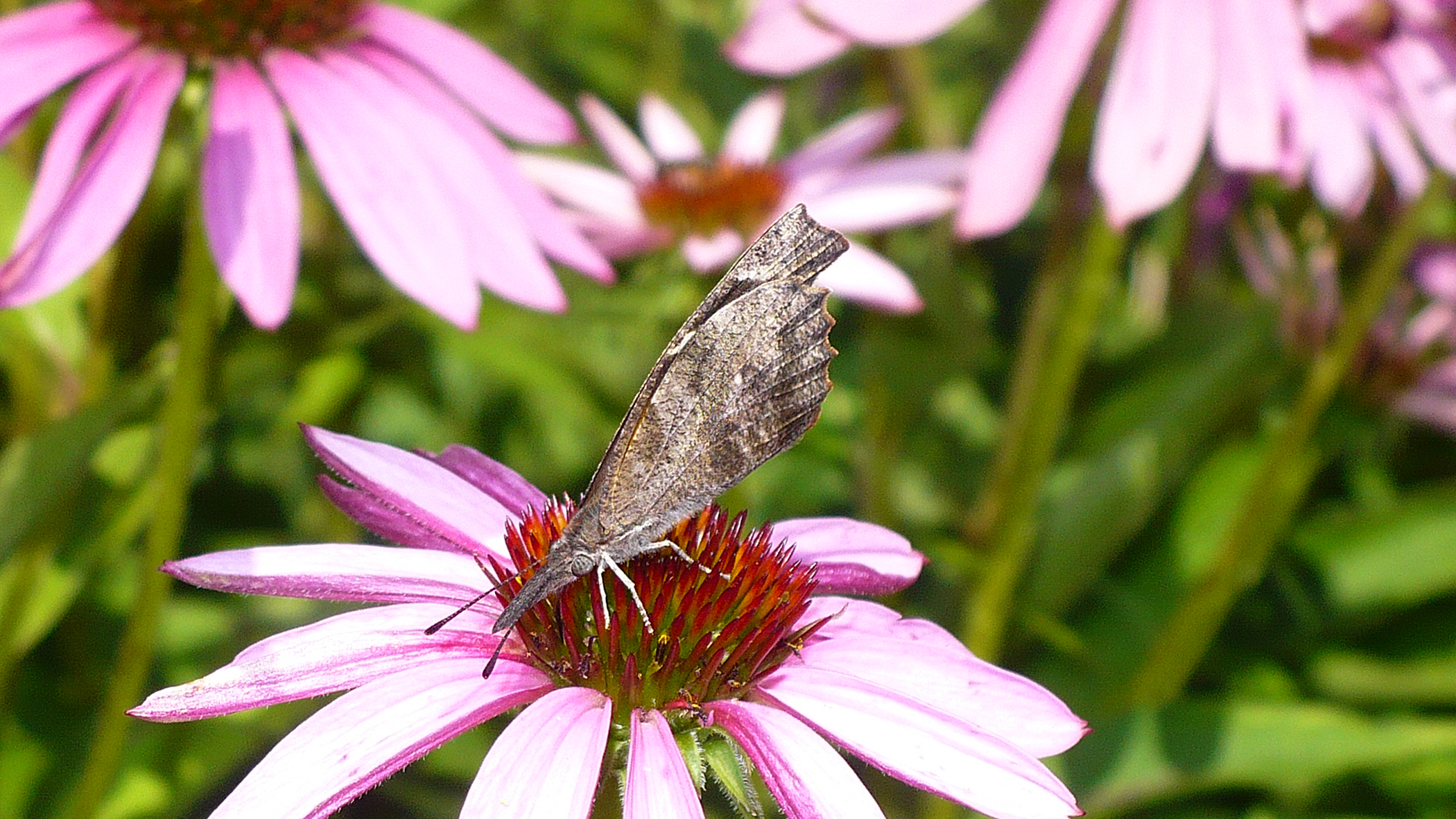 We’re six days and counting with no rain. The morass is drying and the butterflies and other pollinators have landed, flitted, and flown in greater numbers than we have seen in these parts yet this year. Before summer’s end, I may need all 10 fingers to count monarch butterflies. The milkweed keeps sending out its rich fragrance. We can hope.
In between butterfly counts, we loaded a crated Carlton into the car and took him down to the Veterinary Medical Center at Ohio State University. What started out as a solid mass that wrapped under his right foreleg had settled into three abscesses. Fearing a pernicious parasite, we made the trip that 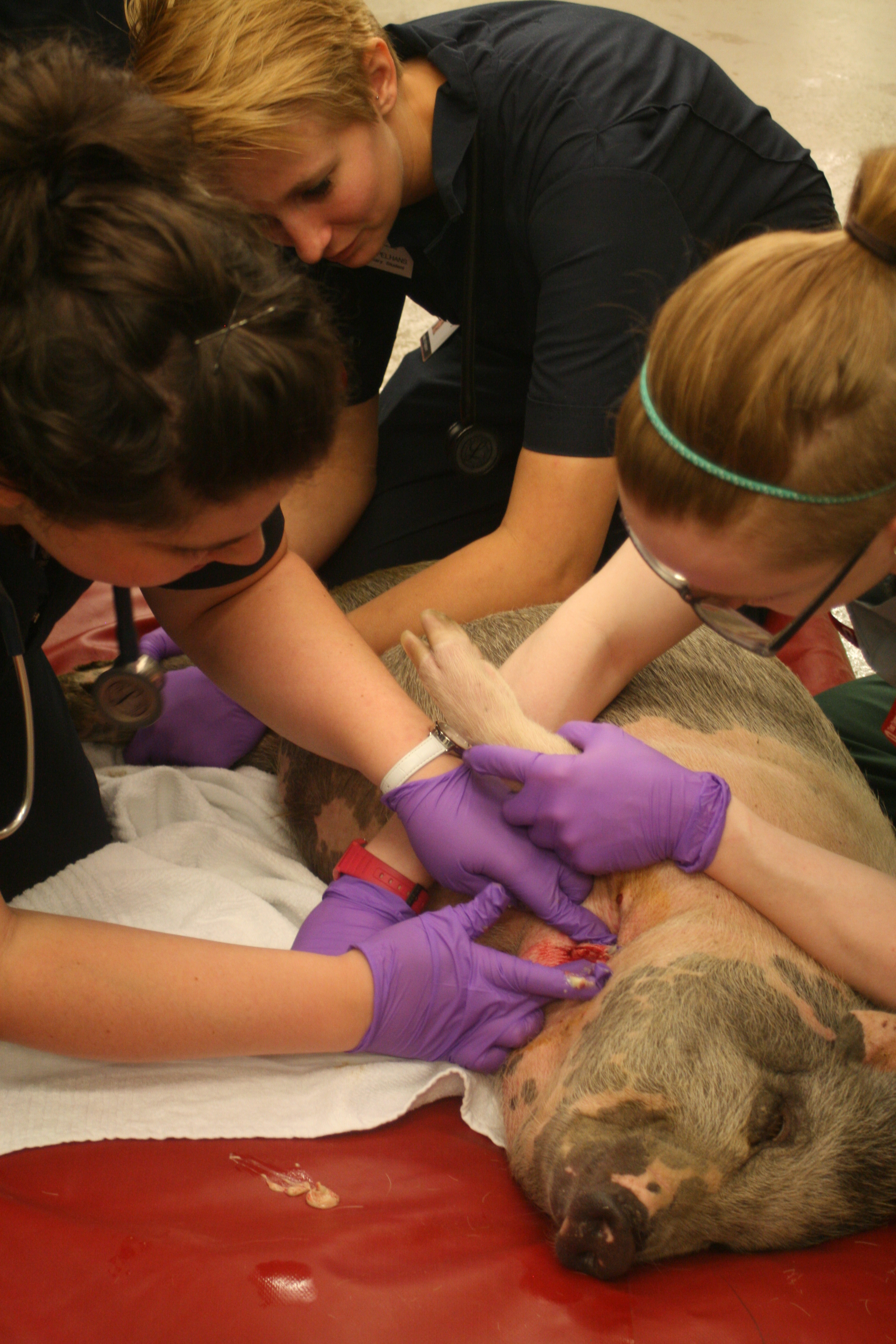 we’ve made twice now with Marsh the Nigerian dwarf goat.
I love that place — if not the reason for going, but for the experience. The veterinary students and faculty and are curious, kind and thorough. On Thursday, with a dozen or so students gathered around, Erin “won” the opportunity to lance the most problematic abscess. It was truly spectacular, so productive as to elicit a burst of, “Ah-ohhhhs!” and applause. Dr. MacKay announced, “I don’t trust anyone who doesn’t appreciate a good abscess.” That right there is a bumper sticker in the making.
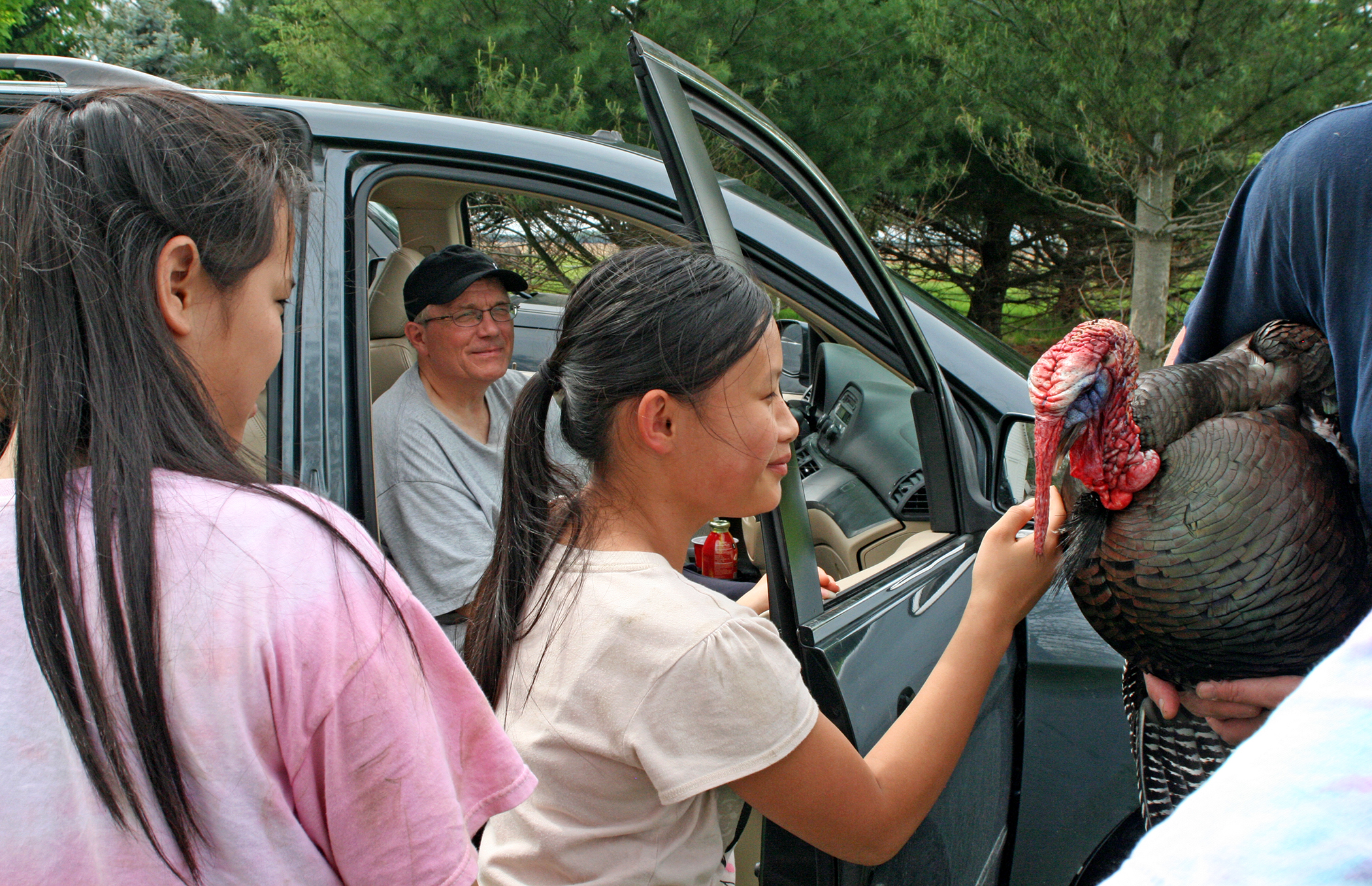
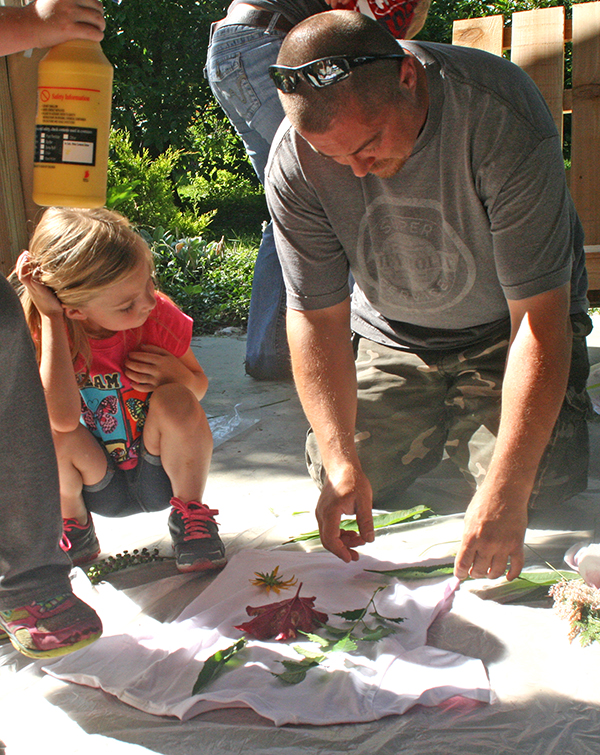 On Friday, more color, of a very different kind, arrived here on The Quarry Farm. The Continental Junior Gardeners visited for the fourth year. There were many new faces this year, although some came into focus as we realized they were the siblings of children who visited in the past. They gathered leaves and arranged them on white t-shirts, then sprayed diluted acrylic paints on the shirts to create one-of-a-kind designs. Leader Charlene Finch said they will wear them in the Continental Fall Festival parade in September.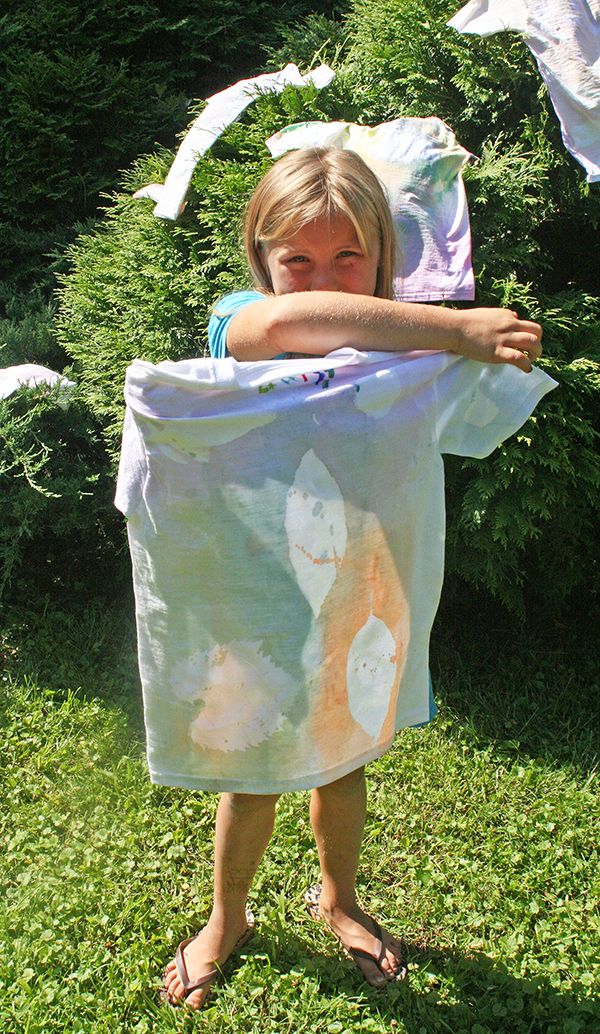
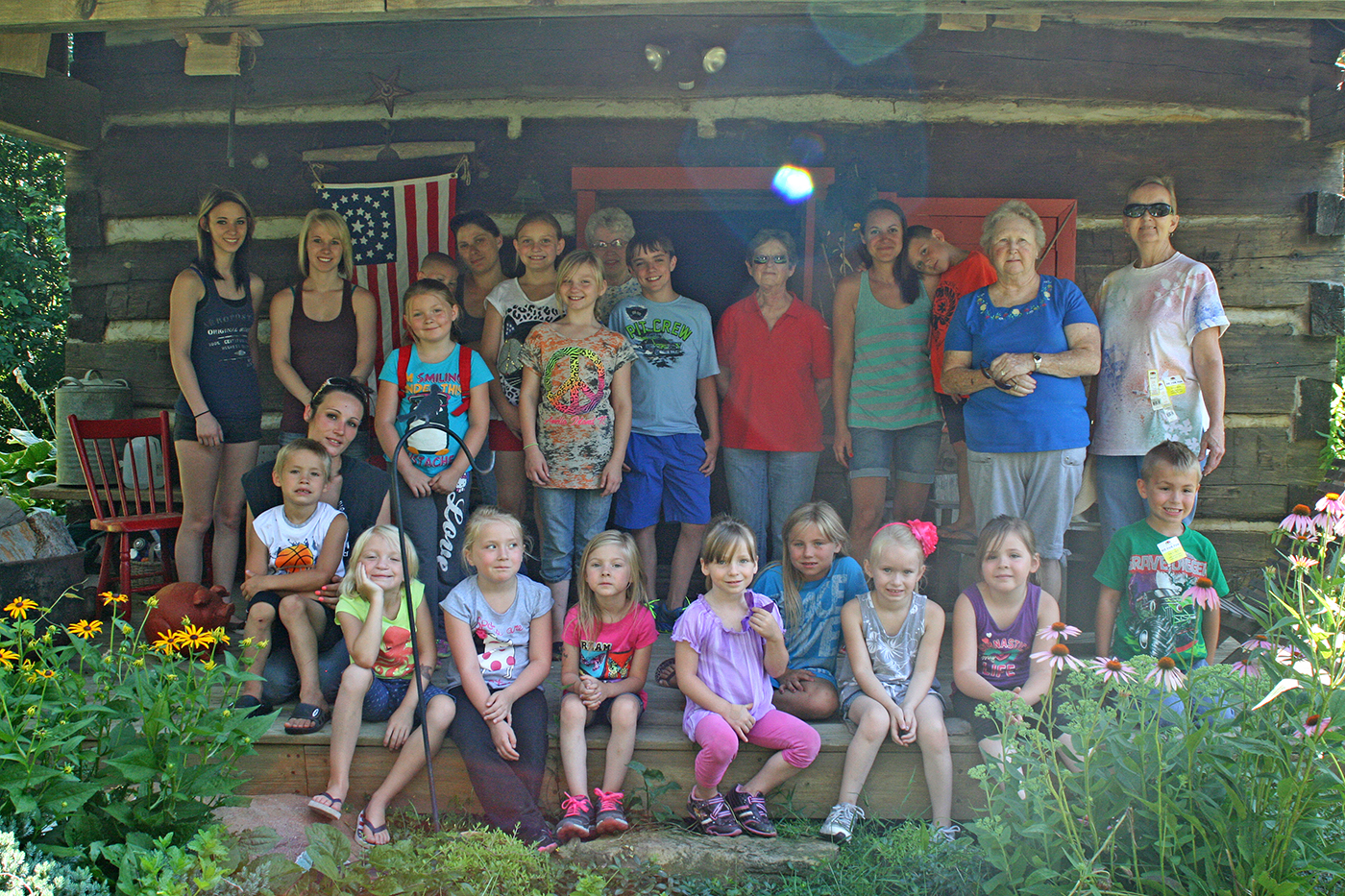
After lemonade and cookies, they walked through the butterfly gardens and visited the farm animal sanctuary. The turkeys claimed the group as their own and gentle giant goat Mr. Bill smiled for several cameras. Before they left us for another year, all but one camera-shy dad posed on the red Fox Cabin front porch for their annual portrait.
 The sun continues to shine today. Damselflies and dragonflies are on the move, lessening the hum of mosquitoes bred in the recent floods. With paint left in the spray bottles, I think a few more t-shirts will be made this afternoon. Pick up a t-shirt of your own and come on by around 3 p.m.
Can’t promise there will be any cookies left, but there are butterflies and a much happier pig next door.
A long week with not enough time
Beginning with an 11 a.m. appointment with a room full of children and a few adults at the main branch in Ottawa, we visited every Putnam County District Library location in the county. In this case, “we” is not a royal “we” but rather two humans, a middle-aged Virginia opossum and a bucket of freshwater macroinvertebrates.
Two weeks ago, we drove an hour east to Honey Creek, a Seneca County tributary to the Sandusky River. Our mission was to collect hellgramites, the impressive predatory aquatic larva of the terrestrial and flighted dobsonfly. By all rights, or if all was right with the world, we should have been able to find them in Cranberry Run as it passes through The Quarry. Underneath all the silt of the stream and Riley Creek into which it flows — even the bigger Blanchard at the end of the Riley — there is a river bottom of cobbles and boulders, prime habitat for hellgrammites. But there’s that silt, smothering everything.
Like I said, we drove to Honey Creek in between heavy rains and flood events and did net a few dobsonfly larva as well as two large dragonfly “babies”: a spidery skimmer and a froglike darner. Here at home, we collected leeches, snails, and half of a freshwater clam shell, its mother-of-pearl lining worn smooth. We set up an aquarium for their stay.
Each weekday morning, Captain John Smith was loaded into a carrier and as many macros as we could fish out of the aquarium were placed in a bucket for transport. No dragonflies made the bucket because, a few days after their arrival in Putnam County, the hellgrammites ate them.

 It was a good week. We met new people, the Captain made a favorable impression for his kind, and I got to play with leeches. One young man suggested that leeches are kind of like shape-shifters. I like that. I’m going to remember that for our next gig. Two more suggested that the Captain’s tail looks like corn on the cob. Never though about that before, and they’re right.
Today is Saturday, and we are kind of tired. It seemed like a long week, what with two speaking engagements per day on top of day jobs, slogging buckets and straw through rain and mud here on the farm and in parking lots and nursing one of the potbellies through a mysterious spate of abscesses until his appointment next week at Ohio State University Veterinary Clinic.
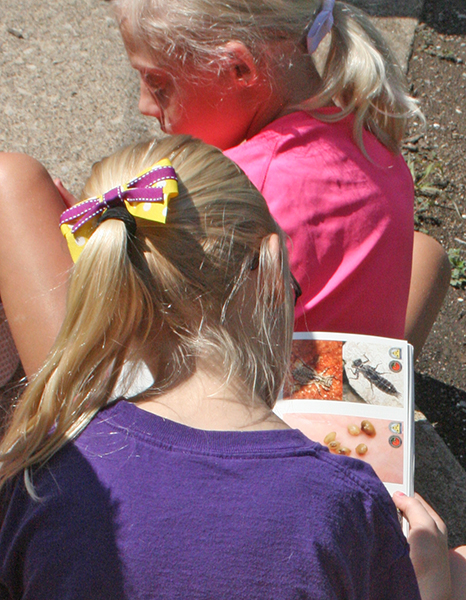 But I realized, after finishing Sy Montgomery’s The Good, Good Pig, that two speaking engagements per day for five days wasn’t nearly enough time to point out the importance of Virginia opossums and hellgrammites in our human lives. You need a lifetime of appreciation.
Nor is it enough time to admire the intricate, delicate patterns that trace the exoskeletons, especially across the backs of their heads. One glance in a bucket at the boneless athleticism of a swimming leech is just not enough, not enough for anyone.
We hope it was at least enough to leave everyone wanting to learn more. As Ms. Montgomery noted in her book, maybe a one-off was enough to lead some to a new way of thinking.
Burdock, concrete, and brown butter icing (not all in the same bowl)
Thursday, it rained. Friday, it rained. Saturday, it didn’t rain.
At 10 a.m. on July 11, the clouds were scarce enough that some blue shown through, a good thing for many reasons not the least of which was that 10 people were involved in the annual leaf-making workshop in the Seitz Family Pavilion.

Tim, Alex, Bob and Marilyn create their own leaves.

Brenda stirs concrete for her leaf.
Because they are large with strong vein definition, burdock leaves are nurtured prior to each summer leaf casting. Two buckets held the giant cut leaves. After play sand was mounded to the shape desired by each leaf maker, the sand mold was covered with plastic cling wrap. The selected leaf topped that and concrete was layered on. Some added river stone or beach glass.

Brenda and Elaine arrange burdock leaves for casting.
Although everyone walks away from these events with a lasting leaf with which to feed and/or water birds and other wildlife, to use as a garden stepper or to display on a coffee table, we on The Quarry Farm love watching the creative process. And on Saturday, we were the grateful recipients of apples and huge bags of peanuts for the farm animal sanctuary residents, as well as a generous check from the Putnam County Master Gardeners.

The Putnam County Master Gardeners present a check to Board President Laura.
We won’t see the final leaves for a week or so, since the rain picked up again on Sunday and Monday to slow the drying process. But we experience the results of generous support everyday. In fact, I think everyone who shared in Saturday’s experience did as butterflies flitted in and out of the open-air classroom, damselflies and dragonflies nabbed mosquitoes and a little bullfrog sounded off in the full raingarden pond.
Oh, and here’s the recipe for those cookie bars that were on the snack table.
Frosted Butter Pecan Bars
2 cups all-purpose flour
2 pkg. (3.4 oz. each) instant butterscotch pudding mix
1/2 cup sugar
1 tsp. baking powder
1/2 tsp. salt
1 egg
1/2 cup butter, melted
1/2 cup canola oil
1/4 cup water
1 tsp. vanilla extract
1/2 cup chopped pecans
FROSTING
3 oz. cream cheese, softened
1/4 cup better, softened
1 tsp. vanilla extract
1/8 tsp. salt
3 cups confectioners’ sugar
[Optional: Use a frosting that doesn’t have to be refrigerated. I use browned butter frosting. See below.]
1. Preheat oven to 350 degrees. In a large bowl, whisk flour, pudding mix, sugar, baking powder and salt. In another bowl, whisk egg, melted butter, oil, water and vanilla until blended; stir into flour mixture. Stir in pecans. (Dough will be stiff.)
2. Press dough into a greased 13 x 9-in. baking pan. Bake 20-25 minutes or until edges begin to brown. Cool completely in pan on a wire rack.
3. In a bowl, beat cream cheese, butter vanilla and salt until blended. Gradually beat in confectioners’ sugar. Spread over top. Sprinkle with more chopped pecans, if desired.
Cut into bars before serving. Store in refrigerator.
BROWNED BUTTER FROSTING
1/4 cup butter
2 and 1/2 cups confectioners’ sugar
1 tsp. vanilla
3 tablespoons milk
1. In a small saucepan, melt butter over medium heat and cook, stirring constantly, until butter turns a caramel-brown color. Be careful not to burn. Allow to cool.
2. Combine all ingredients and beat until creamy. Add a little milk, if necessary, to reach spreading consistency.
Steamed heat

If you look very closely, in the middle and toward the top of this photo, you’ll see a Canada goose cutting a ‘v’ through a temperate rainforest river. That’s our Johnny, and her river cruise was the second in one month that she and the other three Quarry Farm geese took before the river receded into the banks of Cranberry Run, beyond the fence.
Late June and July heat baked the slick coating of flood silt to the ironweed, wild roses, sedges, and other floodplain plants. Now the hens and geese chase insects born from the ooze, at least until the latest downpour fills the lowland again. Probably will happen this evening.
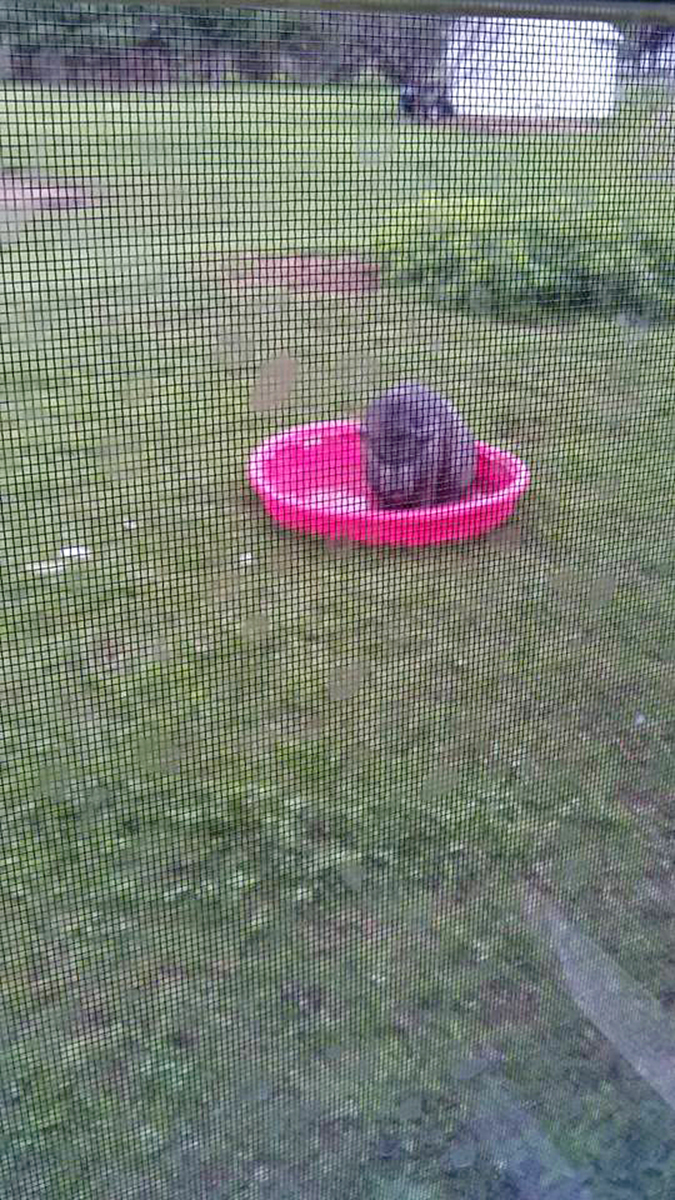
Until then, here’s Carlton, cooling his jets.

And speaking of cooling off, I had one of those conversations yesterday. A colleague has a theory that canals will solve the nitrate problems which, combined with phosphate-loaded runoff, are contributing to harmful algal bloom in Ohio waterways, the Great Lakes, and pretty much everywhere else within driving distance.
“You know, the canal systems that Ohio had? That was some of the greatest engineering, and it was only just getting started when they fell into disrepair. A good series of canals could just carry those nitrates on out to the deep sea where the phytoplankton could eat them.”
Me: What?
“Yes, they drained the swamps because you couldn’t get through and those canals took the erosion away [or something like that] and canals take nitrates away. When the canals were abandoned, we started having all those nitrate issues.”
Me: (sputtering) Do you know what else used to be here, before they were cut down to make canals? Trees. Ohio was covered with trees.
“There were not. This was swamp. Trees don’t grow in that kind of soil.”
Me: I want you to read this book called The Trees by Conrad Richter. It’s part of a trilogy. The next book is called The Fields, after they cut the trees down. Then there’s The Town, which is what we have now. It’s fiction — you’ll like it.
Then there are these:
http://forestry.ohiodnr.gov/history
 The scary part is that this person has a college degree.
Deep breath.
Here’s Beatrice. She makes sense.
2015 Summer Newsletter
 There are three events scheduled for the next three months here on The Quarry Farm, two of which will motivate the creative side of your brain. The third will help get your sillies out while you help us clear an invasive plant to make way for native wildflowers, tree, and grasses
Click on the cover to the left for the full newsletter. And stay tuned to this site as well as “The Quarry Farm” on Facebook for more summer happenings. If the weather permits, there may be a star walk on the calendar.
Horseless carriages pony up to Red Fox
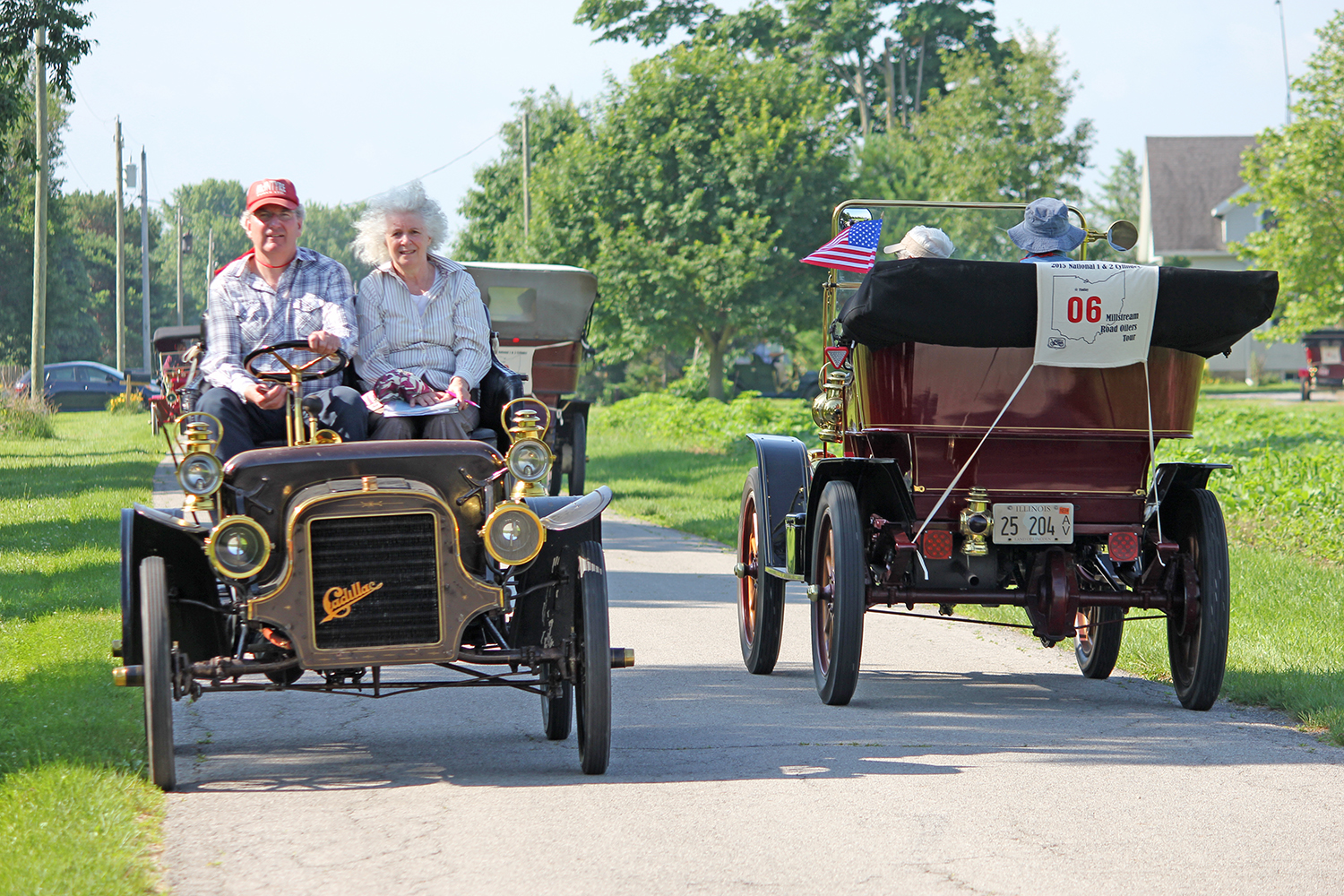 We knew they were coming. But at 9:30 a.m. when the Model Ts, Plymouths and at least one Wolseley rolled south on 7L, it was still an unexpected, thrilling sight.
 Not one of the historic automobiles that were part of the 2015 National 1 & 2 Cylinder Millstream Road Oilers tour came off assembly after 1913, we were told. The 28 horseless carriages and their drivers stopped first at Diane Myers’ Black Swamp Raptor Rehab Center several miles east of here before making their way west to see Red Fox Cabin, the butterfly gardens and the residents of the farm animal sanctuary on their way to Kalida.
Because they came from the north instead of south, the drivers had to loop through the neighboring Walker family’s driveway. It was a surprise photo op for the neighbors and for us.
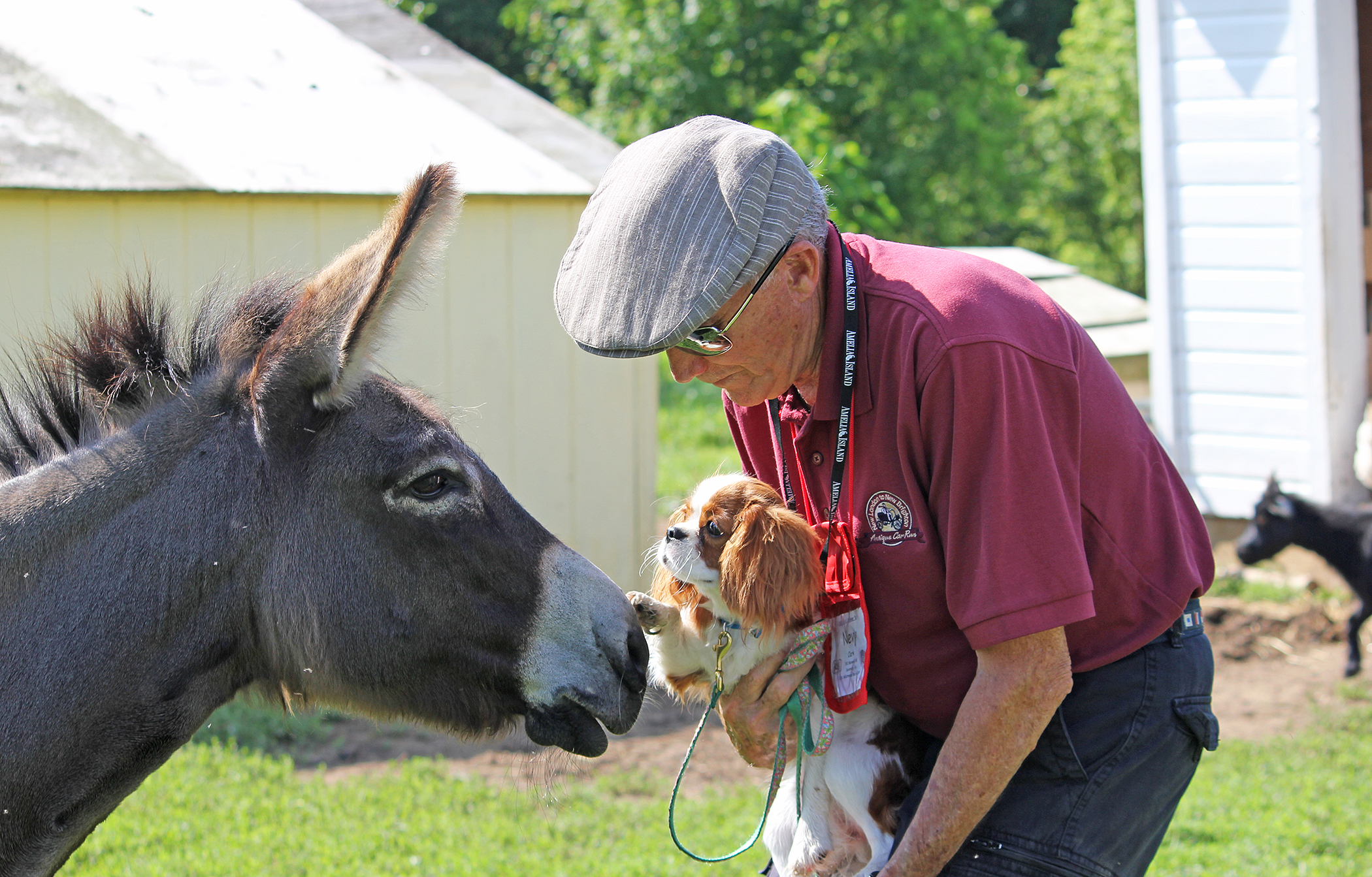
Because the summer is upon us, hot and heavy, Carlton and Beatrice gave a brief ‘hello’ before wagging into the undergrowth for wild raspberries and shade. But Lucy was the gracious hostess for the morning.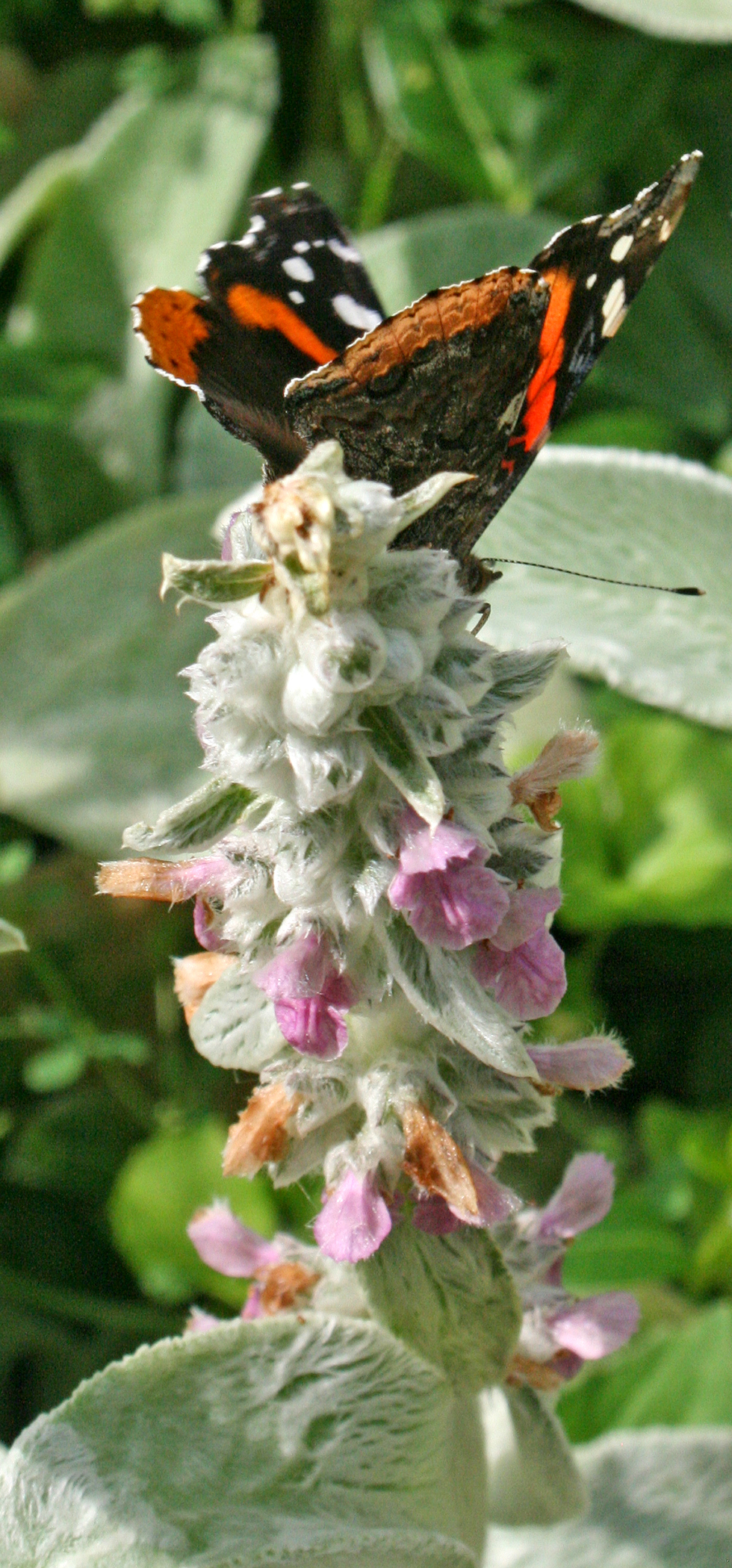
Because high winds aren’t due for another few hours, a zebra swallowtail, a red-spotted purple, a red admiral butterfly, two saddlebag dragonflies and a flock of pondhawks flitted and zipped through the gardens.
Safe travels, and thank you for the generous donation to help us on our way.
Days of flowers and fungi, part 2
On Tuesday afternoon, I walked up the drive to find the geese swimming in the backyard, delightedly dunking themselves in the water as they swam in wide circles. After sunset, Blanchard’s cricket frog and bullfrog calls bounced off the second floor windows. Fireflies flickered over the water, their reflections doubling their numbers.
It was beautiful. The trouble is, we don’t have a pond on the farm animal sanctuary.
What does flow through the Quarry Farm, through the nature preserve, is Cranberry Run, a fairly narrow tributary to Riley Creek which in turn empties into the Blanchard River. From June 12 to June 15, the local Weather Guy reported 3.34 inches of rain, much of it all at once. Beyond that, the National Weather Service has noted 2 more inches around these parts. In a nutshell, for about a day and a half, most of the Quarry Farm became one with the old stone quarry.
 Overnight, the waters receded into the stream banks and the quarry itself. The geese splashed in the floodplain puddles. Donkeys, goats and potbellies were a whole lot happier than the day before with their full salad bar reopened.
The creek itself is brown with runoff from open fields to the south. Given a few days, the preserve trees and grasses will do their work and filter the creek to a clear flow again. Everything is green and lush above the water line, with various mosses growing on the water-soaked deadfall and logs from the the 2012 derecho, a fungi forest in the making. Seems like a good time to play catch-up and post part two of forage expert Tammy Spillis’ spring visit.
Fungus Amongus
In addition to snake root, rue, wake robin, ginger and other wild flowerings of both the native and nonnative sort, the trail walkers who turned out on May 2 found several types of fungi on the Quarry Farm.
Thorny locusts line the path on the northeast rim of the quarry wetland. Their four-inch-long-and-counting barbs were used by women to hold their shawls together, said Spillis. What wasn’t their on Saturday were a shelf mushroom host-specific to the trees.
In the floodplain south of the quarry sits an oxbow of Cranberry Run. Or it once was part of the stream until it was cut-off in the 1950s in a mad dash to engineer every minor waterway in Northwest Ohio. Since that time, the “cut-off” and it the running creek have been working their way back to each other. Until the time that they do rejoin, the oxbow is a deep wetland that is home to fairy shrimp, a variety of amphibians, brooding wood ducks and fungi.
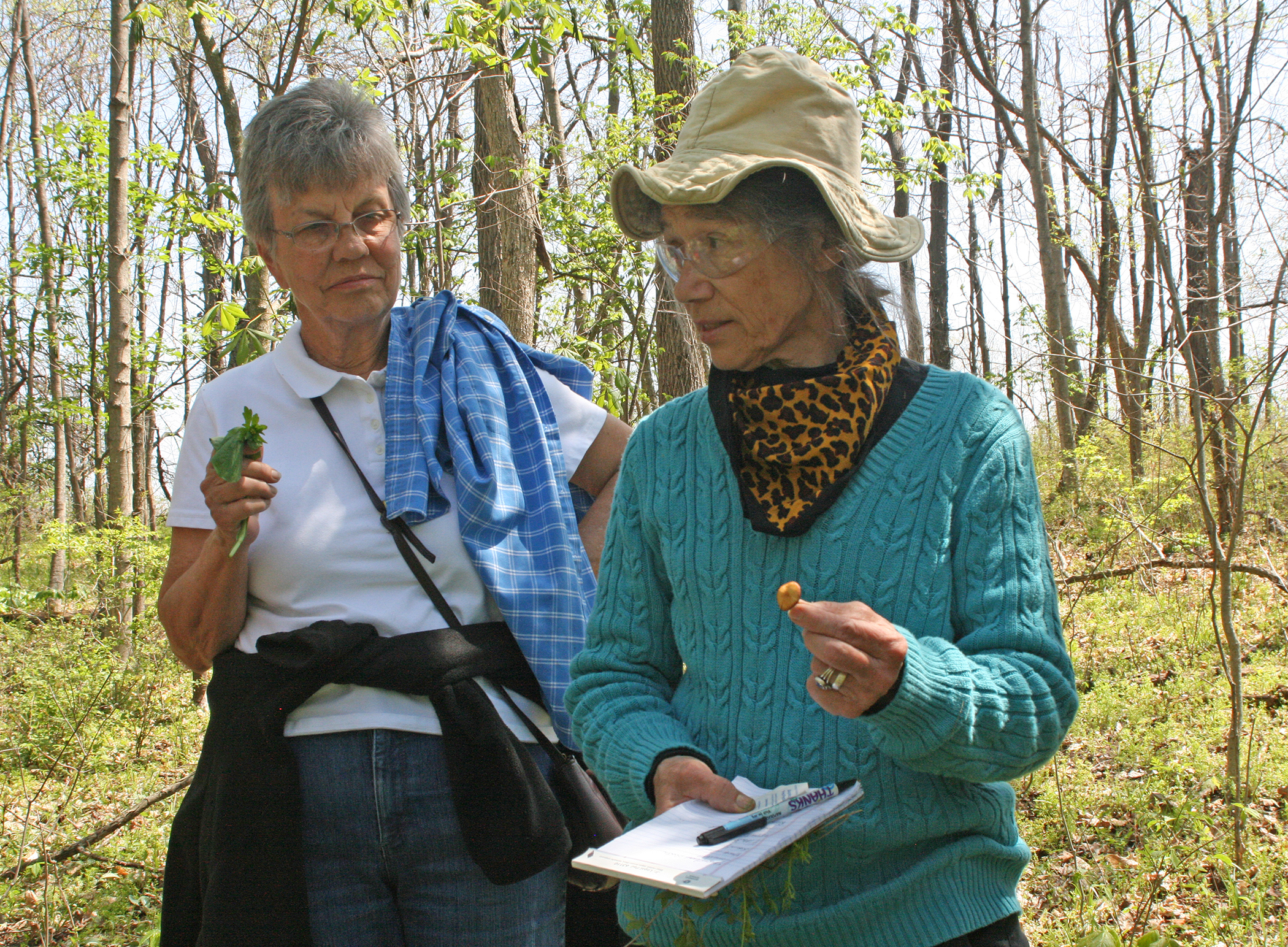 The first we found was a little brown mushroom, one that requires a thorough handwashing if held with bare hands. “Little brown mushroom — leave it alone,” made it into my journal.
Then a cluster of pheasant back mushrooms, a beautiful edible, grew alongside mosses on a decaying log. It was marked with a feathery pattern of browns, exactly as its name implies. Another brilliant-skinned namesake, a leopard frog, hopped across the path as Tammy bent to take a sample.
Whether wild or storebought, Tammy told us that we derive the most benefit from mushrooms that are cooked. “The outside persists because of the protein keratin. All the nutrients, Vitamin B and  others are held within those cellular structures. So when you cook them, you release them. The only benefit you get from raw mushrooms is water and Vitamin C.”
Then there’s the risk that wild mushrooms, when eaten raw, can carry delightful little parasites onto the plate. Tammy said a little wild mustard or something in the horseradish family can dissolve the outside layer on the parasite, if you just have to have your fungus served raw.
She added that cooked mushrooms have tremendous power in fighting tumors. “Your body says, ‘A mushroom just went through me. This mushroom is normally hard, and it has this protein thing.’ And then your body starts attacking other things that are similar to that, stimulating an immune response.
 The last fungus we met was a bed of little gray-brown caps held by black stems. These “inkies” were used to make ink during Thomas Jefferson’s day.
On the return route we learned that, should we run out of water in late summer, plenty of thick, tangled wild grape vine ropes fresh water through the trees and across the paths. Tammy showed us how to wrap a plastic bag around a nicked vine so that it will fill with sweet, clear water.
“Always leave a grape vine in your woods in case your well goes dry,” was her advice. Sounds like a lovely sentiment to weave into a tapestry. I see a workshop in the future.
So like ours
I had another post in mind today; two, actually. Today had other plans.
With the press bill planted on my head, I followed the scanner to a semi overturn on Ohio State Route 12. The word was one slight injury, no heavy rescue required.
This was the scene on approach from the west.

The driver seated in the ambulance to the left was shaken, with a bloodied forearm, but his fingers were mobile. His boss in Defiance was on speed dial. 
This was the view from the east, but the screaming gave them away before I rounded the corner.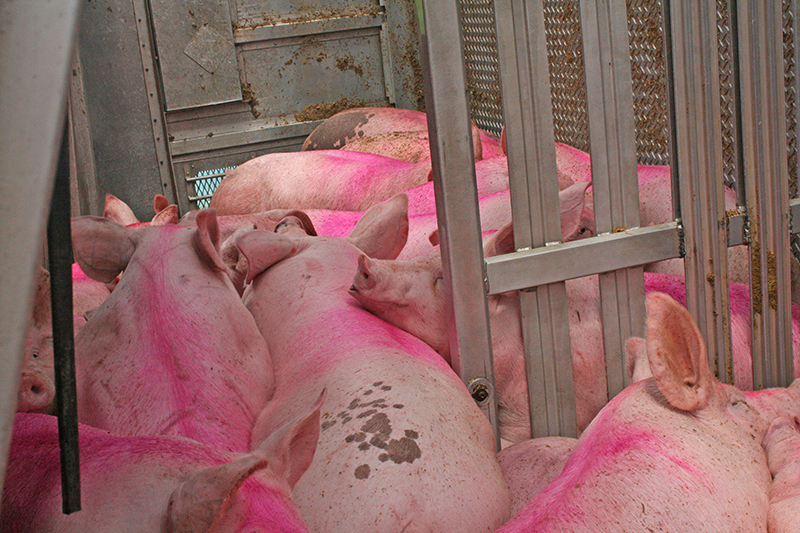
There were 179 gilts (a female who hasn’t born a litter) on the truck. They were less than five months old.
 While I don’t have an exact count, I believe that there were fewer than 15 killed outright (I saw seven outside the trailer and know that there were more in the nose that had yet to be removed). Four severely injured animals were dragged from the truck with chains and a fifth, with a dangling right front hoof, was goaded and prodded and slapped out and into a waiting trailer before instructions were given to cease that kind of activity. The two remaining “downed” pigs were left in the shade of the truck and kept cool
  with water before they were euthanized on the scene. Respondents from the Columbus Grove Volunteer Fire Department climbed on top of the truck and helped to keep them all cool by spraying them with water. This same horror happened earlier this week in Xenia.
I don’t have to explain the pink-paint markings, really.
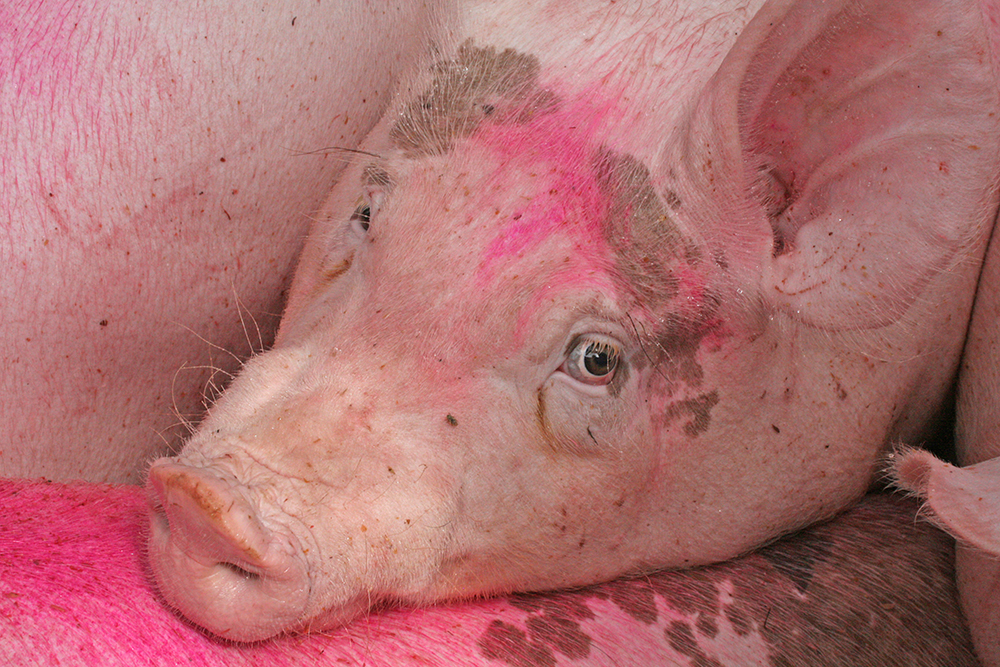 In fact, I’ll not say anything more.
Superheroes swoop in on Saturday (no capes!)
 Everyone has stuff to do. Some of us are list makers, like Quarry Farm Board President Laura. Others have swirls of snippets of chatter spinning through their brain, like yours truly. Or little notes jotted on the backs of envelopes stuffed in the glove compartment, drawers and/or stacked on the kitchen table (again, fingers pointing right back.)
 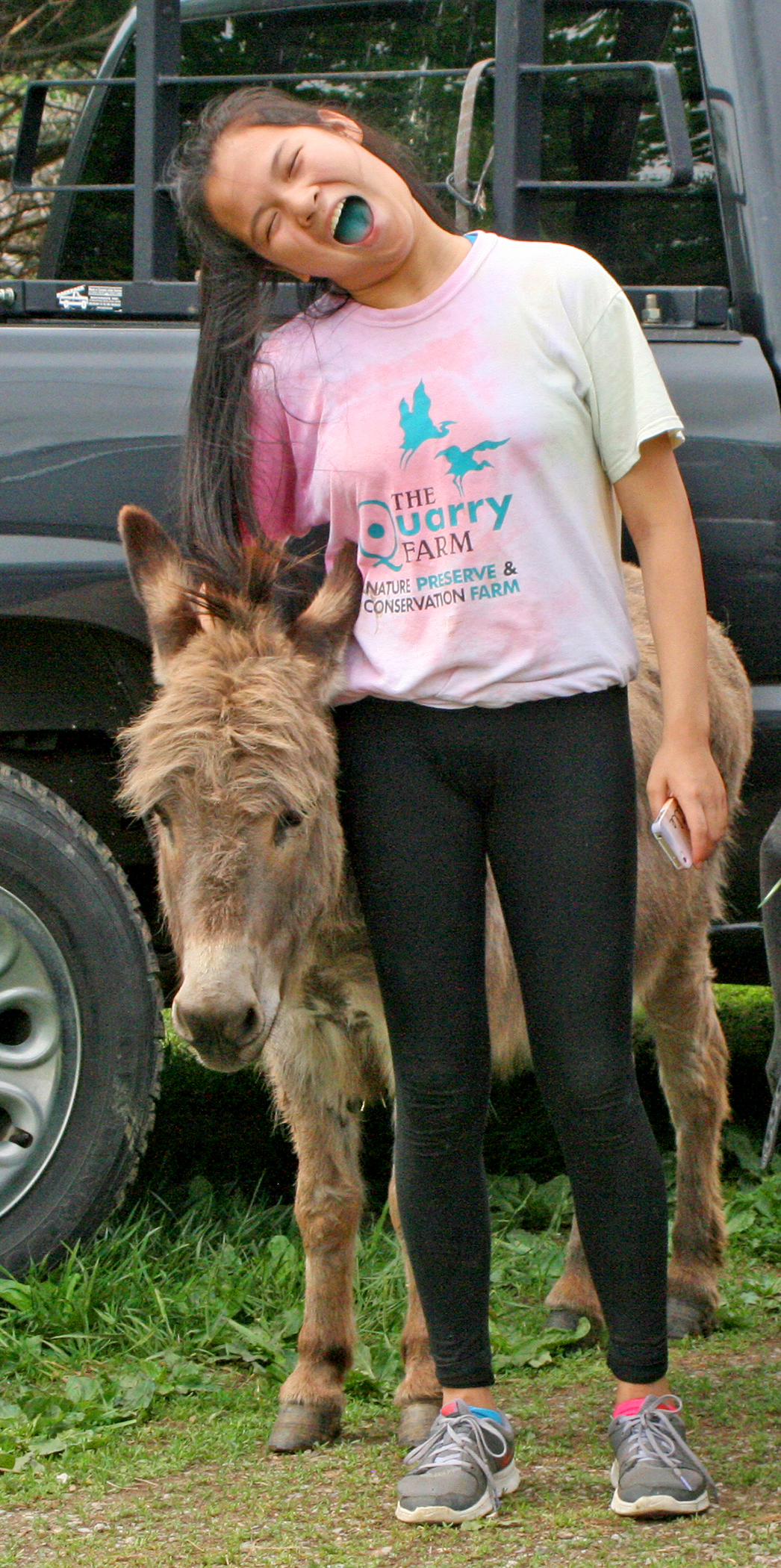 Here on The Quarry Farm, there is always so much to do. Water tubs and buckets to clean and refill, food to prep and food bowls to juggle, hungry potbellies to restrain, hinnying donkeys to brush, and buildings to clean, rinse and repeat. This year, we have buildings to paint. And that’s just in the farm animal sanctuary. In the gardens of Red Fox Cabin, the long wait for nature to prevail over invasives is one which has yet to be won. But Nature is making headway, with a little help from her friends. After years of solarizing beds and hand-picking beetles rather than spraying and dusting, has allowed natural insect predators to get a foothold. The gigantic rainbarrel that collects droplets from the roof of Red Fox Cabin is almost always full for the watering.
  But those of us who currently ‘mind the store’ rarely have the opportunity to check everything off our wish list. Last Saturday — that golden day — we got to pen a whole host of checkmarks. About a month ago, I received an email from William Schumacher. I first met Bill when an Ohio Department of Natural Resources co-worker suggested that the man, an Ohio Environmental Protection Agency employee, might be willing to lend his expertise as a soil science presenter at a teacher workshop I was planning. It turns out that actually wasn’t the first time that I met Bill. He and his brothers Joe and Dan grew up along the opposite bank of Riley Creek. We rode the same school bus and developed the same love for nature while walking the creeks, pastures and woods.
 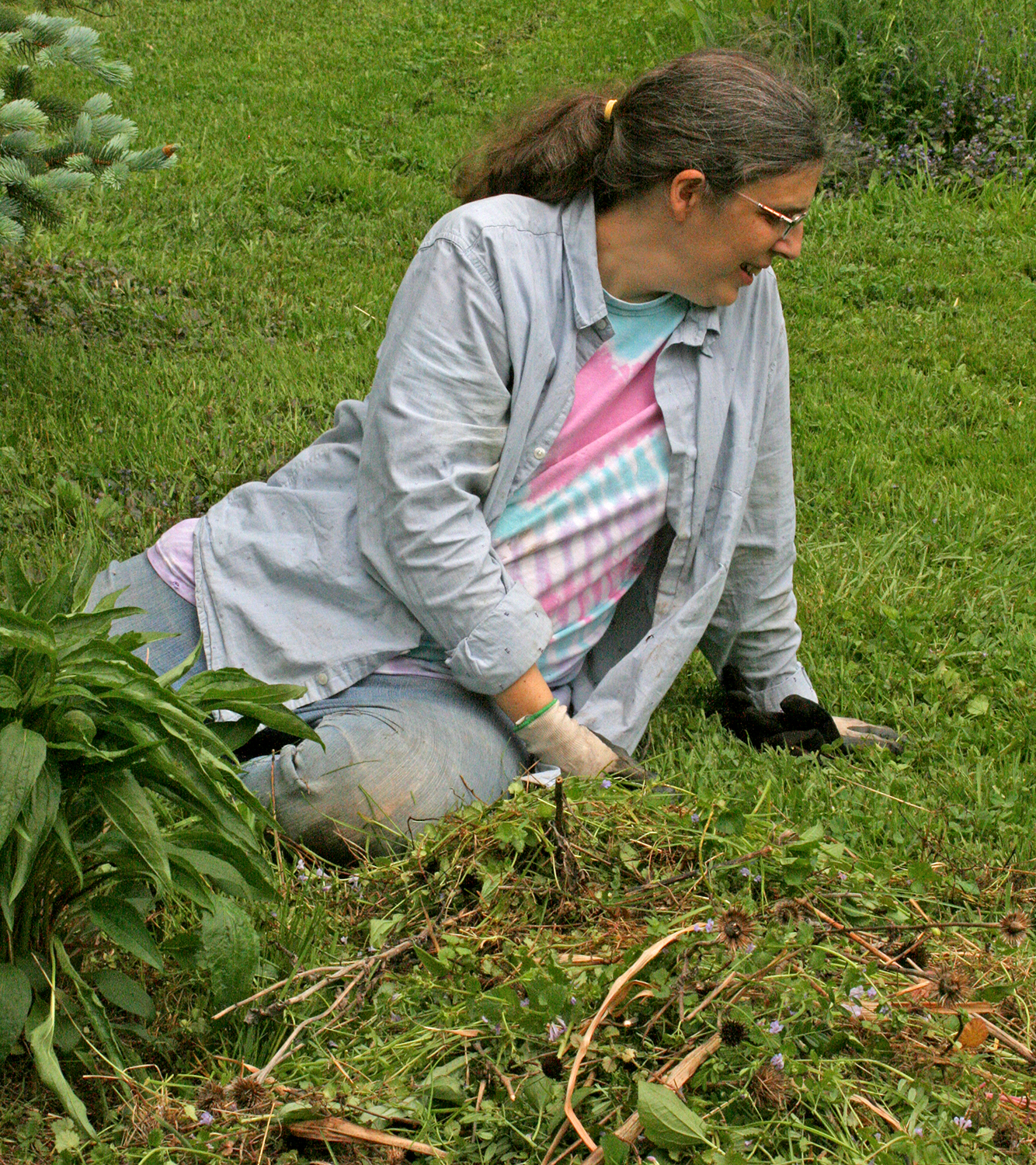 Getting back to that email. Although Bill and his brothers no longer live nearby, they remember. They remember the fish that swam in Riley Creek and the pasture that their dad tended for years. And they’ve seen what happened to the creek when that floodplain pasture was plowed and subsequently eroded. They like the clear waters of Cranberry Run that flow through The Quarry Farm on their way to the Riley, so much so that Bill offered up his helping hand as well of those his wife Carol and their teenaged daughters and sons. Since his brother Joe was flying in from South Dakota and his brother Dan would also be up from the Dayton area, why, they could bring up their tools and pitch in to help us out, too.
 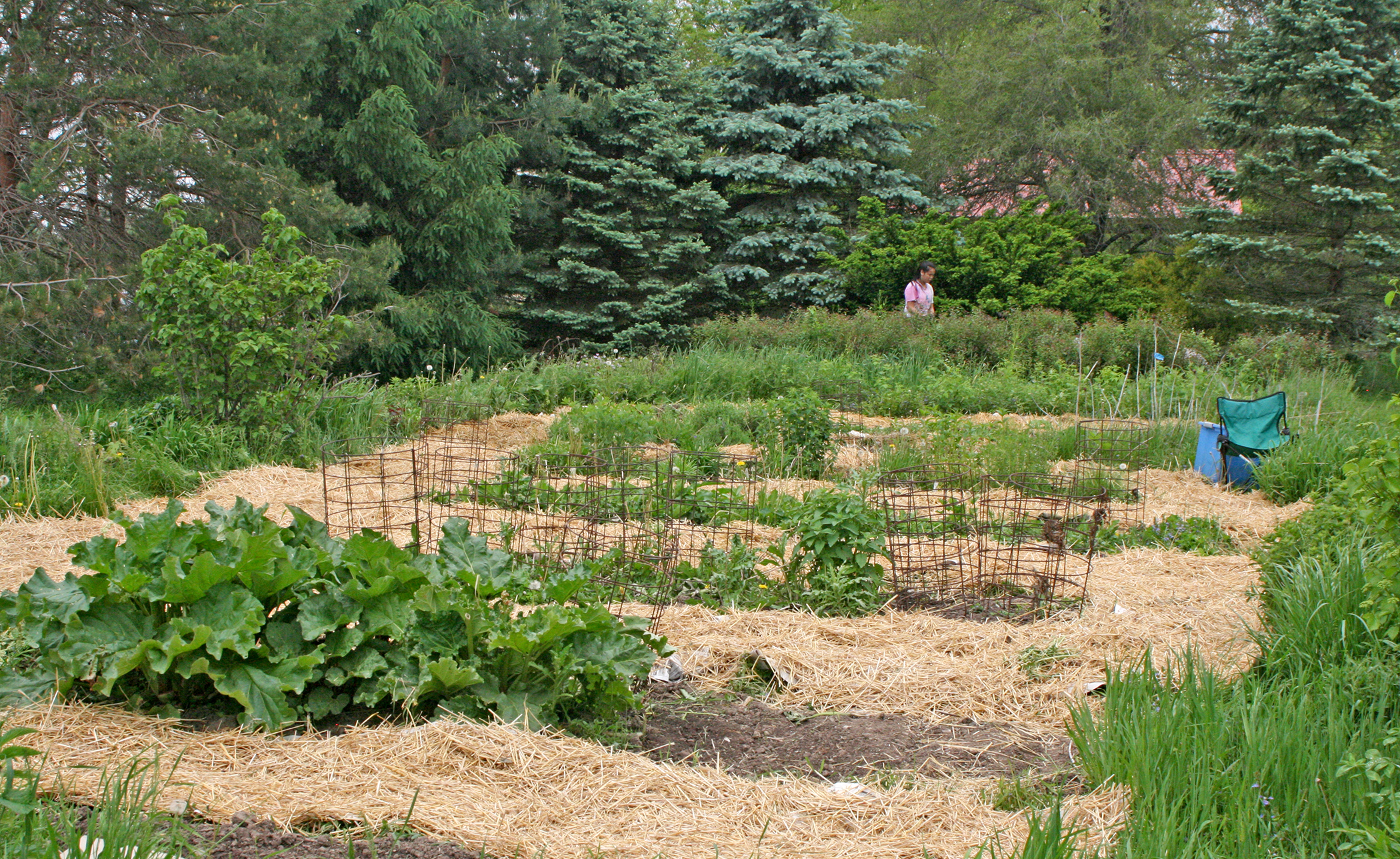 Boy, did they ever. When Sophie the potbelly pig arrived here last month, she was so overweight that she couldn’t walk, much less be spayed. In less than eight hours, we had a new wooden fence in the quarantine area where Sophie is now dieting.
  The butterfly gardens were weeded of quack grass, with straw down between the rows. Bill had dug and walled a kidney-shaped raingarden off the north gable of the cabin. Dan had led a crew along the south end of the Cranberry, clearing windfall from the path and cutting a big dent in bush honeysuckle along the way.
  Words cannot sufficiently express our gratitude to the Schumachers. Instead, I’ll let the impressions of some of our youngest visitors say it for me. These drawings just arrived in the mail, sent to us by the third grade class from Pandora-Gilboa Elementary School following a day spent here on May 8. Those kids are one of the greatest reasons why we do what we do, so that these creeks, pastures and woods, as well as the nonhumans that share it, will mean as much to them as they did to much younger Bill, Joe, Dan and me. Still do.


