In the footsteps of Fizz

Lolly There’s a man we admire who lives near the Forest of Dean. We are genuinely fond of him, though I don’t even know his name. I simply know him as The Tramp. He walks about the Forest, taking pictures of whatever catches his eye, turns his feet home and then cracks open his head and spills an absolute treasure trove of knowledge about the world around him into the ether (if you’ve not yet met him, haven’t found him through social media or some obscure search or simply missed him through sheer bad luck, here he is: https://atrampinthewoods.wordpress.com/). We do, however, know the name of his companion, his Sancho Panza. I think it’s probably safe to say that The Tramp would find his wanderings considerably less in so very many ways without her. Her name is Fizz and she’s every bit as curious about the world around her as any tramp.

But, why, you ask, are we bothering to discuss these someones that are half a world away? Well, first and foremost, The Tramp’s musings and observations are all of that and so much more. Read. Look. You’ll thank me for it. Thank me and The Tramp. And Fizz? Fizz is…well…Fizz. Second, it’s been said that imitation is the sincerest form of flattery and while I’m not above stealing an idea or three if I think it will help move everything along a bit more smoothly, I do draw the line at failing to give credit where credit is due. Having said that…

Here’s Lolly.Lolly crossing

For those of you not near the here we’re at, it’s been cold; so cold that walks to retrieve the mail are arduous undertakings requiring planning, oversight and at least five layers of clothing. Today, however, (and likely tomorrow, if the forecasters read their scattered bones correctly, scried sincerely their battered leaves of tea), it’s been comparatively balmy; nearly 30° F. On Tuesday, though, we’re back into the basement, temperature-wise. So, given that we’ve been cooped up for the better part of a week, we threw open this window of opportunity and bounded back into the woods, Lolly, Anne and I.

DriftsFirst observation of the day: snow is ever so much whiter under the crust. The winds that have battered this area have stripped the topsoil from all of the surrounding fields and tossed it until it couldn’t be tossed any further. Where it falls it lays in blankets, ribbons and bands of varying shades of brown. Sometimes you don’t even notice it until you’ve taken a step or two, all that dirt being evenly distributed so that there’s just no way of knowing. Other times, you just can’t help but see.

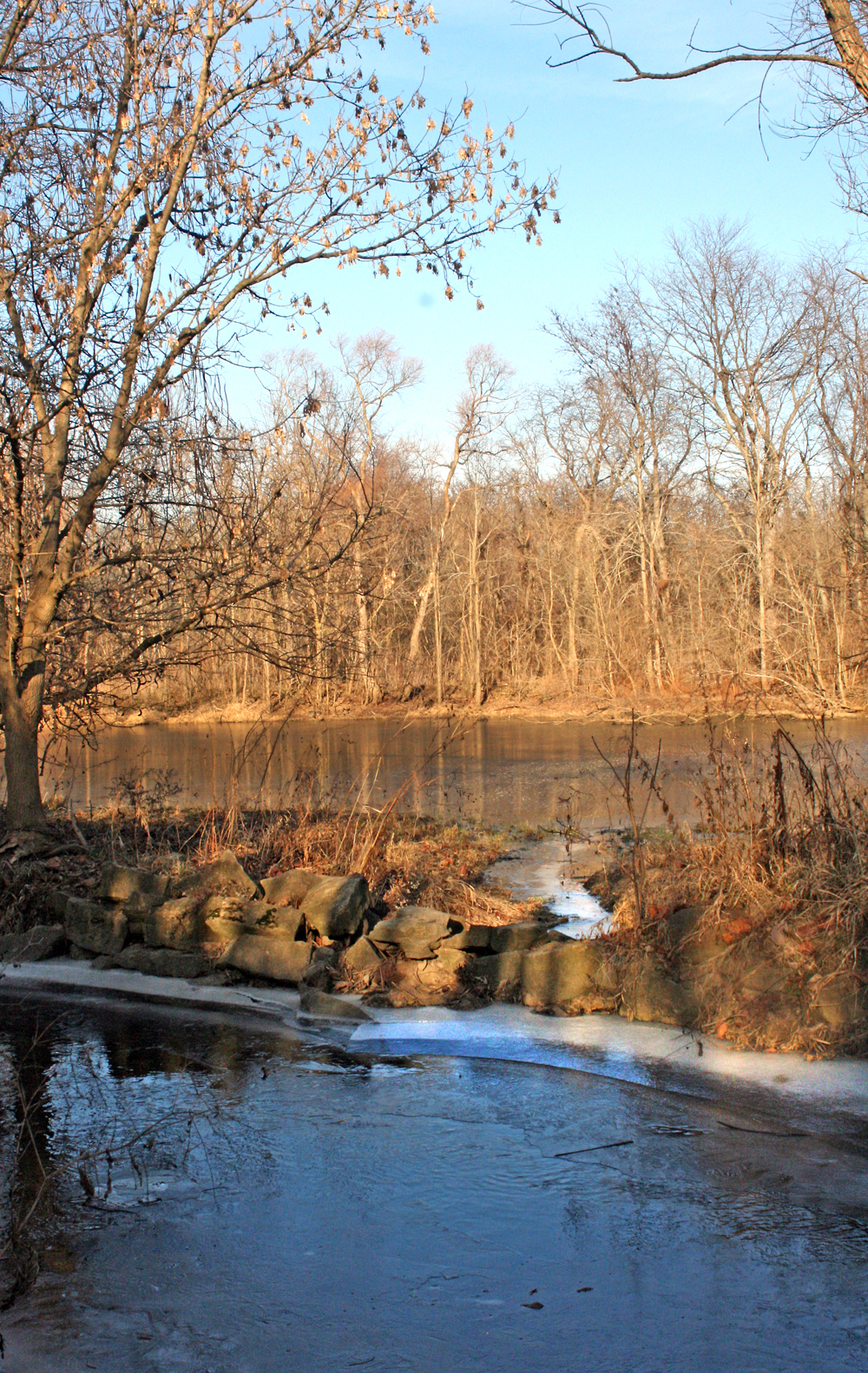
That same wind, though, did interesting things to what little snow has fallen, pushing what must have been little more than two inches of overall snow into two- and three-foot deep frozen waves caught in the process of cascading over the lip and down into the stream bed. Cranberry Run itself is frozen along most its sinuous length, with water breaking through the ice only along the most turbulent runs.Creek sculpture

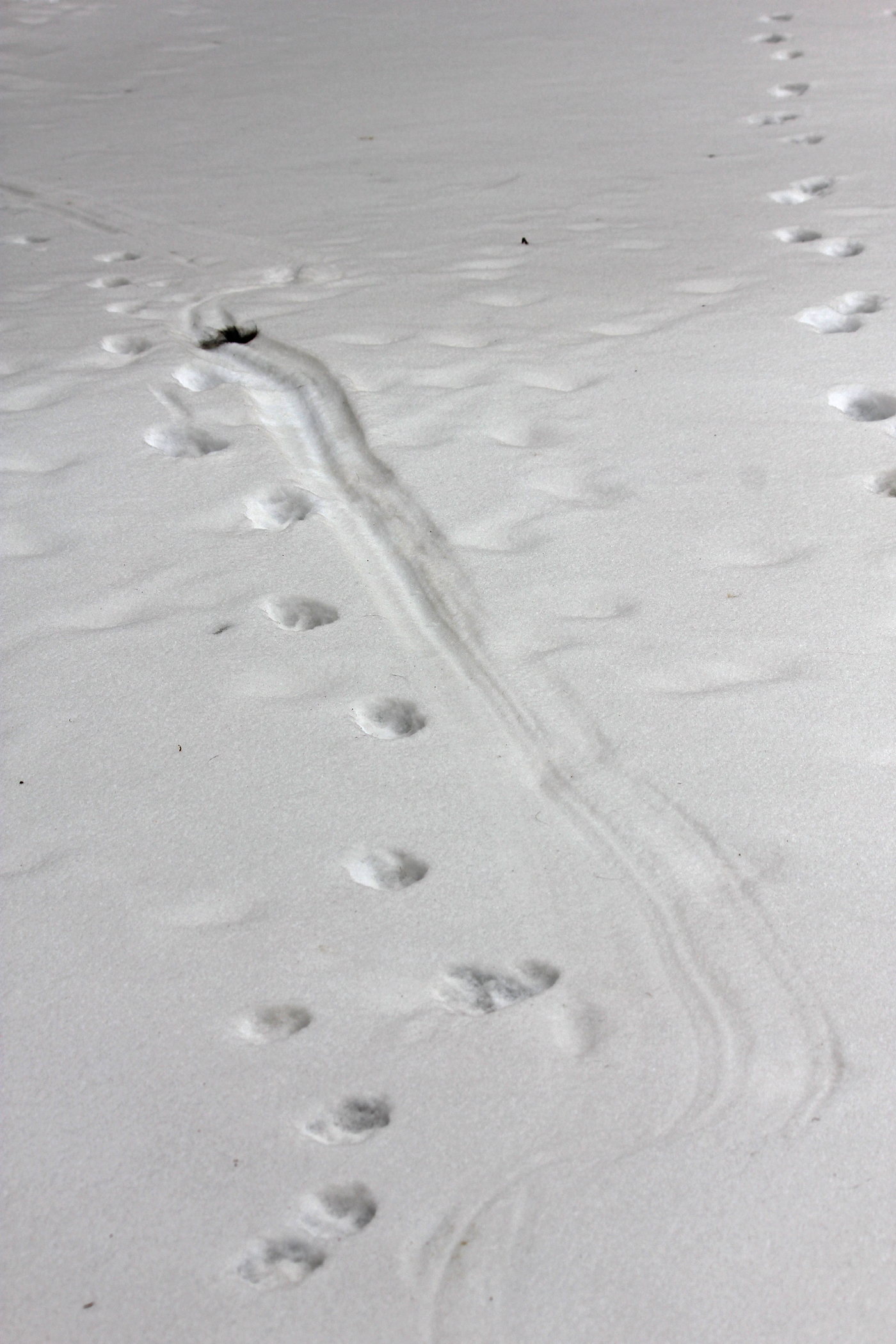
Tracks on QuarryOn the paths we’ve carved through the woods, down on the frozen stream and across the quarry itself were sign after sign after sign of the many and varied creatures that live here. Tracks of rabbit, squirrel and raccoon crisscrossed those of turkey and deer and a host of songbirds. There were even what we suspect were fox tracks and signs that at least one fox was successful at the hunt. Though we’ve not yet managed to photograph any of the foxes that we know live here (we know of two active dens), we hear them at night, interacting with one another in eerie, high-pitched yowls and sharp, barking yips and growls. We’re researching trail cams, at the moment to help us capture visuals and have acquired some sound equipment with which we hope to record the voices of The Quarry, once I’ve figured out how to effectively use it.

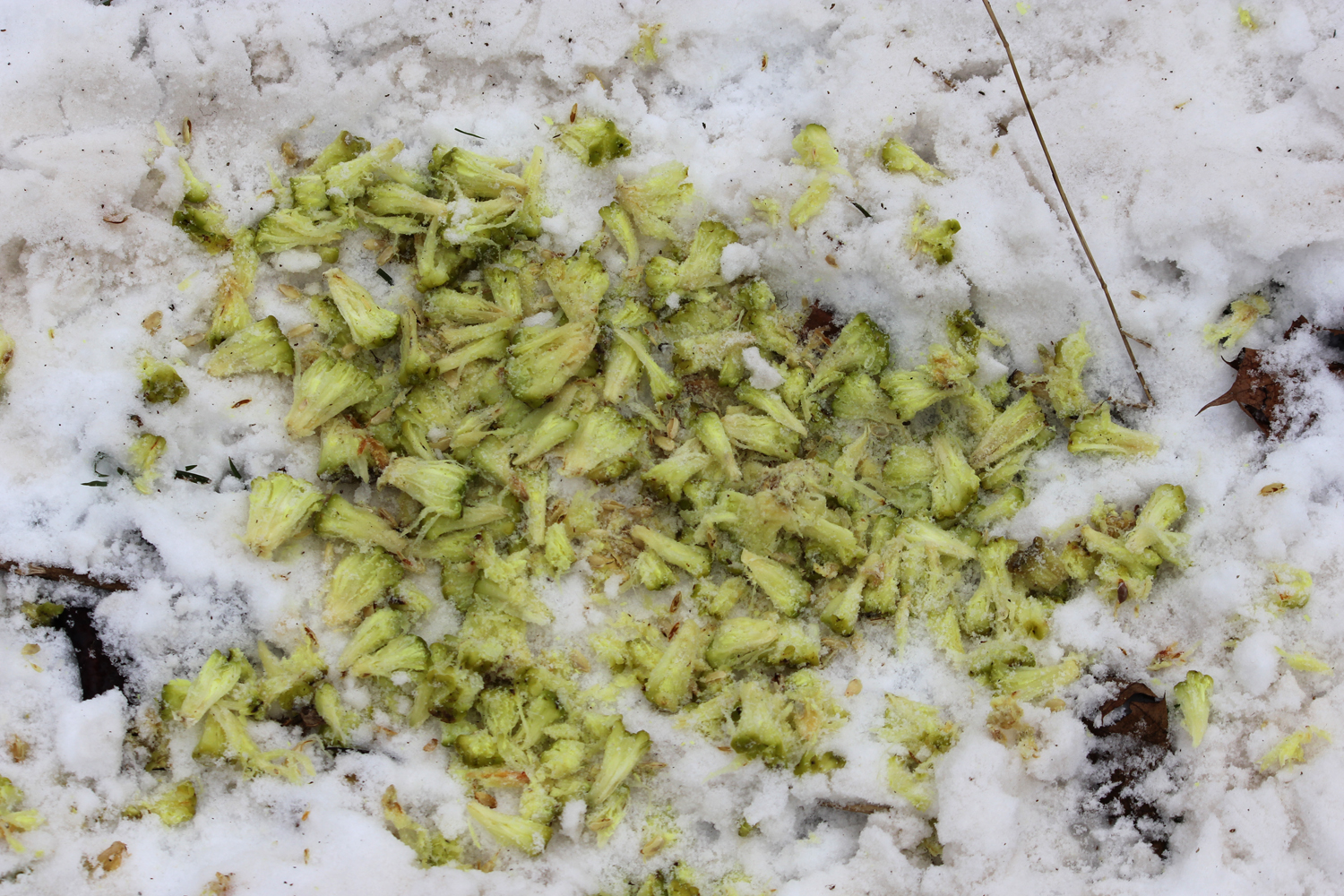
Fox SquirrelIn a tree on the spit of land separating Cranberry Run from the old quarry, a fox squirrel sat on a branch and watched us walk on by. He was fat and sassy and at least one of the reasons for Osage scrapshis good health soon became apparent. Scattered here and there were the remnants of osage oranges, the seed fruit of osage trees. The osage tree (Maclura pomifera), also known as the hedge or hedge-apple tree, is one of the most commonly planted trees in the United States and is used as a field hedge, wind break and to stabilize soils. Unlike apples, pears or cherries, the squirrels tear the tree’s green and yellow fruit apart to get at the seeds, not the flesh. Remnants of their feasts are scattered in oval patches here and there along the stream and back in the woods.
DownySparrowThough there’s little doubt that many simply went unobserved, there seem to be fewer birds about than in past years. We did, however, see various sparrow species, juncos, cardinals, bluejays and several downy woodpeckers flitting from and between the trees.

Tomorrow, if the prognosticators are correct in their prognostications, we’ll probably take the time to do this again.

A New Year’s Day walk below the wind

IMG_2737This new year looks bleak, with harsh, cold wind and an absence of snow. Thursday afternoon, I walked down the lane and had to fight to open the gate against bluster, feeling the cold bite of the latch’s surface through my work gloves. No one followed me to the gate in hopes of treats. I’m sure no apple slices could beat shelter on the sunny side of any outbuilding.

I made it just about 50 yards down the road before ducking down into the lowland along Cranberry Run, where the drop behind Red Fox Cabin blocked the wind. So cold were the trees that they hummed, except for Osage orange trees. These woven, thorny trees make sort of a whirring whine in frigid wind chill (truly exhilarating when one is walking on the trail at night…alone.)

IMG_2736Winter came on so suddenly that many of the Osage fruits are green and whole, their sticky white latex ooze flash-frozen to the ground. The fruit is not poisonous to us mammals, but I hear it’s not much to taste. Further on down the creek, on the east side of the footbridge, I saw something, maybe a fox squirrel, made use of an orange as a food source.

The sun is cold and farther away at the start of the year, a white sun in gray blue sky. Even the bane of the understory, bush honeysuckle, is leafless this year without a snow blanket. No green, other than the Osage fruits, was visible on Jan. 1, 2015. This is a good thing, I know; maybe this will give the maples and oak seedlings a chance to fill in the spaces left where the 2012 derecho took out so many mature trees.

IMG_2739IMG_2734The wind was so high and wild above the creek valley that I saw few birds, not even on the old stone quarry. This winter it is full of water, frozen with reflections of rich, ruddy browns, gold, and sky. There are no breaks in the still quarry’s surface, but Cranberry Run’s riffles keep a brisk pace, leaving open holes here and there, especially below the high blue clay banks at the northwest point of the nature preserve. Two birds, so in shadow that I couldn’t identify the species more than to say they are large songbirds, dipped in the water below a bare root hackberry that has held the top of the bank for as long as I can remember.

IMG_2741The camera, a treasured Rebel of my dad’s, said ‘no more’ to the cold, so I tucked it inside my blanket coat and headed back the way I came. At the top of the hill near The Quarry Farm entrance sign, I tucked my chin closer to the camera, wrapped my scarf around my head and ran for the gate.

With my eyes so adjusted to discerning the different hues of browns, the greeting party under the apple tree was a shock to the senses. Wrapped in new thermal coats, Buddy and the boys were like presents under the tree.

What a happy sight to begin a new year. Rain is promised for Saturday. Luckily, these coats of many colors are waterproof. I think I’ll stay inside and watch.

IMG_2730

New winter comes

Two hours and 20 minutes of 2014 remain to us in Northwest Ohio. If the National Oceanic and Atmospheric Administration has their way with us, we will feel the cold dry air become even more so as three more degrees slip away to 16 degrees F by the time the ball drops.
In the still cold outside, the Christmas solar bulbs hang in a sugar maple. A clear sky of stars and half moon will keep them glowing for a few minutes longer than in the past week of rain. We humans are snug inside, our toes snug in slippers and the rest of our persons wrapped in afghans and quilts, the extended version of “The Two Towers” onscreen to lead us up to the new year.
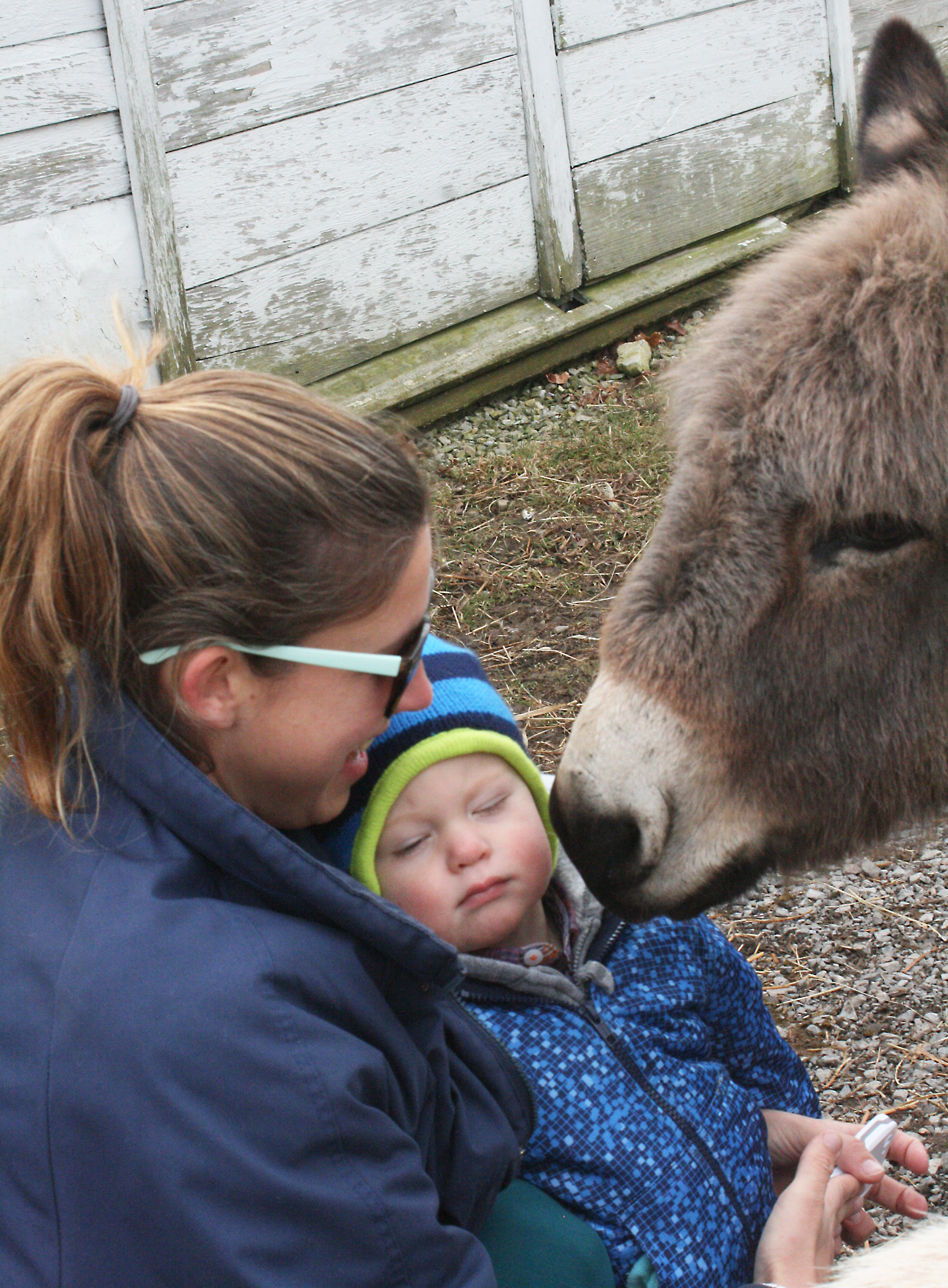
Outside in the farm animal sanctuary, under that sugar maple, donkey and goats are wrapped in the thermal coats that arrived this fall, winter wear purchased through the donations received throughout 2014. Oh, yes, there will be photos.
Buddy Vincent

Buddy visits a Seiler grandchild

Although 16 degrees F is a heatwave compared to the bone-deep bite felt this time last year, it warms the soul to see the little herd walk the moonlit paths from building to building, warm in their shiny new gear. Thanks to Ellen Seiler and her family, who visited on Sunday, there are apples out there, too. Nothing like a very cold, crisp apple to toast 2015. There are enough to share with the red fox pair that bark in the lowland.

Thank you to everyone who helped make 2014 a banner year on The Quarry Farm. Here’s to another year of star walks, art workshops, acoustic music, nature days and whatever else comes our way. We can share one major 2015 project heads up  with you: A whole lot of bush honeysuckle is going by the wayside, if your game for a pullin’.

Thank you for the BIG check

quarry farms - laura coburn

We want all of The Quarry Farm friends, family and neighbors, near and far, to know that we received grant funding from the Operation Round Up program as part of the Paulding Putnam Electric Co-op Trust.

Here’s how it happened: Anyone who is a PPE member rounds up their bill to the nearest dollar amount and the funds are pooled. Periodically, organizations are able to apply for community programming. We did, and our educational programming was elected to benefit from the program.

Yesterday, Board President Laura drove over to Paulding to receive the grant check (actual check much smaller than indicated here) so that we could provide more outreach during this year. By the way, take a look at those presentations and workshops that we do offer and give us a call or send us an email at thequarryfarm@gmail.com.

What and impact that just a few cents each month can make on a community.

Just add paint

117Watercolor is too real painting. As a painter who prefers this two-dimensional medium to most others, I have been in the position to argue this point. My argument accuses oil snobs of decorating their walls with off-the-rack roadside numbers that match a couch.

Boyfriends are broken-up with because of statements like this. But that was providence, it turns out, and a long time ago.

118And painting in oils is fine, if that’s what you like. But don’t tell me that a water-based work, one which requires the painter to give a measure of control over to their chosen medium, allowing light and whims of water, air and pigment to have their way, isn’t real painting.

So, with 94 percent humidity and a forecast of sun, the second “Watercolor for Beginners” workshop took place today under the earth-red roof of the Seitz Family Pavilion. Heavy fog kept a few distant registrants away, but hot black coffee, herbed shortbread and apple oatmeal cookies revived those that took up a brush.

146I love it when watercolor novices tell me, “I have no artistic talent.” These are the ones that are the first to let go; to pool water on their paper and break the surface tension of that pool with a loaded brush. It’s the ones that have painted before, using slow-to-dry, opaque, malleable mediums, that are reluctant let go of control. Because, in my opinion, that’s what you have to do with watercolor. You have to let go and see what water, paint, paper texture and weight and gravity can create when kind of, sort of left to their own devices. Once you have witnessed that, you can begin to take the reins and shape your work.

The seven people who floated through this morning’s fog, included some of the above. They chose their subjects from the Red Fox Cabin gardens, vegetables, flowers and leaves. You can see in the photos the tentative steps, the light lines of paint on cold press paper (I wouldn’t let them sketch their subjects with pencil first). Two hours later, we had a marvelous body of work, each of them showing promise and more than one worthy of exhibition at any art festival.

Of course that, along with my thoughts on how to begin painting with watercolors, is my opinion. I could be wrong.

But I don’t think so.

This slideshow requires JavaScript.

Life lessons

One of the primary goals at The Quarry Farm is to increase understanding, to educate. Sure, we provide sanctuary to animals in need, have established a preserve for the area’s wildlife and offer folks the chance to just kick their shoes off and relax. But, during every interaction that takes place in the name of The Quarry Farm, the primary goal is to provide, and learn, new insights. Arguably, the topic that gets the most attention is water quality. We have a number of programs that we present on the subject, everything from simple, on-site discussions of the various aquatic habitats that help make up The Quarry Farm, to Small Streams, a project that allows us to set up aquatic microhabitats in schools and community centers. During any presentation on streams and rivers, the question that invariably gets asked of us, and that we in turn ask of visitors or classrooms, is this: What’s the biggest pollution problem facing the waterways in rural Ohio?

The responses to that question nearly always include garbage, oil (or some other petroleum product), manure, chemicals, litter and, inevitably, dirt. The correct answer is included in that list and it’s having a profound effect on everything, from the Great Lakes to the shortest of creeks, like roughly five-mile long Cranberry Run, a stretch of which runs through The Quarry Farm.

In the 1950s, and again in the ‘80s, Cranberry Run was channelized, engineered by officials in Putnam and Allen Counties so as to more quickly move water north and ease local flooding concerns. The stream bottom was dredged and the tops of the banks widened; a latitudinal cross-section of the resulting waterway would resemble a wide-mouthed “V”. Cranberry Run was also “straightened”: oxbows were bypassed, as were any extreme serpentine meanders. Anything that could possibly impede the free flow of water was eradicated, including trees and bushes that grew along the banks. What was once a historic waterway, a vibrant habitat for a host of aquatic animals and the myriad species of birds and mammals that depended on them, was reduced to what locals dismissively referred to as “Smith Ditch.”

stream4In the late ‘80s and early ‘90s, Gerald and Laura Coburn, after years of civil protest, negotiated an agreement with the counties that would allow Cranberry Run, or at least that portion of the stream that ran through their property, to reacquire a more natural presence. Within the first decade, the four natural stages of a waterway – riffle, run, pool, glide – reestablished themselves. Trees rooted on the bank, grew and began to provide shade, cooling the passing water and creating a more hospitable environment for all manner of aquatic insects and fish. Today, Cranberry Run snakes its way for approximately one-half of a mile through The Quarry Farm. The meanders in the stream bed slow the water flowing through here enough that sedimentation occurs and, on most days, the “Little Cranberry,” as it is affectionately known, runs so clear that visitors can’t help but comment on its clarity.

Cranberry Run as it approaches its terminus, Riley Creek.

Cranberry Run as it approaches its terminus, Riley Creek.

And that, returning to the question of “what’s the biggest contaminant,” should help provide the answer: dirt. Dirt is our greatest concern and the biggest problem facing all of the animals that live in the water, from insects to mollusks to fish. Not only does dirt, suspended in solution, absorb the sun’s rays and increase water temperatures to dangerous levels for the animals that live there, but it carries with it chemicals bonded at the molecular level and creates an environment in which aquatic organisms find it increasingly difficult to breathe. Imagine standing downwind in the smoke of a brush fire, not for a minute or for an hour or for a day, but perpetually, forever. For gilled animals living in highly turbid water, they may as well live in the smoke generated by an eternal tire fire.

Pictured above and below  is the point at which Cranberry Run enters Riley Creek. Efforts made within the boundaries of The Quarry Farm, and upstream by like-minded neighbors, have nearly erased the sediment load in the waters of Cranberry Run.

Pictured above and below is the point at which Cranberry Run enters Riley Creek. Efforts made within the boundaries of The Quarry Farm, and upstream by like-minded neighbors, have nearly erased the sediment load in the waters of Cranberry Run.

At left is Riley Creek as it flows northwest to the Blanchard River; the clear water to the right flows from Cranberry Run as it meets and enters Riley Creek.

Efforts on the part of private individuals and organizations, and through governmental programs sponsored by state and federal agriculture departments, are beginning to have an effect. Public awareness of the issues is critical in creating healthy environments in which all forms of life can prosper.

creek chubs


Small Triumph

Sandhill Cranes, 2014 Garden, Pipevine Swallowtail Larva 023

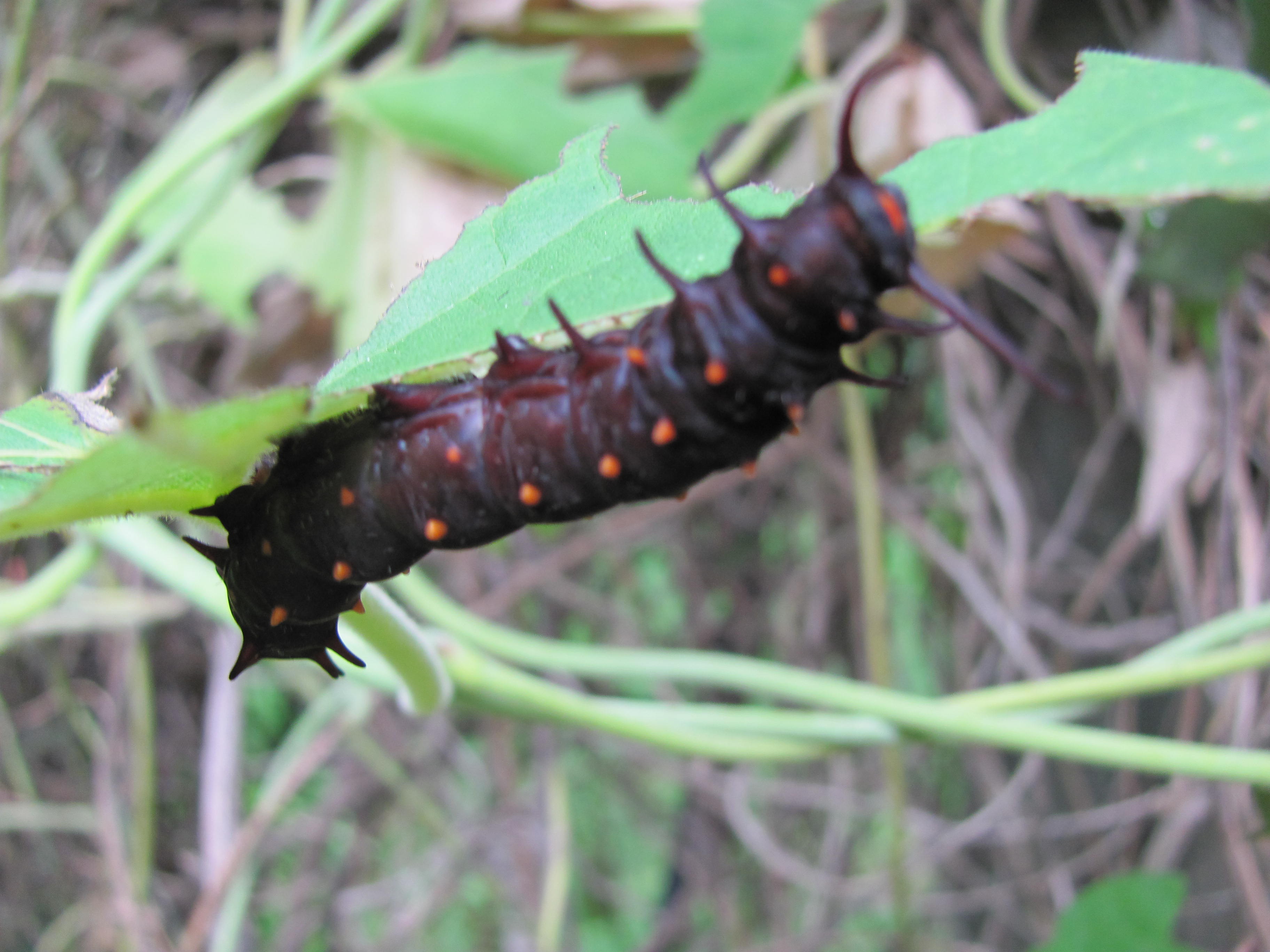
Why would a gardener be happy, overjoyed even, to discover an army of fat, black, spikey-looking caterpillars with red polka dots pillaging a prized ornamental vine?  Answer:  When the marauders are Pipevine Swallowtail butterfly larva and the vine is Dutchman’s Pipe (aristolochia macrophylla), one of their host plants.

For the ten summers and more since husband Gerald planted two pipe vines in the garden at Red Fox Cabin, we have kept watch on them.* We’ve admired the cute little Dutchman’s pipes they bear and checked the foliage for ragged holes that would give away the presence of larva. We’ve peered at black with blue swallowtails, hoping to spot the distinctive coloration of the Pipevine, inky black forewing and iridescent blue hindwing.  However, sightings have been extremely rare and none have chosen to lay eggs on the beautiful Dutchman’s Pipe. Until this July.

Sandhill Cranes, 2014 Garden, Pipevine Swallowtail Larva 016Last Saturday evening as I was walking my Jack Russel, Lefty, or rather as he was leading me where he wanted to go, he tugged me toward the rear of the log cabin, where one of the pipe vines grows luxuriantly on a porch pillar.  Lefty was intent on the rabbit or cat or whatever that he scented underneath the porch, but I was halted in my tracks by the sight of that vine, no longer luxuriant, but ragged, nearly defoliated, and crawling with the aforementioned fat black caterpillars–at least twenty.  Thrilled by the sight and the realization that our vine had finally been discovered by a passing Pipevine Swallowtail, I rushed home with a disappointed Lefty to grab my camera and my Peterson’s field guide to caterpillars, for confirmation.

Sandhill Cranes, 2014 Garden, Pipevine Swallowtail Larva 012According to the guide, predators avoid Pipevine Swallowtail caterpillars because the vine that feeds them is toxic and makes them unpalatable.  Also, when they are ready to pupate they tend to crawl away from their host plant and find other places to attach a greenish chrysalis with a silken thread.  So, the total disappearance of the caterpillars two days later was not as alarming as it might have been.  Photos and a ravaged vine prove they were there.  Quite likely, somewhere on the Quarry Farm later this summer, a Pipevine Swallowtail, or maybe twenty, will emerge from its chrysalis and sail into the butterfly garden to dine, and with luck someone will be there with a camera.  A photo of the shimmering beauty will be a fitting tribute to Gerald, who inspired us with his love of butterflies and planted the Dutchman’s Pipe so many years ago.

*[Pipe vines are native  in some parts of the Northeast but not in Putnam Co., Ohio; ornamental pipe vines were common in Victorian gardens but are less so today. Pipevine Swallowtails can complete their life cycle only if they happen to find a host pipe vine or a Virginia Snakeroot growing wild or deliberately planted.  Adults might stop to nectar in a flower garden but will move on if a host plant is not available.]

In the Storm

IMG_5770[1]Things here at the Quarry Farm are as they are everywhere else it seems. We’re cold, we’re trying to keep warm, and we’re trying to keep everyone else warm. The drifts at the start of the drive are at least four feet deep and the wind persists in howling. The auxiliary heat in the house has kicked up and we humans, when not caring for the animals, are glued to our books and Netflix, covered in layers of dogs and cats and they in turn are covered in blankets and pillows.

Outside, the turkeys are in with Johnny and Andy (Canada goose and duck), the chickens reside in their henhouse, the pygmy goats are staying in their shed, and Buddy and the goats are huddled together beneath their own roof.  So far, we have kept everyone alive.

This cold is dangerous, as the weathermen and sheriff departments keep telling us.  The pigs almost flat-out refuse to go outside—bellowing and pushing backward until we’re able to shove them out the door. Lolly, our bulldog mix, has so little fur to cover her skin, and so it makes the cold that much worse for her. On her first outing she ran out and right back in, but on her second go, she went around to the side of the house, became too cold, and huddled crying beneath the hutch off the side deck. She had to be carried back in the house.

IMG_5780[1]It is Buddy, however, that has made us worry.  He made it through the night, which we worried about, but he is still here. However, as you can see, he is sporting a new look. Quite fetching, I believe.

Our neighbors across the road just plowed out our drive. We saw them start to, but were on a mission to look after another house with animals, so a quick thank you by waving was all that was conveyed. I shouted a thank you across the road when we returned home, but they had already retreated to the warmth. So we shall have to thank them properly later. When it is warmer.

To all:  I hope your days in the snow storm have been at least slightly comfortable. Good luck for the rest of the duration!

At long last, the pie

PieDo you remember this pie, made with wild black raspberries picked right here on the Quarry Farm? A photo of one production of this pie was posted on July 1. What followed were requests for the recipe.

Summer is still with us. The black raspberry picking time may have passed, the last nodules picked clean by hungry birds, but just in case you have some put up in the freezer, here’s that recipe. If you are fresh out, other late summer fruits may suit your taste buds.

BERRY STREUSEL PIE

Crust for single crust pie

  • 5 cups black raspberries or mixed berries such as blackberries, blueberries, and black raspberries
  • ¾ cup sugar
  • 1/3 cup all-purpose flour
  • 2 teaspoons finely shredded lemon peel, 1 tablespoon lemon juice, or ½ teaspoon ground cinnamon

1. Line a 9-inch pie plate with pastry for single-crust pie.

2. In a large bowl combine the sugar and flour. Stir in berries and lemon peel (or lemon juice or cinnamon). Gently toss berries until coated. (If using frozen berries, let mixture stand for 45 minutes or until fruit is partially thawed but still icy.)

3. Transfer berry mixture to the pastry-lined pie plate. Crimp edge of pastry as desired.

Sprinkle with Streusel Topping (below).

4. To prevent overbrowning, cover edge of pie with foil. Bake in a 375 degree oven for 25 minutes (or 50 minutes for frozen fruit). Remove foil. Bake pie for 25 to 30 minutes more or until filling is bubbly and topping is golden. Cool on a wire rack.

Streusel Topping: Stir together ½ cup all-purpose flour and ½ cup packed brown sugar. Using a pastry blender, cut in 3 tablespoons butter until mixture resembles coarse crumbs.

“Best field trip ever”

racg041193 031

One young boy shouted this as he was on his way back from the farm animal sanctuary this morning. How could it not be the headline today?

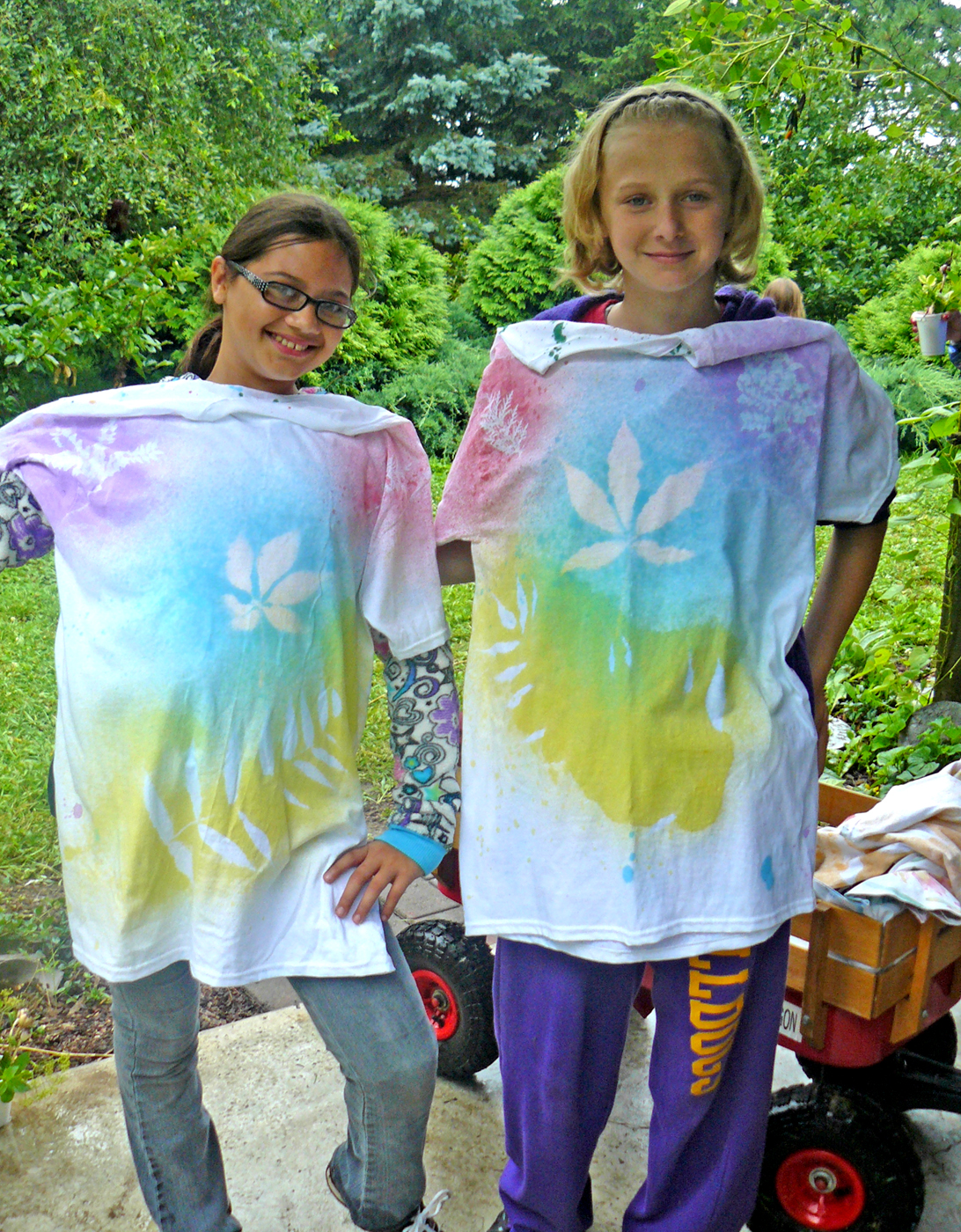
Modeling leaf resist t-shirts

Modeling leaf resist t-shirts

That young man was here with Charlene Finch and her Junior Gardeners from Continental. This was the second year that the group visited the Quarry Farm. They are one of best bunch of people we’ve ever met. Enthusiastic about everything, which is good since their day started here with rain. But since the shelter house went up last summer, the roof was ready and overhead. The new tent curtains were draw to the west and south, so the rain was hampered enough that kids and parents could make leaf shirts and select herbs for culinary, scent and healing bundles.

Charlene and her gardeners make herb bundles

Charlene and her gardeners make herb bundles

Charlene Finch started the Junior Gardeners group four years ago as part of her Defiance County Master Gardeners project. She liked it and the participants so much that she kept at it. Her own pocket paid for materials and seeds at

Costmary, an herb

Costmary, an herb

first. Now the group receives donations, holds 50/50 raffles and sells food at the Continental fall festival to fund summer gardening projects.

During the 2012 visit, Beatrice was just a piglet, a very shy one. Her encounter with Continental Junior Gardener Brandon was a positive turning point for us and Little Pig. Prior to the first trip, she wouldn’t let anyone close. But she liked Brandon. This morning as we all walked up the path to see the animals, Beatrice came at a trot, full grown and not a bit shy. Buddy and the goats were especially happy to see the 50-pound bag of peanuts that the group donated today.