The heat is muddening

Gertie and her makeshift beauty scrub

Gertie and her makeshift beauty scrub

Nothing profound to say here. July in Northwest Ohio is hot. After several days of rain, the outside air is also humid enough to pass as a perpetual steam bath. Or a mud bath in the goose water, if you’re Gertie and Beatrice.

I don’t want to hear anyone complain about their dog rolling in something and needing a bath.

Seriously. Ever.

Sixteen Chicks and a Kit

It’s only Tuesday and it’s already a busy week.

On Monday, we received a call from the Pandora branch of the United States Postal Service.

“There is,” a woman explained, ” a package for you.” Long pause. “And it’s talking.”

Chicks TiredThe chicks we’d ordered late last winter had arrived: five Black Australorps, five Black Giants and, as it turns out, six (though we only ordered five) Buff Orpingtons. Now ordinarily we don’t buy the animals that live here. There are more than enough domestics out there in need of a different situation that we don’t have to. But chickens? Well, they hold a special place in my heart and, frankly, they feed us. Not with their bodies; we’re vegetarians. But we have absolutely no issue with eating the eggs they produce, Chicksparticularly since the eggs they lay are infertile. This is not to say that we don’t take in wayward chickens. We do and have: Barbara the Australorp, Karen the Rhode Island Red and Big Girl, the Ameraucana,  just to name a few. But there’s something about raising a chicken from virtually her first breath. At least, there is for me.

Then, on Tuesday, today, we received a call from Nature’s Nursery Center for Wildlife Rehabilitation and Conservation Education. A couple in our county had found an orphaned red fox kit and were looking for assistance. I met Rachel and Andy in Ottawa in the parking lot of the local Rite Aid. They explained that they’d found him huddled next to a dead sibling and kept a watch out for the mother. 003When nearly two days had passed without an appearance, they took the kit in and contacted NN, which in turn called us. We provided him with a little watered down formula, which he gladly drank, and, since he was severely dehydrated, gave him a subcutaneous injection of sterile saline solution. So he’s here for the interim. Tomorrow, we’ll try him on a slurry of soft cat food and formula.

From there, thanks to Rachel and Andy, the sky’s the limit.

Three Goats, Two Humans and the Very Small Car

Goat CarFive years ago, while bringing Anne home from a stint on the EPA  vessel Lake Guardian, her car, a seven year old Toyota we bought used to begin with, gave up the ghost in dramatic fashion. As we came into Findlay from the east, the car gave a thump and a shudder and began belching thick, black smoke.

We limped into town and into the first car dealership we came to, then walked the roughly half-of-a-mile down to a second, having seen nothing we were interested in at the first. There Anne spotted a Scion xA and almost immediately fell in love. We had her old Toyota towed to the dealership and used it as a downpayment on what she now fondly refers to as her “little rollerskate.” If you’re unfamiliar with the xAs, they’re a smaller version of the current xD and similar in shape to the Honda Fit. In short, they’re microSUVs.

We’ve hauled just about everything in that little car: hawks, falcons, vultures, pigs, dogs, cats, ducks, geese, foxes, opossums, crows, owls over a dozen species of songbird, 55 gallon aquariums, bales of hay and straw and the list goes on. Most recently, Anne’s Little Rollerskate faced what we thought would be its greatest challenge: three pygmy goats.

Willow

Willow

We’ve talked for years about maintaining a small herd of dairy goats, but the closest we’ve come are Marsh and S’more, the two Nigerian Dwarf wethers that have lived on The Quarry Farm for nearly three years now. So, when we were told about these three goats, an intact buck and two does, we contacted the woman with whom they lived. As with so many others, the recession had hit her hard. Having been without work for months and still recovering from a necessary surgery nearly a year ago, she found herself without the means to care for her herd of goats. Most went to a local farm (she lives in Rootstown, south of Ravenna in eastern Ohio), but she was left with these three until she contacted The Quarry Farm.

Alaura

Elora

It was a miserable day for a drive when we left Putnam County. There was just enough snow to make the roads treacherous and it took nearly four hours to make a trip that should have taken only three. Add to that some skepticism on my part that we’d be able to fit three adult goats and ourselves in Anne’s little subcompact and it made for a tense trip.

As it turns out, I should have left my doubts at home.

Martigan

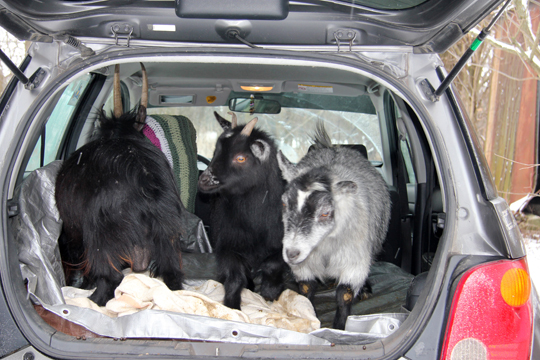
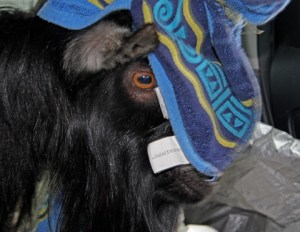
Once we arrived at our destination, we were delighted to discover that the goats were even smaller than we’d imagined. The older doe and the buck, Willow and Madmartigan respectively, stand no taller than eighteen inches at the shoulder, while Elora, the younger doe, is even smaller. Even with a full set of horns, horns that we initially padded turban-like with a towel, Madmartigan could easily stand up straight in the car, and all three were able to move freely around the cargo compartment.

Martigan Home

Martigan

The ride home was uneventful and we introduced all three to their new living quarters. Now they’re permanent members of The Quarry Farm family. And you’re all welcome to come and visit them and the rest of the facility. Just give us a call. We’ll be happy to show you around.

NOTE: Before anyone tells us that we have the wrong kind of goats for milking, we know. The animals that live here on the conservation farm of The Quarry Farm are here because, in almost all cases, they had nowhere else to go and we could offer them a home. Most do carry their weight: goats eat invasive plants, chickens give us eggs, Buddy and the geese guard the property, etc. The pygmies will make it possible for school groups and other visitors to see goats being milked. And we’ll have goat milk.

So. Routines.

Routines. We’re governed by them. The side of the bed we sleep on, the way we rise in the morning, break our fast, brush our teeth, the routes we take to work, slog through the day, reverse the route to work back home, eat our meals, play our games, relax, watch television, listen to music, then climb back into bed. Routines are comfortable. Routines are safe.

But they tend to engender complacency.

And then, all hell breaks loose.

BuddyHere’s a tidbit of information you may or may not know about The Quarry Farm: we practice a pretty rigid little bit of gender segregation where the outside farm animals are concerned. The girls, mostly the hens, live in their coop and are allowed free range of the property, at least the domesticated part of the property. The boys (and by “the boys” I mean Buddy, the miniature donkey, Marsh and S’more, the Nigerian dwarf goats, and Jeff, Ralph and Bernie, three production red roosters) live in a fenced-in paddock on the north side of the property. We keep them contained because Buddy, Marsh and S’more are always up for a short road trip (something the neighbors don’t always appreciate) and because the roosters are, well, roosters. Not only are their affections not always welcomed by the hens, they tend to get a little protective, a little aggressive toward anyone who gets near “their” girls. So there’s a fence. Think of it as a very large, communal chastity belt.

So. Routines.

In the evenings, as the sun begins to set, we work the property: the hens are enticed back to the coop, the duck and the geese are, likewise, encouraged into their shelters and the boys get a little more food, just a little bit of something to tide them over until morning. Yesterday, as we started our evening routine, Marsh and S’more were outside the paddock, roaming the property. While not the ideal situation and not how every day plays out, it’s not unusual for them to go over the wire. We’ve seen it before and we’ll see it again and there’s a routine for dealing with this, as well. Rather than tend to the chickens before visiting the paddock, the boys get their evening snack first. After all, the girls won’t go in with Marsh and S’more leaping in and out of their coop so we have to lure the boys back to the paddock. We trundle out a flake or two of hay and the boys trot along with us, occasionally rearing up and butting heads and practicing all of the other endearing behaviors that make goats such interesting animals.

GoatsEverything was going along according to routine: we had the hay and the goats had gamboled along with us back to the paddock and had run on in when the gate was opened. We carried the hay in, spread it out in their shelter and stepped back. Typically, Buddy will wade in at this point and control the feedlot. Typically. And here’s where complacency leaps up and bites: when you add a vowel and the typicalbecomes atypical. Because Buddy’s behavior is so uniform, so predictable, we’re sometimes careless about the gate. So, even as the goats were jumping to their meal, Buddy bee-lined over, pushed on by and out the open gate behind us.

Understand this: Buddy on the loose is a joy to behold and the epitome of frustration. He will trot by within hand’s reach, head high, ears back and then stop to crop grass, waiting until you’re certain he’s going to let you catch him up before taking to his hooves and trotting just out of reach. Watching him, you’ll swear he’s laughing as he passes by, nudging you in the process. And he can do this for hours, leading you on a merry chase across the property and beyond.

Last night, thankfully, it was a short romp.

With Buddy back in the paddock, we were back to routine: making sure the chickens were safe in their coop. There are thirteen hens: Karen, a Production Red; Barbara, a Black Australorp; Big Girl, an Ameraucana; and the ten remaining Priscillas, all of them Hubbard Golden Comets and the first chickens to come to The Quarry Farm. As part of the routine, we count them each night. Thirteen girls in the coop mean that none are at risk from any of a number of predators looking for an easy meal. Thirteen, for us, is a lucky number.

So we counted.

And came up with fourteen.
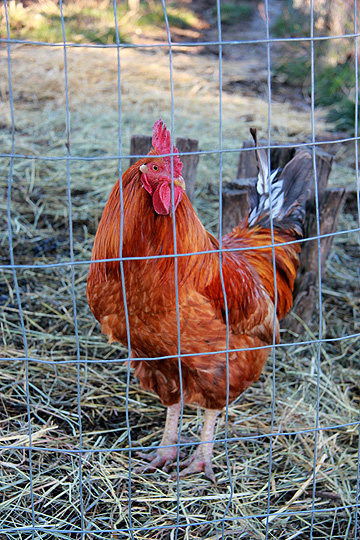
JeffDuring our episode with Buddy, Jeff made good his escape and slipped in with the girls. He’s done it before and we’ve even allowed him to stay in the coop for a night or two. But, as noted earlier, roosters get a bit possessive and protective of the hens they consider their own. So we decided to catch him up and take him back to his enforced celibacy. Jeff’s a docile bird, so getting him in hand wasn’t terribly difficult. Then it was simply a short walk and a quick drop over the fence. Done and done, right?

Not exactly.

As it turns out, Jeff wasn’t the only rooster interested in busting out. As we approached the paddock, Jeff in hand, we noticed Bernie scratching in the tall grass on the wrong side of the fence. Bernie, too, is a fairly docile bird, so long as there are no hens to battle over and you’re not wearing red. Having said that, he’s a bit less inclined to permit any kind of truly close contact than is Jeff. In other words, he’d greatly prefer it if you kept your hands to yourself and he’ll do whatever it is that he needs to do to keep it that way. For a third party, watching someone chase a chicken is slapstick the equal of anything that Hollywood has ever conjured up. For the one doing the chasing, though…well, that’s a completely different set of experiences. Chickens duck and jive as they run, juking this way and that in a series of quick dashes intended to confuse whatever predator happens to be chasing them. Couple that with the gathering dark and it took a good long while before Bernie was back with the boys.

As is the routine, here on The Quarry Farm.

POSTSCRIPT: Some of you may remember the storm that blew through the region this past summer. Last July, a derecho tore this county apart. While the damage inflicted on our little piece of the county paled in comparison to others, we did suffer one significant loss: Little Chicken.
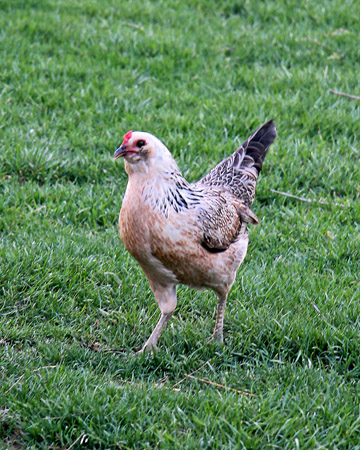
little chickenLittle Chicken was a bantam hen that split her time between The Quarry Farm and a little-used outbuilding on the property immediately adjacent to ours. She would come most frequently in the mornings and evenings, those times when we put out fresh food and water for the chickens that live here full time. The derecho caused significant injury to her nesting spot, the barn next door, and, after she failed to show up for over a week, we assumed her either an immediate casualty of the storm or easy pickings for some predator.

Last Sunday, we learned differently.

It turns out that Little Chicken, pushed out by the storm, wound up at the home of an acquaintance that lives about a mile away. Whether blown there or because she wandered there seeking new and more appropriate sleeping arrangements, we’ll never know. What we do know is that she’s found a wonderful new home, a home where she’s watched over and cared for.

So, apparently, the old adage is true: it’s an ill wind that doesn’t blow some good. And for the Siefkers, that good took the shape of Little Chicken.

They call her Clucks.

Passing Through

Orphans. The word conjures a host of images, mostly Victorian, of wide-eyed children dressed in rags begging on streets or, empty bowl in hand,  pleading for more; of row on row of narrow beds, each filled with a child praying for a good family. These are Hollywood images, as unrealistic in their portrayal of real orphans as television is in its presentation of detectives or living in New York City. They’re the only ones I know, though. The human kind, anyway.

But there are other kinds of orphans.

This year we’ve handled the usual: squirrels, opossums, vultures, swifts, starlings, sparrows and more, all either passing through our hands up to Nature’s Nursery or down to us from there for release or fostering. At present, we’re hosting two: a black squirrel and a Virginia opossum.

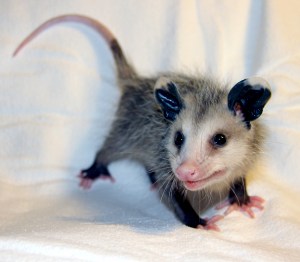
The opossum was one of six found on their dead mother (she was hit by a car). While we’re not certain how long the little ones were out there clinging to her corpse, it’s likely that it was quite a while. All six were slow and skinny and dotted with fly eggs. The worst part of such a case is that the young continue to feed from their mother and after she has died, the milk that sustained becomes corrupted, poisoned. Five of the six died. On the up side, the one that survived is strong and growing and shows no sign of becoming attached to the people fostering him. Just the opposite, in fact. He hisses and growls when we approach, bites when we lift him out to clean his temporary digs. He’s been here about a month and we expect that he’ll need to stay another before moving on and out there, on the Quarry.

The black squirrel is a new arrival, an intake from a Lima man who found him outside his apartment. After doing everything he could to reunite the little squirrel with his mother, James called us. This squirrel, like the opossum, is strong and a good eater. We’re providing a temporary safe haven for him. Tomorrow he’ll make the trip north to Nature’s Nursery where they have several other juvenile black squirrels.

Buddy’s Big Day

Tiger in the garden

The Junior Master Gardeners of Continental (Ohio) graced The Quarry Farm with their presence on July 11, the first group to visit since the big wind blew through. Although there are still a couple of downed trees here and there, the paths were clear and mowed in time for the travelers to arrive.

Led by Charlene Finch, the group of 20 adults and children of varying ages drove in around 10 a.m. to beat the afternoon heat. They divided into three groups to rotate through three different learning and activity stations.

Mints and other herbs and flowers are bundled

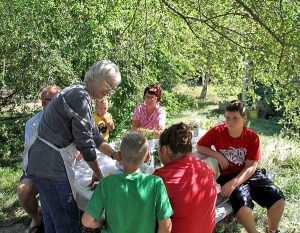
Group #1 met under the shady zelkova in front of Red Fox Cabin. From Board President Laura they discovered the history of the cabin and the grounds, the gardens and made herb bundles from cuttings gathered there.

Group #2 circled next to the ash stumps, recent victims of the invasive emerald ash borer. This was the perfect spot to hear Steve the Insect Guy talk about stream ecology, perfect because his roundtable included a meet-and-greet with riverine beneficial insects that grow up to combat harmful insects.

Meeting a dragonfly nymph

Group #3 walked to the farm animal sanctuary where they were heartily welcomed by Buddy the miniature donkey. Despite the white-hot rising sun, Buddy held his post at the southwest corner of the paddock and brayed greetings to each group, keeping up the conversation throughout their stay at the station. One volunteer in each group was assigned to pet Buddy so that he would keep quiet long enough for Beatrice the pygmy pot-bellied pig to come out and meet the kids. This event was the first educational outing for Beatrice. She took a special shine to a gentle boy named Brandon, allowing him to feed her a piece of apple. Geese and chickens checked out the group from a distance, as did the goats.

Buddy greets a gardener

After all groups had rotated through the stations, everyone met at the cabin for cookies, lemonade, ice water and a group photo on the front porch. Some strolled through the gardens to see the blooms of drought-tolerant flowers and to scout for butterflies and dragonflies. Many thanks to Board Secretary Rita for photographically recording the event and for sharing them for this post.

We’re Still Here

A downed tree blocks the footbridge

Last week’s derecho left a few downed trees over the trails here on the Quarry, but they’ll be clear by the time the Defiance County Junior Master Gardeners’ visit on July 11.

The big impediment to the clearing progress has been and still is the heat. Still no power, which means no blog, no running water nor AC and ice water for the our small clean-up crew. Blessings be on our neighbors for offering the use of their hand pump so the farm animals can be fresh-watered. The wading pool wasn’t filled fast enough for Beatrice the pygmy pot-bellied pig, though. Her Royal Porcine Highness did her best last evening to have a lie-down in the dogs’ water bowl.

If you’re out this way and have a cool, powered home with shower to return to, stop by for a nice game of pick-up-sticks along the paths. There could be a cookie or two in it for you at the cabin.

Recipe Share?

Help us combat voracious invasives in the kitchen! Or, as The Quarry Farm’s Board President Laura says, “If you can’t beat ’em, eat ’em” (thinly-disguised, blatant plug for one of the Quarry Farm’s presentations–see WORKSHOPS AND PRESENTATIONS).

I’m asking you to share any and all recipes using invasive flora. For instance, did you know that garlic mustard (Alliaria officinalis) is a year-round salad green?

Check out RECIPES FOR SUSTAINABILITY in the menu bar on The Quarry Farm home page. I’ll post shared recipes to that page as I receive them. Recipes don’t have to be for edibles. Who knows? Maybe your great-great aunt passed down a tried-and-true mosquito-repellent ointment recipe using juniper berries.

The Appalachian Forest Heritage Area offers the downloadable “Garlic Mustard: From Pest to Pesto, a Culinary Guide”. Now if we can just find a good use for Japanese honeysuckle… http://www.afha.us/garlic_mustard/gm_recipes.pdf

It’s All Give and Take

Trawling for Crumbs

Oftimes chickens giveth breakfast, yet other times they taketh away.

This morning I was out on the front deck encouraging Her Porcine Highness Princess Buttercup Beatrice to come in. I was eating a lovely ciabatta toast smeared with cream cheese and topped with lettuce fresh from the garden. When she came up the steps, I leaned over to pull a fuzz of some sort from her chin.

My mistake.

The Priscillas (all of the original Hubbard Golden Comets here are named Priscilla–another story for another time) had also come up the steps. One of them flew into the air and handily snatched my breakfast from my fingers and ran under the elderberry bush.

Toast Thief on the Run

We love our girls. They are beautiful, happy, insectivorous and give us the best brown eggs. But sometimes a friendly chicken just doesn’t honor that whole personal space thing.