In the footsteps of Fizz

Lolly There’s a man we admire who lives near the Forest of Dean. We are genuinely fond of him, though I don’t even know his name. I simply know him as The Tramp. He walks about the Forest, taking pictures of whatever catches his eye, turns his feet home and then cracks open his head and spills an absolute treasure trove of knowledge about the world around him into the ether (if you’ve not yet met him, haven’t found him through social media or some obscure search or simply missed him through sheer bad luck, here he is: https://atrampinthewoods.wordpress.com/). We do, however, know the name of his companion, his Sancho Panza. I think it’s probably safe to say that The Tramp would find his wanderings considerably less in so very many ways without her. Her name is Fizz and she’s every bit as curious about the world around her as any tramp.

But, why, you ask, are we bothering to discuss these someones that are half a world away? Well, first and foremost, The Tramp’s musings and observations are all of that and so much more. Read. Look. You’ll thank me for it. Thank me and The Tramp. And Fizz? Fizz is…well…Fizz. Second, it’s been said that imitation is the sincerest form of flattery and while I’m not above stealing an idea or three if I think it will help move everything along a bit more smoothly, I do draw the line at failing to give credit where credit is due. Having said that…

Here’s Lolly.Lolly crossing

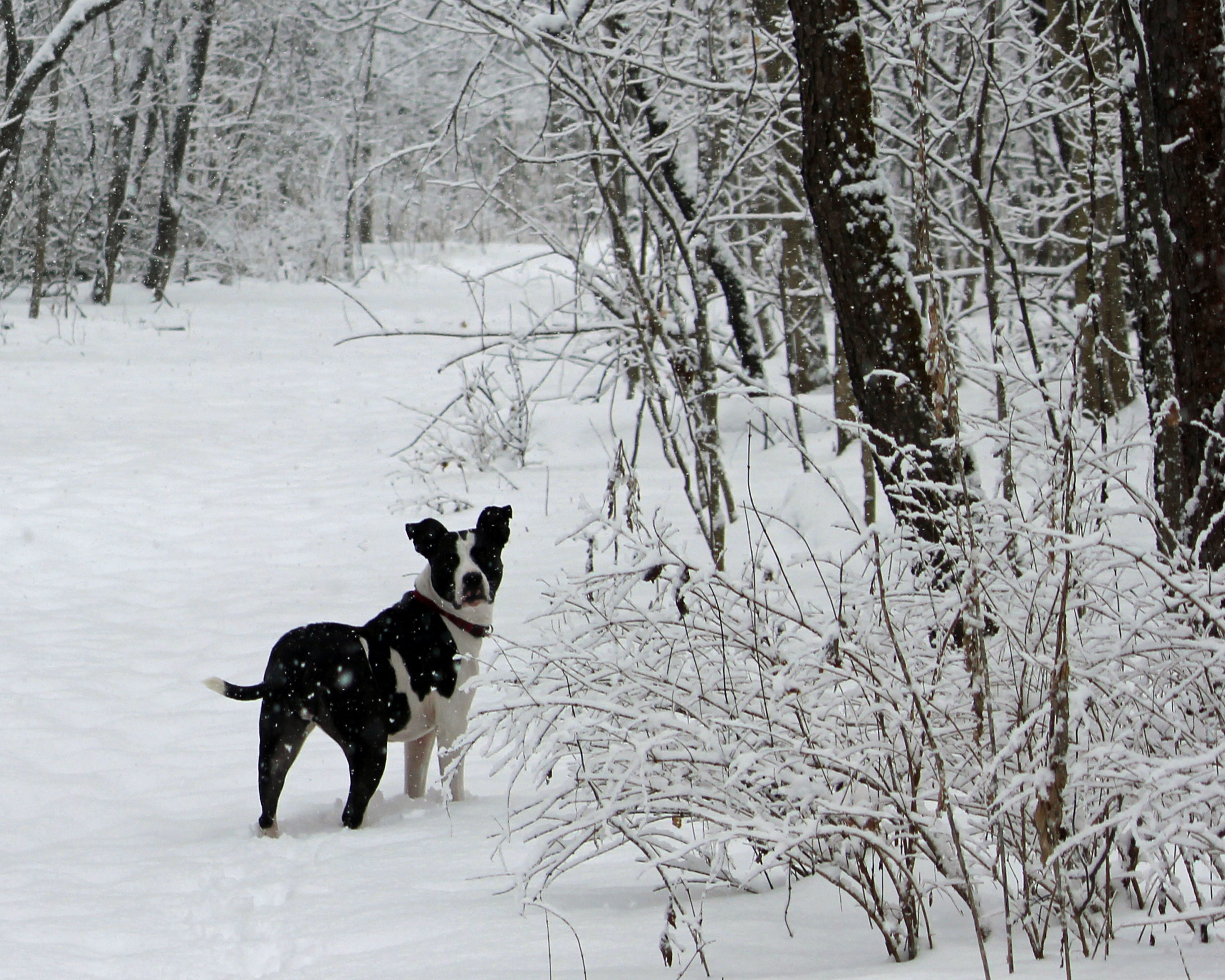
For those of you not near the here we’re at, it’s been cold; so cold that walks to retrieve the mail are arduous undertakings requiring planning, oversight and at least five layers of clothing. Today, however, (and likely tomorrow, if the forecasters read their scattered bones correctly, scried sincerely their battered leaves of tea), it’s been comparatively balmy; nearly 30° F. On Tuesday, though, we’re back into the basement, temperature-wise. So, given that we’ve been cooped up for the better part of a week, we threw open this window of opportunity and bounded back into the woods, Lolly, Anne and I.

DriftsFirst observation of the day: snow is ever so much whiter under the crust. The winds that have battered this area have stripped the topsoil from all of the surrounding fields and tossed it until it couldn’t be tossed any further. Where it falls it lays in blankets, ribbons and bands of varying shades of brown. Sometimes you don’t even notice it until you’ve taken a step or two, all that dirt being evenly distributed so that there’s just no way of knowing. Other times, you just can’t help but see.

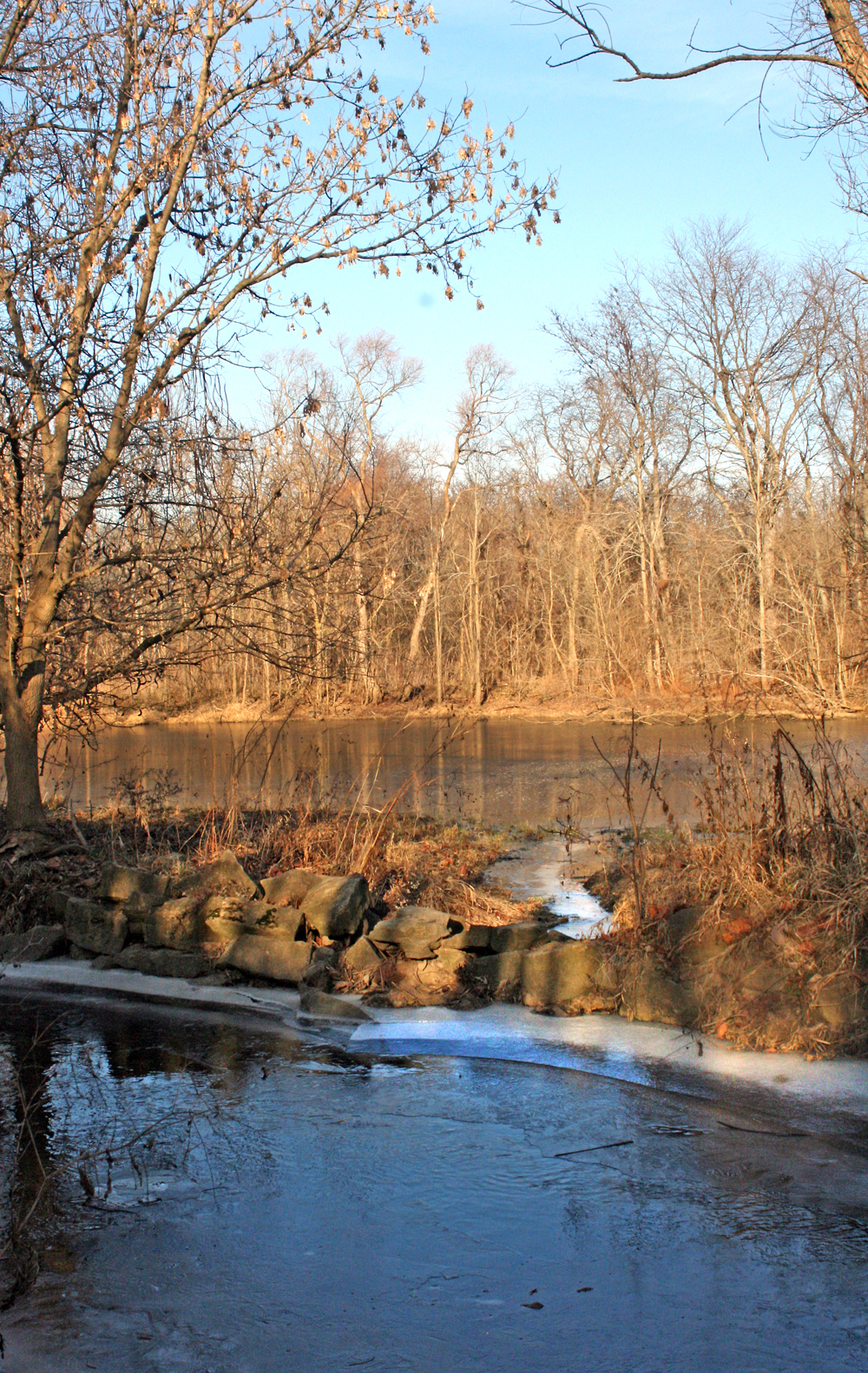
That same wind, though, did interesting things to what little snow has fallen, pushing what must have been little more than two inches of overall snow into two- and three-foot deep frozen waves caught in the process of cascading over the lip and down into the stream bed. Cranberry Run itself is frozen along most its sinuous length, with water breaking through the ice only along the most turbulent runs.Creek sculpture

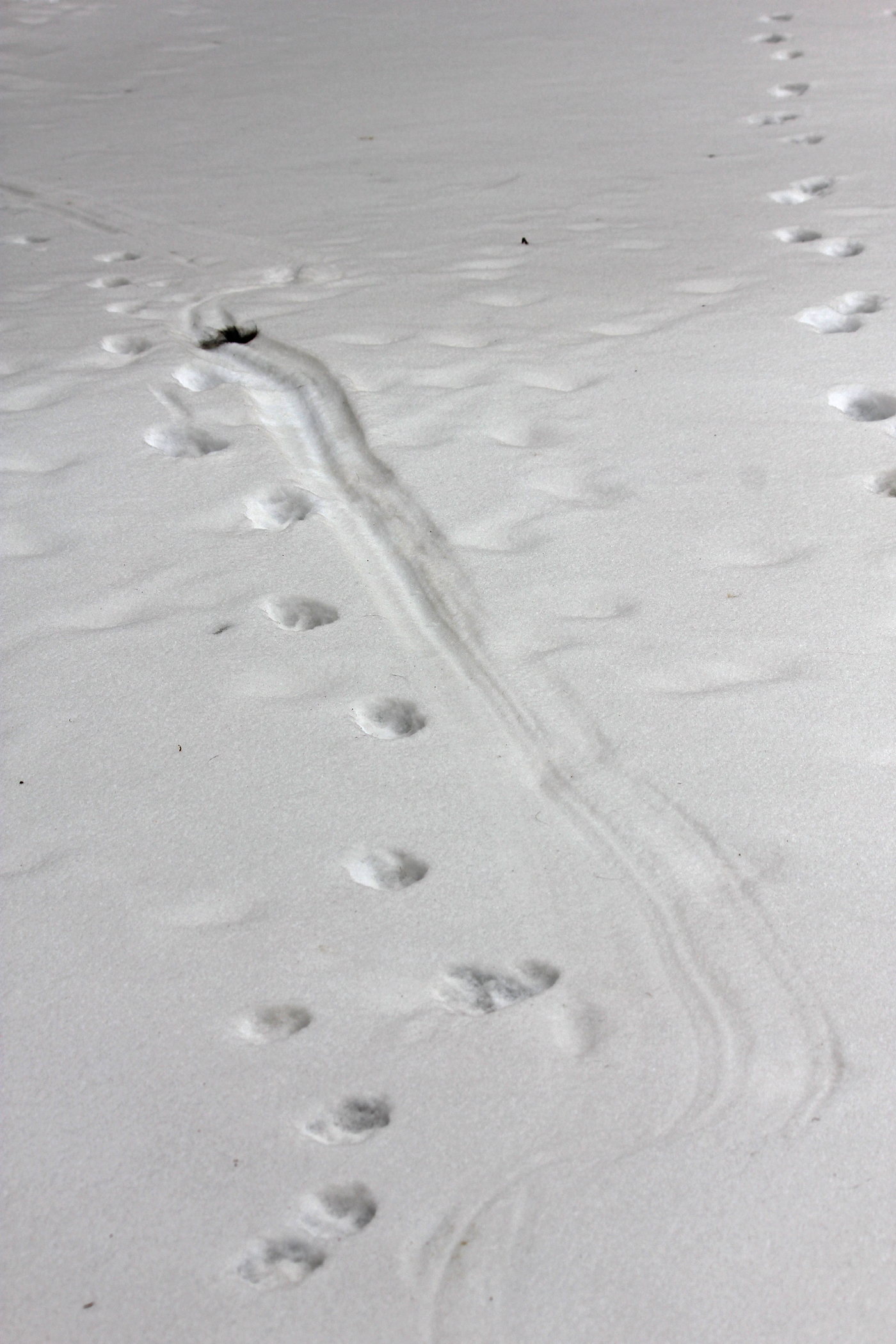
Tracks on QuarryOn the paths we’ve carved through the woods, down on the frozen stream and across the quarry itself were sign after sign after sign of the many and varied creatures that live here. Tracks of rabbit, squirrel and raccoon crisscrossed those of turkey and deer and a host of songbirds. There were even what we suspect were fox tracks and signs that at least one fox was successful at the hunt. Though we’ve not yet managed to photograph any of the foxes that we know live here (we know of two active dens), we hear them at night, interacting with one another in eerie, high-pitched yowls and sharp, barking yips and growls. We’re researching trail cams, at the moment to help us capture visuals and have acquired some sound equipment with which we hope to record the voices of The Quarry, once I’ve figured out how to effectively use it.

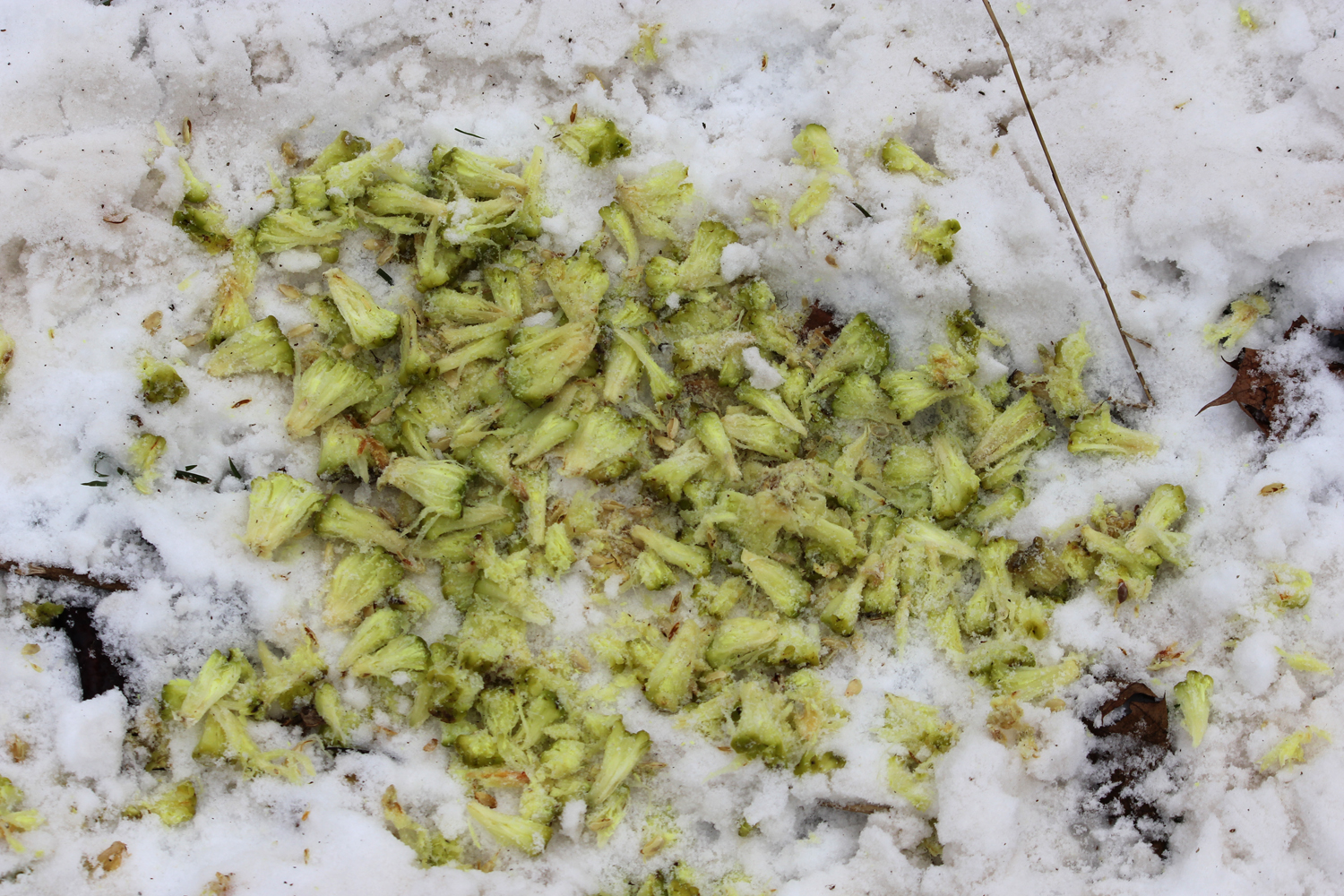
Fox SquirrelIn a tree on the spit of land separating Cranberry Run from the old quarry, a fox squirrel sat on a branch and watched us walk on by. He was fat and sassy and at least one of the reasons for Osage scrapshis good health soon became apparent. Scattered here and there were the remnants of osage oranges, the seed fruit of osage trees. The osage tree (Maclura pomifera), also known as the hedge or hedge-apple tree, is one of the most commonly planted trees in the United States and is used as a field hedge, wind break and to stabilize soils. Unlike apples, pears or cherries, the squirrels tear the tree’s green and yellow fruit apart to get at the seeds, not the flesh. Remnants of their feasts are scattered in oval patches here and there along the stream and back in the woods.

DownySparrowThough there’s little doubt that many simply went unobserved, there seem to be fewer birds about than in past years. We did, however, see various sparrow species, juncos, cardinals, bluejays and several downy woodpeckers flitting from and between the trees.

Tomorrow, if the prognosticators are correct in their prognostications, we’ll probably take the time to do this again.

A New Year’s Day walk below the wind

IMG_2737This new year looks bleak, with harsh, cold wind and an absence of snow. Thursday afternoon, I walked down the lane and had to fight to open the gate against bluster, feeling the cold bite of the latch’s surface through my work gloves. No one followed me to the gate in hopes of treats. I’m sure no apple slices could beat shelter on the sunny side of any outbuilding.

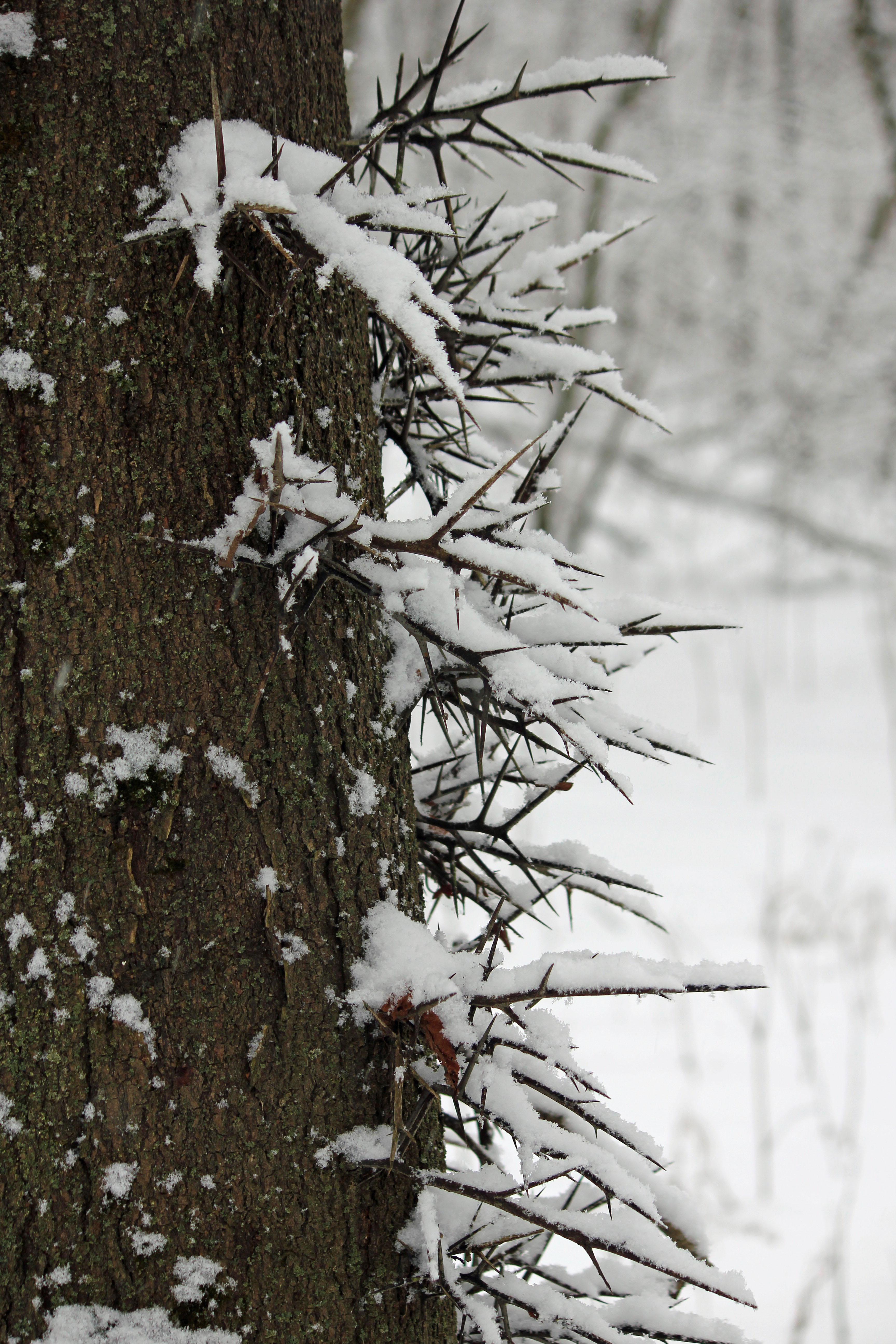
I made it just about 50 yards down the road before ducking down into the lowland along Cranberry Run, where the drop behind Red Fox Cabin blocked the wind. So cold were the trees that they hummed, except for Osage orange trees. These woven, thorny trees make sort of a whirring whine in frigid wind chill (truly exhilarating when one is walking on the trail at night…alone.)

IMG_2736Winter came on so suddenly that many of the Osage fruits are green and whole, their sticky white latex ooze flash-frozen to the ground. The fruit is not poisonous to us mammals, but I hear it’s not much to taste. Further on down the creek, on the east side of the footbridge, I saw something, maybe a fox squirrel, made use of an orange as a food source.

The sun is cold and farther away at the start of the year, a white sun in gray blue sky. Even the bane of the understory, bush honeysuckle, is leafless this year without a snow blanket. No green, other than the Osage fruits, was visible on Jan. 1, 2015. This is a good thing, I know; maybe this will give the maples and oak seedlings a chance to fill in the spaces left where the 2012 derecho took out so many mature trees.

IMG_2739IMG_2734The wind was so high and wild above the creek valley that I saw few birds, not even on the old stone quarry. This winter it is full of water, frozen with reflections of rich, ruddy browns, gold, and sky. There are no breaks in the still quarry’s surface, but Cranberry Run’s riffles keep a brisk pace, leaving open holes here and there, especially below the high blue clay banks at the northwest point of the nature preserve. Two birds, so in shadow that I couldn’t identify the species more than to say they are large songbirds, dipped in the water below a bare root hackberry that has held the top of the bank for as long as I can remember.

IMG_2741The camera, a treasured Rebel of my dad’s, said ‘no more’ to the cold, so I tucked it inside my blanket coat and headed back the way I came. At the top of the hill near The Quarry Farm entrance sign, I tucked my chin closer to the camera, wrapped my scarf around my head and ran for the gate.

With my eyes so adjusted to discerning the different hues of browns, the greeting party under the apple tree was a shock to the senses. Wrapped in new thermal coats, Buddy and the boys were like presents under the tree.

What a happy sight to begin a new year. Rain is promised for Saturday. Luckily, these coats of many colors are waterproof. I think I’ll stay inside and watch.

IMG_2730

New winter comes

Two hours and 20 minutes of 2014 remain to us in Northwest Ohio. If the National Oceanic and Atmospheric Administration has their way with us, we will feel the cold dry air become even more so as three more degrees slip away to 16 degrees F by the time the ball drops.
In the still cold outside, the Christmas solar bulbs hang in a sugar maple. A clear sky of stars and half moon will keep them glowing for a few minutes longer than in the past week of rain. We humans are snug inside, our toes snug in slippers and the rest of our persons wrapped in afghans and quilts, the extended version of “The Two Towers” onscreen to lead us up to the new year.
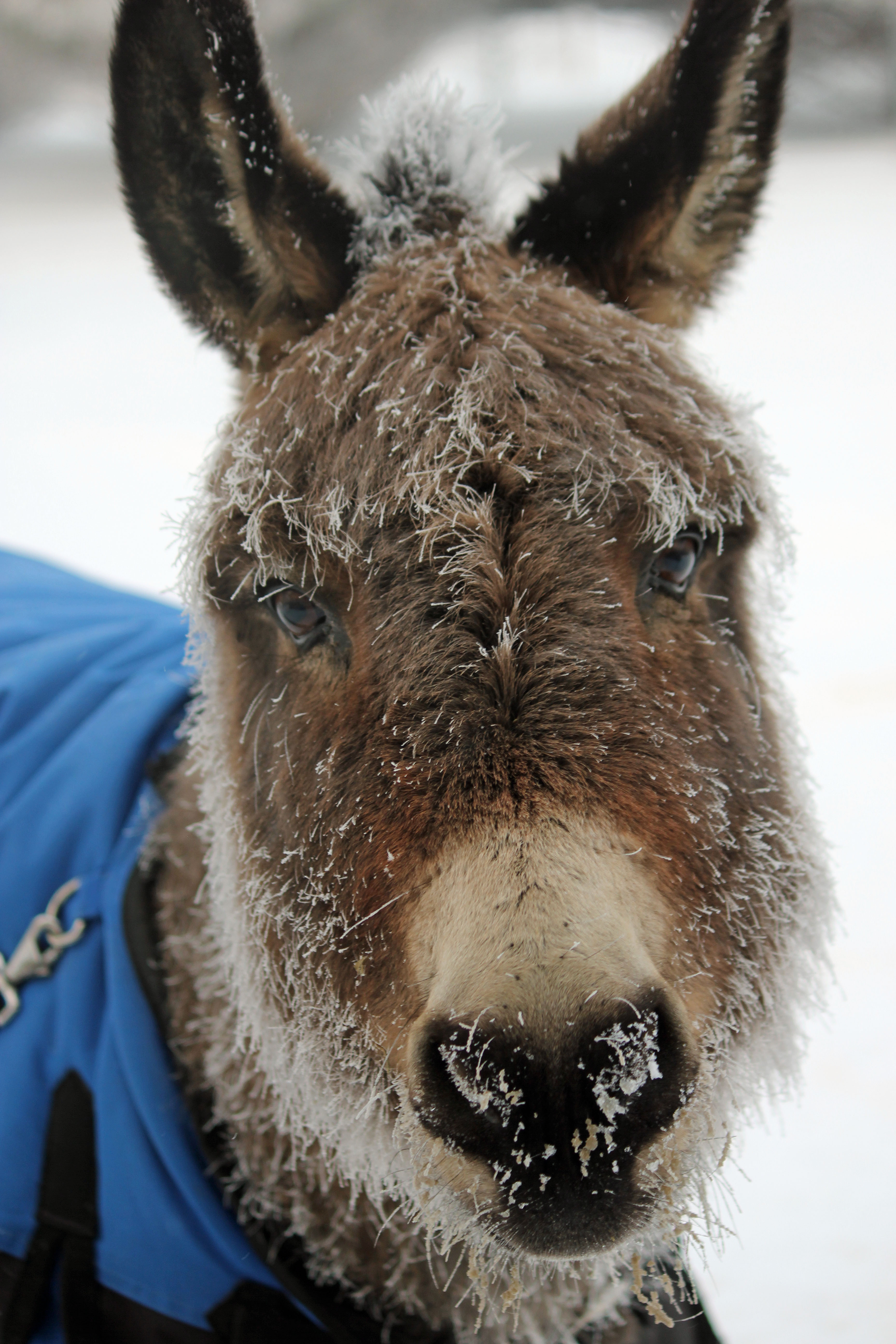
Outside in the farm animal sanctuary, under that sugar maple, donkey and goats are wrapped in the thermal coats that arrived this fall, winter wear purchased through the donations received throughout 2014. Oh, yes, there will be photos.
Buddy Vincent

Buddy visits a Seiler grandchild

Although 16 degrees F is a heatwave compared to the bone-deep bite felt this time last year, it warms the soul to see the little herd walk the moonlit paths from building to building, warm in their shiny new gear. Thanks to Ellen Seiler and her family, who visited on Sunday, there are apples out there, too. Nothing like a very cold, crisp apple to toast 2015. There are enough to share with the red fox pair that bark in the lowland.

Thank you to everyone who helped make 2014 a banner year on The Quarry Farm. Here’s to another year of star walks, art workshops, acoustic music, nature days and whatever else comes our way. We can share one major 2015 project heads up  with you: A whole lot of bush honeysuckle is going by the wayside, if your game for a pullin’.

Christmas readings with Captain John

One animal stayed outside in the winter snow to clean up after everyone else who snuggled inside the mitten. That’s what third grade students in Mrs. Arthur’s class at Pandora-Gilboa Elementary School found out this week when one class member invited Steve to read a story to his class.

PG visit3As a holiday treat, with language arts side effects, students were allowed to bring sleeping bags and pillows to class. They read favorite books in comfort and listened to visiting friends and family read out loud.

Quarry Farm friend Jaren asked Steve to be his reading guest. Steve chose to read Jan Brett’s The Mitten, a tale of woodland inhabitants who all find cold-weather shelter inside a mitten that was left alongside a trail.

If you’ve ever read The Mitten, you’ll know that quite a few animals, big and small, fit inside. But the Virginia opossum didn’t make the cut. We figure it’s because Nature’s garbage collector wandered on, cleaning up everything else that the bipedal trail walkers left behind.

PG visit2This being said, Captain John Smith*, The Quarry Farm educationalPG visit animal ambassador for Virginia opossums everywhere, accompanied Steve on the classroom visit. The Captain’s beautiful self was a hit, so much so that he was invited to visit Mrs. Henry’s class across the hall. But, since Captain John hadn’t had his breakfast yet, nor had he used the loo, Steve thought it best that the two of them return home.

There will be other visits. Like his namesake, Captain John Smith is up for the adventure. As he is nonreleasable due to his lack of fear, especially when it comes to humans like those that dropped that mitten, he benefits from the outing and is a wonderful guest.

* The opossum received its name in the early 1600s from Captain John Smith of the Jamestown colony in Virginia. Smith was trying to pronounce, for his mates across the pond, the word aposoum, a Virginia Algonquian word meaning “white beast.”

You’re The Great Pumpkin, Dave Hilty

There’s a story that makes the rounds every autumn on farms and in fields, and especially here on The Quarry Farm, about the generosity and beneficence of The Great Pumpkin, who rises from the pumpkin patch some time during the month of October and gifts all the good chickens and ducks and donkeys, turkeys and geese and goats and pigs with succulent orange orbs packed full of seeds and strings and goo. And while it’s rumored that the legend of The Great Pumpkin is born of humans, that particular mindset gains little acceptance on the farm, for it’s as the goats say, Humans spend most of their brainpower just maintaining their balance. And for the few that still might think otherwise, the donkey’s argument always prevails, one which he delivers in the most solemn of voices: Schulz, or no Schulz, Peanuts are for eating.

This year, as in years past, the residents here all waited anxiously as the month wore on, staring to the south for a sign of His (though some say Her) coming. Baskets of apples were delivered and pears by the bucketful and truckloads of zucchini and they were greatly appreciated, certainly, and swallowed down to the very last seed. But of The Great Pumpkin, there was no sign. October came and went and…

Nothing.

It’s just as we thought, the geese cried. Great Pumpkin, piffle. Great Poppycock is more like it. To which comment there was general agreement, particularly among the fowl (birds of a feather, you know). The goats made do, browsing the trees and bushes. Buddy, the donkey, cropped grass and chewed hay and if, occasionally, he seemed a bit tearful, nobody said a word. Little Pig, though, kept her own counsel and spent a good bit of each day off alone, walking along the southern fence line, eyes on the horizon, waiting.

And so it was that Little Pig was the first to see him: The Great Pumpkin, sitting in the cab of his red and silver pickup truck and towing along behind him a veritable mountain of pumpkins. A whole week late, he was, the first full week of November having past, but those that live here on The Quarry Farm are quick to understand simple truths: Time is fluid and Better late than not at all, not to mention All that matters is what matters in the end, especially when it’s pumpkins in the end.

The Great Pumpkin pulled in through the gate and up the stone drive before stopping and hopping down from his perch. To either side of the squash-laden wagon he threw the great round balls of sheer joy. The pumpkins bounced and broke and spilled their treasure of seeds and strings and slippery orange goo.

Heaven! Little Pig shouted. Slippery orange heaven!

The pumpkins flew and flew and still they flew and, finally, when the ducks and chickens and turkeys and geese and goats and donkey and pigs were certain that he had finished, when the blue and gray sky was no longer streaked with orange, what they heard him say made them all stop and stare.

How ‘bout if I just leave the wagon, The Great Pumpkin said. I won’t need it again ‘til spring.

turkey

They all looked to the wagon and it was heaped with pumpkins, mounded with pumpkins, buried in pumpkins as if not a single one had ever soared and fallen and broken and exploded in great gouts of seeds and strings and (heavenly) slippery orange goo.

The Great Pumpkin fiddled about a bit at the front of the wagon and then hopped into his red and silver truck.

Give a shout when you’re through, they all heard him say. No hurry, though.

The Great Pumpkin waved as he pulled away and through the gate, moving south until he’d disappeared from sight. Every duck and chicken, goose and turkey, donkey and goat and pig thanked him a big thanks before tucking into their chosen pumpkin. And if Little Pig was a bit greedy, if she pushed aside a goose or three to suckle at the slippery orange goo, nudged out of her way a chicken or a turkey or a duck, well, then, maybe she could find forgiveness in the eyes of those who keep the faith, in the hearts of those who believe.

POSTSCRIPT:
Special thanks to Dave and Jane Hilty, who are this year’s Great Pumpkins at The Quarry Farm.

Thank you for the BIG check

quarry farms - laura coburn

We want all of The Quarry Farm friends, family and neighbors, near and far, to know that we received grant funding from the Operation Round Up program as part of the Paulding Putnam Electric Co-op Trust.

Here’s how it happened: Anyone who is a PPE member rounds up their bill to the nearest dollar amount and the funds are pooled. Periodically, organizations are able to apply for community programming. We did, and our educational programming was elected to benefit from the program.

Yesterday, Board President Laura drove over to Paulding to receive the grant check (actual check much smaller than indicated here) so that we could provide more outreach during this year. By the way, take a look at those presentations and workshops that we do offer and give us a call or send us an email at thequarryfarm@gmail.com.

What and impact that just a few cents each month can make on a community.

Fall 2014 newsletter

Fall 2014 TQF Newsletter-1


The temperature may be dropping, but the beat goes on here on The Quarry Farm. Click on the newsletter cover over to the left and keep up with what’s happening in the pavilion, the sanctuary, the Red Fox and on the trails.

And speaking of trails, hope to see you on them this autumn.

preparing puffball

Gerald Owen Coburn, the man who first set foot to the path that led to The Quarry Farm as we know it, was, at his very core, an artist. It was with an artist’s eye that he looked on absolutely everything, particularly the natural world; a recurring theme in the body of work that he left, whether in paper, canvas, wood or stone. He was relentless in his desire to understand the world that he took to representing, primarily with brush, methodical and nearly clinical in his efforts to that end. And why not? It’s a fundamental truth that among the very many things that art is, it is most certainly science, peeled and filtered and laid out sideways so as to permit viewing from a different perspective.

One of the first Coburn paintings I had the opportunity to see was a watercolor. It depicted a young boy carrying in his arms what I first mistook to be a large stone, bigger than the boy’s head. It wasn’t a stone, though. It was a puffball, a fungus in the division Basidiomycota. To put an even finer point on it, it was probably Calvatia gigantea, the giant puffball, specimens of which commonly grow to a foot or more in diameter. Even more impressive, when they’re immature they’re not only edible, but supremely tasty. Be sure, though, that you are indeed in possession of an edible mushroom before taking a bite. If you have any doubts whatsoever, caution is the word of the day.

While puffballs are agreeable to most types of preparation, I have a fondness for them cut thick, breaded and sautéed. It’s simple, it’s quick and the results are noteworthy. Here’s how:

  • sliced puffballCut the puffball into ½ to ¾ inch slices. An immature puffball, when cut, will have a uniform white appearance. If they’re turning yellow on the inside, they’re too far gone to eat. Make a slit in the tough, outer skin and peel it away. It should come free quite easily.
  • Heat 2 tablespoons of cooking oil (each imparts its own flavor; choose to your taste) in a skillet over medium heat. Alternatively, use melted butter, but do not brown it. Dependent on the amount of puffball you’re preparing, you may need to add more oil or butter to the skillet as you go.
  • breaded puffballIn a pan large enough to accommodate the puffball slices, combine one egg with 1 ½ tablespoons of milk. On a different plate, prepare a bed of breadcrumbs. I’ve developed a preference for making my own, but store bought will do nicely.
  • Dip both sides of the puffball slices in the egg mixture, then dredge them through the breadcrumbs.
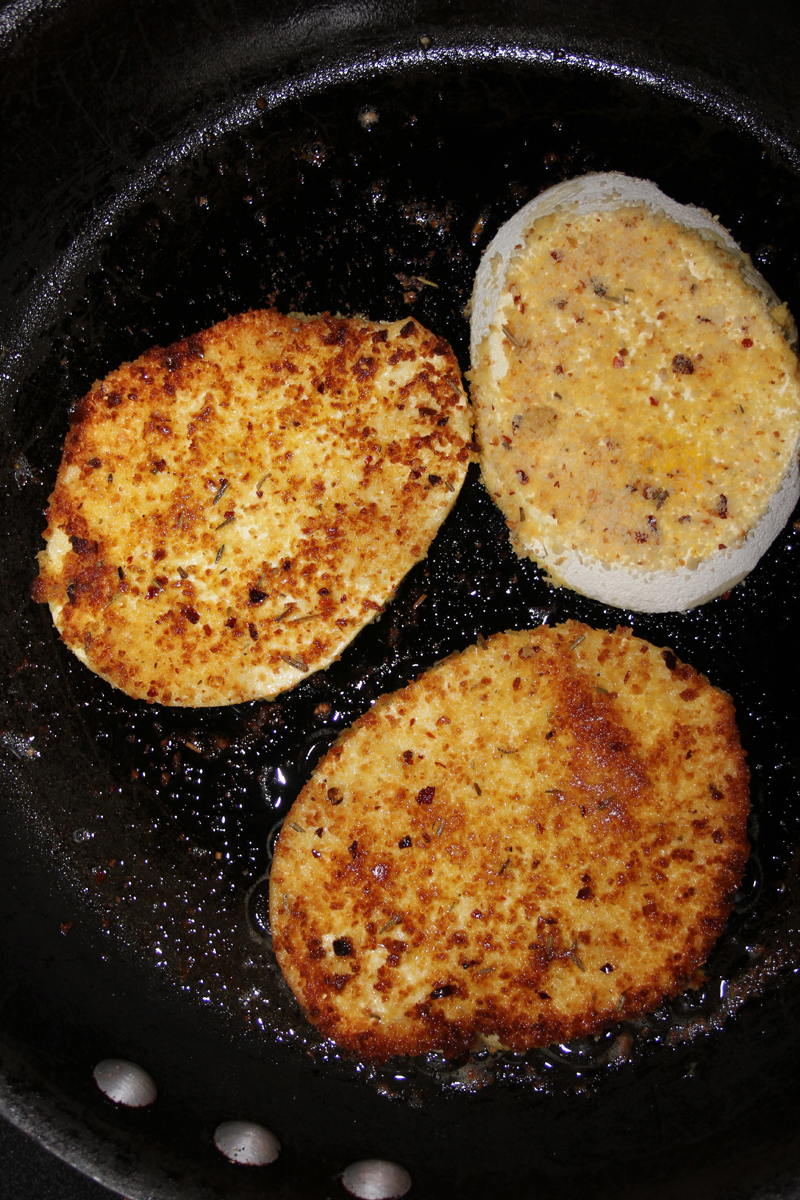
  • Sauté each side until golden brown, then drain momentarily on paper towels. Serve hot.

sautéed puffball

Unplugged at The Quarry Farm, second time around

Acoustic NightAbout the time that we spent a year visiting local classrooms and introducing students to aquatic health canaries like dragonfly nymphs and hellgrammites, yet before the first goat, pig or donkey had trotted onto the farm animal sanctuary —we hadn’t even thought of attempting a farm animal sanctuary — we pipe-dreamed of what might happen here on The Quarry Farm.Acoustic Night2

There is no state or even county park system in Putnam County, nor is there a nature preserve. As family and friends have long enjoyed the woods, stream, oxbow the old quarry itself, we began to develop a trail system that is more identifiable to those of us who just know the way.

With teachers in that circle of relationships, we began to plan educational programs. Visual artists are also part of the mix, so we crafted some 2- and 3-D workshops.IMG_1081

Then Steve said wouldn’t it be something to invite musicians/nonmusicians from all over to come here and play/listen for a night? So in October of last year we sent a few emails around, made a few phone calls, put out chairs, chips and cider and waited for people to show.

IMG_1082And they did. You may have read the post about Acoustic Night 2013. If not, it’s still in the archives. I will tell you that the photos are lovely, so lovely that we have gone annual with Acoustic Night.

On September 13, 2014, the skies were full of stars and cool temperatures kept the mosquitos away. Laura lit a fire in the Red Fox Cabin fireplace and kept hot coffee, tea and hot chocolate flowing. There were volunteer-baked cookies and muffins. I’m still not sure why she sent me to the store for Cheetos, saying, “Everyone likes Cheetos, even when they’re stale,” but I have to admit that I ate quite a few of the dusty fluorescent bits myself. I guess she was right.

1908061_875195272492033_3010147628062901086_nAnd Steve was right about Acoustic Night. Musicians from 2013 returned, and others just kept coming. Erin Coburn (guitar and ukelele) and Mark Gallimore (guitar) were back. Bobbie Sue, Zoe (saxophone) Mike (trombone), another Mike (guitar) and Clara (violin) jammed from 6 to 10 p.m. A few other people came through carrying guitars but played off to the side. 10624884_875195359158691_4731297319852830606_n

There were kazoos for the first 25 arrivals and I heard a few of those. Little Caroline became quite proficient, as a matter of fact. She was a hit with the bronze turkeys next door at the sanctuary.

If you made it out this year, thank you. I hope the Cheeto dust came off your pant legs in the wash. If not, we’re thinking Labor Day weekend for Acoustic Night 2015. The Cheetos will be fresh.

yesterday and today

Life in the DevonianBefore The Quarry Farm in its current incarnation, with Red Fox Cabin and the gardens and a forest and the sanctuary, there was the quarry farm, pasturage for cattle and two ponies. Before the quarry farm, there was a great forest of hardwoods, oak and hickory and maple, on the very southern edge of the Great Black Swamp. Before the forest on the edge of the swamp, there was a glacier that traveled inexorably south, planing everything before it flat. Before the glacier, there was a vast, shallow, warm sea boiling with life in what we’ve come to call the Devonian Period.

And we live there now, on the floor of a sea that died some four hundred million years ago. Even so, the reality of it remains.

crinoid segmentsThe Quarry Farm isn’t simply The Quarry Farm (though, to be honest, there is little simple about it). It is also literally our home. We built here fifteen years ago and when they excavated our basement, they pulled up all manner of wonderful things; bits and pieces of what once lived here that had turned, over time, into stone. There were round chunks of coral, too big to play softball, but too small for soccer, and flat sheets of dolomite speckled with clam-like brachiopods. Later, as we began to seriously explore Cranberry Run, we found smaller pieces of coral, smoothed by time and weather and water, and tiny stone discs and columns of discs: the individual segments and broken sections from the stalks of crinoids. And all of these things were evidence of what had once been, of an ocean with strange and fantastic animals that struggled for survival before ultimately, for some at least, making their way onto land to begin a whole new aspect of life.

Everything changes. Everything evolves.

Turkey VulturesCurrent scientific theory is that present day birds are what remain of the dinosaurs, that over the course of some fifty million years, dinosaurs shrank in size and developed feathers in greater abundance (while it was once thought that only avian dinos had feathers, discoveries in the mid 1990s indicated that even non-avian species, including velociraptors, were feathered to some degree). So, the blue jay in the yard, the crows in the spare bedroom, the turkey vultures that soar over the quarry, the ducks and geese in the stream…all descended from dinosaurs. And, oh yes, the chickens.

I spend a lot of time with the chickens that live here. There is something comforting about them; the nonchalant way that they roam the property looking for food, their quiet crooning. I enjoy their interactions Smart Girland I am particularly appreciative when one, or more, chooses to spend time with me, to sit beside me or in my lap and simply be. I find them calming and inspirational and a source of nearly endless fascination. As odd as it may sound, they bring me peace. Every now and again, though, they remind of me of where they come from, what they once were.

There is one hen in particular, an eighteen-month old Jersey Giant that, when we call her anything, we simply call her Smart Girl. Smart Girl will leap into the apple trees and throw fruit down. This isn’t some phenomenally new behavior; others have done it. But when she climbs, she always throws down enough apples to distract the other chickens, ducks, geese, goats and any other animal swirling about the base of the tree before throwing something down for her. She plans her actions. And, it’s possible, she hunts. On three different occasions, I’ve seen her run across the yard with a small adult bird in her beak. On a fourth, she was carrying either a small rat or a large mouse. It may be that she’s finding these animals, dead, on the ground or stealing them from a neighbor’s cat, but I can’t preclude the possibility that she is actively pursuing prey. Sometimes now, when I’m watching her as she roams the grounds of the sanctuary, I see her differently, her and the property she’s stalking.

Time travel, as it turns out, isn’t all that difficult. All you have to do is squint.

chicken feet 3