Routines. We’re governed by them. The side of the bed we sleep on, the way we rise in the morning, break our fast, brush our teeth, the routes we take to work, slog through the day, reverse the route to work back home, eat our meals, play our games, relax, watch television, listen to music, then climb back into bed. Routines are comfortable. Routines are safe.
But they tend to engender complacency.
And then, all hell breaks loose.
 Here’s a tidbit of information you may or may not know about The Quarry Farm: we practice a pretty rigid little bit of gender segregation where the outside farm animals are concerned. The girls, mostly the hens, live in their coop and are allowed free range of the property, at least the domesticated part of the property. The boys (and by “the boys” I mean Buddy, the miniature donkey, Marsh and S’more, the Nigerian dwarf goats, and Jeff, Ralph and Bernie, three production red roosters) live in a fenced-in paddock on the north side of the property. We keep them contained because Buddy, Marsh and S’more are always up for a short road trip (something the neighbors don’t always appreciate) and because the roosters are, well, roosters. Not only are their affections not always welcomed by the hens, they tend to get a little protective, a little aggressive toward anyone who gets near “their” girls. So there’s a fence. Think of it as a very large, communal chastity belt.
So. Routines.
In the evenings, as the sun begins to set, we work the property: the hens are enticed back to the coop, the duck and the geese are, likewise, encouraged into their shelters and the boys get a little more food, just a little bit of something to tide them over until morning. Yesterday, as we started our evening routine, Marsh and S’more were outside the paddock, roaming the property. While not the ideal situation and not how every day plays out, it’s not unusual for them to go over the wire. We’ve seen it before and we’ll see it again and there’s a routine for dealing with this, as well. Rather than tend to the chickens before visiting the paddock, the boys get their evening snack first. After all, the girls won’t go in with Marsh and S’more leaping in and out of their coop so we have to lure the boys back to the paddock. We trundle out a flake or two of hay and the boys trot along with us, occasionally rearing up and butting heads and practicing all of the other endearing behaviors that make goats such interesting animals.
 Everything was going along according to routine: we had the hay and the goats had gamboled along with us back to the paddock and had run on in when the gate was opened. We carried the hay in, spread it out in their shelter and stepped back. Typically, Buddy will wade in at this point and control the feedlot. Typically. And here’s where complacency leaps up and bites: when you add a vowel and the typicalbecomes atypical. Because Buddy’s behavior is so uniform, so predictable, we’re sometimes careless about the gate. So, even as the goats were jumping to their meal, Buddy bee-lined over, pushed on by and out the open gate behind us.
Understand this: Buddy on the loose is a joy to behold and the epitome of frustration. He will trot by within hand’s reach, head high, ears back and then stop to crop grass, waiting until you’re certain he’s going to let you catch him up before taking to his hooves and trotting just out of reach. Watching him, you’ll swear he’s laughing as he passes by, nudging you in the process. And he can do this for hours, leading you on a merry chase across the property and beyond.
Last night, thankfully, it was a short romp.
With Buddy back in the paddock, we were back to routine: making sure the chickens were safe in their coop. There are thirteen hens: Karen, a Production Red; Barbara, a Black Australorp; Big Girl, an Ameraucana; and the ten remaining Priscillas, all of them Hubbard Golden Comets and the first chickens to come to The Quarry Farm. As part of the routine, we count them each night. Thirteen girls in the coop mean that none are at risk from any of a number of predators looking for an easy meal. Thirteen, for us, is a lucky number.
So we counted.
And came up with fourteen.
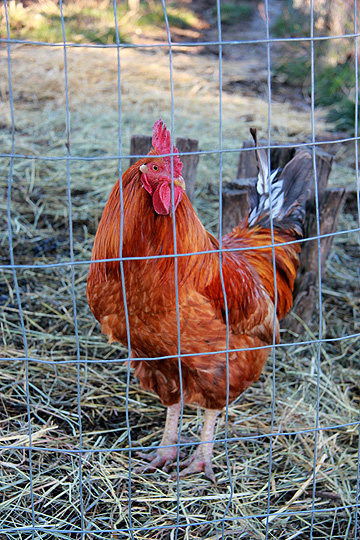 During our episode with Buddy, Jeff made good his escape and slipped in with the girls. He’s done it before and we’ve even allowed him to stay in the coop for a night or two. But, as noted earlier, roosters get a bit possessive and protective of the hens they consider their own. So we decided to catch him up and take him back to his enforced celibacy. Jeff’s a docile bird, so getting him in hand wasn’t terribly difficult. Then it was simply a short walk and a quick drop over the fence. Done and done, right?
Not exactly.
As it turns out, Jeff wasn’t the only rooster interested in busting out. As we approached the paddock, Jeff in hand, we noticed Bernie scratching in the tall grass on the wrong side of the fence. Bernie, too, is a fairly docile bird, so long as there are no hens to battle over and you’re not wearing red. Having said that, he’s a bit less inclined to permit any kind of truly close contact than is Jeff. In other words, he’d greatly prefer it if you kept your hands to yourself and he’ll do whatever it is that he needs to do to keep it that way. For a third party, watching someone chase a chicken is slapstick the equal of anything that Hollywood has ever conjured up. For the one doing the chasing, though…well, that’s a completely different set of experiences. Chickens duck and jive as they run, juking this way and that in a series of quick dashes intended to confuse whatever predator happens to be chasing them. Couple that with the gathering dark and it took a good long while before Bernie was back with the boys.
As is the routine, here on The Quarry Farm.
POSTSCRIPT: Some of you may remember the storm that blew through the region this past summer. Last July, a derecho tore this county apart. While the damage inflicted on our little piece of the county paled in comparison to others, we did suffer one significant loss: Little Chicken.
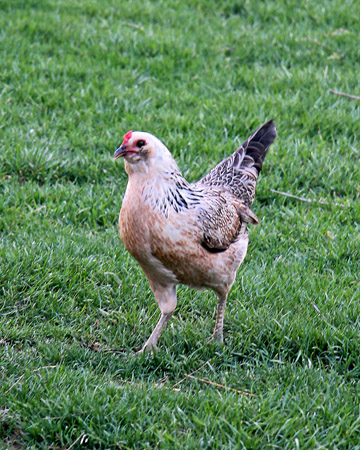 Little Chicken was a bantam hen that split her time between The Quarry Farm and a little-used outbuilding on the property immediately adjacent to ours. She would come most frequently in the mornings and evenings, those times when we put out fresh food and water for the chickens that live here full time. The derecho caused significant injury to her nesting spot, the barn next door, and, after she failed to show up for over a week, we assumed her either an immediate casualty of the storm or easy pickings for some predator.
Last Sunday, we learned differently.
It turns out that Little Chicken, pushed out by the storm, wound up at the home of an acquaintance that lives about a mile away. Whether blown there or because she wandered there seeking new and more appropriate sleeping arrangements, we’ll never know. What we do know is that she’s found a wonderful new home, a home where she’s watched over and cared for.
So, apparently, the old adage is true: it’s an ill wind that doesn’t blow some good. And for the Siefkers, that good took the shape of Little Chicken.
They call her Clucks.