One pumpkin to go

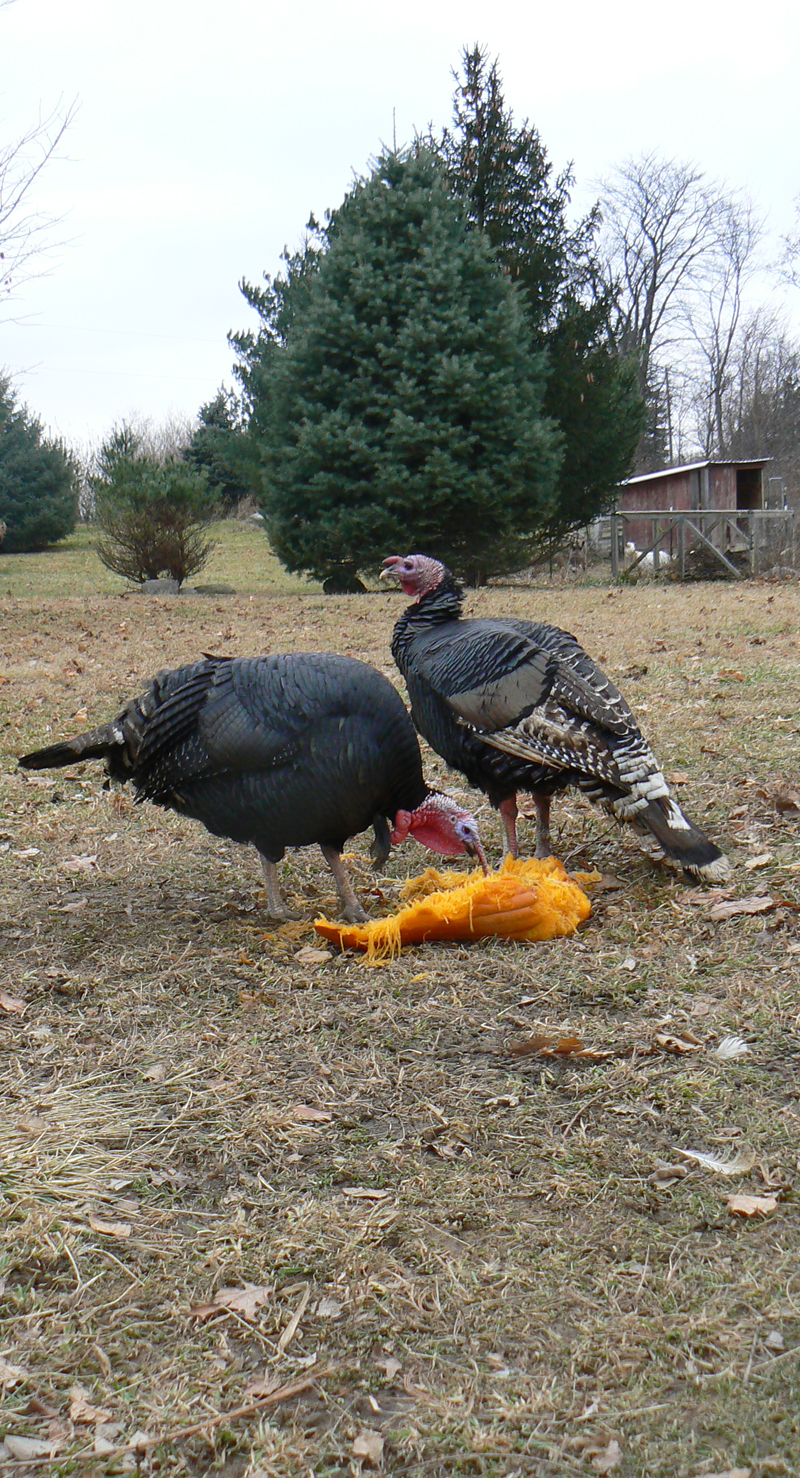
Inigo and FezzikHours before predicted temperature drops, 25 m.p.h. wind gusts, rain, snow and sleet (sneet), Inigo and Fezzik are finishing off the last of a frost-softened pumpkin. Marsh (upper right) worked his way through the dregs of another inside the paddock. Beatrice is just out of the frame, strings of orange squash trailing from either side of her jaws.

NOAA tells us that this latest roller coaster ride in the weather is due sometime this evening. For now, the air is mild enough for the hens, geese and goats to forage, and for Jo to caw at them from her window.

They do know something is coming, though, without Internet access. The animals are connected to everything in a way that humans lost long ago. So we watch them dance across the browned grass as they snatch seeds and midges that hatched in the warmth of last night. This is one clue that cold and wet is on its way. Another is the very fact that Marsh is in the paddock and not lazing with the other goats under the pines. He is keeping close to the shelter of a warm donkey and an east-facing outer wall.

One pumpkin is in storage, so to speak, under the roof of the pavilion beside Red Fox Cabin. That will be a treat to put out when the weather breaks on Sunday. That’s what the National Weather Service predicts, anyway. We’ll watch the animals on Saturday and let them make the final call.

The Quarry Farm Fall 2013 Newsletter

2013 Fall Newsletter-2Although predictions cast doubt on fall color in the Midwest, The Quarry Farm summer was brilliant. Fall is pretty fantastic, too. Check out the latest newsletter by clicking on the cover imaged here.

“Best field trip ever”

racg041193 031

One young boy shouted this as he was on his way back from the farm animal sanctuary this morning. How could it not be the headline today?

Modeling leaf resist t-shirts

Modeling leaf resist t-shirts

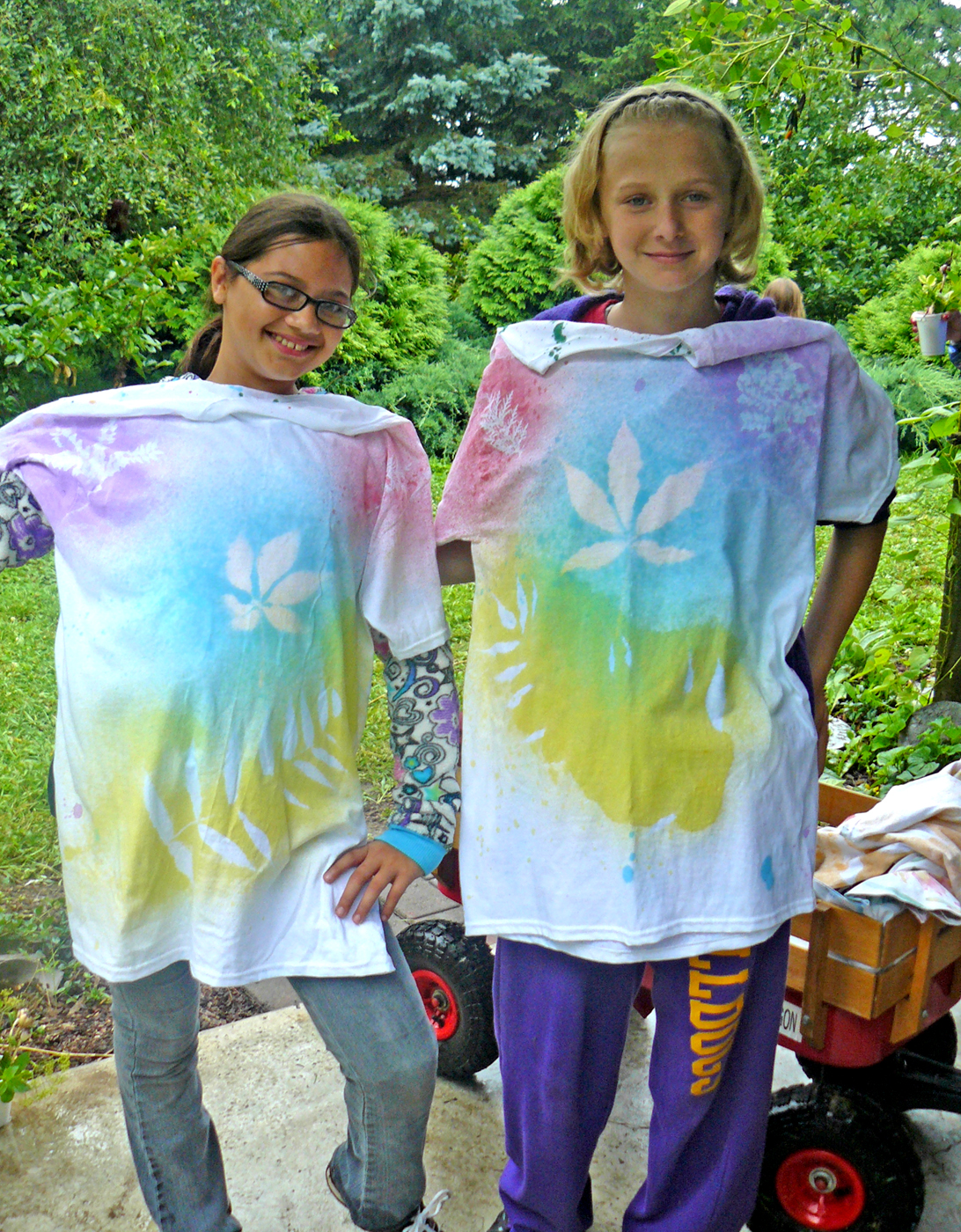
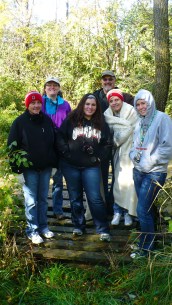
That young man was here with Charlene Finch and her Junior Gardeners from Continental. This was the second year that the group visited the Quarry Farm. They are one of best bunch of people we’ve ever met. Enthusiastic about everything, which is good since their day started here with rain. But since the shelter house went up last summer, the roof was ready and overhead. The new tent curtains were draw to the west and south, so the rain was hampered enough that kids and parents could make leaf shirts and select herbs for culinary, scent and healing bundles.

Charlene and her gardeners make herb bundles

Charlene and her gardeners make herb bundles

Charlene Finch started the Junior Gardeners group four years ago as part of her Defiance County Master Gardeners project. She liked it and the participants so much that she kept at it. Her own pocket paid for materials and seeds at

Costmary, an herb

Costmary, an herb

first. Now the group receives donations, holds 50/50 raffles and sells food at the Continental fall festival to fund summer gardening projects.

During the 2012 visit, Beatrice was just a piglet, a very shy one. Her encounter with Continental Junior Gardener Brandon was a positive turning point for us and Little Pig. Prior to the first trip, she wouldn’t let anyone close. But she liked Brandon. This morning as we all walked up the path to see the animals, Beatrice came at a trot, full grown and not a bit shy. Buddy and the goats were especially happy to see the 50-pound bag of peanuts that the group donated today.

The heat is muddening

Gertie and her makeshift beauty scrub

Gertie and her makeshift beauty scrub

Nothing profound to say here. July in Northwest Ohio is hot. After several days of rain, the outside air is also humid enough to pass as a perpetual steam bath. Or a mud bath in the goose water, if you’re Gertie and Beatrice.

I don’t want to hear anyone complain about their dog rolling in something and needing a bath.

Seriously. Ever.

Talking Turkey

Ready For Love

Ready For Love

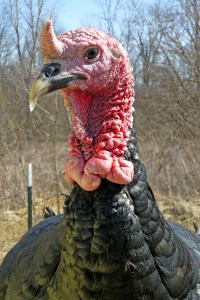
It’s spring, the time of year when love is in the air, or, as Walt Disney put it, when all the animals are twitterpated. Insofar as The Quarry Farm is concerned, noboby shows their love quite so dramatically as the two bronze turkeys we recently took in. The fact that both birds are male hasn’t dampened their ardor. Not one bit. They strut about the property, feathers fluffed and tails fanned, gobbling for all they’re worth. But it’s their heads that provide the real entertainment.

Not in the mood

Not in the mood

Turkeys, both wild and domestic, have two prominent features on and about their heads: wattles and snoods. The wattle hangs below the beak while the snood sprouts from the cere just above the bony part of the beak. During peak periods of romantic interest, both the snood and the wattle fill up with blood and turn bright red. Contrarily, when they’re scared, tired or simply don’t find you attractive, both features turn a grayish blue.

The Unbearable Lightness of Turkeys

Rear ViewDon’t let the turkeys get you down. Have you seen this thing? A simple drawing by Sandra Boynton of an elephant driven to its knees by six or seven of the aforementioned birds? It was everywhere for a while a long while ago (and apparently lives on as t-shirts, coffee mugs, posters and greeting cards; but, then, everything that ever was still is somewhere on the internet).

The message was simple: any troubles you have are analogous to turkeys and you shouldn’t let them get you down, those darn turkeys.

Big GuyYeah? Well, bunk. While I suppose that there are some turkeys out there that are a constant headache, that would do everything in their power to make a person’s life absolutely miserable, the turkeys with which I’ve interacted have been a pure joy. Case in point, the two newest residents at The Quarry Farm.

A couple of months ago, Laura Zitzelberger, operations director at Nature’s Nursery Center for Wildlife Rehabilitation and Conservation Education, contacted us about possibly taking in three bronze turkeys that had been seen wandering in a residential neighborhood in Toledo. And, while three were spotted, once volunteers from the center arrived on-scene, only two were found. Of the two, one was suffering from a variety of injuries (the consequence of getting on the wrong side of a dog). So, after Inigo, Willow and Fezzikrehabbing the bird and determining absolutely that these were indeed domestic and not wild turkeys (bronzes bear a remarkable resemblence to their undomesticated cousins), they contacted us late last week and made arrangements for us to pick them up.

We bundled them into the back of Rowan’s Subaru Forester and made the hour long trek back south to Putnam County where we set them up in the same run as Johnny, the Canada goose, and Andi, the Pekin duck. During the whole of the trip, despite being unceremoniously lifted from the home they had come to know and dragged into a whole new situation, not once did either bird make more than an idle and near-inaudible complaint.

So here they are now, these two birds we’ve dubbed Fezzik and Inigo. And glad we are that they’re here.

Snow Day

This morning, bands of clouds the color of dust stretched from the horizon to the sky. I know that sounds strange: of course the clouds stretched to the sky. What I mean to say is that the clouds didn’t lay horizontally across the heavens. No. Instead they seemed to start at some point on the horizon and launch themselves into space, like rocket trails or streamers of toilet paper. And when I say that they were the color of dust, I don’t mean gray. They were more beige with a little bit of peach thrown in, somewhere between a very light brown and red. And even though they weren’t red, I couldn’t help but think, “Red sky in morning, sailor take warning.”

As it turns out, that was more than a little melodramatic. But even so, the day had its moments. Every little bit a snow squall would blow through with heavy flakes swirling about making it hard to see, or with small, hard, almost-pellets of snow that would sting your face and hands. And it’s been cold, and growing colder as the day progresses. Thankfully, we held our Backyard Bird Count event (and more about that tomorrow) before the worst of it rolled in. Short, hard snowfalls offer interesting opportunities photographically, so we decided to take a few shots of the animals that live close to the house. These, then, also give us the chance to relate an anecdote or two, to introduce you to some of the animals that live here.

So. Here we go.

Gigi

Gigi

Gigi and Louise are two of four geese that live here on The Quarry Farm. Anne brought them home from Van Buren State Park near Findlay. She was there to give a presentation on water quality and macroinvertebrates about a year and a half ago when the naturalist who organized the event, Natalie Rossman Miller, conscripted Anne in an effort to trap two geese that were dumped at the park. Suffice it to say that, ultimately, they were successful, and Anne brought them here. Gigi is an Embden goose and, despite the name, entirely male (we’re not great at sexing birds at a distance; we once named a rooster Miss Kitty). Louise is an African goose and very much female.

Louise

Louise

These two, along with Henry, the other female goose (I know, I know) on the property, serve as our early warning system. On those occasions when the mail carrier has a package to bring to the house, or American Electric Power has come to read the meter, or someone has simply come to visit, these three make enough noise so that, even in the house we know that we have guests. And if we’re being completely honest, they make enough noise so that our neighbors a quarter of a mile away know that we have guests.

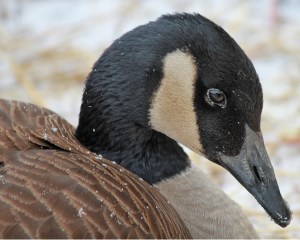
While we’re on the subject of geese, here’s Johnny. Johnny is a Canada goose. He was found oiled in Lima, Ohio. A local veterinarian took him on, cleaned him up and treated him for about a month before calling Nature’s Nursery Center for Wildlife Rehabilitation and Conservation Education. Over the course of that time, Johnny imprinted on humans.

Johnny

Johnny

In addition to that setback, Johnny also has a congenital wing defect; his left wrist never developed properly and consequently the end of his wing protrudes at a right angle to the rest of his body, precluding any possibility of flight. In Johnny’s plus column, however, is one of the sweetest dispositions of any animal, anywhere. This bird just doesn’t know the meaning of ill-tempered. When we pull into the drive, he greets us with a honk characteristic of all Canada geese, then rises up and beats his wings.

Little Red

Little Red

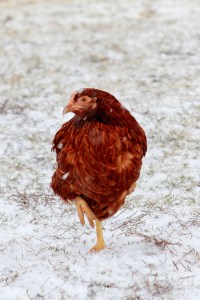
Nearly a month ago, we were provided with the opportunity to expand our flock of chickens.  A local farmer received an unexpected bonus shipment of pullets that increased his flock beyond his capacity to safely maintain. We took on fourteen of the hens, the most the farmer would allow us to acquire. In the overcrowded conditions to which the birds were temporarily subjected, they inflicted no small degree of damage to one another. Feathers were pulled loose until many of the birds were half-plucked. Their skin was raw and sore and, in some cases, infected. Despite our best efforts, four of the hens died. But, being the kind of people who believe that the glass is half full, ten survived and are thriving. One of them, a Rhode Island Red, is particularly friendly. She’s the first to bound out of the coop each morning and will run across the yard to greet us when we arrive back home. We call her Little Red.

(from left) Buddy, Marsh and S'more

(from left) Buddy, Marsh and S’more

Finally, at least for the purposes of this post, there are the boys: Buddy, Marsh and S’more. Marsh and S’more, two Nigerian Dwarf goats, came to us first, arriving in July of 2o11. They came to us from a family in Cincinnati. Although the family loved them their two large dogs didn’t and made life miserable for the brothers. In seeking a home for them, they contacted the American Society for the Prevention of Cruelty to Animals, and through them, us. Buddy, a miniature donkey, came from closer to home. A Putnam County couple kept Buddy as a companion for their horse. When it became too difficult for them to continue caring for the horse, they found it a new home. Sadly, the people who took the horse weren’t interested in Buddy. According to his old family, without companionship, Buddy began to waste away. They contacted us and Marsh and S’more became Buddy’s new buddies. And while they get along phenomenally, that doesn’t mean that they don’t have issues. Jonelle Meyer, a young woman who volunteers here at The Quarry Farm, recently told us of one such incident. As she was currying Buddy, the goats kept wandering up looking for attention. Buddy grew increasingly impatient with this until finally, when S’more refused to take the hint, he reached out, took the brush from Jonelle’s hand, smacked S’more in the face with the brush, then returned it to Jonelle so she could get back to what was really important: taking care of him.

A Long Overdue (but brief) Introduction

If you have ever had an affinity for writing, someone at sometime has said to you, “Write what you know.” It’s good advice. But what they don’t tell you is that sometimes what you know is what you love and, on occasion, you are so close to what you love that writing about it becomes more than simply difficult. Your love becomes a chasm that words can’t bridge. I’m going to type a word now that, to me, embodies this whole concept.

Crows.

It’s a little word and they are a common bird, but even so, I have been enamoured and fascinated by crows for decades. By those who study animal intelligence, they are widely considered the most intelligent of birds. They aren’t simply tool users, but meta-tool users, designing tools by which they can get a tool to accomplish a task. They raise their young in multigenerational family groups, teach specific lessons to their young who, in turn, teach their own offspring these self-same lessons, communally avoid areas of known danger and may even use the same insecticide (formic acid deliberately obtained from the crushed bodies of ants) they use to rid themselves of lice and other pests to attain a state of inebriation.

That’s right. Crows may get loopy on ant juice.

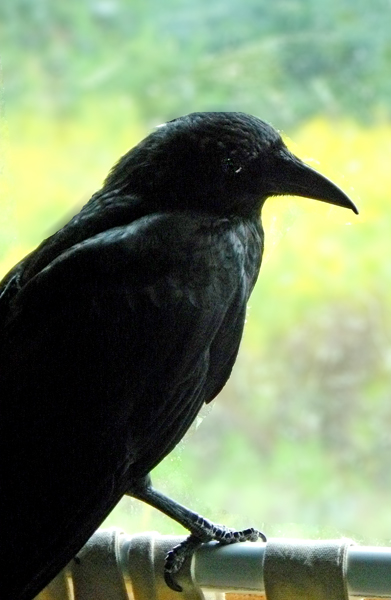
And here’s the rub: I live with two of them. Literally live with them. In my house. And have done so for over a year. Their names are Blackie and Jo. Both came to us through Nature’s Nursery Center for Wildlife Rehabilitation and Conservation Education. Blackie first and then Jo. Over that time, a day hasn’t passed that one or the other of the two hasn’t done something noteworthy, engaged in behavior that wasn’t worthy of mention. Even so, getting the concept of them down, the enormity of their impact on my life, has proven overwhelmingly difficult. So, although I’ve tried, and there are literally dozens of drafts on this site that support my claim, I haven’t passed along a single anecdote.

Until now.

To get to the meat of it, though, I have to seemingly stray away from the subject. Be patient.

Recently, we took in an additional fourteen hens. We acquired them locally from a pair of farmers who found themselves swimming in chickens. As I understand it, they were told by their supplier that their order of 150 chickens couldn’t be mailed, that they would have to drive to the hatchery and pick them up. Which they did, only to receive, a few days later, a shipment by mail of another 150. They were completely unprepared for so many birds, didn’t have the facility to house them all, although it appeared that they had tried. When we picked up our fourteen, the most the farmers were willing to part with, there were easily 200 hens and several roosters housed in a building no more than ten foot by fourteen. The birds had pecked each other raw, stripping the feathers from one another until many were half-plucked. To make a long story short, two of the chickens we took in have died, the (hopefully) last of them either late last night or early this morning. And now we get back to the crows.

Jo in WindowOf the two crows that live with us, Jo is my girl. We bonded immediately. She greets me each morning, and I, her. It’s a complex thing involving specific crooning vocalizations. We visit with each other and preen one another. And when I’m outside where she can see me, she caws loudly and sits on the windowsill, watching me as I go about whatever task is at hand. Today, the one she watched me perform was the disposal of the body of the chicken that had died sometime during the night. As I was coming back up to the house, in the window of the room where the crows stay, I saw a small blob of brown bobbing in the window. It was obvious that Jo was in the window waving something around, but it took me a moment to figure out what it was.

As I mentioned earlier, crows are highly intelligent and they need a variety of stimulations to keep themselves occupied. We give them puzzles to solve and simple objects that they find interesting. One of Jo’s favorite toys is one of those tiny little plastic ducks, and by little I mean just a couple of inches long and maybe an inch and a half high, that you find all over the place. I’m sure you’ve seen them: little plastic ducks dressed like firemen or doctors or executives or sports figures. At the very least, you get the picture.

Jo's ChickenIn this case, the little plastic duck looks like a little, brown, lifeless chicken.

And she was waving it in the window after watching me walk down the path behind our house with my own little, brown, lifeless chicken.

Think of it what you will. Maybe Jo was just showing off one of her favorite toys, trying to entice me back into the room for a little play time (which, by the way, she succeeded in doing). Maybe it was simply coincidence. It’s possible.

But I don’t think so.

No Point In Mopping

Winter 2013 TQF CoverThe word of the day is WET. The Quarry Farm, indeed all of Putnam County, went from snow and blue skies to green grass, brown fields, swollen and fast-moving streams and gray skies in 48 hours.

Saturday’s 60-degree temperatures saw the flock–all ten Priscillas, Barbara, Big Girl and Karen–out of the hen-house. As I cleaned their digs, as well as the goose buildings, the girls murmured their pleasure at being out to scratch in the grass and in their tunnels under the forsythia, elderberry and tamarisk. I swear they even purred.

Buddy brayed a few times, bringing me on the run to see what concerned our good guard donkey. Twice it was to let me know that Beatrice was thinking about visiting the neighbors. The third I found out later was because a pair of bald eagles had led a Gilboa couple from the Blanchard down the Riley Creek river valley to The Quarry Farm and the banks of Cranberry Run.

October BridgeLast night’s and today’s rains have laid low the eagles as well as the hens. The geese enjoyed splashing in the puddles, but the girls preferred to scratch through the fresh straw of the hen-house. Buddy stuck his head out a couple of times, but he and the goats mostly stayed high and dry. Not so for anything in the floodplain. Compare the photo taken during the fall photo shoot and sketch walk (right) to the one taken today of the same foot bridge and you’ll see that Cranberry Run has some receding to do from the rainfall, snowmelt and torrential runoff from surrounding fields. But if you scroll back to the January 1 post you’ll see how quickly the scenery changes here.

Here’s a little quiz for you: Your eyes and nose present clues that can help you determine cause and effect. We all know that. When you study the photo above of the flooded foot bridge (click for an enlargement) you can see different kinds of plants, trees, and even water. See the stacked foam along the bridge? What does an accumulation of six inches or more of foam along a water body’s edge indicate? Check back tomorrow for the answer.

flooded bridge

No doubt we’ll have clear skies and firm ground by January 19. Click on the cover of our current newsletter (upper left) to download the complete issue. You’ll find announcements for two upcoming events including this weekend’s first Stargazing Walk. Hope to have a good gathering for this new event. Mike Erchenbrecher is a dynamic speaker and educator. He’s one of those people who can draw you into a subject with his infectious love for all things earth science. Top that off with hot chocolate and a warm campfire and you couldn’t find a better way to spend your winter Saturday evening. Owl calling and counting is optional.

Since The Quarry Farm trails aren’t open to the public without appointment, at least until the boardwalks are in and the permanent trail markers are up, we ask that you call or email ahead. Plus we need to know how many lanterns to have on hand to light the way.

She’s Come a Long Way, Baby

001

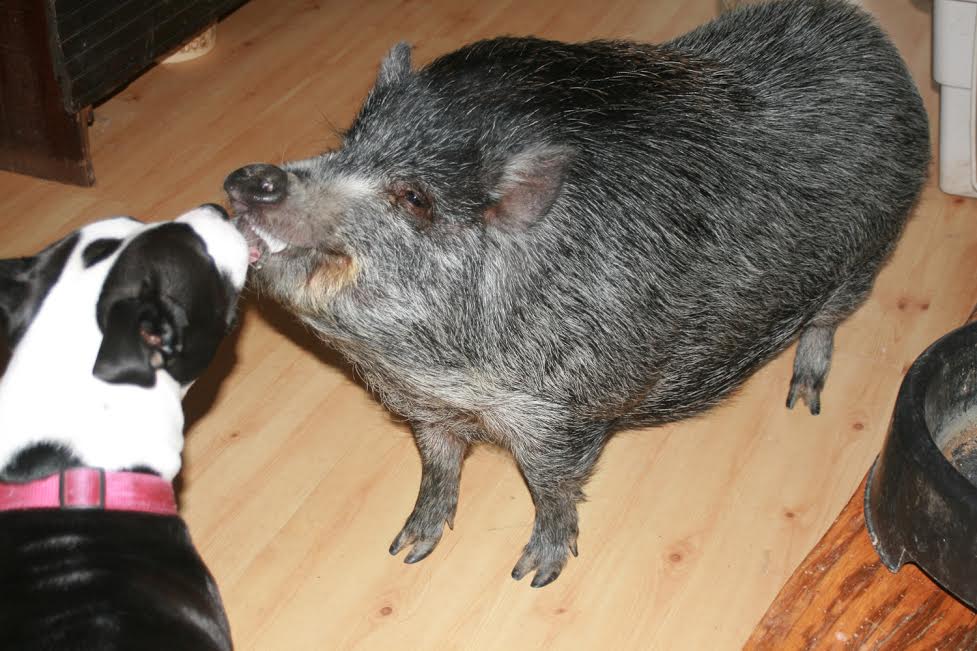
This is Gertie. Remember Gertie? She came to the Quarry Farm just a little less than a year ago, a few months before her apprentice Beatrice the pygmy pot-bellied pig.

Gertie is an eight-year-old, 140-pound (give or take) pot-bellied pig. Like so many pot-bellied pigs, Gertie found her self in need of rescue. Just do a search online for pot-belly pigs and you’ll find hundreds in need of good homes. They come from homes where, just like Easter chicks and bunnies, someone thought how cute it would be to have a sweet little pig to cuddle and take on America’s Got Talent or David Letterman. Then, just like the chick and the bunny, the pig grew.

In Gertie’s case, Gertie did have a loving home. But her person died, leaving no plan for her care. Gertie was lucky enough to make it to the Allen County (Ohio) Humane Society. They found us and Gertie found a home.

Although Gertie’s first person did give her a home, even that person didn’t know what it took to house a pot-bellied pig. When Gertie came to us, she was immensely overweight. Obesity and overgrown hooves left her very arthritic. Her skin was in terrible shape. Her eyes were gunky. And she was afraid and angry.

The caring people at the Humane Society tell us that they used to see who could get close enough to Gertie to touch the white star on her forehead. That should give you some indication of how afraid and angry Gertie was. She did become a favorite there, however, occasionally poking her head into various rooms to see what the staff and volunteers were up to.

Well, it’s been almost a year since Gertie arrived here in a white van. Thanks to the Lima Animal Hospital, Gertie’s hooves are to the point where she can almost walk up on her toes the way a pig should. It helps that she’s lost somewhere between 30 and 40 pounds. She is completely housebroken. Her skin is a little flaky but she loves to have that brushed. Like Beatrice, she even likes to have lotion rubbed into her skin (lavender and peppermint are favorites.) She has a glorious mane that stands strong up on the ridge of her back. And you can see from the photo that you can do more than dash in to touch her star. You can hug her sweet face and give the star a smooch.