Walk on the Wildflower Side

  • Mom and RowanOh, yes I did.

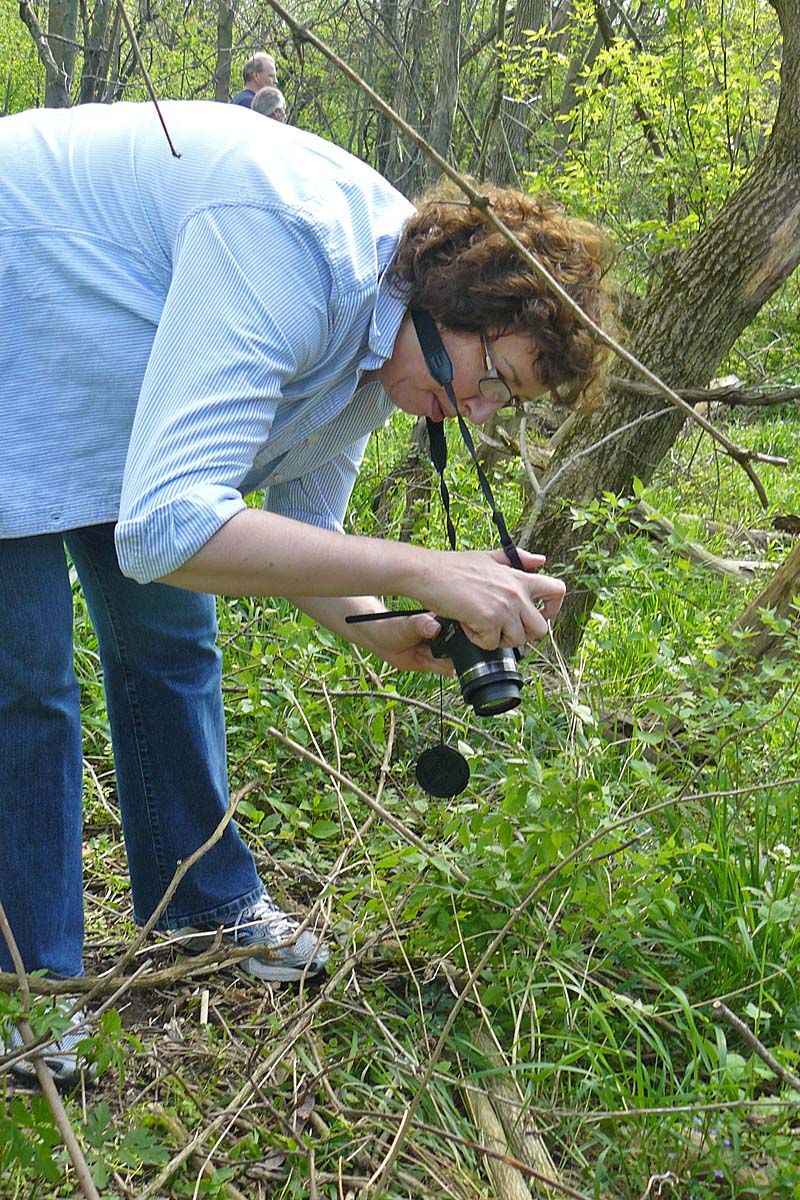
I titled this post what I did a) to get an eye-roll from you and b) because that is just what several of us did last Saturday. Cameras were slung over shoulders as intrepid amateur botanists crossed Cranberry Run to record spring wildlflowers on the Quarry Farm.

The “first really good time walking through the woods taking photos of pretty things” Spring Wildflower Photo Shoot and Sketch Walk resulted in a good list of the showiest wildflowers that Northwest Ohio has to offer in May. At least those that we could identify. 

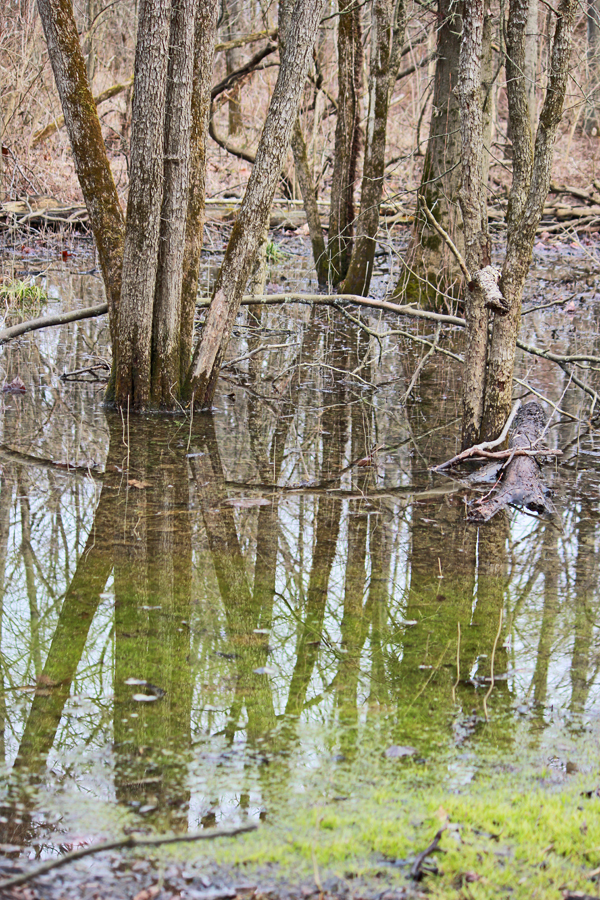
RMcKeeA late blooming season resulted in here-and-gone bloodroot blossoms and trout lilies, but we did see the distinctive foliage. The same cool conditions did mean that ramps were still green and a few Dutchman’s breeches were starched white and puffed. There is a new trail cleared for visitation around the old oxbow, a site rich with engraved brackets, soft moss and woodduck calls. An expanding forest of mayapples lines the ridge of this young path.

Here’s the list, common names only, and a few photos of flowers and other wild things seen that day. The gauntlet is down, Becky. Let’s see what you’ve got on your box.

  • Bloodroot (foliage)
  • Toadshade
  • Wood Violet
  • Cinquefoil (Common?)
  • Jack-in-the-Pulpit
  • Dutchman’s Breeches
  • Mayapple
  • Wild Ginger
  • False Solomon’s Seal
  • Spring Beauty
  • Cutleaf Toothwort
  • Dandelions
  • Creeping Jenny
  • Wild Geranium
  • Trout Lily
  • Ramps (stems and leaves)

This slideshow requires JavaScript.

This One’s for the Dogs (and the Opossum)

Rowan and OpossumIt’s been a bit longer than we like between posts. But since spring is finally here (knock on wood) you will forgive us since you, like us, are probably running around in today’s sunshine before tonight’s predicted rain.

Silence on the web does not mean it’s been quiet for The Quarry Farm. The new chicks are growing, as is the grass for Buddy and the goats. Fezzik and Inigo are displaying for every female fowl that could conceivably give them the time of day. Inconceivable? Not so for the little red hen that follows Fezzik around. The wild turkey hens on the nature preserve could care less, however.

Eventwise, The Quarry Farm has been on the road for the last couple of weekends. Saturday, April 20 took us up I-75 into Michigan for the Monroe Conservation District Tree Sale. Tim Kwiatkowski, good friend and conservationist for Michigan Agriculture Environmental Assurance Program (MAEAP), invited us, and an assortment of aquatic macroinvertebrates from Cranberry Run as well as an opossum that matured overwinter here, to be part of the Monroe County Earth Day celebration that was held alongside the tree sale pickup.

It was cold and the wind blew. Despite the weather thousands of trees were sold and the buyers learned a little about biological indicators and that Virginia opossums are fantastic garbage collectors. Some even decided the little guy was cute.

He was cute. And we assume he still is, wherever his nomadic opossum ways take him. Once the evenings warmed toward the middle of the week he finally ventured out of his open hutch and into the wild.

Cassie

Cassie poses

Today, we had a short drive to the 6th Annual Mutt Strut and Craft Market sponsored by Putnam Pet Pals to benefit the homeless and neglected dogs of Putnam County and Northwest Ohio. They do good work and put on a great, loud show every year at the Putnam County Fairgrounds. Last year we set up a table at the Strut; it turned out to be one of the best offsite events that The Quarry Farm has ever been part of as we handed out packs of newsletters, talked to some amazing, compassionate people, and produced more canine caricatures than we could track. Although this year’s weather was sunny and warm, a day for breeding garage sales and other such competitions for public attention, the fairground was still hopping.

Better make that barking.

Good times.

Sixteen Chicks and a Kit

It’s only Tuesday and it’s already a busy week.

On Monday, we received a call from the Pandora branch of the United States Postal Service.

“There is,” a woman explained, ” a package for you.” Long pause. “And it’s talking.”

Chicks TiredThe chicks we’d ordered late last winter had arrived: five Black Australorps, five Black Giants and, as it turns out, six (though we only ordered five) Buff Orpingtons. Now ordinarily we don’t buy the animals that live here. There are more than enough domestics out there in need of a different situation that we don’t have to. But chickens? Well, they hold a special place in my heart and, frankly, they feed us. Not with their bodies; we’re vegetarians. But we have absolutely no issue with eating the eggs they produce, Chicksparticularly since the eggs they lay are infertile. This is not to say that we don’t take in wayward chickens. We do and have: Barbara the Australorp, Karen the Rhode Island Red and Big Girl, the Ameraucana,  just to name a few. But there’s something about raising a chicken from virtually her first breath. At least, there is for me.

Then, on Tuesday, today, we received a call from Nature’s Nursery Center for Wildlife Rehabilitation and Conservation Education. A couple in our county had found an orphaned red fox kit and were looking for assistance. I met Rachel and Andy in Ottawa in the parking lot of the local Rite Aid. They explained that they’d found him huddled next to a dead sibling and kept a watch out for the mother. 003When nearly two days had passed without an appearance, they took the kit in and contacted NN, which in turn called us. We provided him with a little watered down formula, which he gladly drank, and, since he was severely dehydrated, gave him a subcutaneous injection of sterile saline solution. So he’s here for the interim. Tomorrow, we’ll try him on a slurry of soft cat food and formula.

From there, thanks to Rachel and Andy, the sky’s the limit.

Talking Turkey

Ready For Love

Ready For Love

It’s spring, the time of year when love is in the air, or, as Walt Disney put it, when all the animals are twitterpated. Insofar as The Quarry Farm is concerned, noboby shows their love quite so dramatically as the two bronze turkeys we recently took in. The fact that both birds are male hasn’t dampened their ardor. Not one bit. They strut about the property, feathers fluffed and tails fanned, gobbling for all they’re worth. But it’s their heads that provide the real entertainment.

Not in the mood

Not in the mood

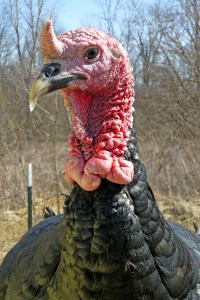
Turkeys, both wild and domestic, have two prominent features on and about their heads: wattles and snoods. The wattle hangs below the beak while the snood sprouts from the cere just above the bony part of the beak. During peak periods of romantic interest, both the snood and the wattle fill up with blood and turn bright red. Contrarily, when they’re scared, tired or simply don’t find you attractive, both features turn a grayish blue.

Signs

I woke up this morning with this in my head:

[In Just-]
by e.e. cummings

in Just-
spring when the world is mud-
luscious the little
lame balloonman

whistles far and wee

and eddieandbill come
running from marbles and
piracies and it’s
spring

when the world is puddle-wonderful

the queer
old balloonman whistles
far and wee
and bettyandisbel come dancing

from hop-scotch and jump-rope and

it’s
spring
and
the

goat-footed

balloonMan whistles
far
and
wee

I have a passion for poetry and cummings is one of my favorite artists. Inevitably, this particular piece of work comes to mind at some point in March. While not the first sign of Spring, it is a significant one for me. Still, you needn’t look to the page, or even delve into the convolutions of my sleep-addled mind to find the artistry of onrushing Spring.

Fox Squirrel Geese CabinOf late I’ve seen the return of turkey vultures and red-winged blackbirds and American robins in arguing masses so large that they’ve painted an acre of the big back field nearly white with their droppings. I’ve heard the buzz of a woodcock and the whickering of its wings as it flew toward the moon to prove its worth to a potential mate. Skunks and ‘coons and squirrels quarrel and fight in the woods and Canada geese and mallard ducks, in flocks and individual pairs, holler from the quarry.

Fairy Shrimp CircleTracksIn the lowest lying areas of The Quarry Farm, back in the woods and well below the quarry itself, on the ground referred to by locals as Coburn’s Bottom, vernal pools have already formed. These temporary ponds serve as habitat for a host of ephemeral animals: fairy shrimp and salamanders and mayfly nymphs and dragonflies. Within a few months, the pools will have evaporated, but their inhabitants remain in burrows underground or as eggs, tiny packets of a potential future.

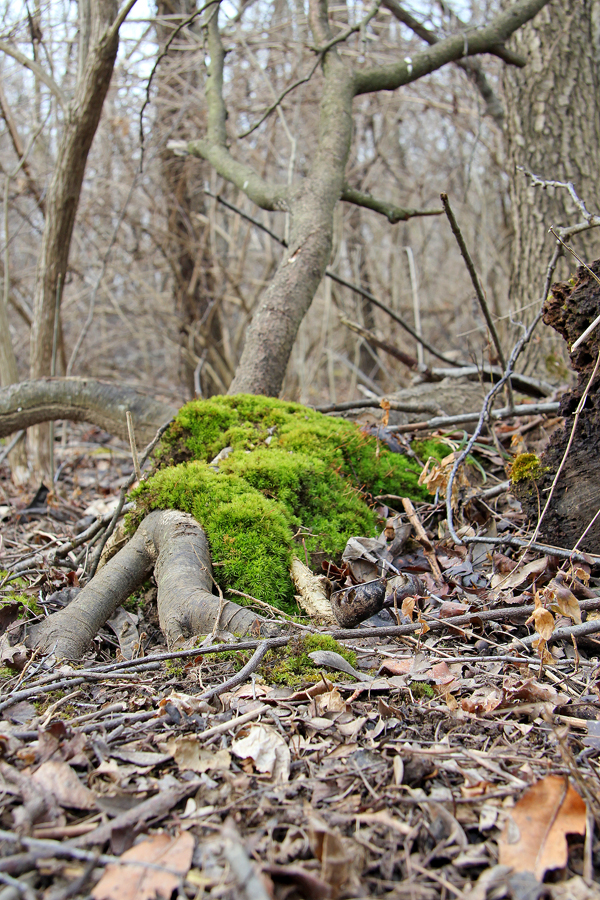
MossAnd then there’s the greening of the woods, with mosses already climbing up the trees and laying soft blankets on the ground. It’s easy to forget that this whole area was once rainforest. It’s easy to forget, that is, until you take the time to walk into an Ohio woods and take an honest look around. And if it’s not a matter of forgetting – if, in fact, you didn’t know – then the realization of where you are is an epiphany and you’ll never look at a stand of trees in Northwest Ohio in quite the same way again.

(e.e. cumming’s [in Just-] was originally published in The Dial, Volume LXVIII, Number 5: May, 1920)

The Unbearable Lightness of Turkeys

Rear ViewDon’t let the turkeys get you down. Have you seen this thing? A simple drawing by Sandra Boynton of an elephant driven to its knees by six or seven of the aforementioned birds? It was everywhere for a while a long while ago (and apparently lives on as t-shirts, coffee mugs, posters and greeting cards; but, then, everything that ever was still is somewhere on the internet).

The message was simple: any troubles you have are analogous to turkeys and you shouldn’t let them get you down, those darn turkeys.

Big GuyYeah? Well, bunk. While I suppose that there are some turkeys out there that are a constant headache, that would do everything in their power to make a person’s life absolutely miserable, the turkeys with which I’ve interacted have been a pure joy. Case in point, the two newest residents at The Quarry Farm.

A couple of months ago, Laura Zitzelberger, operations director at Nature’s Nursery Center for Wildlife Rehabilitation and Conservation Education, contacted us about possibly taking in three bronze turkeys that had been seen wandering in a residential neighborhood in Toledo. And, while three were spotted, once volunteers from the center arrived on-scene, only two were found. Of the two, one was suffering from a variety of injuries (the consequence of getting on the wrong side of a dog). So, after Inigo, Willow and Fezzikrehabbing the bird and determining absolutely that these were indeed domestic and not wild turkeys (bronzes bear a remarkable resemblence to their undomesticated cousins), they contacted us late last week and made arrangements for us to pick them up.

We bundled them into the back of Rowan’s Subaru Forester and made the hour long trek back south to Putnam County where we set them up in the same run as Johnny, the Canada goose, and Andi, the Pekin duck. During the whole of the trip, despite being unceremoniously lifted from the home they had come to know and dragged into a whole new situation, not once did either bird make more than an idle and near-inaudible complaint.

So here they are now, these two birds we’ve dubbed Fezzik and Inigo. And glad we are that they’re here.

And the Tally Is…

BirdingOver the course of a lifetime, we count any number of things: the number of cars we’ve owned, the dates we’ve had, the hours or minutes left before the end of the work day, the children in a school group we’re chaperoning and on and on and on. This past weekend, we counted birds. And it wasn’t just us, the folks who showed up at The Quarry Farm for this latest event. It was people all across North America and around the world participating in this year’s Great Backyard Bird Count.

Cooper's hawk

Cooper’s hawk

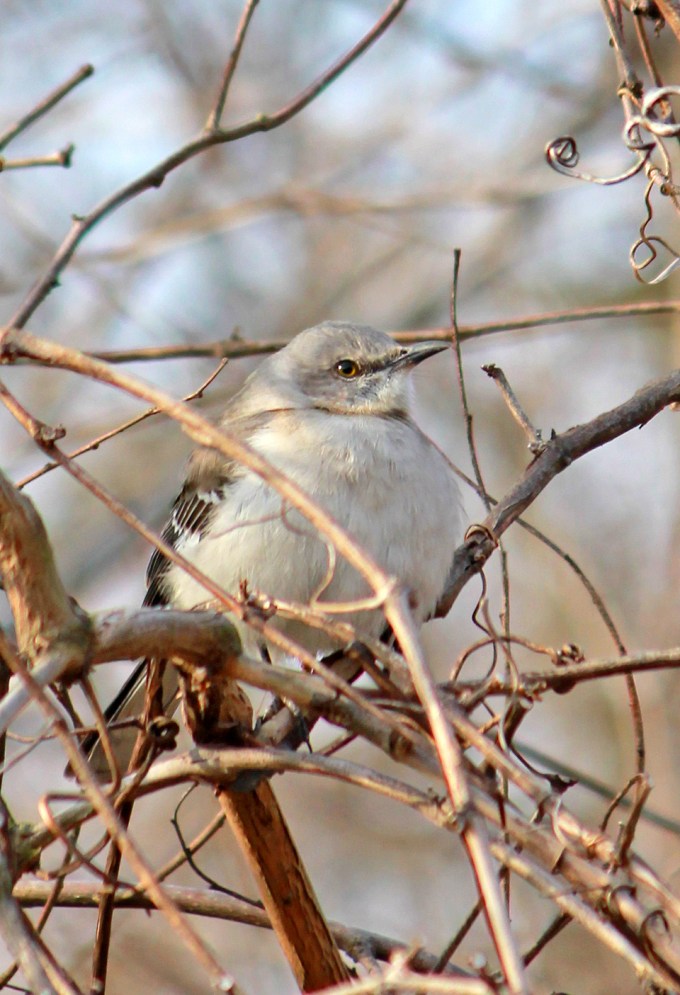
Sponsored by the Audubon Society, the Cornell Lab of Ornithology and Bird Studies Canada, this four-day annual event provides data about bird populations and migration to these giants in ornithological research. For us, the event has provided the opportunity to specifically record some of the birds that live here. The birds spotted and identified included: house sparrows, white-crowned sparrows, gold finches, white-breasted nuthatches, American crows, turkeys, great-horned owls, eastern screech owls, red-tailed hawks, Cooper’s hawks, juncos, American robins, Downy woodpeckers, red-bellied woodpeckers, hairy woodpeckers, northern cardinals, blue jays, horned larks, starlings, mourning doves, rock doves, brown creepers, Canada geese, mallards, great blue herons, black-capped chicadees, tufted titmice, song sparrows, dark-eyed juncos and one bird species that, a little over a year ago, perplexed more than a few of us.

Northern shrike

Northern mockingbird

Last year, on our annual Winter Walk, we discovered a vole skewered on a thorn in a hawthorn tree. At the time, none of us were sure how the vole came to be there, though we threw a lot of guesses around and came to the mistaken conclusion that a passing raptor had dropped its dinner and it was inadvertently pinned in the tree. Three seasons later, on yet another walk, a naturalist and amateur ornithologist told us that it was likely the result of a Loggerhead shrike pinioning the vole for later. Well, he was close. One of the birds we discovered on our walk was not the Loggerhead shrike, but the Northern shrike, a close cousin to the Loggerhead.

vole 1Although classified as a songbird, all shrikes share a behavior commonly associated with raptors: that is, they prey on small mammals, lizards and amphibians. Not only do they prey on these small animals, they store them away for later feasting by skewering their prey on thorns. So the cause of our earlier conundrum came clearly into view and was the highlight of our count this year.

It was a good weekend and a stellar bird count. In total, we identified nearly thirty different species of birds. That, and we definitively put to rest the bizarre and somewhat gruesome puzzle of the impaled vole.

This slideshow requires JavaScript.

Snow Day

This morning, bands of clouds the color of dust stretched from the horizon to the sky. I know that sounds strange: of course the clouds stretched to the sky. What I mean to say is that the clouds didn’t lay horizontally across the heavens. No. Instead they seemed to start at some point on the horizon and launch themselves into space, like rocket trails or streamers of toilet paper. And when I say that they were the color of dust, I don’t mean gray. They were more beige with a little bit of peach thrown in, somewhere between a very light brown and red. And even though they weren’t red, I couldn’t help but think, “Red sky in morning, sailor take warning.”

As it turns out, that was more than a little melodramatic. But even so, the day had its moments. Every little bit a snow squall would blow through with heavy flakes swirling about making it hard to see, or with small, hard, almost-pellets of snow that would sting your face and hands. And it’s been cold, and growing colder as the day progresses. Thankfully, we held our Backyard Bird Count event (and more about that tomorrow) before the worst of it rolled in. Short, hard snowfalls offer interesting opportunities photographically, so we decided to take a few shots of the animals that live close to the house. These, then, also give us the chance to relate an anecdote or two, to introduce you to some of the animals that live here.

So. Here we go.

Gigi

Gigi

Gigi and Louise are two of four geese that live here on The Quarry Farm. Anne brought them home from Van Buren State Park near Findlay. She was there to give a presentation on water quality and macroinvertebrates about a year and a half ago when the naturalist who organized the event, Natalie Rossman Miller, conscripted Anne in an effort to trap two geese that were dumped at the park. Suffice it to say that, ultimately, they were successful, and Anne brought them here. Gigi is an Embden goose and, despite the name, entirely male (we’re not great at sexing birds at a distance; we once named a rooster Miss Kitty). Louise is an African goose and very much female.

Louise

Louise

These two, along with Henry, the other female goose (I know, I know) on the property, serve as our early warning system. On those occasions when the mail carrier has a package to bring to the house, or American Electric Power has come to read the meter, or someone has simply come to visit, these three make enough noise so that, even in the house we know that we have guests. And if we’re being completely honest, they make enough noise so that our neighbors a quarter of a mile away know that we have guests.

While we’re on the subject of geese, here’s Johnny. Johnny is a Canada goose. He was found oiled in Lima, Ohio. A local veterinarian took him on, cleaned him up and treated him for about a month before calling Nature’s Nursery Center for Wildlife Rehabilitation and Conservation Education. Over the course of that time, Johnny imprinted on humans.
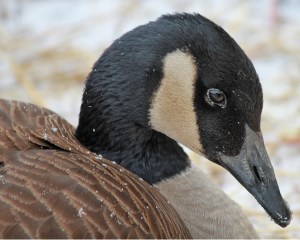
Johnny

Johnny

In addition to that setback, Johnny also has a congenital wing defect; his left wrist never developed properly and consequently the end of his wing protrudes at a right angle to the rest of his body, precluding any possibility of flight. In Johnny’s plus column, however, is one of the sweetest dispositions of any animal, anywhere. This bird just doesn’t know the meaning of ill-tempered. When we pull into the drive, he greets us with a honk characteristic of all Canada geese, then rises up and beats his wings.
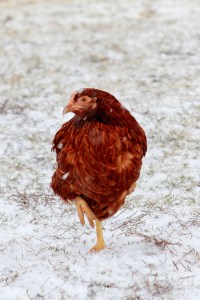
Little Red

Little Red

Nearly a month ago, we were provided with the opportunity to expand our flock of chickens.  A local farmer received an unexpected bonus shipment of pullets that increased his flock beyond his capacity to safely maintain. We took on fourteen of the hens, the most the farmer would allow us to acquire. In the overcrowded conditions to which the birds were temporarily subjected, they inflicted no small degree of damage to one another. Feathers were pulled loose until many of the birds were half-plucked. Their skin was raw and sore and, in some cases, infected. Despite our best efforts, four of the hens died. But, being the kind of people who believe that the glass is half full, ten survived and are thriving. One of them, a Rhode Island Red, is particularly friendly. She’s the first to bound out of the coop each morning and will run across the yard to greet us when we arrive back home. We call her Little Red.

(from left) Buddy, Marsh and S'more

(from left) Buddy, Marsh and S’more

Finally, at least for the purposes of this post, there are the boys: Buddy, Marsh and S’more. Marsh and S’more, two Nigerian Dwarf goats, came to us first, arriving in July of 2o11. They came to us from a family in Cincinnati. Although the family loved them their two large dogs didn’t and made life miserable for the brothers. In seeking a home for them, they contacted the American Society for the Prevention of Cruelty to Animals, and through them, us. Buddy, a miniature donkey, came from closer to home. A Putnam County couple kept Buddy as a companion for their horse. When it became too difficult for them to continue caring for the horse, they found it a new home. Sadly, the people who took the horse weren’t interested in Buddy. According to his old family, without companionship, Buddy began to waste away. They contacted us and Marsh and S’more became Buddy’s new buddies. And while they get along phenomenally, that doesn’t mean that they don’t have issues. Jonelle Meyer, a young woman who volunteers here at The Quarry Farm, recently told us of one such incident. As she was currying Buddy, the goats kept wandering up looking for attention. Buddy grew increasingly impatient with this until finally, when S’more refused to take the hint, he reached out, took the brush from Jonelle’s hand, smacked S’more in the face with the brush, then returned it to Jonelle so she could get back to what was really important: taking care of him.

Three Goats, Two Humans and the Very Small Car

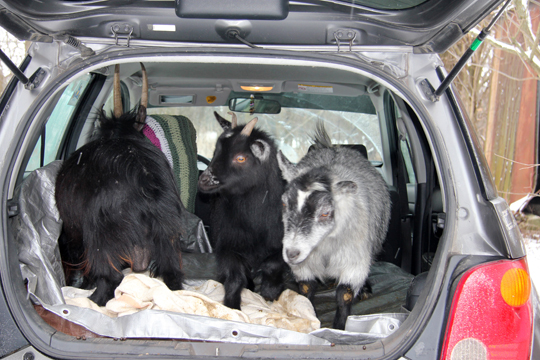
Goat CarFive years ago, while bringing Anne home from a stint on the EPA  vessel Lake Guardian, her car, a seven year old Toyota we bought used to begin with, gave up the ghost in dramatic fashion. As we came into Findlay from the east, the car gave a thump and a shudder and began belching thick, black smoke.

We limped into town and into the first car dealership we came to, then walked the roughly half-of-a-mile down to a second, having seen nothing we were interested in at the first. There Anne spotted a Scion xA and almost immediately fell in love. We had her old Toyota towed to the dealership and used it as a downpayment on what she now fondly refers to as her “little rollerskate.” If you’re unfamiliar with the xAs, they’re a smaller version of the current xD and similar in shape to the Honda Fit. In short, they’re microSUVs.

We’ve hauled just about everything in that little car: hawks, falcons, vultures, pigs, dogs, cats, ducks, geese, foxes, opossums, crows, owls over a dozen species of songbird, 55 gallon aquariums, bales of hay and straw and the list goes on. Most recently, Anne’s Little Rollerskate faced what we thought would be its greatest challenge: three pygmy goats.

Willow

Willow

We’ve talked for years about maintaining a small herd of dairy goats, but the closest we’ve come are Marsh and S’more, the two Nigerian Dwarf wethers that have lived on The Quarry Farm for nearly three years now. So, when we were told about these three goats, an intact buck and two does, we contacted the woman with whom they lived. As with so many others, the recession had hit her hard. Having been without work for months and still recovering from a necessary surgery nearly a year ago, she found herself without the means to care for her herd of goats. Most went to a local farm (she lives in Rootstown, south of Ravenna in eastern Ohio), but she was left with these three until she contacted The Quarry Farm.

Alaura

Elora

It was a miserable day for a drive when we left Putnam County. There was just enough snow to make the roads treacherous and it took nearly four hours to make a trip that should have taken only three. Add to that some skepticism on my part that we’d be able to fit three adult goats and ourselves in Anne’s little subcompact and it made for a tense trip.

As it turns out, I should have left my doubts at home.

Martigan

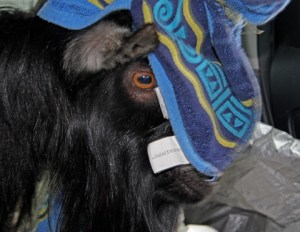
Once we arrived at our destination, we were delighted to discover that the goats were even smaller than we’d imagined. The older doe and the buck, Willow and Madmartigan respectively, stand no taller than eighteen inches at the shoulder, while Elora, the younger doe, is even smaller. Even with a full set of horns, horns that we initially padded turban-like with a towel, Madmartigan could easily stand up straight in the car, and all three were able to move freely around the cargo compartment.

Martigan Home

Martigan

The ride home was uneventful and we introduced all three to their new living quarters. Now they’re permanent members of The Quarry Farm family. And you’re all welcome to come and visit them and the rest of the facility. Just give us a call. We’ll be happy to show you around.

NOTE: Before anyone tells us that we have the wrong kind of goats for milking, we know. The animals that live here on the conservation farm of The Quarry Farm are here because, in almost all cases, they had nowhere else to go and we could offer them a home. Most do carry their weight: goats eat invasive plants, chickens give us eggs, Buddy and the geese guard the property, etc. The pygmies will make it possible for school groups and other visitors to see goats being milked. And we’ll have goat milk.