And the Tally Is…

BirdingOver the course of a lifetime, we count any number of things: the number of cars we’ve owned, the dates we’ve had, the hours or minutes left before the end of the work day, the children in a school group we’re chaperoning and on and on and on. This past weekend, we counted birds. And it wasn’t just us, the folks who showed up at The Quarry Farm for this latest event. It was people all across North America and around the world participating in this year’s Great Backyard Bird Count.

Cooper's hawk

Cooper’s hawk

Sponsored by the Audubon Society, the Cornell Lab of Ornithology and Bird Studies Canada, this four-day annual event provides data about bird populations and migration to these giants in ornithological research. For us, the event has provided the opportunity to specifically record some of the birds that live here. The birds spotted and identified included: house sparrows, white-crowned sparrows, gold finches, white-breasted nuthatches, American crows, turkeys, great-horned owls, eastern screech owls, red-tailed hawks, Cooper’s hawks, juncos, American robins, Downy woodpeckers, red-bellied woodpeckers, hairy woodpeckers, northern cardinals, blue jays, horned larks, starlings, mourning doves, rock doves, brown creepers, Canada geese, mallards, great blue herons, black-capped chicadees, tufted titmice, song sparrows, dark-eyed juncos and one bird species that, a little over a year ago, perplexed more than a few of us.

Northern shrike

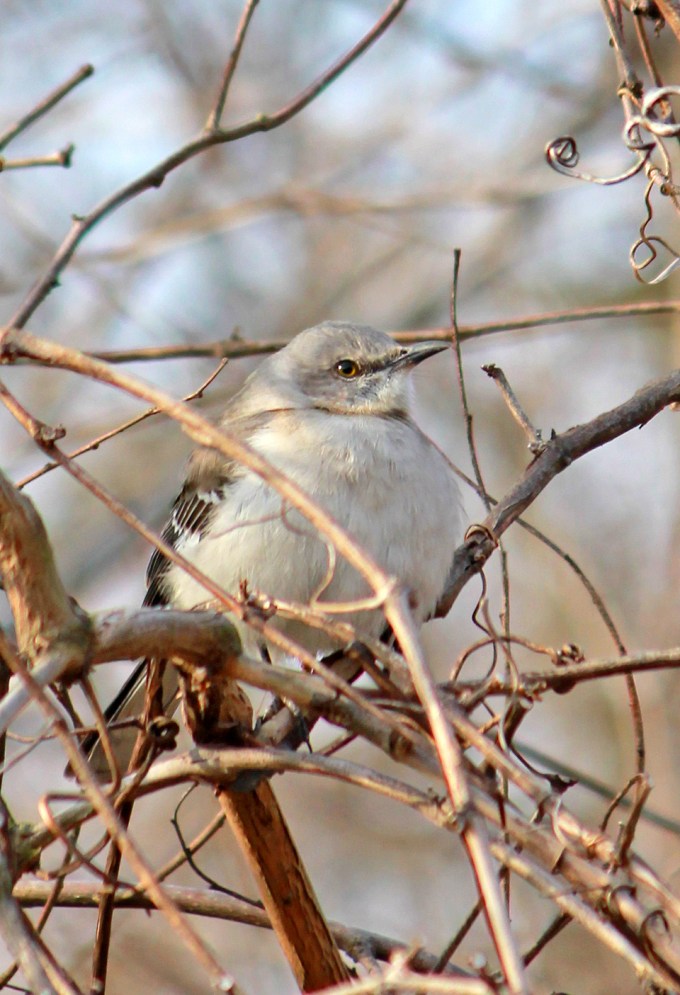
Northern mockingbird

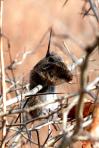
Last year, on our annual Winter Walk, we discovered a vole skewered on a thorn in a hawthorn tree. At the time, none of us were sure how the vole came to be there, though we threw a lot of guesses around and came to the mistaken conclusion that a passing raptor had dropped its dinner and it was inadvertently pinned in the tree. Three seasons later, on yet another walk, a naturalist and amateur ornithologist told us that it was likely the result of a Loggerhead shrike pinioning the vole for later. Well, he was close. One of the birds we discovered on our walk was not the Loggerhead shrike, but the Northern shrike, a close cousin to the Loggerhead.

vole 1Although classified as a songbird, all shrikes share a behavior commonly associated with raptors: that is, they prey on small mammals, lizards and amphibians. Not only do they prey on these small animals, they store them away for later feasting by skewering their prey on thorns. So the cause of our earlier conundrum came clearly into view and was the highlight of our count this year.

It was a good weekend and a stellar bird count. In total, we identified nearly thirty different species of birds. That, and we definitively put to rest the bizarre and somewhat gruesome puzzle of the impaled vole.

This slideshow requires JavaScript.

Snow Day

This morning, bands of clouds the color of dust stretched from the horizon to the sky. I know that sounds strange: of course the clouds stretched to the sky. What I mean to say is that the clouds didn’t lay horizontally across the heavens. No. Instead they seemed to start at some point on the horizon and launch themselves into space, like rocket trails or streamers of toilet paper. And when I say that they were the color of dust, I don’t mean gray. They were more beige with a little bit of peach thrown in, somewhere between a very light brown and red. And even though they weren’t red, I couldn’t help but think, “Red sky in morning, sailor take warning.”

As it turns out, that was more than a little melodramatic. But even so, the day had its moments. Every little bit a snow squall would blow through with heavy flakes swirling about making it hard to see, or with small, hard, almost-pellets of snow that would sting your face and hands. And it’s been cold, and growing colder as the day progresses. Thankfully, we held our Backyard Bird Count event (and more about that tomorrow) before the worst of it rolled in. Short, hard snowfalls offer interesting opportunities photographically, so we decided to take a few shots of the animals that live close to the house. These, then, also give us the chance to relate an anecdote or two, to introduce you to some of the animals that live here.

So. Here we go.

Gigi

Gigi

Gigi and Louise are two of four geese that live here on The Quarry Farm. Anne brought them home from Van Buren State Park near Findlay. She was there to give a presentation on water quality and macroinvertebrates about a year and a half ago when the naturalist who organized the event, Natalie Rossman Miller, conscripted Anne in an effort to trap two geese that were dumped at the park. Suffice it to say that, ultimately, they were successful, and Anne brought them here. Gigi is an Embden goose and, despite the name, entirely male (we’re not great at sexing birds at a distance; we once named a rooster Miss Kitty). Louise is an African goose and very much female.

Louise

Louise

These two, along with Henry, the other female goose (I know, I know) on the property, serve as our early warning system. On those occasions when the mail carrier has a package to bring to the house, or American Electric Power has come to read the meter, or someone has simply come to visit, these three make enough noise so that, even in the house we know that we have guests. And if we’re being completely honest, they make enough noise so that our neighbors a quarter of a mile away know that we have guests.

While we’re on the subject of geese, here’s Johnny. Johnny is a Canada goose. He was found oiled in Lima, Ohio. A local veterinarian took him on, cleaned him up and treated him for about a month before calling Nature’s Nursery Center for Wildlife Rehabilitation and Conservation Education. Over the course of that time, Johnny imprinted on humans.
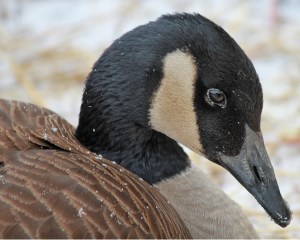
Johnny

Johnny

In addition to that setback, Johnny also has a congenital wing defect; his left wrist never developed properly and consequently the end of his wing protrudes at a right angle to the rest of his body, precluding any possibility of flight. In Johnny’s plus column, however, is one of the sweetest dispositions of any animal, anywhere. This bird just doesn’t know the meaning of ill-tempered. When we pull into the drive, he greets us with a honk characteristic of all Canada geese, then rises up and beats his wings.
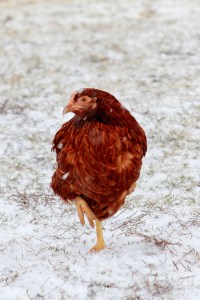
Little Red

Little Red

Nearly a month ago, we were provided with the opportunity to expand our flock of chickens.  A local farmer received an unexpected bonus shipment of pullets that increased his flock beyond his capacity to safely maintain. We took on fourteen of the hens, the most the farmer would allow us to acquire. In the overcrowded conditions to which the birds were temporarily subjected, they inflicted no small degree of damage to one another. Feathers were pulled loose until many of the birds were half-plucked. Their skin was raw and sore and, in some cases, infected. Despite our best efforts, four of the hens died. But, being the kind of people who believe that the glass is half full, ten survived and are thriving. One of them, a Rhode Island Red, is particularly friendly. She’s the first to bound out of the coop each morning and will run across the yard to greet us when we arrive back home. We call her Little Red.

(from left) Buddy, Marsh and S'more

(from left) Buddy, Marsh and S’more

Finally, at least for the purposes of this post, there are the boys: Buddy, Marsh and S’more. Marsh and S’more, two Nigerian Dwarf goats, came to us first, arriving in July of 2o11. They came to us from a family in Cincinnati. Although the family loved them their two large dogs didn’t and made life miserable for the brothers. In seeking a home for them, they contacted the American Society for the Prevention of Cruelty to Animals, and through them, us. Buddy, a miniature donkey, came from closer to home. A Putnam County couple kept Buddy as a companion for their horse. When it became too difficult for them to continue caring for the horse, they found it a new home. Sadly, the people who took the horse weren’t interested in Buddy. According to his old family, without companionship, Buddy began to waste away. They contacted us and Marsh and S’more became Buddy’s new buddies. And while they get along phenomenally, that doesn’t mean that they don’t have issues. Jonelle Meyer, a young woman who volunteers here at The Quarry Farm, recently told us of one such incident. As she was currying Buddy, the goats kept wandering up looking for attention. Buddy grew increasingly impatient with this until finally, when S’more refused to take the hint, he reached out, took the brush from Jonelle’s hand, smacked S’more in the face with the brush, then returned it to Jonelle so she could get back to what was really important: taking care of him.

Three Goats, Two Humans and the Very Small Car

Goat CarFive years ago, while bringing Anne home from a stint on the EPA  vessel Lake Guardian, her car, a seven year old Toyota we bought used to begin with, gave up the ghost in dramatic fashion. As we came into Findlay from the east, the car gave a thump and a shudder and began belching thick, black smoke.

We limped into town and into the first car dealership we came to, then walked the roughly half-of-a-mile down to a second, having seen nothing we were interested in at the first. There Anne spotted a Scion xA and almost immediately fell in love. We had her old Toyota towed to the dealership and used it as a downpayment on what she now fondly refers to as her “little rollerskate.” If you’re unfamiliar with the xAs, they’re a smaller version of the current xD and similar in shape to the Honda Fit. In short, they’re microSUVs.

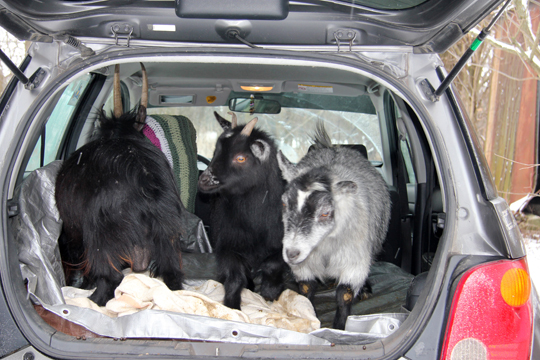
We’ve hauled just about everything in that little car: hawks, falcons, vultures, pigs, dogs, cats, ducks, geese, foxes, opossums, crows, owls over a dozen species of songbird, 55 gallon aquariums, bales of hay and straw and the list goes on. Most recently, Anne’s Little Rollerskate faced what we thought would be its greatest challenge: three pygmy goats.

Willow

Willow

We’ve talked for years about maintaining a small herd of dairy goats, but the closest we’ve come are Marsh and S’more, the two Nigerian Dwarf wethers that have lived on The Quarry Farm for nearly three years now. So, when we were told about these three goats, an intact buck and two does, we contacted the woman with whom they lived. As with so many others, the recession had hit her hard. Having been without work for months and still recovering from a necessary surgery nearly a year ago, she found herself without the means to care for her herd of goats. Most went to a local farm (she lives in Rootstown, south of Ravenna in eastern Ohio), but she was left with these three until she contacted The Quarry Farm.

Alaura

Elora

It was a miserable day for a drive when we left Putnam County. There was just enough snow to make the roads treacherous and it took nearly four hours to make a trip that should have taken only three. Add to that some skepticism on my part that we’d be able to fit three adult goats and ourselves in Anne’s little subcompact and it made for a tense trip.

As it turns out, I should have left my doubts at home.

Martigan

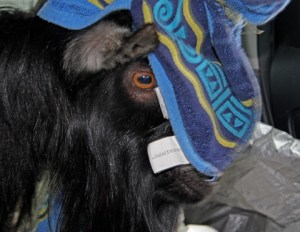
Once we arrived at our destination, we were delighted to discover that the goats were even smaller than we’d imagined. The older doe and the buck, Willow and Madmartigan respectively, stand no taller than eighteen inches at the shoulder, while Elora, the younger doe, is even smaller. Even with a full set of horns, horns that we initially padded turban-like with a towel, Madmartigan could easily stand up straight in the car, and all three were able to move freely around the cargo compartment.

Martigan Home

Martigan

The ride home was uneventful and we introduced all three to their new living quarters. Now they’re permanent members of The Quarry Farm family. And you’re all welcome to come and visit them and the rest of the facility. Just give us a call. We’ll be happy to show you around.

NOTE: Before anyone tells us that we have the wrong kind of goats for milking, we know. The animals that live here on the conservation farm of The Quarry Farm are here because, in almost all cases, they had nowhere else to go and we could offer them a home. Most do carry their weight: goats eat invasive plants, chickens give us eggs, Buddy and the geese guard the property, etc. The pygmies will make it possible for school groups and other visitors to see goats being milked. And we’ll have goat milk.

A Long Overdue (but brief) Introduction

If you have ever had an affinity for writing, someone at sometime has said to you, “Write what you know.” It’s good advice. But what they don’t tell you is that sometimes what you know is what you love and, on occasion, you are so close to what you love that writing about it becomes more than simply difficult. Your love becomes a chasm that words can’t bridge. I’m going to type a word now that, to me, embodies this whole concept.

Crows.

It’s a little word and they are a common bird, but even so, I have been enamoured and fascinated by crows for decades. By those who study animal intelligence, they are widely considered the most intelligent of birds. They aren’t simply tool users, but meta-tool users, designing tools by which they can get a tool to accomplish a task. They raise their young in multigenerational family groups, teach specific lessons to their young who, in turn, teach their own offspring these self-same lessons, communally avoid areas of known danger and may even use the same insecticide (formic acid deliberately obtained from the crushed bodies of ants) they use to rid themselves of lice and other pests to attain a state of inebriation.

That’s right. Crows may get loopy on ant juice.

And here’s the rub: I live with two of them. Literally live with them. In my house. And have done so for over a year. Their names are Blackie and Jo. Both came to us through Nature’s Nursery Center for Wildlife Rehabilitation and Conservation Education. Blackie first and then Jo. Over that time, a day hasn’t passed that one or the other of the two hasn’t done something noteworthy, engaged in behavior that wasn’t worthy of mention. Even so, getting the concept of them down, the enormity of their impact on my life, has proven overwhelmingly difficult. So, although I’ve tried, and there are literally dozens of drafts on this site that support my claim, I haven’t passed along a single anecdote.

Until now.

To get to the meat of it, though, I have to seemingly stray away from the subject. Be patient.

Recently, we took in an additional fourteen hens. We acquired them locally from a pair of farmers who found themselves swimming in chickens. As I understand it, they were told by their supplier that their order of 150 chickens couldn’t be mailed, that they would have to drive to the hatchery and pick them up. Which they did, only to receive, a few days later, a shipment by mail of another 150. They were completely unprepared for so many birds, didn’t have the facility to house them all, although it appeared that they had tried. When we picked up our fourteen, the most the farmers were willing to part with, there were easily 200 hens and several roosters housed in a building no more than ten foot by fourteen. The birds had pecked each other raw, stripping the feathers from one another until many were half-plucked. To make a long story short, two of the chickens we took in have died, the (hopefully) last of them either late last night or early this morning. And now we get back to the crows.

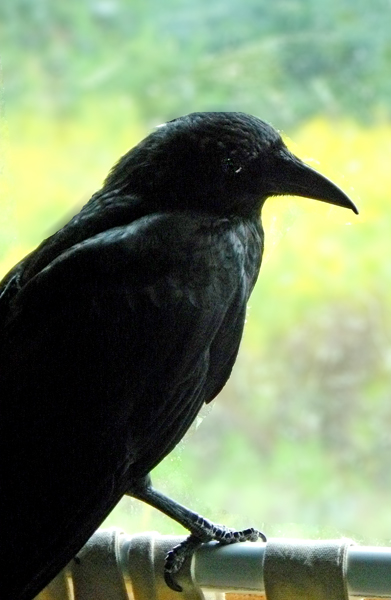
Jo in WindowOf the two crows that live with us, Jo is my girl. We bonded immediately. She greets me each morning, and I, her. It’s a complex thing involving specific crooning vocalizations. We visit with each other and preen one another. And when I’m outside where she can see me, she caws loudly and sits on the windowsill, watching me as I go about whatever task is at hand. Today, the one she watched me perform was the disposal of the body of the chicken that had died sometime during the night. As I was coming back up to the house, in the window of the room where the crows stay, I saw a small blob of brown bobbing in the window. It was obvious that Jo was in the window waving something around, but it took me a moment to figure out what it was.

As I mentioned earlier, crows are highly intelligent and they need a variety of stimulations to keep themselves occupied. We give them puzzles to solve and simple objects that they find interesting. One of Jo’s favorite toys is one of those tiny little plastic ducks, and by little I mean just a couple of inches long and maybe an inch and a half high, that you find all over the place. I’m sure you’ve seen them: little plastic ducks dressed like firemen or doctors or executives or sports figures. At the very least, you get the picture.

Jo's ChickenIn this case, the little plastic duck looks like a little, brown, lifeless chicken.

And she was waving it in the window after watching me walk down the path behind our house with my own little, brown, lifeless chicken.

Think of it what you will. Maybe Jo was just showing off one of her favorite toys, trying to entice me back into the room for a little play time (which, by the way, she succeeded in doing). Maybe it was simply coincidence. It’s possible.

But I don’t think so.

The Answer, a Bit Later Than Intended

Perhaps you recall the quiz that wrapped the January 14 post?

flooded bridgeHere’s a little quiz for you: Your eyes and nose present clues that can help you determine cause and effect. We all know that. When you study the photo above of the flooded foot bridge (click for an enlargement) you can see different kinds of plants, trees, and even water. See the stacked foam along the bridge? What does an accumulation of six inches or more of foam along a water body’s edge indicate?”

Thanks to Daryl Bridenbaugh who pointed out that the answer was not forthcoming the following day as noted in the original post, here’s the rest of the story:

A) Too many toad eggs to count

B) Everyone in the tri-county area did laundry today

C) Something smells fishy!

ANSWER: Both B and C. The foam build up on this particular day was piled up above six inches on the bridge and stream bank and did not break apart easily. It smelled musty…kind of like laundry that been left out on a rainy day. However, there was patchy foam floating in the current.

Some of this foam is caused by naturally occurring dissolved organic compounds. Foam that doesn’t build up very high and that breaks apart easily. This kind of foam sometimes smells fishy.

The day-old-wash stuff may be a different story. It can be a sign of human activity, including detergents and excess nutrients that can increase algae growth, more suspended solids and lower dissolved oxygen for the fish, insects and everything else that makes its living in the aquatic food chain.

Sometimes you don’t need a chemical test kit to get an idea what’s flowing downstream. Just use your eyes, ears and nose. If they tell you something’s fishy (and not in a good way), then it’s time to take a closer look for the source.

For more detailed reading, visit http://www.umaine.edu/WaterResearch/FieldGuide/onthewater.htm.

Another Hour On a Different Day

Seven months ago, I took an hour and wandered through the wild part of The Quarry Farm taking pictures. It was June then and the temperature beneath the green overhang of the woods was pushing 90 degrees. All manner of birds and insects were buzzing, chirping and flitting about and the sky was clear and blue.

Today was a little different.

While there was blue sky to be seen, it was through ragged patches in the cloud cover. There were birds, as well, but they moved about only as needed, making quick trips from the tall grass below our house to the feeders hanging from the cherry tree off our north deck. The temperature was in the middle teens with a wind chill of negative one.

Like I said, different.

Wild TurkeysEven so, there was a lot to see. It all started with Anne exclaiming about turkeys. The Ohio Department of Natural Resource’s Division of Wildlife released about half a dozen near here some ten years ago. Over that decade, they’ve flourished. We’ve seen flocks of more than a dozen moving through the brush below our house and on the other side of Cranberry Run. Today, there were four of them as close to the house as I’ve seen them. In all likelihood, they were eating the seed that had fallen from the feeders.

LollyLolly, an American Bulldog mix that we adopted from the Allen County Humane Society shortly before Christmas, joined me on the trek, ranging ahead of me, then back, sniffing at everything and exploring every nook and crannyTurkey's Demise that caught her eye. To the east of the quarry, she brought to my attention a former member of the flock of turkeys that had passed through our yard earlier in the day. It had been there for some time and there was no sign of the cause of its fate. There are any number of predators that could have killed the bird: foxes, hawks, eagles, raccoons, the occasional coyote or dog and, of course, us. Humans.

Trees in WinterThe trees that are filling in the wooded area of the property are mostly sugar maples, though there are plenty of honey locusts, walnuts, sycamores and buckeyes, as well. In the summer, their leaves shade the ground below and, at least psychologically, provide some relief from the heat. In the winter, their branches scrape at the sky, catch at the clouds and capture a weak winter sun. The visuals are stark, these dark branches against the fleeting gaps of blue where the clouds are torn apart by the wind. It’s clear why winter trees, stripped of their softening leaves, are often described as skeletal. Even so, it’s beautiful, this contrast of dark on light, darkest brown on blue.

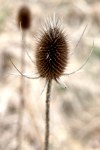
The big back field, over eleven acres of grass grown rampant and thorny brush, is brownTeasel and dry and bitterly cold. There are constant rustlings in the dead undergrowth: possibly the wanderings of mice, voles or field rats. More likely, though, these sounds are the scraping of dried plant against dried plant, pushed together by the wind. Most common in this field of brown are the spiky heads of teasel. They rise up above the dead grass in clusters of two or five or seven or more.

I’ve managed to photograph quite a bit, though possibly more interesting are the things that I’ve failed to capture. Like the pair of bald eagles that rose up out of the southern part of The Quarry Farm and looped over my head while I stood in the back field, hand in pockets against the cold, camera in its bag. By the time I got it out, the camera, they had soared the better part of a mile away to the east. Or the four white-tailed deer that Lolly scared up. All I saw of them were their flashing tails as they bounded leisurely away from Lolly’s spirited chase.

The CabinBy the time all of this has happened, the wind has found both Lolly and me. My hands and face are numb and slow to respond. Even Lolly’s had enough, leading me back to the path that will take us back to the house. I would say “home”, but we are already there. Even here, in the cold.

After all, every bit of it, every twig and branch and frozen patch of ground, is The Quarry Farm.

Buddy and Jeff

What’s Your Sign?

Group in Field

Alicia and Andrew Phillips review a winter star chart before leaving Red Fox Cabin for the trails.

Alicia and Andrew Phillips review a winter star chart before leaving Red Fox Cabin for the trails.

Astronomers have posited that if you were to count each and every grain of sand on all of the world’s beaches, you still wouldn’t come close to the number of stars in the sky. As a matter of fact, it’s suggested that you’d have to multiply that number by ten before you’d even come close. So it should come as no surprise, then, that the human imagination has configured the stars into any number of shapes over the thousands of years that we’ve been staring skyward. This past Saturday night, a group of participants in The Quarry Farm’s first Star Walk had the opportunity to view a few of these constellations.

It was nearly a perfect night for such an event. Although cloud cover had made star-gazing next to impossible for most of the week, a cold front moved in late Saturday afternoon and swept the sky clear. And while still chilly, the woods that surround the big back field provided a windbreak and pulled the teeth of the worst of the cold. While the wind howled outside the preserve, some stargazers even removed an outer layer.

Mike Erchenbrecher looks to the stars

Mike Erchenbrecher looks to the stars

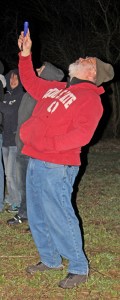
Mike Erchenbrecher, an award-winning retired Franklin County science teacher and avid amateur astronomist, escorted more than a dozen people through the woods and back to the big eleven-acre field where we all turned our faces up. Mike immediately pointed out the Hunter’s two dogs, Canis Major, the big dog, and Procyon, the little dog, and then the Hunter himself, Orion, with his belt of three stars. His finger traced a giant W as he talked about Cassiopeia, the Queen, who is forever chased by Cepheus, the King. And then, of course, there were the zodiacal constellations. At this time of year, the most readily recognizable of such is Gemini, with its two bright stars, Castor and Pollux. Taurus is also recognizable, as well as Cancer.

Some closeups of what we saw:

  • The constellation Cygnus the Swan, which contains Cygnus X-1, the first object identified as a probable black hole
  • jupmoon4Jupiter and its moons*…we could make out a moon on either side of bright Jupiter overhead.
  • Orion NebulaThe Orion Nebula** below Orion’s Belt appeared to us as a hazy spot.
  • Core of Andromeda GalaxyOur Milky Way was outshown by the half moon, but the Andromeda galaxy** was visible to the north.


Mike handed out star charts and independent-study over hot chocolate and cookies. Here are satellite passes for the next few days:

International Space Station

Brightness                 Start                 Highest point                 End                 Pass type
                [Mag]                 Time                 Alt.                 Az.                 Time                 Alt.                 Az.                 Time                 Alt.                 Az.
20 Jan -0.8 06:11:53 13° N 06:11:53 13° N 06:13:03 10° NNE Visible
21 Jan -0.9 06:56:32 10° NNW 06:58:23 14° N 07:00:13 10° NE Visible
22 Jan -0.8 06:08:04 13° N 06:08:04 13° N 06:09:28 10° NNE Visible
23 Jan -1.2 06:52:31 11° NNW 06:54:49 18° NNE 06:57:12 10° ENE Visible
24 Jan -0.9 06:04:09 15° N 06:04:14 15° N 06:06:16 10° NE Visible
25 Jan -1.8 06:48:34 13° NNW 06:51:01 29° NNE 06:53:57 10° E Visible
26 Jan -1.4 06:00:13 21° NNE 06:00:27 21° NNE 06:03:04 10° ENE Visible
27 Jan 0.1 05:11:53 11° NE 05:11:53 11° NE 05:12:04 10° ENE Visible
27 Jan -3.0 06:44:40 18° NW 06:46:56 62° NNE 06:50:11 10° ESE Visible
28 Jan -2.2 05:56:22 37° NNE 05:56:25 37° NNE 05:59:30 10° E Visible
29 Jan 0.0 05:08:06 13° ENE 05:08:06 13° ENE 05:08:37 10° E Visible
29 Jan -3.0 06:40:53 24° WNW 06:42:33 50° SW 06:45:44 10° SE Visible

Iridium Flares
OK, so what’s an iridium flare? Iridium flares are relatively new ultra bright objects in the sky, produced by the glancing reflection of the sun’s rays off a particular type of satellite–the Iridium satellite. Because the main mission antenna are pointing towards Earth, at predictable points in their orbit, they pickup the sun’s glare and direct it towards the Earth, producing the “flash”. Because they flash so quickly, here are the dates and times to look fast:

Time                     Brightness                     Altitude                     Azimuth                 Satellite                 Distance to flare centre                 Brightness at flare centre                 Sun altitude
Jan 22, 18:18:55 -0.5 31° 198° (SSW) Iridium 46 33 km (W) -7.0 -7°
Jan 23, 18:12:57 -2.6 31° 200° (SSW) Iridium 49 17 km (W) -6.9 -6°
Jan 23, 19:48:44 -0.9 34° 155° (SSE) Iridium 58 34 km (W) -7.6 -24°
Jan 24, 19:42:42 -3.7 35° 156° (SSE) Iridium 55 14 km (W) -7.6 -22°
Jan 25, 19:36:36 -0.1 34° 155° (SSE) Iridium 31 40 km (E) -7.6 -21°

For these and other updates realted to satellites (natural and human-made): http://www.heavens-above.com/?lat=40.94806&lng=-83.96111&loc=Pandora&alt=227&tz=EST

To find out where the International Space Station is in relation to you, enroll at http://spotthestation.nasa.gov/ to get alerts for your specific area

Find yourself looking at the night sky with your cell phone in hand? Use to “GoogleSky” to help you navigate the view.

* Michael Stegina/Adam Block/NOAO/AURA/NSF

** Satellite images taken by the Advanced Camera for Surveys (ACS) aboard NASA/ESA Hubble Space Telescope

No Point In Mopping

Winter 2013 TQF CoverThe word of the day is WET. The Quarry Farm, indeed all of Putnam County, went from snow and blue skies to green grass, brown fields, swollen and fast-moving streams and gray skies in 48 hours.

Saturday’s 60-degree temperatures saw the flock–all ten Priscillas, Barbara, Big Girl and Karen–out of the hen-house. As I cleaned their digs, as well as the goose buildings, the girls murmured their pleasure at being out to scratch in the grass and in their tunnels under the forsythia, elderberry and tamarisk. I swear they even purred.

Buddy brayed a few times, bringing me on the run to see what concerned our good guard donkey. Twice it was to let me know that Beatrice was thinking about visiting the neighbors. The third I found out later was because a pair of bald eagles had led a Gilboa couple from the Blanchard down the Riley Creek river valley to The Quarry Farm and the banks of Cranberry Run.

October BridgeLast night’s and today’s rains have laid low the eagles as well as the hens. The geese enjoyed splashing in the puddles, but the girls preferred to scratch through the fresh straw of the hen-house. Buddy stuck his head out a couple of times, but he and the goats mostly stayed high and dry. Not so for anything in the floodplain. Compare the photo taken during the fall photo shoot and sketch walk (right) to the one taken today of the same foot bridge and you’ll see that Cranberry Run has some receding to do from the rainfall, snowmelt and torrential runoff from surrounding fields. But if you scroll back to the January 1 post you’ll see how quickly the scenery changes here.

Here’s a little quiz for you: Your eyes and nose present clues that can help you determine cause and effect. We all know that. When you study the photo above of the flooded foot bridge (click for an enlargement) you can see different kinds of plants, trees, and even water. See the stacked foam along the bridge? What does an accumulation of six inches or more of foam along a water body’s edge indicate? Check back tomorrow for the answer.

flooded bridge

No doubt we’ll have clear skies and firm ground by January 19. Click on the cover of our current newsletter (upper left) to download the complete issue. You’ll find announcements for two upcoming events including this weekend’s first Stargazing Walk. Hope to have a good gathering for this new event. Mike Erchenbrecher is a dynamic speaker and educator. He’s one of those people who can draw you into a subject with his infectious love for all things earth science. Top that off with hot chocolate and a warm campfire and you couldn’t find a better way to spend your winter Saturday evening. Owl calling and counting is optional.

Since The Quarry Farm trails aren’t open to the public without appointment, at least until the boardwalks are in and the permanent trail markers are up, we ask that you call or email ahead. Plus we need to know how many lanterns to have on hand to light the way.

A New Year’s Celebration

Lolly 3Although we didn’t celebrate a white Christmas on The Quarry Farm, when the snow finally did come, it failed to disappoint. In the last week we’ve received the better part of eight inches and it has transformed the area into a winter scene that would make even Currier & Ives jealous. For Lolly, a recent addition to the farm made possible by the good people at The Humane Society of Allen County, it was also her introduction to the wild part of The Quarry Farm.

We could try to paint a picture for you with words, talk about the stark contrast of the trees against the snow, the blue of the sky, Lolly’s exuberance as she bounded across the back field, but I’d inevitably fall short. So I’ll not even try. Instead, we’ll let the pictures speak for themselves.

Happy New Year, everybody.