We, here at The Quarry Farm, have the great good fortune of living on a piece of land that provides a host of possibilities. Because of the forward thinking of a few remarkable people (and here I’m going to name names: Carl Seitz, Joyce Seitz, Gerald Coburn and Laura Coburn), we have houses and gardens and driveways and such. But we also have an area that, for the past 40 years at any rate, has had the opportunity to go Nature’s way.
For me, there’s a definite split, a line where domestic ends and wild begins. Here is where we keep the chickens, chase the pig, run the dogs, elude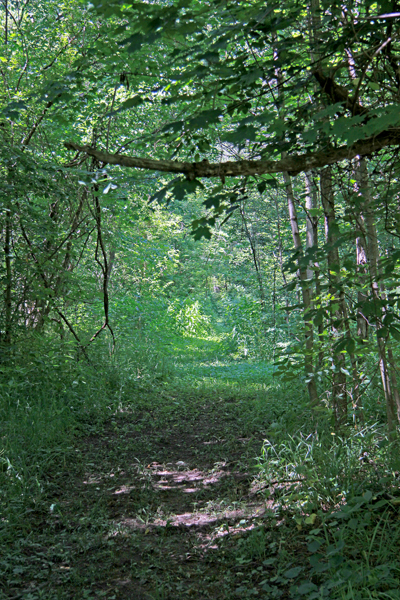 the duck and other happy little domestic activities. There is where the wild things are. Here: yard. There: not yard. It’s a convenient line, too, because it’s visible: a strip of trees that divides here and there. I include the line itself, the trees, in the there category, as part of the wild area of the Quarry Farm. From the tree line on is where Nature looms. That’s where Cranberry Run snakes through the property, where the turkeys make themselves known with gobbles and great splay-footed tracks, where great blue herons heave themselves from the water with complaining voices that Hollywood stole for Jurassic Park, where the occasional coyote howls and the foxes yip and the tree frogs sing and the squirrels, raccoons and skunks argue amongst themselves and with anyone or anything else that happens to grab their attention. It’s loud, it’s messy, it’s chaotic and it is absolutely beautiful. It’s a place I love to go. And today, in a very small way, I’m going to share. I set myself a challenge, gave myself one hour to walk along and across the stream, past the quarry and through the trees to the big field, then loop back along the path, across the stream and home again. In that time and along that walk, I took photographs. Fifty-nine photographs, to be precise. I’m not going to burden you with all of them, but I do want to share a few. And it all started in the tree line.
 My first photo op fell into the “well, you just don’t see that every day” category. Before passing from here to there, I paused to try and get a shot of a widow skimmer dragonfly. While in the process of completely failing to do that, I heard a rustling in the grass in the treeline. Rabbit, I thought. Then rethought, because I heard a bit of scrabbling as it ran up a tree. Squirrel, then. Nope. I’d heard of groundhogs climbing trees, but that was the first time I’d ever seen it up close and personal. It was a juvenile and had obviously found something tasty (as evidenced by the leaf dangling from the corner of its mouth) that drew it just a little too far from a bolt hole. When it realized that I was coming in its direction, it took the best avenue of escape open to it. Up.
I was pleased to find that the wood duck who had nested on the quarry was still in place along with her brood of four ducklings. They’re skittish birds, quick to run at the first sign of possible trouble. As I came up on them, mother went one way and the four little ones, another. Even so, I caught a quick glimpse of them as they fled across the duck weed. The little ones have grown enough so that they are nearly fully feathered. Their wings whickered as they half-flew, half-ran across the water.
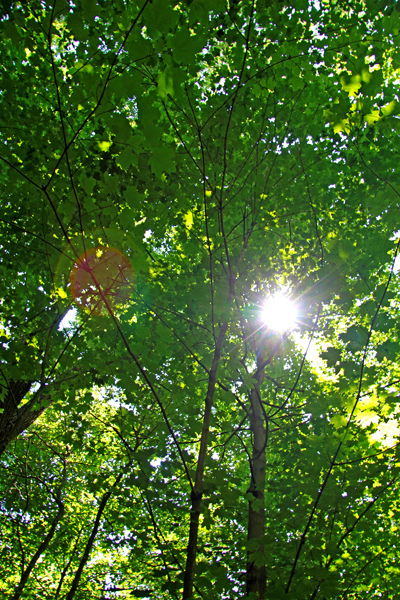 Although it was hot today – temperatures here were pushing 90 degrees – the main trail leading to the big back field was relatively cool. Over the course of the past four decades, the property surrounding the quarry has undergone significant changes. In many places, scrub and thick undergrowth is giving way to hard woods: in most cases, sugar maple trees. Where a relatively short time ago jersey cows grazed, there is now a full-blown second-stage forest. This year in particular, with its mild winter and wet spring, seems to have fostered growth. The trees form a canopy that filters the sun, dappling the ground with shifting patterns of light.
The big back field is nearly as varied in its habitats as the whole of the property. The greatest part of the eleven acres could easily be considered meadow, though there are, spotted here and there, scrub trees and brush. It is surrounded on all four sides by verdant growth: the forest that is the bulk of The Quarry Farm. Black raspberry and blackberry brambles tangle at the edges with wild rose and grape vines reaching out from the woods. On this particular day, a red-tailed hawk spun about the field in ever-widening circles. She screamed as she flew, though I’m not sure why. Maybe calling to a mate or to young offspring in nearby trees, or possibly just announcing her presence.
It’s a source of pride for us that we have such a healthy macroinvertebrate population on the property. This time of year, we see all manner of dragonflies and damselflies.
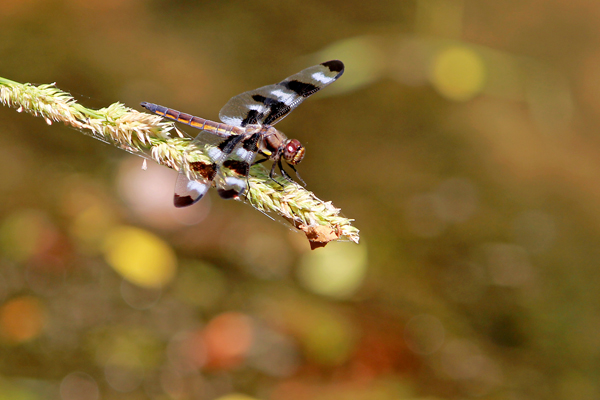
Twelve-spotted skimmer
They swarm up and down the stream, hunting, procreating and laying eggs, and they teem in the back field where there are plenty of prey species for them to feed on. While there are all manner of stories suggesting that dragonflies and damselflies are a nuisance, possibly even life-threatening, they are simply not true.

Bluet damselfly on rose cane
The fact is that these members of the order Odonata are some of the most beneficial insects out there, eating their weight every day in mosquitoes, midges and other annoying insects.

Ebony jewelwing damselfy
I was fascinated by them as a child, though I rarely had the opportunity to see them.
Now, generally beginning in late April, I go for a walk and there they are. When I see them, I can’t help but think of how cartographers, when they were filling in uncharted areas on maps, would write, Here Be Dragons. And they were probably right.
So there it is. One hour on the quarry. But you don’t have to take my word for it. It’s not necessary to limit yourself to two-dimensions. Contact us and make an appointment to see it in 3D. We’re not only happy to show it to you, but, in many ways, doing precisely that is who we are and certainly what we do. Contact us. Please. We’re counting on it.
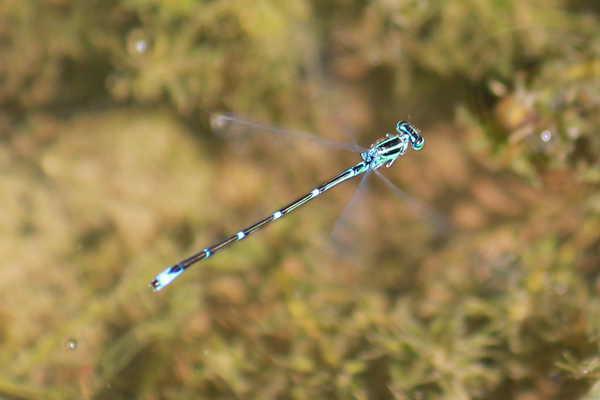
Bluet damselfly hovering over Cranberry Run