Buddy’s Big Day

Tiger in the garden

The Junior Master Gardeners of Continental (Ohio) graced The Quarry Farm with their presence on July 11, the first group to visit since the big wind blew through. Although there are still a couple of downed trees here and there, the paths were clear and mowed in time for the travelers to arrive.

Led by Charlene Finch, the group of 20 adults and children of varying ages drove in around 10 a.m. to beat the afternoon heat. They divided into three groups to rotate through three different learning and activity stations.

Mints and other herbs and flowers are bundled

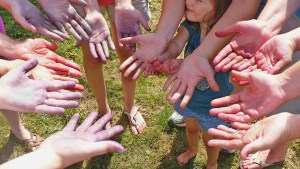
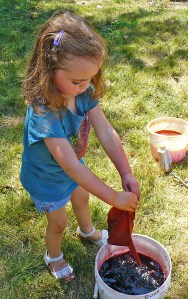
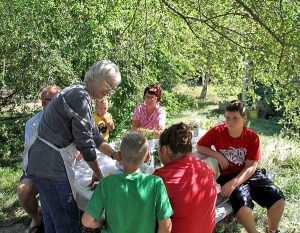
Group #1 met under the shady zelkova in front of Red Fox Cabin. From Board President Laura they discovered the history of the cabin and the grounds, the gardens and made herb bundles from cuttings gathered there.

Group #2 circled next to the ash stumps, recent victims of the invasive emerald ash borer. This was the perfect spot to hear Steve the Insect Guy talk about stream ecology, perfect because his roundtable included a meet-and-greet with riverine beneficial insects that grow up to combat harmful insects.

Meeting a dragonfly nymph

Group #3 walked to the farm animal sanctuary where they were heartily welcomed by Buddy the miniature donkey. Despite the white-hot rising sun, Buddy held his post at the southwest corner of the paddock and brayed greetings to each group, keeping up the conversation throughout their stay at the station. One volunteer in each group was assigned to pet Buddy so that he would keep quiet long enough for Beatrice the pygmy pot-bellied pig to come out and meet the kids. This event was the first educational outing for Beatrice. She took a special shine to a gentle boy named Brandon, allowing him to feed her a piece of apple. Geese and chickens checked out the group from a distance, as did the goats.

Buddy greets a gardener

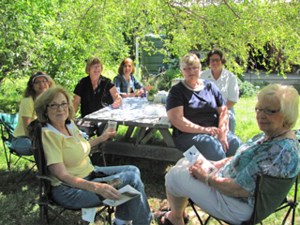
After all groups had rotated through the stations, everyone met at the cabin for cookies, lemonade, ice water and a group photo on the front porch. Some strolled through the gardens to see the blooms of drought-tolerant flowers and to scout for butterflies and dragonflies. Many thanks to Board Secretary Rita for photographically recording the event and for sharing them for this post.

When life gives you apples

On the morning of June 29, the apple trees here were loaded with a promising crop. That afternoon, the derecho left most scattered across the grounds of the farm sanctuary.

So as to keep a fair share of the windfall for human consumption (and to keep Beatrice the pygmy pot-bellied pig from gaining more than the 15 pounds she quickly added from chowing on little green apples) we put up a batch of green apple jelly.

If you happen to be at the Bluffton Farmer’s Market tomorrow morning, stop by and pick up a jar of this tangy goodness. We’ll also have other items and jellies of the season, including wood violet, chocolate mint and dandelion. All proceeds benefit the work we do here on the Quarry Farm.

We’re Still Here

A downed tree blocks the footbridge

Last week’s derecho left a few downed trees over the trails here on the Quarry, but they’ll be clear by the time the Defiance County Junior Master Gardeners’ visit on July 11.

The big impediment to the clearing progress has been and still is the heat. Still no power, which means no blog, no running water nor AC and ice water for the our small clean-up crew. Blessings be on our neighbors for offering the use of their hand pump so the farm animals can be fresh-watered. The wading pool wasn’t filled fast enough for Beatrice the pygmy pot-bellied pig, though. Her Royal Porcine Highness did her best last evening to have a lie-down in the dogs’ water bowl.

If you’re out this way and have a cool, powered home with shower to return to, stop by for a nice game of pick-up-sticks along the paths. There could be a cookie or two in it for you at the cabin.

An Eighth Direction

Preparing shelter house pad

The shelter house project at Red Fox Cabin is underway. A crew from Hovest Construction broke ground on Tuesday, clearing and leveling ground between the posts of the compass garden for 24’ x 24’ concrete pad. The crew finished and sealed the pad on Wednesday and cleaned and leveled the work site this morning. By August, this pad should support a 20’ x 20’ shelter house, the site of many future meetings, presentations and gatherings of all sorts on the Quarry Farm.

For anyone helping to raise the shelter house, there will be food. That includes observers.

Dooryard Garden Club at Red Fox Cabin’s zelkova

Members of the Putnam County Dooryard Garden Club visited right after Hovest Construction packed up their Bobcat. The group inspected the new project before touring the cabin, walking the Cranberry Run Trail, and meeting Educational Ambassadors Buddy the miniature donkey and Beatrice the pygmy potbellied pig.


Back up! What is a compass garden?

As the official name states, the Quarry Farm includes a nature preserve and a conservation farm. Red Fox Cabin and the gardens that surround it are part of both designations. One of the original gardens developed by Gerald and Laura Coburn was the compass garden. This garden is engineered according to the European navigational instrument that measures directions in a frame of reference that is stationary relative to the surface of the earth. However, the Red Fox Cabin compass garden was also designed in homage to the Coburn clan’s Native American heritage, primarily with traceable roots to the Cherokee Nation.

The Cherokee honor seven sacred directions to encompass a fully-dimensional world rather than one of singular dimension. In addition to the four singular dimension directions (east, north, west and south), there are: up (above), down (below) and center (which is where you are). Each direction is also associated with a season and a color:

  • NORTH is the keeper of winter, the season of survival and waiting. The North is associated with the color blue and the path of quiet.
  • SOUTH is the keeper of summer, the season of warmth. The South is associated with the color white, representing peace, happiness, and serenity.
  • EAST is the keeper of spring, the re-awakening of Mother Earth after a long sleep. The East is associated with the color red and represents victory, power, and war.
  • WEST is the keeper of autumn, the season of death and where it is hidden. The West is associated with the color black.
  • ABOVE is associated with the color yellow and represents peace.
  • CENTER is associated with the color green and represents the here and now.
  • BELOW is associated with orange/brown which represents the chaos and turmoil of the ever-changing Earth.

Note that I speak of the compass garden in the past tense. Invasive plants overran most of the directional plantings. Recently, the Quarry Farm board decided a permanent structure was needed to shelter visiting groups requiring seated onsite presentations since Red Fox Cabin can only hold a limited number of people at a time. The compass garden ground was deemed the most convenient location for such a shelter. The spot also sits just above the old stone quarry-turned-wetland, offering cool summer breezes and good views of butterflies, migratory birds and native trees.

So maybe some of the visual symbols of the old compass garden are missing, but the fully-directional world of the Quarry Farm is still growing. The house wren that is nesting in the apple gourd even stood her ground next to the construction site. She was back at her post this morning, scolding all visitors from her high tower in the zelkova tree.

Find out more about the Cherokee Nation, past, present and future, folklore and tradition, at
http://www.cherokee.org/Default.aspx.

This slideshow requires JavaScript.

Caption This!

It was suggested to us that a photo in an earlier post was just begging for a caption. It was further suggested that we might offer up another little competition. So, here’s Caption This! Not only do you get the opportunity to win a set of ten Quarry Farm notecards, but I get to put off writing a lengthier piece for yet another day. What say we give it a deadline of Monday, June 11, 2012.

Pig in a Blanket

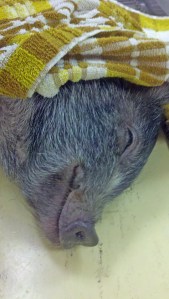
The newest resident of the conservation farm is in recovery as I type. Beatrice the pygmy pot-bellied pig was spayed this afternoon by Dr. Kathleen Babbitt of Lima Animal Hospital. Vet Tech Kaylie called with the news that Beatrice came through surgery with flying colors. Dr. Babbitt took lots of photos with her cell phone, including the image posted here.

Although Beatrice has only been with us for several days, our research led us to the conclusion that it would best for her health (and our collective sanity) to have her spayed as soon as possible. Seems that as they age, intact female pigs are prone to fibroids and abdominal tumors.

This morning this sweet pig thoroughly explored the back rooms and surgery of the hospital before I left for work. Although she squealed lustily (quite piercingly, actually) when I picked her up to put her back in the carrier, Dr. Babbitt exclaimed, “I love her!” Lord love her, that woman is a joy and a godsend to our sanctuary as she is the only vet in a five-county radius willing and able to take on The Quarry Farm pigs, crows, and Johnny the Canada goose.

More about Beatrice later. In the meantime, you just have to love this little face.

The Buzz

I’ve been struggling to find some clever way to start this post, to write the hook I need to pull you in and I’m failing miserably. Miserably. So, because my brain is fogged with the ridiculous heat we’re dealing with, I’ll just say that it’s about bees. Yeah. Bees. The kind that make honey, that bumble flower to flower, that kamikaze in defense of their homes, that, in conjunction with birds, create a happy little euphemism for sex. And sex is sexy, so maybe that’s all the hook I really need.

Clever me.

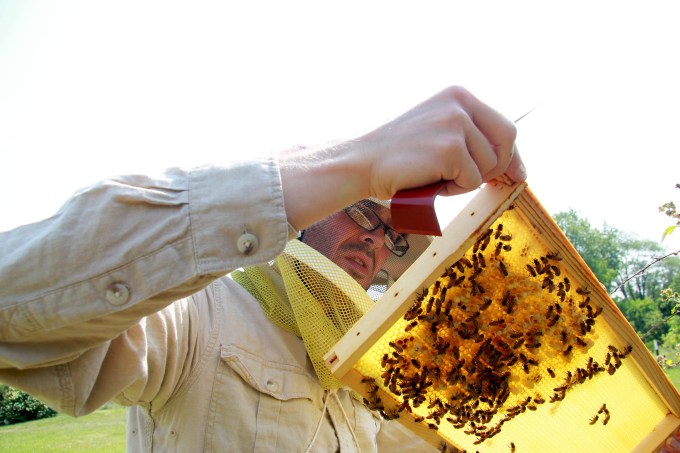
So, the bees. We set up a hive in mid April. Anne’s cousin, Brian, made all the arrangements for the bees and we took care of the materials: the hive body, the supers, the frames, the feeding troughs. We provided them a steady diet of syrup (sugar and water) and we’d pull off the hive cover and the inner cover on a nearly daily basis and ogle them from a distance. Yesterday, we got up close and personal. Brian came up from Columbus and he and Anne cracked the hive, pulled out the frames and checked out the action. The news could have been better.

Brian Erchenbrecher examining a frame from The Quarry Farm hive.

While the bees had developed new comb on the frames, there wasn’t nearly enough. And, again, while there were eggs and signs of developing brood, there wasn’t much and indications are that the developing brood are mostly drones. What are drones, you ask? They’re ne’er-do-well playboys, eating the nectar and giving back nearly nothing. They have no stinger, so they can’t protect the hive. They have no pollen sacs, so they can’t gather food. Their idea of work is chasing virgin queens.

Think Bruce Wayne, but no Batman. There you have it. Drones.

So what’s the big deal? So what if the hive’s Bohemian, populated with lotus eaters? If there are  only drones and no workers, there’s no comb. Without comb, there’s no honey. Without honey, the bees starve come winter. In fact, come late autumn the worker bees force the drones from the hive. They have to. Driving them out could well mean the difference between starving to death and surviving until spring.

It’s been suggested by scientists who study bees that a bee hive operates very much like a human brain. I mean, there’s no higher cognitive function, but otherwise, scientists have posited that their operations are very similar. If that’s the case, then our hive brain is more like Forrest Gump’s than Stephen Hawking’s. Which is not to say that it can’t improve. There is still hope, albeit one akin to the Flowers for Algernon variety. Realistically? Odds are, based on what we saw yesterday, that the hive will fail, the brain will die and we’ll have to start fresh next spring. That’s not what we wanted to hear, but there’s still good news.

And here it is.

The catalpa hive

Down the road from us, near the intersection of Roads 7-L and O, there’s a line of catalpa trees. In one of those trees is a hive of feral bees. This is a very cool thing, particularly when you understand that the hive has survived and thrived for roughly four years. With the population of bees dwindling as a consequence of a host of issues, to find a succesful wild hive is seriously cool. Why? Bees are our primary pollinators. Without them, plants that reproduce through pollination, and that’s the vast majority of our fruits and vegetables, simply don’t reproduce. No reproduction = No food.

So cheer on the bees, both wild and domestic. We’ll keep you posted on their progress.

Rain!

A lovely, much-needed rain greened this morning. Can almost hear the trees sighing, and the birds…the birds!

Sid is sporting a new wet look for the day. What do you think? Let’s have a little creative writing contest here. There’s a free Quarry Farm t-shirt for the winner. The most descriptive commentary will be awarded a shirt in the author’s size. You have until June 1 to weigh in here on www.thequarryfarm.com.

Happy Trails

Carrying tussie mussies

Although the air is hot and dry and the fields are gasping, this same daytime heat and cool nights kept the mosquitoes at bay long enough for Ottawa Elementary third grade to spend some time on The Quarry Farm before summer vacation begins. Teachers Kelly Nienberg and Vicki Otto blazed the trail for what we hope will be many field visits by local schools.

We only had this group for an hour and a half, but while they were here they made fresh, fragrant tussie mussies of mints, lavender, rose and oregano. Also called nosegays or posies, tussie mussies are small bunches of flowers or aromatic herbs that have been given as gifts since Medieval times. ‘Nosegay’ is probably the best label, because they likely gave the recipient something to bury their nose in to hide the fact that the giver (and themselves) didn’t bathe very often.

Posing on the porch of Red Fox Cabin

After tussie mussies were stored for the bus ride back to school, kids, teachers and chaperones walked down the hill and up the hill along floodplain streambank, meeting Nigerian dwarf goats Marsh and S’more and Buddy the donkey along the path as the trio worked their day jobs eating invasive plant species. They watched and heard bullfrogs, leopard frogs and Blanchard’s cricket frogs (unless the frogs saw them first) and sampled wild strawberries.

Mama Woodduck

Some caught a glimpse of a mother woodduck as she fled the scene. They saw the difference between poison ivy and Virginia creeper. They learned that nature provides a cure for many of its thorns, like sowing anti-itch, astringent jewelweed right next to poison ivy.

Cookies and lemonade cooled all hikers as they gathered off the porch of Red Fox Cabin. Some bundled fresh garlic from the cabin gardens to take home. Someone even snacked on a garlic bulb (we know because we found it, bite out and all.) Before boarding their bus, the students presented a donation to help support The Quarry Farm. We hope they come back and see what comes of their good works.

Who Are You Calling Chicken?

There are milestones in all lives: births, deaths, graduations, marriage, love. As much as this statement may sound like the prologue to a soap, these are the events that shape our lives. I’ve experienced all of the above and have to include another: chickens. I’m going to wait a few seconds while you take that in, get whatever comments you feel you have to make out of your system.

Everybody okay? May we move on?

Now I’ll say it again. As much as any other event in my life, chickens have helped to make me who I am, here and now. And, man, did I fight it.

It was Anne’s idea to get chickens, Anne’s and Rowan’s. I had … reservations. Many of them. They smell, right? They’re mean. They’re stupid. They’re noisy. They attract pests. The list was longer, but I’ve forgotten most of it. All of it was true in my head at the time and all of it, as it turns out, was wrong.

They came in a little box, delivered via USPS by our local mail carrier, Dorothy. There were sixteen of them. We had ordered fifteen, but somebody counted wrong or it’s the practice of the hatchery we ordered them from to throw in an extra. At any rate, there were sixteen Hubbard Golden Comet chicks in a little container that was half the size of a shoebox. We set them up in a storage tub in the house, dedicating a room to their safekeeping. They were tiny and yellow and fuzzy and cute and busy in their dedication to growing. I found myself fascinated and spent hours watching them, holding them, talking to them. We called them all Priscilla, each and every last one of them, and, yes, there’s a story there, but not one for the telling here, now. I discovered that all of the preconceived notions I had about chickens were, for the most part, wrong. Do chickens smell? Only because their living quarters aren’t properly maintained. If you keep their coop clean, smell isn’t an issue. Are they mean? They give what they get. If you treat them like property, like machines, and take, but never give, then yes, probably. I wouldn’t know for sure. The chickens here are friendly. Are they stupid? Well, they’re not going to be doing calculus any time soon, but, then, neither am I.

Priscilla

They presented us with no problems, no surprises, and eventually we moved them outside to a coop. I was still fascinated, spending hours with them, watching them live their lives. I discovered that, for me, they were more than fascinating, more than simply interesting observable phenomena. They brought me a degree of peace I’ve rarely experienced. They calmed me down. They made me think. They inspired me.

And now there are even more than there were to begin with. Big Girl, an Ameraucana, came to us through Nature’s Nursery. So did Audrey and Miss Kitty. Barbara, Karen, Nancy, Jeff, Ralph, Bernie and Sid all came to us from people looking to find a new home for birds they found they couldn’t handle. Most of these birds are still with us, ranging across the property and perching in the trees. Others haven’t fared as well.

Audrey

Audrey was found wandering along Interstate 75 somewhere south of Toledo. She was so docile when I picked her up from the people that had found her that I honestly believe she’d have been content sitting in my lap for the hour-long drive home (she didn’t; I transported her in a dog kennel). She’d been debeaked. Most hatcheries offer this “service.” A hot wire is used to slice a chicken’s beak from its head. This is done while they are chicks. The idea is that irritable chickens that have been debeaked will do less damage to other nearby chickens and, I suspect, to the hands that feed them. On the downside, this practice can also lead to feeding difficulties and respiratory issues. Even so, Audrey was one of the most benign animals it has ever been my good fortune to meet. She was nearly always the first one to greet us in the morning and would come and sit in our laps. She established a relationship with Buddy, a miniature donkey that lives here, and would spend a part of her day riding around on his back. She lived with us for just over a year before she died.

Miss Kitty

Miss Kitty died yesterday, much to our sorrow. He (and, yes, Miss Kitty was a rooster, though we didn’t know that when we named him) was, we assume, a meat production bird. Initially we believed that he was a Catalana hen (hence Miss Kitty). It wasn’t until he started crowing that we suspected the truth. He grew extremely large extremely fast and, as a consequence, developed a host of physical issues. He was less than a year old when his body simply and finally failed. Over the last few days of his life, all of the hens cared for him. He was never alone, one of the girls was always nearby. They were warm days and dry, and he spent his time lying in the shade of a crabapple tree or under the branches of an elderberry.

Big Girl

And then there are the successes. Big Girl came from a pretty rough neighborhood near downtown Toledo. How she got there is anybody’s guess, but we know how she came to be here. She was rescued by an elderly man who drove off a group boys. They were menacing her with sticks and stones. He called Nature’s Nursery and Nature’s Nursery called us. She was nervous, at first, and maintained her distance. If you took a step toward her, she took a step away. She stayed that way for months. Now she’ll shift out of the way if it pleases her, otherwise we have to step around.

Bernie and Barbara and Karen were part of a flock that kept dwindling, their coop mates the victims of an undetermined predator. Ralph and Jeff were abandoned (Jeff because he crows twenty-four hours a day, seven days a week, and Ralph, I suspect, because he’s cock of the walk and not afraid to let you know it). While these two do lock horns, so to speak, they spend the bulk of their time pointedly ignoring one another. Sid was simply unwanted.

I suspect that our flock will grow again this year. I sincerely hope so, at any rate. I look forward to it. I gain far more from them than I give.

And I’m not just talking about eggs.

The Quarry Farm Musicians: Audrey, Buddy and S’More