The Answer, a Bit Later Than Intended

Perhaps you recall the quiz that wrapped the January 14 post?

flooded bridgeHere’s a little quiz for you: Your eyes and nose present clues that can help you determine cause and effect. We all know that. When you study the photo above of the flooded foot bridge (click for an enlargement) you can see different kinds of plants, trees, and even water. See the stacked foam along the bridge? What does an accumulation of six inches or more of foam along a water body’s edge indicate?”

Thanks to Daryl Bridenbaugh who pointed out that the answer was not forthcoming the following day as noted in the original post, here’s the rest of the story:

A) Too many toad eggs to count

B) Everyone in the tri-county area did laundry today

C) Something smells fishy!

ANSWER: Both B and C. The foam build up on this particular day was piled up above six inches on the bridge and stream bank and did not break apart easily. It smelled musty…kind of like laundry that been left out on a rainy day. However, there was patchy foam floating in the current.

Some of this foam is caused by naturally occurring dissolved organic compounds. Foam that doesn’t build up very high and that breaks apart easily. This kind of foam sometimes smells fishy.

The day-old-wash stuff may be a different story. It can be a sign of human activity, including detergents and excess nutrients that can increase algae growth, more suspended solids and lower dissolved oxygen for the fish, insects and everything else that makes its living in the aquatic food chain.

Sometimes you don’t need a chemical test kit to get an idea what’s flowing downstream. Just use your eyes, ears and nose. If they tell you something’s fishy (and not in a good way), then it’s time to take a closer look for the source.

For more detailed reading, visit http://www.umaine.edu/WaterResearch/FieldGuide/onthewater.htm.

What’s Your Sign?

Group in Field

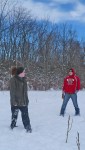
Alicia and Andrew Phillips review a winter star chart before leaving Red Fox Cabin for the trails.

Alicia and Andrew Phillips review a winter star chart before leaving Red Fox Cabin for the trails.

Astronomers have posited that if you were to count each and every grain of sand on all of the world’s beaches, you still wouldn’t come close to the number of stars in the sky. As a matter of fact, it’s suggested that you’d have to multiply that number by ten before you’d even come close. So it should come as no surprise, then, that the human imagination has configured the stars into any number of shapes over the thousands of years that we’ve been staring skyward. This past Saturday night, a group of participants in The Quarry Farm’s first Star Walk had the opportunity to view a few of these constellations.

It was nearly a perfect night for such an event. Although cloud cover had made star-gazing next to impossible for most of the week, a cold front moved in late Saturday afternoon and swept the sky clear. And while still chilly, the woods that surround the big back field provided a windbreak and pulled the teeth of the worst of the cold. While the wind howled outside the preserve, some stargazers even removed an outer layer.

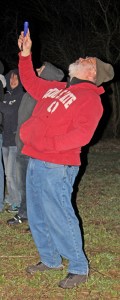
Mike Erchenbrecher looks to the stars

Mike Erchenbrecher looks to the stars

Mike Erchenbrecher, an award-winning retired Franklin County science teacher and avid amateur astronomist, escorted more than a dozen people through the woods and back to the big eleven-acre field where we all turned our faces up. Mike immediately pointed out the Hunter’s two dogs, Canis Major, the big dog, and Procyon, the little dog, and then the Hunter himself, Orion, with his belt of three stars. His finger traced a giant W as he talked about Cassiopeia, the Queen, who is forever chased by Cepheus, the King. And then, of course, there were the zodiacal constellations. At this time of year, the most readily recognizable of such is Gemini, with its two bright stars, Castor and Pollux. Taurus is also recognizable, as well as Cancer.

Some closeups of what we saw:

  • The constellation Cygnus the Swan, which contains Cygnus X-1, the first object identified as a probable black hole
  • jupmoon4Jupiter and its moons*…we could make out a moon on either side of bright Jupiter overhead.
  • Orion NebulaThe Orion Nebula** below Orion’s Belt appeared to us as a hazy spot.
  • Core of Andromeda GalaxyOur Milky Way was outshown by the half moon, but the Andromeda galaxy** was visible to the north.


Mike handed out star charts and independent-study over hot chocolate and cookies. Here are satellite passes for the next few days:

International Space Station

Brightness                 Start                 Highest point                 End                 Pass type
                [Mag]                 Time                 Alt.                 Az.                 Time                 Alt.                 Az.                 Time                 Alt.                 Az.
20 Jan -0.8 06:11:53 13° N 06:11:53 13° N 06:13:03 10° NNE Visible
21 Jan -0.9 06:56:32 10° NNW 06:58:23 14° N 07:00:13 10° NE Visible
22 Jan -0.8 06:08:04 13° N 06:08:04 13° N 06:09:28 10° NNE Visible
23 Jan -1.2 06:52:31 11° NNW 06:54:49 18° NNE 06:57:12 10° ENE Visible
24 Jan -0.9 06:04:09 15° N 06:04:14 15° N 06:06:16 10° NE Visible
25 Jan -1.8 06:48:34 13° NNW 06:51:01 29° NNE 06:53:57 10° E Visible
26 Jan -1.4 06:00:13 21° NNE 06:00:27 21° NNE 06:03:04 10° ENE Visible
27 Jan 0.1 05:11:53 11° NE 05:11:53 11° NE 05:12:04 10° ENE Visible
27 Jan -3.0 06:44:40 18° NW 06:46:56 62° NNE 06:50:11 10° ESE Visible
28 Jan -2.2 05:56:22 37° NNE 05:56:25 37° NNE 05:59:30 10° E Visible
29 Jan 0.0 05:08:06 13° ENE 05:08:06 13° ENE 05:08:37 10° E Visible
29 Jan -3.0 06:40:53 24° WNW 06:42:33 50° SW 06:45:44 10° SE Visible

Iridium Flares
OK, so what’s an iridium flare? Iridium flares are relatively new ultra bright objects in the sky, produced by the glancing reflection of the sun’s rays off a particular type of satellite–the Iridium satellite. Because the main mission antenna are pointing towards Earth, at predictable points in their orbit, they pickup the sun’s glare and direct it towards the Earth, producing the “flash”. Because they flash so quickly, here are the dates and times to look fast:

Time                     Brightness                     Altitude                     Azimuth                 Satellite                 Distance to flare centre                 Brightness at flare centre                 Sun altitude
Jan 22, 18:18:55 -0.5 31° 198° (SSW) Iridium 46 33 km (W) -7.0 -7°
Jan 23, 18:12:57 -2.6 31° 200° (SSW) Iridium 49 17 km (W) -6.9 -6°
Jan 23, 19:48:44 -0.9 34° 155° (SSE) Iridium 58 34 km (W) -7.6 -24°
Jan 24, 19:42:42 -3.7 35° 156° (SSE) Iridium 55 14 km (W) -7.6 -22°
Jan 25, 19:36:36 -0.1 34° 155° (SSE) Iridium 31 40 km (E) -7.6 -21°

For these and other updates realted to satellites (natural and human-made): http://www.heavens-above.com/?lat=40.94806&lng=-83.96111&loc=Pandora&alt=227&tz=EST

To find out where the International Space Station is in relation to you, enroll at http://spotthestation.nasa.gov/ to get alerts for your specific area

Find yourself looking at the night sky with your cell phone in hand? Use to “GoogleSky” to help you navigate the view.

* Michael Stegina/Adam Block/NOAO/AURA/NSF

** Satellite images taken by the Advanced Camera for Surveys (ACS) aboard NASA/ESA Hubble Space Telescope

No Point In Mopping

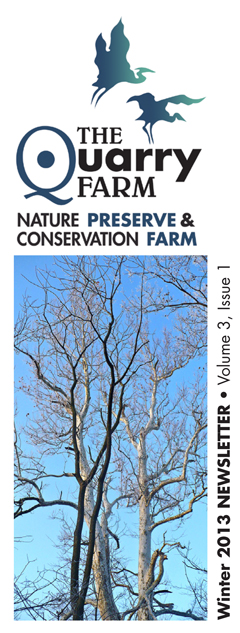
Winter 2013 TQF CoverThe word of the day is WET. The Quarry Farm, indeed all of Putnam County, went from snow and blue skies to green grass, brown fields, swollen and fast-moving streams and gray skies in 48 hours.

Saturday’s 60-degree temperatures saw the flock–all ten Priscillas, Barbara, Big Girl and Karen–out of the hen-house. As I cleaned their digs, as well as the goose buildings, the girls murmured their pleasure at being out to scratch in the grass and in their tunnels under the forsythia, elderberry and tamarisk. I swear they even purred.

Buddy brayed a few times, bringing me on the run to see what concerned our good guard donkey. Twice it was to let me know that Beatrice was thinking about visiting the neighbors. The third I found out later was because a pair of bald eagles had led a Gilboa couple from the Blanchard down the Riley Creek river valley to The Quarry Farm and the banks of Cranberry Run.

October BridgeLast night’s and today’s rains have laid low the eagles as well as the hens. The geese enjoyed splashing in the puddles, but the girls preferred to scratch through the fresh straw of the hen-house. Buddy stuck his head out a couple of times, but he and the goats mostly stayed high and dry. Not so for anything in the floodplain. Compare the photo taken during the fall photo shoot and sketch walk (right) to the one taken today of the same foot bridge and you’ll see that Cranberry Run has some receding to do from the rainfall, snowmelt and torrential runoff from surrounding fields. But if you scroll back to the January 1 post you’ll see how quickly the scenery changes here.

Here’s a little quiz for you: Your eyes and nose present clues that can help you determine cause and effect. We all know that. When you study the photo above of the flooded foot bridge (click for an enlargement) you can see different kinds of plants, trees, and even water. See the stacked foam along the bridge? What does an accumulation of six inches or more of foam along a water body’s edge indicate? Check back tomorrow for the answer.

flooded bridge

No doubt we’ll have clear skies and firm ground by January 19. Click on the cover of our current newsletter (upper left) to download the complete issue. You’ll find announcements for two upcoming events including this weekend’s first Stargazing Walk. Hope to have a good gathering for this new event. Mike Erchenbrecher is a dynamic speaker and educator. He’s one of those people who can draw you into a subject with his infectious love for all things earth science. Top that off with hot chocolate and a warm campfire and you couldn’t find a better way to spend your winter Saturday evening. Owl calling and counting is optional.

Since The Quarry Farm trails aren’t open to the public without appointment, at least until the boardwalks are in and the permanent trail markers are up, we ask that you call or email ahead. Plus we need to know how many lanterns to have on hand to light the way.

A New Year’s Celebration

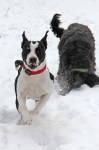
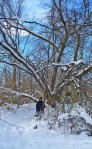
Lolly 3Although we didn’t celebrate a white Christmas on The Quarry Farm, when the snow finally did come, it failed to disappoint. In the last week we’ve received the better part of eight inches and it has transformed the area into a winter scene that would make even Currier & Ives jealous. For Lolly, a recent addition to the farm made possible by the good people at The Humane Society of Allen County, it was also her introduction to the wild part of The Quarry Farm.

We could try to paint a picture for you with words, talk about the stark contrast of the trees against the snow, the blue of the sky, Lolly’s exuberance as she bounded across the back field, but I’d inevitably fall short. So I’ll not even try. Instead, we’ll let the pictures speak for themselves.

Happy New Year, everybody.

So. Routines.

Routines. We’re governed by them. The side of the bed we sleep on, the way we rise in the morning, break our fast, brush our teeth, the routes we take to work, slog through the day, reverse the route to work back home, eat our meals, play our games, relax, watch television, listen to music, then climb back into bed. Routines are comfortable. Routines are safe.

But they tend to engender complacency.

And then, all hell breaks loose.

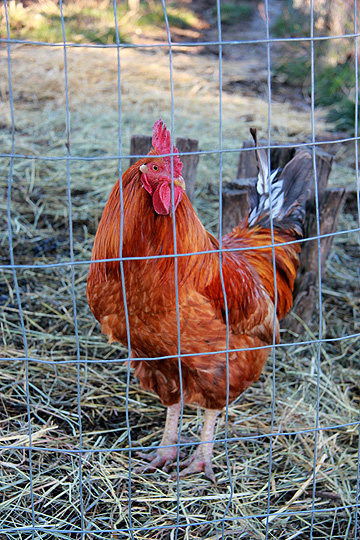
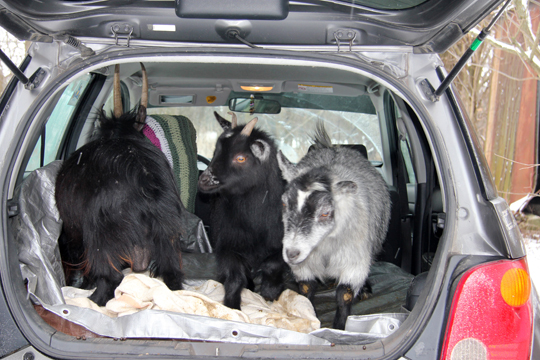
BuddyHere’s a tidbit of information you may or may not know about The Quarry Farm: we practice a pretty rigid little bit of gender segregation where the outside farm animals are concerned. The girls, mostly the hens, live in their coop and are allowed free range of the property, at least the domesticated part of the property. The boys (and by “the boys” I mean Buddy, the miniature donkey, Marsh and S’more, the Nigerian dwarf goats, and Jeff, Ralph and Bernie, three production red roosters) live in a fenced-in paddock on the north side of the property. We keep them contained because Buddy, Marsh and S’more are always up for a short road trip (something the neighbors don’t always appreciate) and because the roosters are, well, roosters. Not only are their affections not always welcomed by the hens, they tend to get a little protective, a little aggressive toward anyone who gets near “their” girls. So there’s a fence. Think of it as a very large, communal chastity belt.

So. Routines.

In the evenings, as the sun begins to set, we work the property: the hens are enticed back to the coop, the duck and the geese are, likewise, encouraged into their shelters and the boys get a little more food, just a little bit of something to tide them over until morning. Yesterday, as we started our evening routine, Marsh and S’more were outside the paddock, roaming the property. While not the ideal situation and not how every day plays out, it’s not unusual for them to go over the wire. We’ve seen it before and we’ll see it again and there’s a routine for dealing with this, as well. Rather than tend to the chickens before visiting the paddock, the boys get their evening snack first. After all, the girls won’t go in with Marsh and S’more leaping in and out of their coop so we have to lure the boys back to the paddock. We trundle out a flake or two of hay and the boys trot along with us, occasionally rearing up and butting heads and practicing all of the other endearing behaviors that make goats such interesting animals.
GoatsEverything was going along according to routine: we had the hay and the goats had gamboled along with us back to the paddock and had run on in when the gate was opened. We carried the hay in, spread it out in their shelter and stepped back. Typically, Buddy will wade in at this point and control the feedlot. Typically. And here’s where complacency leaps up and bites: when you add a vowel and the typicalbecomes atypical. Because Buddy’s behavior is so uniform, so predictable, we’re sometimes careless about the gate. So, even as the goats were jumping to their meal, Buddy bee-lined over, pushed on by and out the open gate behind us.

Understand this: Buddy on the loose is a joy to behold and the epitome of frustration. He will trot by within hand’s reach, head high, ears back and then stop to crop grass, waiting until you’re certain he’s going to let you catch him up before taking to his hooves and trotting just out of reach. Watching him, you’ll swear he’s laughing as he passes by, nudging you in the process. And he can do this for hours, leading you on a merry chase across the property and beyond.

Last night, thankfully, it was a short romp.

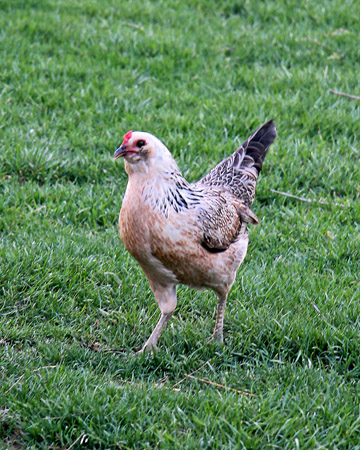
With Buddy back in the paddock, we were back to routine: making sure the chickens were safe in their coop. There are thirteen hens: Karen, a Production Red; Barbara, a Black Australorp; Big Girl, an Ameraucana; and the ten remaining Priscillas, all of them Hubbard Golden Comets and the first chickens to come to The Quarry Farm. As part of the routine, we count them each night. Thirteen girls in the coop mean that none are at risk from any of a number of predators looking for an easy meal. Thirteen, for us, is a lucky number.

So we counted.

And came up with fourteen.

JeffDuring our episode with Buddy, Jeff made good his escape and slipped in with the girls. He’s done it before and we’ve even allowed him to stay in the coop for a night or two. But, as noted earlier, roosters get a bit possessive and protective of the hens they consider their own. So we decided to catch him up and take him back to his enforced celibacy. Jeff’s a docile bird, so getting him in hand wasn’t terribly difficult. Then it was simply a short walk and a quick drop over the fence. Done and done, right?

Not exactly.

As it turns out, Jeff wasn’t the only rooster interested in busting out. As we approached the paddock, Jeff in hand, we noticed Bernie scratching in the tall grass on the wrong side of the fence. Bernie, too, is a fairly docile bird, so long as there are no hens to battle over and you’re not wearing red. Having said that, he’s a bit less inclined to permit any kind of truly close contact than is Jeff. In other words, he’d greatly prefer it if you kept your hands to yourself and he’ll do whatever it is that he needs to do to keep it that way. For a third party, watching someone chase a chicken is slapstick the equal of anything that Hollywood has ever conjured up. For the one doing the chasing, though…well, that’s a completely different set of experiences. Chickens duck and jive as they run, juking this way and that in a series of quick dashes intended to confuse whatever predator happens to be chasing them. Couple that with the gathering dark and it took a good long while before Bernie was back with the boys.

As is the routine, here on The Quarry Farm.

POSTSCRIPT: Some of you may remember the storm that blew through the region this past summer. Last July, a derecho tore this county apart. While the damage inflicted on our little piece of the county paled in comparison to others, we did suffer one significant loss: Little Chicken.

little chickenLittle Chicken was a bantam hen that split her time between The Quarry Farm and a little-used outbuilding on the property immediately adjacent to ours. She would come most frequently in the mornings and evenings, those times when we put out fresh food and water for the chickens that live here full time. The derecho caused significant injury to her nesting spot, the barn next door, and, after she failed to show up for over a week, we assumed her either an immediate casualty of the storm or easy pickings for some predator.

Last Sunday, we learned differently.

It turns out that Little Chicken, pushed out by the storm, wound up at the home of an acquaintance that lives about a mile away. Whether blown there or because she wandered there seeking new and more appropriate sleeping arrangements, we’ll never know. What we do know is that she’s found a wonderful new home, a home where she’s watched over and cared for.

So, apparently, the old adage is true: it’s an ill wind that doesn’t blow some good. And for the Siefkers, that good took the shape of Little Chicken.

They call her Clucks.

When the Frost Is On the Donkey

There was a hoary frost this morning. Donkey and goats were the first to be watered and fed, mostly because Buddy’s braying echoed resoundingly across the fields to bounce off the neighboring homes and farms. Buddy must have been at his post in the southeast corner of the paddock, watching the house for signs of movement for some time since a thick layer of frost iced his back. Once the boys were satisfied with fresh hay and the roosters had their feed, I had to run for the camera.

I figured I would take another photo on my way back for more water buckets. Just one more. The sunflowers still have a few seeds to feed the birds. Almost to the front door at the top of the path that leads to the nature preserve, Gertie’s blankets hung to dry. The bright contrasts of orange, yellow and green struck against the crystal grays, blues and browns of the treeline.

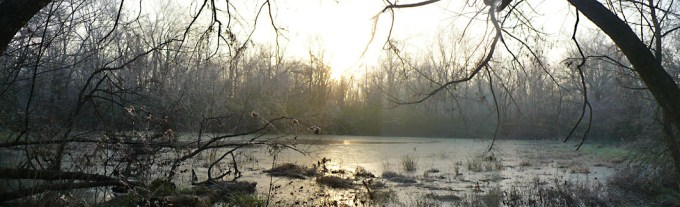
Although there are few this year, the osage orange trees have dropped their fruit beside Cranberry Run. The only green otherwise are the dreadful invasive honeysuckle, but the red berries of the shrub are undeniably jewels for the returning slate-colored juncos and other snowbirds. I made it to the old stone quarry in time to capture the mist and sunrise above the wetland. Photos never do their subject true justice, but there you have it at the top of the post.

The frost layers have peeled away and are snowing to the ground. The sun is high enough that some of the frost is more like cold rain, at least under the trees. The hens have eaten their fill for now and Beatrice is on cleanup. I’m off to the road myself.

Long Sleeve Weather

In the upland with Tri-Moraine Audubon

The air was chill but the sun was high on Saturday, October 6 for the “Wetland Wonderland” (see WORKSHOPS AND PRESENTATIONS) Tri-Moraine Audubon Society field trip to The Quarry Farm.  The group was led by Quarry Farm Friend Dave Betts.  All the Thursday rain put water back in the oxbow, enough to yield a sampling of aquatic macroinvertebrates that included a scud. This freshwater crustacean was the first such mini-shrimp seen and held by participants. Got to love that. I did.

Want to know more about scuds? Come to the Quarry Farm in the spring, but check them out here while ice covers the vernal pools: http://www.fcps.edu/islandcreekes/ecology/scud.htm

The water continued to rise in Cranberry Run while the Tri-Moraine Audubon Society walked the trails on Saturday. But by Monday, October 8, the creek had dropped back into its banks in time for 30 Pandora Cub Scouts, accompanied by their siblings and parents, to visit for a presentation and a tour. The “show” consisted of meet-and-greets with Buddy, aquatic macroinvertebrates, a juvenile opossum, a walk to the creek, cabin, and a cider-and-cookies finish around the fire bowl. What are some of the things that we hope the Scouts learned? That fish leeches won’t drain your arm of blood, that baby dragonflies eat lots of baby mosquitos, that opossums are nature’s garbage collectors, and that Northwest Ohio sunsets are the best. What did we learn? That you can cover a lot of ground in an hour. Beautiful night.

After cider fire

Passing Through

Orphans. The word conjures a host of images, mostly Victorian, of wide-eyed children dressed in rags begging on streets or, empty bowl in hand,  pleading for more; of row on row of narrow beds, each filled with a child praying for a good family. These are Hollywood images, as unrealistic in their portrayal of real orphans as television is in its presentation of detectives or living in New York City. They’re the only ones I know, though. The human kind, anyway.

But there are other kinds of orphans.

This year we’ve handled the usual: squirrels, opossums, vultures, swifts, starlings, sparrows and more, all either passing through our hands up to Nature’s Nursery or down to us from there for release or fostering. At present, we’re hosting two: a black squirrel and a Virginia opossum.

The opossum was one of six found on their dead mother (she was hit by a car). While we’re not certain how long the little ones were out there clinging to her corpse, it’s likely that it was quite a while. All six were slow and skinny and dotted with fly eggs. The worst part of such a case is that the young continue to feed from their mother and after she has died, the milk that sustained becomes corrupted, poisoned. Five of the six died. On the up side, the one that survived is strong and growing and shows no sign of becoming attached to the people fostering him. Just the opposite, in fact. He hisses and growls when we approach, bites when we lift him out to clean his temporary digs. He’s been here about a month and we expect that he’ll need to stay another before moving on and out there, on the Quarry.

The black squirrel is a new arrival, an intake from a Lima man who found him outside his apartment. After doing everything he could to reunite the little squirrel with his mother, James called us. This squirrel, like the opossum, is strong and a good eater. We’re providing a temporary safe haven for him. Tomorrow he’ll make the trip north to Nature’s Nursery where they have several other juvenile black squirrels.

The gloves are off

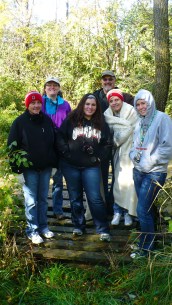
Peter Noyes and his camera lead the way down the hill from the upland trail

The rains finally came and the trees, grasses, birds and animals with every number of feet collectively sighed with relief. Most joyously, the rains fell throughout the day of July 19 and stopped just long enough for the Allen County Ohio Certified Volunteer Naturalists (OCVN) to hold a meeting at Red Fox Cabin and walk the floodplain and upland forest trails. As the group emerged from the nature preserve and reassembled on the cabin porch for cookies and lemonade, the sky opened up for another dousing. Photographer Peter M. Noyes recorded the OCVN visit. Check out his website at http://www.naturebypete.com/ for that album as well as more from his portfolio. Good stuff all around.

Today was quite literally of a different color. Many colors. A major tie-dye event produced a gallery of hats, shirts, cloths and even a few onesies that are now drying on tree branches and chairs at the neighboring Seitz farmhouse. A few hands were dyed in the process, as pictured above.

 Meanwhile back on the Quarry Farm, the shelter house is rising as a Seitz family crew is now in its third day of adding timber to the pad poured last month. Chief architect and foreman Keith Seitz designed the shelter house to blend aesthetically with the natural environment. The facility will be the site for many future gatherings, workshops and meetings, open to all by reservation appointment.