Belle’s Goodbye

Four weeks ago, Belle, a shih tzu who came to live with us on The Quarry Farm some five years ago, was diagnosed with a particularly aggressive form of cancer. The word “inoperable” was used more than once as her condition was explained to us, though whether or not that was a consequence of her assumed age and the belief that she wouldn’t survive the surgery is a question I never asked.

I was once told that cancer is the embodiment of chaos. I’m not sure who said it or if it was even remotely accurate, but it stuck with me. In this particular case, it was about as true a statement as was ever made. The cancer attacked her lymph nodes and grossly distorted the lower half of her face. As the disease rapidly progressed, tumors swelled the glands on either side of her jaw and ripened until they began to intrude into her mouth, pressing her tongue to the side and interfering with her ability to eat (mark that I said, “interfering”; her appetite was huge and she ate well and as often as she wished, though with a bit more difficulty than she had before her cancer). Her doctor assured us that she wasn’t in any particular discomfort and that she would enjoy life for a little while longer, possibly as long as a couple of months.

 When she stops eating, he told us, it’s time.

 Last Thursday, she stopped eating.

 On Friday, we took her in.

 We brought what was left of her, her biomass, home and buried it at the base of a Kentucky coffee tree that graces the area just outside our front door. Heat and drought had turned the ground into something much harder than simple earth and it took an old railroad pickaxe to loosen the dirt enough to shovel it aside. Eventually we placed her in a hole that seemed much too small for her. Tiny as she was physically, she was possessed of a huge personality and could, when she chose, fill a room. We further marked the spot with a slab of dolomite and placed pieces of granite and quartz and red shale on and about the stone in celebration of a life that was our great good fortune to share. We then went inside and wondered at how much smaller our house seemed to be.

 Less than an hour later, as a headline in our local newspaper so colorfully put it, the area was “blown to pieces.”

 The storm that swept through was deemed a derecho (http://www.weather.com/news/weather-severe/derecho-explainer-20120612). Straight-line winds in excess of ninety miles per hour tore through the region, uprooting and snapping trees, tearing roofs from buildings and, in some cases, leveling the buildings themselves. Power and telephone lines were cut by flying debris and the poles to which they were attached were battered to the ground. While there were reports of multiple tornadoes in neighboring counties to the west, none touched down here. Even so, the area suffered some of the most significant widespread damage in its history. Nearly every homestead was affected, including ours.

The Quarry Farm fared better than some, worse than others. In the domestic areas of the farm we lost about a dozen trees, mostly evergreens, and several shrubs. Shingles were blown from the roof of one outbuilding and the door to the chicken coop was ripped from its hinges and beaten to splinters. A big, wooden outdoor storage cupboard was teased out from under the eaves of our house and torn apart. A window was blown loose in the big shed and smashed. The bee hive was reduced to its component parts and scattered across the yard and even though the hive was already failing, it was a hard sight to witness. In the woods and along Cranberry Run, dozens of trees were left bent and broken. The largest and oldest of the trees, the ones that reached above the common canopy, bore the greatest insult. Limbs as large as some of the less mature trees on the property were rent free and fell, dragging smaller limbs and even some smaller trees with them. Honey locust, sycamore and black walnut trees were affected the most and their limbs and trunks fell and blocked many of the paths that we have so arduously cut through the woods.

 Even so, we were lucky. Our homes came through the storm unscathed and, more importantly, no one was hurt. Buddy and the boys, S’more and Marsh, seemed nonplussed. The chickens made a last second mad dash to the coop and, despite the flying debris, beat the odds. Even the duck and geese came through it without a scratch, all of whom weathered the storm out in the open despite immediate access to shelter. They simply faced into the storm and made themselves as small as possible, holding their wings tightly to their sides and pressing themselves into the earth, riding the storm out as best they could. As did we all.

 The biggest part of me recognizes that this was strictly an atmospheric event, an accumulation of physical conditions that culminated in a significant release of energy. I know that, should I choose to, I can go online and research this until I know each and every factor – heat, humidity, air pressure, ocean currents, whatever – that played a role in the creation of this storm. I know that this was a cause and effect scenario.

I know this.

 Even so, there’s a part of me that thinks that maybe there was something more to it than just pressure systems and cold fronts. That maybe this was a release of energy of a completely different Nature. That maybe, just maybe, this was more personal than that. Maybe this was Belle’s exuberant release, her nod to us as she went wherever it was that she wanted to go.

 That’s how I’ll remember it, anyway, despite logic and Carl Sagan. After the shingles are replaced and the chicken coop door is repaired. After the debris is raked up and put aside and the paths are cleared. After all of the electrical and telephone lines are restrung and the grid is whole and fully functional once again. After the fallen trees are reduced to neatly trimmed and stacked piles of drying wood and even after that wood has eventually dried and is burned in some future fire, that is how I’ll remember last Friday.

 It was the day that Belle said, “Goodbye.”


POSTSCRIPT

I was going to leave this for another day, but I find that I can’t. I have a couple of final thoughts I’d like to express. First, my soapbox. When Belle came to us, she was broken. Literally broken. Both eyes were severly scarred, particularly the right, which was all but entirely closed with scar tissue. At some point, she had broken her jaw and it had never healed properly. I never understood the mechanics of it, but her veterinarian explained that there was a gap in her lower jaw that had never closed. She was constantly on edge. Vague movements sent her scrambling, and with her eyesight, all movements were vague. She lived in constant fear, her bladder emptying in uncontrollable spasms of fright. Worst of all, I think, was the tattoo in her left ear: the number 25 writ in large block numerals. Again, her veterinarian explained that the number was a means of identification. Not to assure her safe return should she come up missing, but as a simple means of differentiating her from any other shih tzus that the person (and I use that term conditionally) who had her before us may have, must have, kept.

She was Bitch Number 25 and that may well have been the only name she had before coming here. She had been bred and bred and bred and bred until there was almost nothing left. Just that tattoo in her ear.

And now my plea. Should you have to live with a specific breed of dog, if a pure breed is what you must have, please check first with the rescues. There is one for every breed. If that’s not enough, not something you want to pursue, please go to great lengths to assure that the breeder with whom you are working is responsible. And please do go to a breeder. Don’t buy from a store. You just never know. http://www.humanesociety.org/issues/puppy_mills/

And now, as we so very often hear on Monty Python’s Flying Circus, for something completely different. As a consequence of the storm, power was out for most of the region for varying amounts of time (and there may still be those whose power has yet to be restored). We lost ours for four days. Four days without power meant four days without water. Thankfully, we have good neighbors. Casey and Dan Walker, realizing our predicament, offered us the use of an old well on their property that has a manual pump. Without that, tending to the hydration needs of the ducks, geese, goats and donkey that live here would have been extremely difficult, at the very best. So to the Walkers, our most heart -felt thanks. You exemplify the best in good neighbors.

An Eighth Direction

Preparing shelter house pad

The shelter house project at Red Fox Cabin is underway. A crew from Hovest Construction broke ground on Tuesday, clearing and leveling ground between the posts of the compass garden for 24’ x 24’ concrete pad. The crew finished and sealed the pad on Wednesday and cleaned and leveled the work site this morning. By August, this pad should support a 20’ x 20’ shelter house, the site of many future meetings, presentations and gatherings of all sorts on the Quarry Farm.

For anyone helping to raise the shelter house, there will be food. That includes observers.

Dooryard Garden Club at Red Fox Cabin’s zelkova

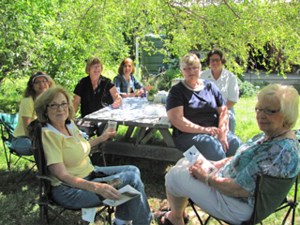
Members of the Putnam County Dooryard Garden Club visited right after Hovest Construction packed up their Bobcat. The group inspected the new project before touring the cabin, walking the Cranberry Run Trail, and meeting Educational Ambassadors Buddy the miniature donkey and Beatrice the pygmy potbellied pig.


Back up! What is a compass garden?

As the official name states, the Quarry Farm includes a nature preserve and a conservation farm. Red Fox Cabin and the gardens that surround it are part of both designations. One of the original gardens developed by Gerald and Laura Coburn was the compass garden. This garden is engineered according to the European navigational instrument that measures directions in a frame of reference that is stationary relative to the surface of the earth. However, the Red Fox Cabin compass garden was also designed in homage to the Coburn clan’s Native American heritage, primarily with traceable roots to the Cherokee Nation.

The Cherokee honor seven sacred directions to encompass a fully-dimensional world rather than one of singular dimension. In addition to the four singular dimension directions (east, north, west and south), there are: up (above), down (below) and center (which is where you are). Each direction is also associated with a season and a color:

  • NORTH is the keeper of winter, the season of survival and waiting. The North is associated with the color blue and the path of quiet.
  • SOUTH is the keeper of summer, the season of warmth. The South is associated with the color white, representing peace, happiness, and serenity.
  • EAST is the keeper of spring, the re-awakening of Mother Earth after a long sleep. The East is associated with the color red and represents victory, power, and war.
  • WEST is the keeper of autumn, the season of death and where it is hidden. The West is associated with the color black.
  • ABOVE is associated with the color yellow and represents peace.
  • CENTER is associated with the color green and represents the here and now.
  • BELOW is associated with orange/brown which represents the chaos and turmoil of the ever-changing Earth.

Note that I speak of the compass garden in the past tense. Invasive plants overran most of the directional plantings. Recently, the Quarry Farm board decided a permanent structure was needed to shelter visiting groups requiring seated onsite presentations since Red Fox Cabin can only hold a limited number of people at a time. The compass garden ground was deemed the most convenient location for such a shelter. The spot also sits just above the old stone quarry-turned-wetland, offering cool summer breezes and good views of butterflies, migratory birds and native trees.

So maybe some of the visual symbols of the old compass garden are missing, but the fully-directional world of the Quarry Farm is still growing. The house wren that is nesting in the apple gourd even stood her ground next to the construction site. She was back at her post this morning, scolding all visitors from her high tower in the zelkova tree.

Find out more about the Cherokee Nation, past, present and future, folklore and tradition, at
http://www.cherokee.org/Default.aspx.

This slideshow requires JavaScript.

Making Leaves While the Sun Shines

Putting Burdock to Work

For everyone who wonders why there have been colossal burdock plants flourishing in certain yards in the neighborhood, you can rest easy as the plants have been harvested. The giant leaves from these towering weeds* were reserved for today’s “Art in Nature: Make a Lasting Leaf” workshop on the grounds of The Quarry Farm’s Red Fox Cabin here on Road 7L.

Casting in Concrete

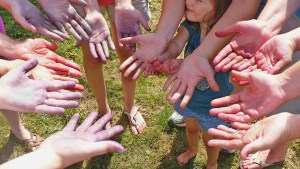
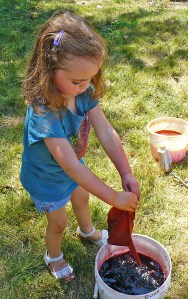
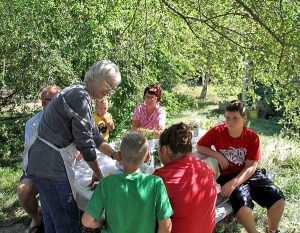
NOAA predicted a hot, dry day without much-needed rain but the shade trees off the front porch kept today’s outdoor studio cool enough to cast leaf-molded birdbaths, bowls and stepping stones. But enough talk. Here are some photos of the Class of June 9, 2012.

If you couldn’t make today’s event, look for upcoming workshops posted in “events”, or get on our emailing list by sending a message saying, “Sign me up for the newsletter” or “Put me on the mailing list” or “Hey, you!” to thequarryfarm@gmail.com.

*Although I’m paraphrasing, a favorite quote says something along the lines that one person’s flower is another man’s weed growing where he doesn’t want it.

This slideshow requires JavaScript.

The Buzz

I’ve been struggling to find some clever way to start this post, to write the hook I need to pull you in and I’m failing miserably. Miserably. So, because my brain is fogged with the ridiculous heat we’re dealing with, I’ll just say that it’s about bees. Yeah. Bees. The kind that make honey, that bumble flower to flower, that kamikaze in defense of their homes, that, in conjunction with birds, create a happy little euphemism for sex. And sex is sexy, so maybe that’s all the hook I really need.

Clever me.

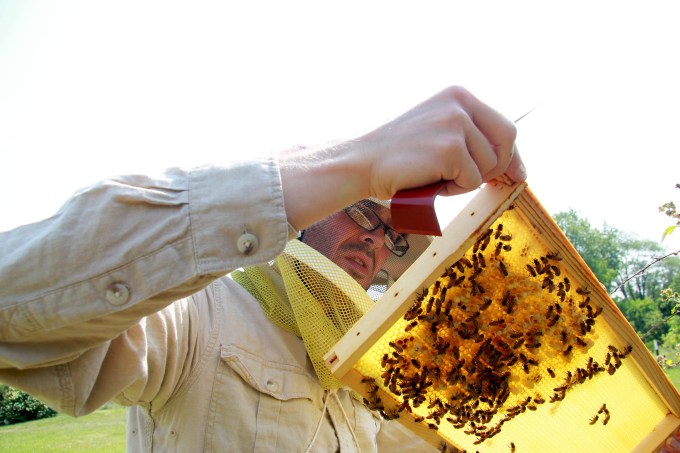
So, the bees. We set up a hive in mid April. Anne’s cousin, Brian, made all the arrangements for the bees and we took care of the materials: the hive body, the supers, the frames, the feeding troughs. We provided them a steady diet of syrup (sugar and water) and we’d pull off the hive cover and the inner cover on a nearly daily basis and ogle them from a distance. Yesterday, we got up close and personal. Brian came up from Columbus and he and Anne cracked the hive, pulled out the frames and checked out the action. The news could have been better.

Brian Erchenbrecher examining a frame from The Quarry Farm hive.

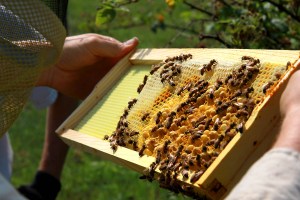
While the bees had developed new comb on the frames, there wasn’t nearly enough. And, again, while there were eggs and signs of developing brood, there wasn’t much and indications are that the developing brood are mostly drones. What are drones, you ask? They’re ne’er-do-well playboys, eating the nectar and giving back nearly nothing. They have no stinger, so they can’t protect the hive. They have no pollen sacs, so they can’t gather food. Their idea of work is chasing virgin queens.

Think Bruce Wayne, but no Batman. There you have it. Drones.

So what’s the big deal? So what if the hive’s Bohemian, populated with lotus eaters? If there are  only drones and no workers, there’s no comb. Without comb, there’s no honey. Without honey, the bees starve come winter. In fact, come late autumn the worker bees force the drones from the hive. They have to. Driving them out could well mean the difference between starving to death and surviving until spring.

It’s been suggested by scientists who study bees that a bee hive operates very much like a human brain. I mean, there’s no higher cognitive function, but otherwise, scientists have posited that their operations are very similar. If that’s the case, then our hive brain is more like Forrest Gump’s than Stephen Hawking’s. Which is not to say that it can’t improve. There is still hope, albeit one akin to the Flowers for Algernon variety. Realistically? Odds are, based on what we saw yesterday, that the hive will fail, the brain will die and we’ll have to start fresh next spring. That’s not what we wanted to hear, but there’s still good news.

And here it is.

The catalpa hive

Down the road from us, near the intersection of Roads 7-L and O, there’s a line of catalpa trees. In one of those trees is a hive of feral bees. This is a very cool thing, particularly when you understand that the hive has survived and thrived for roughly four years. With the population of bees dwindling as a consequence of a host of issues, to find a succesful wild hive is seriously cool. Why? Bees are our primary pollinators. Without them, plants that reproduce through pollination, and that’s the vast majority of our fruits and vegetables, simply don’t reproduce. No reproduction = No food.

So cheer on the bees, both wild and domestic. We’ll keep you posted on their progress.

Who Are You Calling Chicken?

There are milestones in all lives: births, deaths, graduations, marriage, love. As much as this statement may sound like the prologue to a soap, these are the events that shape our lives. I’ve experienced all of the above and have to include another: chickens. I’m going to wait a few seconds while you take that in, get whatever comments you feel you have to make out of your system.
Everybody okay? May we move on?

Now I’ll say it again. As much as any other event in my life, chickens have helped to make me who I am, here and now. And, man, did I fight it.

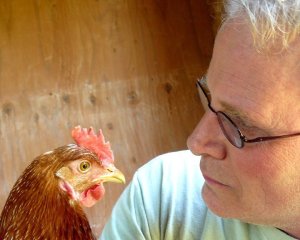
It was Anne’s idea to get chickens, Anne’s and Rowan’s. I had … reservations. Many of them. They smell, right? They’re mean. They’re stupid. They’re noisy. They attract pests. The list was longer, but I’ve forgotten most of it. All of it was true in my head at the time and all of it, as it turns out, was wrong.

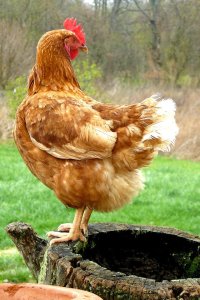
They came in a little box, delivered via USPS by our local mail carrier, Dorothy. There were sixteen of them. We had ordered fifteen, but somebody counted wrong or it’s the practice of the hatchery we ordered them from to throw in an extra. At any rate, there were sixteen Hubbard Golden Comet chicks in a little container that was half the size of a shoebox. We set them up in a storage tub in the house, dedicating a room to their safekeeping. They were tiny and yellow and fuzzy and cute and busy in their dedication to growing. I found myself fascinated and spent hours watching them, holding them, talking to them. We called them all Priscilla, each and every last one of them, and, yes, there’s a story there, but not one for the telling here, now. I discovered that all of the preconceived notions I had about chickens were, for the most part, wrong. Do chickens smell? Only because their living quarters aren’t properly maintained. If you keep their coop clean, smell isn’t an issue. Are they mean? They give what they get. If you treat them like property, like machines, and take, but never give, then yes, probably. I wouldn’t know for sure. The chickens here are friendly. Are they stupid? Well, they’re not going to be doing calculus any time soon, but, then, neither am I.

Priscilla

They presented us with no problems, no surprises, and eventually we moved them outside to a coop. I was still fascinated, spending hours with them, watching them live their lives. I discovered that, for me, they were more than fascinating, more than simply interesting observable phenomena. They brought me a degree of peace I’ve rarely experienced. They calmed me down. They made me think. They inspired me.

And now there are even more than there were to begin with. Big Girl, an Ameraucana, came to us through Nature’s Nursery. So did Audrey and Miss Kitty. Barbara, Karen, Nancy, Jeff, Ralph, Bernie and Sid all came to us from people looking to find a new home for birds they found they couldn’t handle. Most of these birds are still with us, ranging across the property and perching in the trees. Others haven’t fared as well.

Audrey

Audrey was found wandering along Interstate 75 somewhere south of Toledo. She was so docile when I picked her up from the people that had found her that I honestly believe she’d have been content sitting in my lap for the hour-long drive home (she didn’t; I transported her in a dog kennel). She’d been debeaked. Most hatcheries offer this “service.” A hot wire is used to slice a chicken’s beak from its head. This is done while they are chicks. The idea is that irritable chickens that have been debeaked will do less damage to other nearby chickens and, I suspect, to the hands that feed them. On the downside, this practice can also lead to feeding difficulties and respiratory issues. Even so, Audrey was one of the most benign animals it has ever been my good fortune to meet. She was nearly always the first one to greet us in the morning and would come and sit in our laps. She established a relationship with Buddy, a miniature donkey that lives here, and would spend a part of her day riding around on his back. She lived with us for just over a year before she died.

Miss Kitty

Miss Kitty died yesterday, much to our sorrow. He (and, yes, Miss Kitty was a rooster, though we didn’t know that when we named him) was, we assume, a meat production bird. Initially we believed that he was a Catalana hen (hence Miss Kitty). It wasn’t until he started crowing that we suspected the truth. He grew extremely large extremely fast and, as a consequence, developed a host of physical issues. He was less than a year old when his body simply and finally failed. Over the last few days of his life, all of the hens cared for him. He was never alone, one of the girls was always nearby. They were warm days and dry, and he spent his time lying in the shade of a crabapple tree or under the branches of an elderberry.

Big Girl

And then there are the successes. Big Girl came from a pretty rough neighborhood near downtown Toledo. How she got there is anybody’s guess, but we know how she came to be here. She was rescued by an elderly man who drove off a group boys. They were menacing her with sticks and stones. He called Nature’s Nursery and Nature’s Nursery called us. She was nervous, at first, and maintained her distance. If you took a step toward her, she took a step away. She stayed that way for months. Now she’ll shift out of the way if it pleases her, otherwise we have to step around.

Bernie and Barbara and Karen were part of a flock that kept dwindling, their coop mates the victims of an undetermined predator. Ralph and Jeff were abandoned (Jeff because he crows twenty-four hours a day, seven days a week, and Ralph, I suspect, because he’s cock of the walk and not afraid to let you know it). While these two do lock horns, so to speak, they spend the bulk of their time pointedly ignoring one another. Sid was simply unwanted.

I suspect that our flock will grow again this year. I sincerely hope so, at any rate. I look forward to it. I gain far more from them than I give.

And I’m not just talking about eggs.

The Quarry Farm Musicians: Audrey, Buddy and S’More

Photos from a Friend

Sue Kreidler Frey shared these images that she captured on May 12 during the spring Photo Shoot and Sketch Walk. “My sister and I attended the PhotoShoot at The Quarry Farm today. We had a great time, and thoroughly enjoyed the afternoon. The Farm is a beautiful area – I loved all the farm animals too. I can’t wait to come back to take more pictures, and help pull the dreaded garlic mustard.”

Thank you, Sue. And speaking of garlic mustard, here’s a recipe to help wipe out this invasive. Eat plenty of this delicious, nutritious pesto and make a dent in the population.

Rita’s Garlic Mustard Pesto

Ingredients:

• 3/4 cup extra virgin olive oil

• 2 garlic cloves

• 2 Tbl pine nuts (we use walnut pieces)

• 1/4 tsp salt

• 1/3 cup freshly grated Parmesan cheese, about 1 ounce

• 4 cups of garlic mustard leaves

Instructions: Place all of the ingredients except for the garlic mustard in a blender or food processor. Blend until smooth, then add the garlic mustard a handful at a time, blending until all of the greens are incorporated and the pesto is smooth.

Makes about 1 cup.

A Mother’s Love

Two weeks ago, we received a call from an acquaintance on the east side of Findlay, Ohio. He’d found a female opossum at the side of the road near his home and she was still nursing a litter of babies. When we arrived, he led us to his old horse barn where he’d stashed mother and babies. The mother appeared to have been rolled by a car; she bore a series of scrapes and small lacerations and was favoring her right front leg. The little ones had their eyes open and were covered in a fuzz of short hair. We bundled her into a carrier and brought her home, called Nature’s Nursery Center for Wildlife Rehabilitation and Conservation Education to let them know we’d picked up the family and set them up in a hutch just off our north deck.

Over the ensuing two weeks, we fed her a combination of dried cat food, soft cat food, apples, peaches, corn and duck eggs. Lots and lots of duck eggs. Once she began restlessly moving around the hutch, we decided it was time to cut her loose. Last night, we opened the hutch door and walked away, went about the business of entertaining ourselves on a Friday evening. Before calling it a night, we checked to see if they had indeed left, or if the amenities of the hutch were too much to take for granted. I was more than a little suprised to find the mother opossum gone, but her little ones still huddled in a corner of the hutch on the blanket we’d provided as bedding. We caught a glimpse of the adult as she moved away and into the tall grass in the bottomland below our house.

I was shocked. While the young opossums had grown considerably during their time here, they were still nowhere near ready to go it on their own. We waited by the door and watched to see if she’d return. She didn’t. Finally, too tired to maintain a vigil any longer, we shut the hutch door, locking the nine babies inside, and went to bed, disappointed and confused and more than a little heartsick.

This morning, a quick glance out the door showed the babies scrambling over the wire mesh of the hutch door. On the deck just outside the hutch and trying to figure out how to open the door was the mother. She barely reacted when I stepped onto the deck and still didn’t as I walked to the hutch, reached over her and pulled the pin that keeps the hutch door closed. The little ones scrambled out and found perches on their mother, who, after all of her little ones had climbed aboard, turned and, lumbering under their weight, climbed down off the deck and away.

I can only guess at what drove her off to begin with; there’s no shortage of nocturnal predators here. But I can say with certainty what brought her back. Call it instinct, if it suits you. “That which we call a rose by any other name would smell as sweet.”

From The Quarry Farm to all mothers, thank you for your love, sacrifice and determination. Happy Mothers Day.

And, Yes, There Are Rules

While this space (I’m having a very hard time using the word “blog”; it seems alien to me, like something out of a ’60s sci-fi novel) is designed primarily as a venue to talk about The Quarry Farm and its inhabitants, activities and progress, I want it to behave interactively, need input from elsewhere. Part of what I perceive The Quarry Farm to be is community. Not community in the it-takes-a-village sense, so much. But community in the reality that without interaction, there is no progress.

Because of the nature of things, perhaps the nurture of things, open access is out of the question. By that I mean that just a very few will have the ability to blog, do you grok? However, please, please feel free to comment and comment at length.  Feel free to express yourself in whatever fashion seems appropriate. Having said that, and again because of the nature/nurture of things, there are RULES, albeit, very few. No strong language (and by that I mean anything your grandmother would deem inappropriate). And no hate speak. Not only is it unappreciated, it isn’t tolerated. One of the many cool things about the service through which this site is enabled is the ability to blacklist certain words and phrases. They simply won’t appear. We’ve kept the list small; very small. I don’t like censorship. If you feel the need to test it, feel free. But enough about this. I don’t want to dwell on the negative. Talk to me. Talk to us. But, please, be civil. And, again, enough.

Finally, be patient. I’m new at this. More, and hopefully more interesting, tomorrow.

A Brand New Intimidation

For those of you unfamiliar with The Quarry Farm, we’re a small, nonprofit conservation farm and nature preserve located in Riley Township, Putnam County, Ohio, just about halfway between the villages of Ottawa and Pandora. It’s a family operation, as are most undertakings in this little corner of the state. Taking this whole adventure one step further, we’ve decided to start blogging; it seemed the likeliest avenue down which we should optimistically skip. In theory, at least. In fact? Well, that remains to be seen.

As this whole concept ultimately gelled, for me at least, around a small flock of reddish chickens … this, then, and I’ll bow out (for the moment):

red and purple sky
horned owls stir in cottonwoods
in the coop, silence