An Hour On the Quarry

We, here at The Quarry Farm, have the great good fortune of living on a piece of land that provides a host of possibilities. Because of the forward thinking of a few remarkable people (and here I’m going to name names: Carl Seitz, Joyce Seitz, Gerald Coburn and Laura Coburn), we have houses and gardens and driveways and such. But we also have an area that, for the past 40 years at any rate, has had the opportunity to go Nature’s way.

For me, there’s a definite split, a line where domestic ends and wild begins. Here is where we keep the chickens, chase the pig, run the dogs, elude the duck and other happy little domestic activities. There is where the wild things are. Here: yard. There: not yard. It’s a convenient line, too, because it’s visible: a strip of trees that divides here and there. I include the line itself, the trees, in the there category, as part of the wild area of the Quarry Farm. From the tree line on is where Nature looms. That’s where Cranberry Run snakes through the property, where the turkeys make themselves known with gobbles and great splay-footed tracks, where great blue herons heave themselves from the water with complaining voices that Hollywood stole for Jurassic Park, where the occasional coyote howls and the foxes yip and the tree frogs sing and the squirrels, raccoons and skunks argue amongst themselves and with anyone or anything else that happens to grab their attention. It’s loud, it’s messy, it’s chaotic and it is absolutely beautiful. It’s a place I love to go. And today, in a very small way, I’m going to share. I set myself a challenge, gave myself one hour to walk along and across the stream, past the quarry and through the trees to the big field, then loop back along the path, across the stream and home again. In that time and along that walk, I took photographs. Fifty-nine photographs, to be precise. I’m not going to burden you with all of them, but I do want to share a few. And it all started in the tree line.
My first photo op fell into the “well, you just don’t see that every day” category. Before passing from here to there, I paused to try and get a shot of a widow skimmer dragonfly. While in the process of completely failing to do that, I heard a rustling in the grass in the treeline. Rabbit, I thought. Then rethought, because I heard a bit of scrabbling as it ran up a tree. Squirrel, then. Nope. I’d heard of groundhogs climbing trees, but that was the first time I’d ever seen it up close and personal. It was a juvenile and had obviously found something tasty (as evidenced by the leaf dangling from the corner of its mouth) that drew it just a little too far from a bolt hole. When it realized that I was coming in its direction, it took the best avenue of escape open to it. Up.

I was pleased to find that the wood duck who had nested on the quarry was still in place along with her brood of four ducklings. They’re skittish birds, quick to run at the first sign of possible trouble. As I came up on them, mother went one way and the four little ones, another. Even so, I caught a quick glimpse of them as they fled across the duck weed. The little ones have grown enough so that they are nearly fully feathered. Their wings whickered as they half-flew, half-ran across the water.
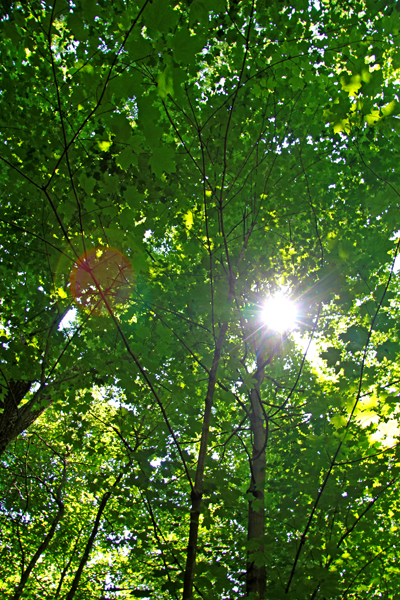
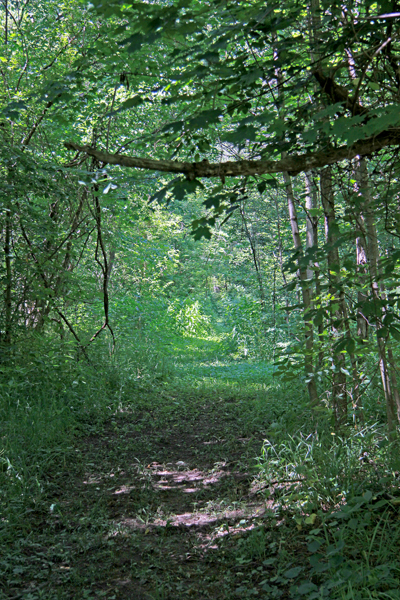
Although it was hot today – temperatures here were pushing 90 degrees – the main trail leading to the big back field was relatively cool. Over the course of the past four decades, the property surrounding the quarry has undergone significant changes. In many places, scrub and thick undergrowth is giving way to hard woods: in most cases, sugar maple trees. Where a relatively short time ago jersey cows grazed, there is now a full-blown second-stage forest. This year in particular, with its mild winter and wet spring, seems to have fostered growth. The trees form a canopy that filters the sun, dappling the ground with shifting patterns of light.

The big back field is nearly as varied in its habitats as the whole of the property. The greatest part of the eleven acres could easily be considered meadow, though there are, spotted here and there, scrub trees and brush. It is surrounded on all four sides by verdant growth: the forest that is the bulk of The Quarry Farm. Black raspberry and blackberry brambles tangle at the edges with wild rose and grape vines reaching out from the woods. On this particular day, a red-tailed hawk spun about the field in ever-widening circles. She screamed as she flew, though I’m not sure why. Maybe calling to a mate or to young offspring in nearby trees, or possibly just announcing her presence.

It’s a source of pride for us that we have such a healthy macroinvertebrate population on the property. This time of year, we see all manner of dragonflies and damselflies.
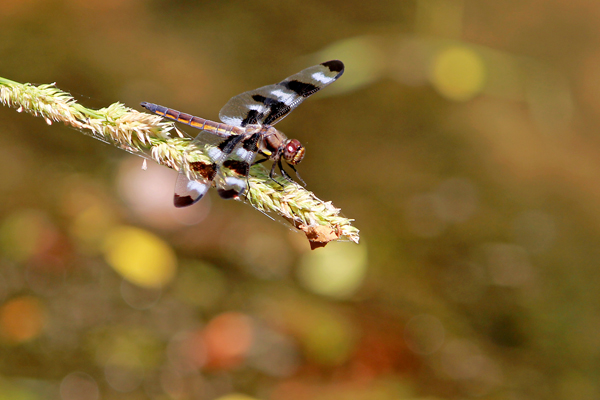
Twelve-spotted skimmer

They swarm up and down the stream, hunting, procreating and laying eggs, and they teem in the back field where there are plenty of prey species for them to feed on. While there are all manner of stories suggesting that dragonflies and damselflies are a nuisance, possibly even life-threatening, they are simply not true.

Bluet damselfly on rose cane

The fact is that these members of the order Odonata are some of the most beneficial insects out there, eating their weight every day in mosquitoes, midges and other annoying insects.

Ebony jewelwing damselfy

I was fascinated by them as a child, though I rarely had the opportunity to see them.

Now, generally beginning in late April, I go for a walk and there they are. When I see them, I can’t help but think of how cartographers, when they were filling in uncharted areas on maps, would write, Here Be Dragons. And they were probably right.

So there it is. One hour on the quarry. But you don’t have to take my word for it. It’s not necessary to limit yourself to two-dimensions. Contact us and make an appointment to see it in 3D. We’re not only happy to show it to you, but, in many ways, doing precisely that is who we are and certainly what we do. Contact us. Please. We’re counting on it.
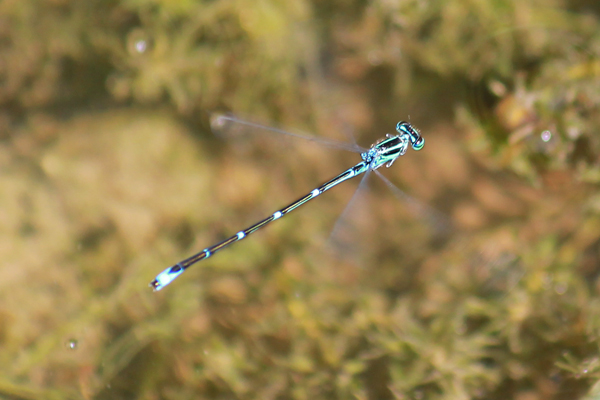
Bluet damselfly hovering over Cranberry Run

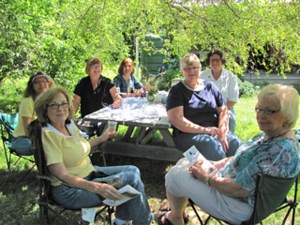
 

An Eighth Direction

Preparing shelter house pad

The shelter house project at Red Fox Cabin is underway. A crew from Hovest Construction broke ground on Tuesday, clearing and leveling ground between the posts of the compass garden for 24’ x 24’ concrete pad. The crew finished and sealed the pad on Wednesday and cleaned and leveled the work site this morning. By August, this pad should support a 20’ x 20’ shelter house, the site of many future meetings, presentations and gatherings of all sorts on the Quarry Farm.

For anyone helping to raise the shelter house, there will be food. That includes observers.

Dooryard Garden Club at Red Fox Cabin’s zelkova

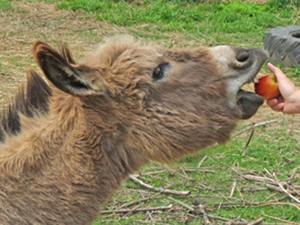
Members of the Putnam County Dooryard Garden Club visited right after Hovest Construction packed up their Bobcat. The group inspected the new project before touring the cabin, walking the Cranberry Run Trail, and meeting Educational Ambassadors Buddy the miniature donkey and Beatrice the pygmy potbellied pig.


Back up! What is a compass garden?

As the official name states, the Quarry Farm includes a nature preserve and a conservation farm. Red Fox Cabin and the gardens that surround it are part of both designations. One of the original gardens developed by Gerald and Laura Coburn was the compass garden. This garden is engineered according to the European navigational instrument that measures directions in a frame of reference that is stationary relative to the surface of the earth. However, the Red Fox Cabin compass garden was also designed in homage to the Coburn clan’s Native American heritage, primarily with traceable roots to the Cherokee Nation.

The Cherokee honor seven sacred directions to encompass a fully-dimensional world rather than one of singular dimension. In addition to the four singular dimension directions (east, north, west and south), there are: up (above), down (below) and center (which is where you are). Each direction is also associated with a season and a color:

  • NORTH is the keeper of winter, the season of survival and waiting. The North is associated with the color blue and the path of quiet.
  • SOUTH is the keeper of summer, the season of warmth. The South is associated with the color white, representing peace, happiness, and serenity.
  • EAST is the keeper of spring, the re-awakening of Mother Earth after a long sleep. The East is associated with the color red and represents victory, power, and war.
  • WEST is the keeper of autumn, the season of death and where it is hidden. The West is associated with the color black.
  • ABOVE is associated with the color yellow and represents peace.
  • CENTER is associated with the color green and represents the here and now.
  • BELOW is associated with orange/brown which represents the chaos and turmoil of the ever-changing Earth.

Note that I speak of the compass garden in the past tense. Invasive plants overran most of the directional plantings. Recently, the Quarry Farm board decided a permanent structure was needed to shelter visiting groups requiring seated onsite presentations since Red Fox Cabin can only hold a limited number of people at a time. The compass garden ground was deemed the most convenient location for such a shelter. The spot also sits just above the old stone quarry-turned-wetland, offering cool summer breezes and good views of butterflies, migratory birds and native trees.

So maybe some of the visual symbols of the old compass garden are missing, but the fully-directional world of the Quarry Farm is still growing. The house wren that is nesting in the apple gourd even stood her ground next to the construction site. She was back at her post this morning, scolding all visitors from her high tower in the zelkova tree.

Find out more about the Cherokee Nation, past, present and future, folklore and tradition, at
http://www.cherokee.org/Default.aspx.

This slideshow requires JavaScript.

Making Leaves While the Sun Shines

Putting Burdock to Work

For everyone who wonders why there have been colossal burdock plants flourishing in certain yards in the neighborhood, you can rest easy as the plants have been harvested. The giant leaves from these towering weeds* were reserved for today’s “Art in Nature: Make a Lasting Leaf” workshop on the grounds of The Quarry Farm’s Red Fox Cabin here on Road 7L.

Casting in Concrete

NOAA predicted a hot, dry day without much-needed rain but the shade trees off the front porch kept today’s outdoor studio cool enough to cast leaf-molded birdbaths, bowls and stepping stones. But enough talk. Here are some photos of the Class of June 9, 2012.

If you couldn’t make today’s event, look for upcoming workshops posted in “events”, or get on our emailing list by sending a message saying, “Sign me up for the newsletter” or “Put me on the mailing list” or “Hey, you!” to thequarryfarm@gmail.com.

*Although I’m paraphrasing, a favorite quote says something along the lines that one person’s flower is another man’s weed growing where he doesn’t want it.

This slideshow requires JavaScript.

It’s All Give and Take

Trawling for Crumbs

Oftimes chickens giveth breakfast, yet other times they taketh away.

This morning I was out on the front deck encouraging Her Porcine Highness Princess Buttercup Beatrice to come in. I was eating a lovely ciabatta toast smeared with cream cheese and topped with lettuce fresh from the garden. When she came up the steps, I leaned over to pull a fuzz of some sort from her chin.

My mistake.

The Priscillas (all of the original Hubbard Golden Comets here are named Priscilla–another story for another time) had also come up the steps. One of them flew into the air and handily snatched my breakfast from my fingers and ran under the elderberry bush.

Toast Thief on the Run

We love our girls. They are beautiful, happy, insectivorous and give us the best brown eggs. But sometimes a friendly chicken just doesn’t honor that whole personal space thing.

Caption This!

It was suggested to us that a photo in an earlier post was just begging for a caption. It was further suggested that we might offer up another little competition. So, here’s Caption This! Not only do you get the opportunity to win a set of ten Quarry Farm notecards, but I get to put off writing a lengthier piece for yet another day. What say we give it a deadline of Monday, June 11, 2012.

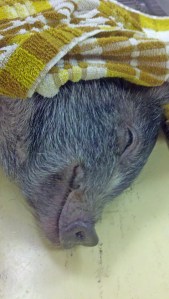
Pig in a Blanket

The newest resident of the conservation farm is in recovery as I type. Beatrice the pygmy pot-bellied pig was spayed this afternoon by Dr. Kathleen Babbitt of Lima Animal Hospital. Vet Tech Kaylie called with the news that Beatrice came through surgery with flying colors. Dr. Babbitt took lots of photos with her cell phone, including the image posted here.

Although Beatrice has only been with us for several days, our research led us to the conclusion that it would best for her health (and our collective sanity) to have her spayed as soon as possible. Seems that as they age, intact female pigs are prone to fibroids and abdominal tumors.

This morning this sweet pig thoroughly explored the back rooms and surgery of the hospital before I left for work. Although she squealed lustily (quite piercingly, actually) when I picked her up to put her back in the carrier, Dr. Babbitt exclaimed, “I love her!” Lord love her, that woman is a joy and a godsend to our sanctuary as she is the only vet in a five-county radius willing and able to take on The Quarry Farm pigs, crows, and Johnny the Canada goose.

More about Beatrice later. In the meantime, you just have to love this little face.

The Buzz

I’ve been struggling to find some clever way to start this post, to write the hook I need to pull you in and I’m failing miserably. Miserably. So, because my brain is fogged with the ridiculous heat we’re dealing with, I’ll just say that it’s about bees. Yeah. Bees. The kind that make honey, that bumble flower to flower, that kamikaze in defense of their homes, that, in conjunction with birds, create a happy little euphemism for sex. And sex is sexy, so maybe that’s all the hook I really need.

Clever me.

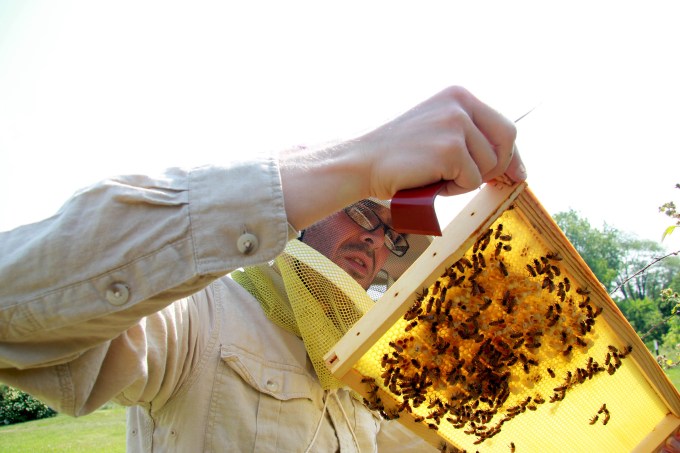
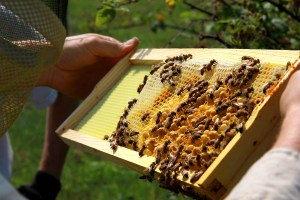
So, the bees. We set up a hive in mid April. Anne’s cousin, Brian, made all the arrangements for the bees and we took care of the materials: the hive body, the supers, the frames, the feeding troughs. We provided them a steady diet of syrup (sugar and water) and we’d pull off the hive cover and the inner cover on a nearly daily basis and ogle them from a distance. Yesterday, we got up close and personal. Brian came up from Columbus and he and Anne cracked the hive, pulled out the frames and checked out the action. The news could have been better.

Brian Erchenbrecher examining a frame from The Quarry Farm hive.

While the bees had developed new comb on the frames, there wasn’t nearly enough. And, again, while there were eggs and signs of developing brood, there wasn’t much and indications are that the developing brood are mostly drones. What are drones, you ask? They’re ne’er-do-well playboys, eating the nectar and giving back nearly nothing. They have no stinger, so they can’t protect the hive. They have no pollen sacs, so they can’t gather food. Their idea of work is chasing virgin queens.

Think Bruce Wayne, but no Batman. There you have it. Drones.

So what’s the big deal? So what if the hive’s Bohemian, populated with lotus eaters? If there are  only drones and no workers, there’s no comb. Without comb, there’s no honey. Without honey, the bees starve come winter. In fact, come late autumn the worker bees force the drones from the hive. They have to. Driving them out could well mean the difference between starving to death and surviving until spring.

It’s been suggested by scientists who study bees that a bee hive operates very much like a human brain. I mean, there’s no higher cognitive function, but otherwise, scientists have posited that their operations are very similar. If that’s the case, then our hive brain is more like Forrest Gump’s than Stephen Hawking’s. Which is not to say that it can’t improve. There is still hope, albeit one akin to the Flowers for Algernon variety. Realistically? Odds are, based on what we saw yesterday, that the hive will fail, the brain will die and we’ll have to start fresh next spring. That’s not what we wanted to hear, but there’s still good news.

And here it is.

The catalpa hive

Down the road from us, near the intersection of Roads 7-L and O, there’s a line of catalpa trees. In one of those trees is a hive of feral bees. This is a very cool thing, particularly when you understand that the hive has survived and thrived for roughly four years. With the population of bees dwindling as a consequence of a host of issues, to find a succesful wild hive is seriously cool. Why? Bees are our primary pollinators. Without them, plants that reproduce through pollination, and that’s the vast majority of our fruits and vegetables, simply don’t reproduce. No reproduction = No food.

So cheer on the bees, both wild and domestic. We’ll keep you posted on their progress.

Happy Trails

Carrying tussie mussies

Although the air is hot and dry and the fields are gasping, this same daytime heat and cool nights kept the mosquitoes at bay long enough for Ottawa Elementary third grade to spend some time on The Quarry Farm before summer vacation begins. Teachers Kelly Nienberg and Vicki Otto blazed the trail for what we hope will be many field visits by local schools.

We only had this group for an hour and a half, but while they were here they made fresh, fragrant tussie mussies of mints, lavender, rose and oregano. Also called nosegays or posies, tussie mussies are small bunches of flowers or aromatic herbs that have been given as gifts since Medieval times. ‘Nosegay’ is probably the best label, because they likely gave the recipient something to bury their nose in to hide the fact that the giver (and themselves) didn’t bathe very often.

Posing on the porch of Red Fox Cabin

After tussie mussies were stored for the bus ride back to school, kids, teachers and chaperones walked down the hill and up the hill along floodplain streambank, meeting Nigerian dwarf goats Marsh and S’more and Buddy the donkey along the path as the trio worked their day jobs eating invasive plant species. They watched and heard bullfrogs, leopard frogs and Blanchard’s cricket frogs (unless the frogs saw them first) and sampled wild strawberries.

Mama Woodduck

Some caught a glimpse of a mother woodduck as she fled the scene. They saw the difference between poison ivy and Virginia creeper. They learned that nature provides a cure for many of its thorns, like sowing anti-itch, astringent jewelweed right next to poison ivy.

Cookies and lemonade cooled all hikers as they gathered off the porch of Red Fox Cabin. Some bundled fresh garlic from the cabin gardens to take home. Someone even snacked on a garlic bulb (we know because we found it, bite out and all.) Before boarding their bus, the students presented a donation to help support The Quarry Farm. We hope they come back and see what comes of their good works.

Who Are You Calling Chicken?

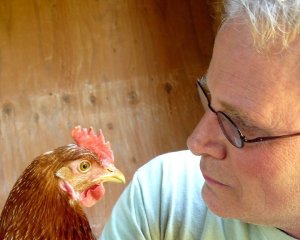
There are milestones in all lives: births, deaths, graduations, marriage, love. As much as this statement may sound like the prologue to a soap, these are the events that shape our lives. I’ve experienced all of the above and have to include another: chickens. I’m going to wait a few seconds while you take that in, get whatever comments you feel you have to make out of your system.
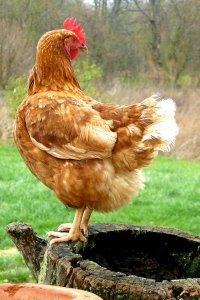
Everybody okay? May we move on?

Now I’ll say it again. As much as any other event in my life, chickens have helped to make me who I am, here and now. And, man, did I fight it.

It was Anne’s idea to get chickens, Anne’s and Rowan’s. I had … reservations. Many of them. They smell, right? They’re mean. They’re stupid. They’re noisy. They attract pests. The list was longer, but I’ve forgotten most of it. All of it was true in my head at the time and all of it, as it turns out, was wrong.

They came in a little box, delivered via USPS by our local mail carrier, Dorothy. There were sixteen of them. We had ordered fifteen, but somebody counted wrong or it’s the practice of the hatchery we ordered them from to throw in an extra. At any rate, there were sixteen Hubbard Golden Comet chicks in a little container that was half the size of a shoebox. We set them up in a storage tub in the house, dedicating a room to their safekeeping. They were tiny and yellow and fuzzy and cute and busy in their dedication to growing. I found myself fascinated and spent hours watching them, holding them, talking to them. We called them all Priscilla, each and every last one of them, and, yes, there’s a story there, but not one for the telling here, now. I discovered that all of the preconceived notions I had about chickens were, for the most part, wrong. Do chickens smell? Only because their living quarters aren’t properly maintained. If you keep their coop clean, smell isn’t an issue. Are they mean? They give what they get. If you treat them like property, like machines, and take, but never give, then yes, probably. I wouldn’t know for sure. The chickens here are friendly. Are they stupid? Well, they’re not going to be doing calculus any time soon, but, then, neither am I.

Priscilla

They presented us with no problems, no surprises, and eventually we moved them outside to a coop. I was still fascinated, spending hours with them, watching them live their lives. I discovered that, for me, they were more than fascinating, more than simply interesting observable phenomena. They brought me a degree of peace I’ve rarely experienced. They calmed me down. They made me think. They inspired me.

And now there are even more than there were to begin with. Big Girl, an Ameraucana, came to us through Nature’s Nursery. So did Audrey and Miss Kitty. Barbara, Karen, Nancy, Jeff, Ralph, Bernie and Sid all came to us from people looking to find a new home for birds they found they couldn’t handle. Most of these birds are still with us, ranging across the property and perching in the trees. Others haven’t fared as well.

Audrey

Audrey was found wandering along Interstate 75 somewhere south of Toledo. She was so docile when I picked her up from the people that had found her that I honestly believe she’d have been content sitting in my lap for the hour-long drive home (she didn’t; I transported her in a dog kennel). She’d been debeaked. Most hatcheries offer this “service.” A hot wire is used to slice a chicken’s beak from its head. This is done while they are chicks. The idea is that irritable chickens that have been debeaked will do less damage to other nearby chickens and, I suspect, to the hands that feed them. On the downside, this practice can also lead to feeding difficulties and respiratory issues. Even so, Audrey was one of the most benign animals it has ever been my good fortune to meet. She was nearly always the first one to greet us in the morning and would come and sit in our laps. She established a relationship with Buddy, a miniature donkey that lives here, and would spend a part of her day riding around on his back. She lived with us for just over a year before she died.

Miss Kitty

Miss Kitty died yesterday, much to our sorrow. He (and, yes, Miss Kitty was a rooster, though we didn’t know that when we named him) was, we assume, a meat production bird. Initially we believed that he was a Catalana hen (hence Miss Kitty). It wasn’t until he started crowing that we suspected the truth. He grew extremely large extremely fast and, as a consequence, developed a host of physical issues. He was less than a year old when his body simply and finally failed. Over the last few days of his life, all of the hens cared for him. He was never alone, one of the girls was always nearby. They were warm days and dry, and he spent his time lying in the shade of a crabapple tree or under the branches of an elderberry.

Big Girl

And then there are the successes. Big Girl came from a pretty rough neighborhood near downtown Toledo. How she got there is anybody’s guess, but we know how she came to be here. She was rescued by an elderly man who drove off a group boys. They were menacing her with sticks and stones. He called Nature’s Nursery and Nature’s Nursery called us. She was nervous, at first, and maintained her distance. If you took a step toward her, she took a step away. She stayed that way for months. Now she’ll shift out of the way if it pleases her, otherwise we have to step around.

Bernie and Barbara and Karen were part of a flock that kept dwindling, their coop mates the victims of an undetermined predator. Ralph and Jeff were abandoned (Jeff because he crows twenty-four hours a day, seven days a week, and Ralph, I suspect, because he’s cock of the walk and not afraid to let you know it). While these two do lock horns, so to speak, they spend the bulk of their time pointedly ignoring one another. Sid was simply unwanted.

I suspect that our flock will grow again this year. I sincerely hope so, at any rate. I look forward to it. I gain far more from them than I give.

And I’m not just talking about eggs.

The Quarry Farm Musicians: Audrey, Buddy and S’More

Photos from a Friend

Sue Kreidler Frey shared these images that she captured on May 12 during the spring Photo Shoot and Sketch Walk. “My sister and I attended the PhotoShoot at The Quarry Farm today. We had a great time, and thoroughly enjoyed the afternoon. The Farm is a beautiful area – I loved all the farm animals too. I can’t wait to come back to take more pictures, and help pull the dreaded garlic mustard.”

Thank you, Sue. And speaking of garlic mustard, here’s a recipe to help wipe out this invasive. Eat plenty of this delicious, nutritious pesto and make a dent in the population.

Rita’s Garlic Mustard Pesto

Ingredients:

• 3/4 cup extra virgin olive oil

• 2 garlic cloves

• 2 Tbl pine nuts (we use walnut pieces)

• 1/4 tsp salt

• 1/3 cup freshly grated Parmesan cheese, about 1 ounce

• 4 cups of garlic mustard leaves

Instructions: Place all of the ingredients except for the garlic mustard in a blender or food processor. Blend until smooth, then add the garlic mustard a handful at a time, blending until all of the greens are incorporated and the pesto is smooth.

Makes about 1 cup.